

Why Tax Relief Matters for Los Angeles Taxpayers
A tax relief lawyer los angeles provides expert legal help for individuals and businesses facing serious tax problems with the IRS and California state agencies.
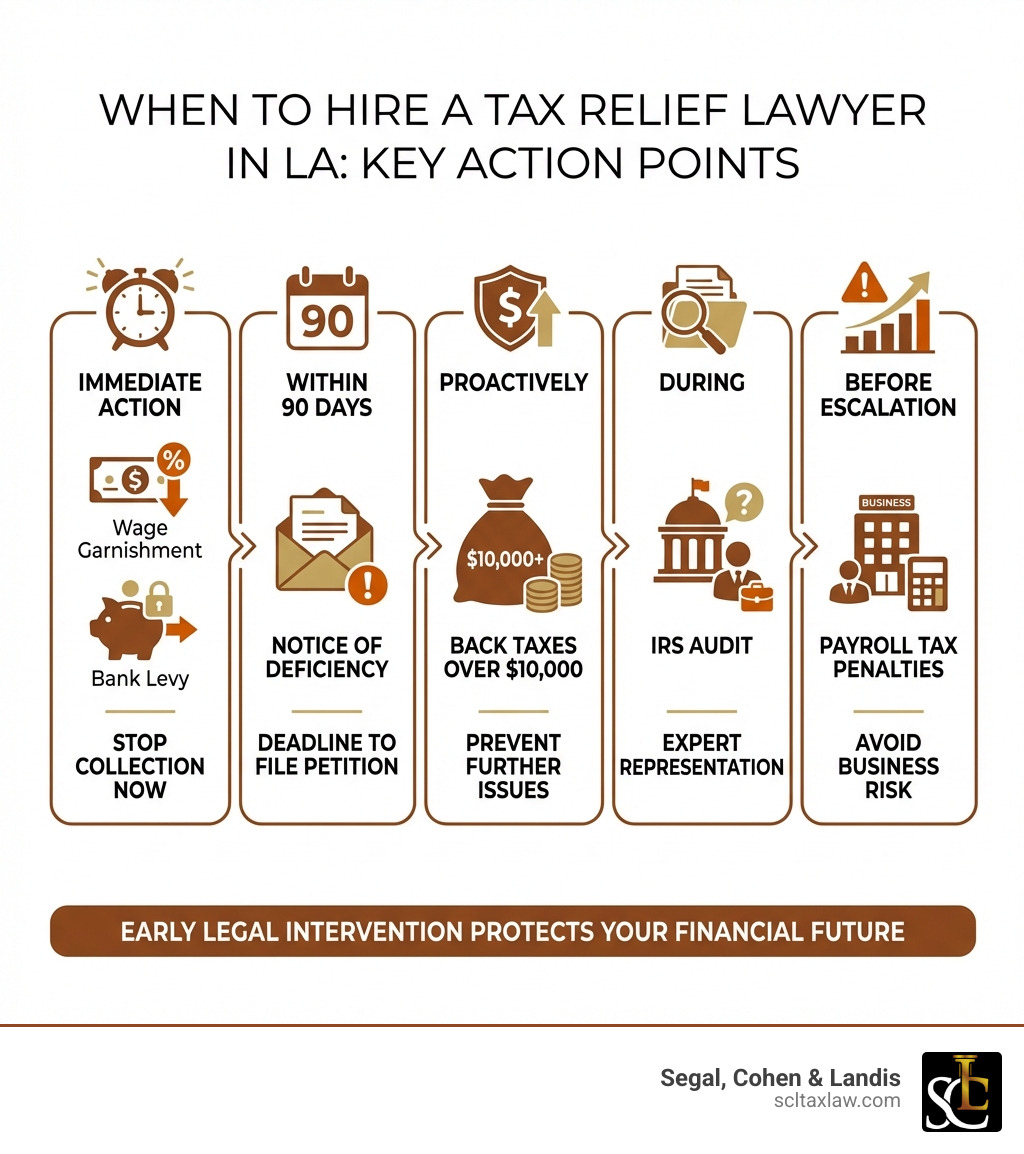
When You Need a Tax Relief Lawyer in LA:
- You owe back taxes to the IRS or California Franchise Tax Board (FTB)
- You received an audit notice or Notice of Deficiency
- The IRS or state has started wage garnishment or bank levies
- You have unfiled tax returns spanning multiple years
- You face payroll tax issues or the Trust Fund Recovery Penalty
- You need to negotiate an Offer in Compromise or payment plan
Tax problems cause immense financial stress and can have devastating consequences. In Los Angeles, with its high cost of living and complex regulations, even minor tax issues can quickly spiral out of control. In FY 2023 alone, IRS audits resulted in $31.9 billion in recommended additional taxes.
The stakes are high in California, where the FTB has a 20-year statute of limitations to collect back taxes—double the IRS’s 10-year window. Both agencies can pursue authorized collection remedies. Passport restrictions follow federal IRS certification of qualifying seriously delinquent tax debt to the State Department; FTB debt alone is not a passport-certification basis.
Many taxpayers mistakenly ignore IRS notices or trust national “tax relief” companies that overpromise, charge excessive fees, and use non-attorneys. These firms lack the local expertise needed for California’s complex tax environment.
The good news? You have options. A qualified tax attorney can negotiate settlements like an Offer in Compromise, arrange payment plans, halt aggressive collection actions, and represent you in audits, appeals, and Tax Court.
This guide discusses las lifeline when to call a tax relief lawyer. Review the applicable rules and facts, and verify the qualifications and scope of any proposed representation.
Related content about tax relief lawyer los angeles:
The High Stakes: IRS and FTB’s Aggressive Collection Powers
Dealing with the Internal Revenue Service (IRS) or California’s tax agencies—the Franchise Tax Board (FTB), California Department of Tax and Fee Administration (CDTFA), and Employment Development Department (EDD)—can be intimidating. These agencies have significant enforcement power, and ignoring them can lead to severe consequences for your finances, business, and personal freedom.

The Government’s Arsenal: Liens, Levies, and Garnishments
The powers of the IRS and California state tax agencies are extensive and designed to ensure compliance. These aren’t idle threats; they are real actions that can drastically affect your financial stability.
- Wage Garnishment: The IRS and state agencies can garnish your wages without a court order, forcing your employer to send a portion of your paycheck directly to them.
- Bank Levy: The IRS and FTB can pursue authorized bank collection after applicable notice and procedural requirements, subject to their respective exceptions.
- Review the relevant notices, filing history, records, and deadlines before choosing a response. Evaluate professional assistance according to the facts, applicable law, and agreed scope of representation. Related resources: Federal Tax Liens.
- Asset Seizure: In severe cases, the IRS and FTB can seize personal or business assets like vehicles and real estate to satisfy tax debts.
- Passport Revocation: For significant tax debts, the IRS can have your U.S. passport denied or revoked, impacting international travel and business.
- More on Tax Levies: While a lien is a claim against your property, a levy is the actual seizure of your property—such as bank accounts, retirement funds, or physical assets—to satisfy a tax debt.
These collection actions are intimidating, but it’s crucial to remember that you have rights and options, especially with a skilled tax relief lawyer los angeles by your side.
The Clock is Ticking: Statutes of Limitation
Ignoring tax debt doesn’t make it disappear; it only allows penalties and interest to compound daily. Understanding the statutes of limitation is critical.
- IRS 10-Year Rule: Generally, the IRS has 10 years to collect back taxes from the date of assessment.
- FTB 20-Year Rule: In California, the Franchise Tax Board (FTB) has an even longer reach, with a 20-year statute of limitations to collect back taxes.
These timeframes aren’t absolute, as certain actions can extend them. Proactive engagement is always better than reactive damage control when dealing with understanding back taxes and developing a resolution strategy.
Common Issues That Need a Tax Relief Lawyer in Los Angeles
Tax problems can emerge unexpectedly in Los Angeles, turning into significant burdens if not addressed promptly and professionally.

Personal Tax Crises
Many individuals find themselves in a tax bind due to various reasons, from simple oversight to unexpected financial hardships.
- Unfiled Tax Returns: Failing to file is a common but serious offense that can lead to major penalties, interest, and even criminal charges. It’s crucial to address this issue promptly.
- Large Tax Debt: A substantial tax debt, regardless of the cause, can feel overwhelming and trigger aggressive collection actions.
- IRS Audit Notices: An audit notice can be terrifying. While overall audit rates are low, certain groups like the self-employed and high-income earners face higher scrutiny. Notices like the CP2000 (income mismatch) require a careful, strategic response.
- Innocent Spouse Relief: If you filed a joint return, you might qualify for relief from tax debt caused solely by your spouse or ex-spouse. This complex process can absolve you of liability but requires legal expertise.
- Cryptocurrency Tax Liability: The rise of digital assets has created new tax complexities. Many are unaware of their tax obligations for crypto transactions, leading to unreported income and penalties.
Business Tax Nightmares
Business tax issues often carry more severe penalties and can directly impact your operations and personal liability.
- Payroll Tax Debt: Unpaid payroll taxes are a serious issue for businesses, leading to massive penalties and interest. The IRS can hold both the business and responsible individuals liable.
- The IRS can assess the TFRP against persons responsible for collecting or paying trust-fund taxes who willfully fail to do so. It generally equals unpaid withheld income taxes and employee FICA, not the entire employer payroll-tax liability.
- 941 Tax Issues: Errors or failure to file Form 941, the Employer’s Quarterly Federal Tax Return, can quickly lead to severe payroll tax problems, including the TFRP.
- Sales Tax Audits: The California Department of Tax and Fee Administration (CDTFA) aggressively audits businesses for sales tax compliance. These intrusive audits can result in large assessments and personal liability for owners.
- Worker Misclassification: The IRS and EDD heavily scrutinize worker classification. Misclassifying employees as independent contractors leads to significant back taxes, penalties, and interest for failure to pay employment taxes.
Your Path to Freedom: A Guide to Tax Relief Solutions
Facing tax problems can feel like being trapped in a maze, but there are clear paths to freedom. A skilled tax relief lawyer los angeles can guide you through various solutions designed to alleviate your tax burden and help you regain financial stability.
Settling Eligible Tax Debt Through an Offer in Compromise
An Offer in Compromise (OIC) is an agreement with the IRS or state that settles your tax liability for less than you originally owe. Qualifying requires meeting specific criteria, generally based on:
- Doubt as to Collectibility: This is the most common basis, used when the IRS determines you cannot pay the full tax liability based on your income, expenses, and assets.
- Doubt as to Liability: This is used when there is a genuine dispute over whether you owe the tax debt at all.
- Effective Tax Administration: This applies when paying the full amount would cause significant economic hardship or be otherwise unfair, even if you can technically afford it.
A successful OIC can dramatically reduce tax debt, with past settlements reducing liabilities of over $600,000 to under $1,500. The IRS Offer in Compromise process is complex and requires expert legal representation for the best results.
Making Debt Manageable: Payment Plans
An installment agreement may permit payment over time. Eligibility, levy restrictions and lien treatment depend on the applicable agreement and compliance rules; an application does not prevent every collection action.
- A guaranteed installment agreement under Internal Revenue Code section 6159(c) applies to qualifying individual income-tax liabilities of $10,000 or less, excluding penalties and interest for that threshold, with payment within three years and the other statutory filing, payment, prior-agreement and compliance conditions.
- Simple Payment Plan: Qualified individuals may apply with $50,000 or less in assessed tax, penalties and interest. Business thresholds vary by trust-fund status: generally $25,000 with trust-fund taxes and $50,000 without them, with a $50,000 rule for an out-of-business sole proprietorship. Filing and payment requirements must be current; most taxpayers have up to 10 years.
- Partial Payment Installment Agreement: If you can’t pay in full before the collection statute expires, the IRS may accept smaller monthly payments, with the remaining balance potentially written off.
For a comprehensive overview, consult our guide on tax debt payment options.
Other Powerful Relief Tools
Beyond OICs and payment plans, several other options can mitigate your tax burden.
- IRS Penalty Abatement: The IRS assesses penalties for many reasons, but they can be removed if you demonstrate “reasonable cause” for your non-compliance.
- First-Time Abate (FTA): FTA eligibility depends on current filing/payment compliance, the applicable penalty and the prior same-form compliance history. Current automatic exemptions apply to eligible 2025 annual and 2026 quarterly returns; for covered returns originally due on or after January 1, 2027, AEP replaces FTA.
- Reasonable Cause: Penalties can be abated if you show you acted with ordinary business care but were unable to comply due to circumstances beyond your control (e.g., serious illness, disaster).
- Currently Not Collectible (CNC) Status: If your income is below necessary living expenses, the IRS may temporarily halt collections by placing your account in CNC status. This provides breathing room, but interest and penalties still accrue.
- Disaster Relief: The IRS offers relief for taxpayers in federally declared disaster zones, including automatic deadline extensions and penalty waivers. We can help you secure all available disaster relief if you’ve been affected.
Why a Tax Attorney is Your Strongest Ally
When you’re entangled in tax issues, choosing the right professional is paramount. While CPAs and Enrolled Agents are helpful, a tax relief lawyer los angeles offers critical advantages, especially in complex disputes.
| Professional Type | Representation Rights | Attorney-Client Privilege | Tax Court Litigation |
|---|---|---|---|
| Tax Attorney | Agency eligibility and court-specific admission requirements apply | Yes (with exceptions) | Yes |
| CPA | Authorized IRS representation within applicable scope | Limited IRC 7525 protection may apply | Separate Tax Court admission required |
| Enrolled Agent | Authorized IRS representation within applicable scope | Limited IRC 7525 protection may apply | Separate Tax Court admission required |
The Legal Edge: Why a tax relief lawyer in Los Angeles Outperforms Other Pros
The distinctions between tax professionals can determine your case’s outcome.
- Attorney-Client Privilege: This is the most critical advantage. Qualifying confidential legal communications may be privileged; privilege does not cover every conversation or underlying fact or record. This is vital in cases involving potential criminal issues, such as tax fraud or FBAR violations. IRC 7525 may protect qualifying tax advice from federally authorized practitioners in limited noncriminal federal matters; it does not provide a general criminal privilege.
- Review the relevant notices, filing history, records, and deadlines before choosing a response. Evaluate professional assistance according to the facts, applicable law, and agreed scope of representation. Related resources: tax controversy expertise.
- Comprehensive Legal Training: Tax attorneys hold a J.D. and often a specialized LL.M. in Taxation. This legal training allows them to interpret complex statutes and argue points of law beyond the scope of most CPAs and EAs.
- Verify the professional’s current credentials and experience relevant to the matter. Confirm who will perform each legal, accounting or filing task and what the engagement includes.
From Audits to Appeals: A Lawyer’s Role
Navigating an audit or appeal requires a strategic approach that a lawyer is uniquely qualified to provide.
- During an audit, an authorized representative can handle specified matters and communications; the IRS may still require taxpayer information or send notices directly. See IRS Audit Representation.
- Challenging Audit Findings: If you disagree with an audit’s conclusion, your attorney can challenge the findings with additional documentation or legal arguments.
- Filing an IRS Appeal: You have the right to challenge an adverse IRS decision with the independent IRS Office of Appeals. This process can resolve disputes over audits or penalties, often resulting in favorable settlements without litigation.
Taking the Fight to Court
Sometimes, the only recourse is to take your case to court.
- U.S. Tax Court: To contest an IRS Notice of Deficiency, the petition period is generally 90 days from mailing, or 150 days if addressed to a person outside the United States, subject to applicable rules. Seek advice about the actual notice deadline promptly. Missing this deadline forfeits your right to challenge the tax in this court.
- Litigation Strategy: Tax Court has strict rules and complex strategies. A tax attorney is essential to steer the process, from drafting the petition to arguing your case at trial against experienced IRS lawyers.
Your Guide to Hiring a Top Tax Relief Lawyer in Los Angeles
Choosing the right tax relief lawyer los angeles is a critical decision. You need a trusted advocate who understands federal and California tax systems and can fight for the best outcome.
Key Qualities of a Top tax relief lawyer in Los Angeles
Here’s what to look for when hiring a tax relief attorney:
- Local LA Expertise: An attorney with deep LA roots understands the specific procedures of regional IRS offices and California agencies (FTB, CDTFA, EDD), which is invaluable for crafting effective strategies.
- Verifiable Credentials: Look for a J.D., admission to the California State Bar, and ideally a specialized LL.M. in Taxation. Verify they are in good standing.
- Contact Segal, Cohen & Landis (SCL) to discuss the tax matter, relevant notices and deadlines, and available response options. Confirm the qualifications of the proposed representative and the scope of the engagement.
- Transparent Fee Structure: The attorney should clearly explain their fees (flat or hourly) during the initial consultation. We prioritize clear communication on costs.
- Positive Client Reviews: Look for positive reviews on independent platforms like Google and an A+ BBB rating as indicators of client satisfaction.
- Avoiding “Tax Relief Mill” Scams: Beware of national companies making unrealistic promises, charging high upfront fees, and using non-attorneys. They often lack local expertise. Always work directly with a licensed attorney.
The Step-by-Step Resolution Process
While every case is unique, the resolution process generally follows these steps:
- Review the relevant notices, filing history, records, and deadlines before choosing a response. Evaluate professional assistance according to the facts, applicable law, and agreed scope of representation.
- Case Investigation: We conduct a thorough investigation, including an IRS transcript analysis, to understand your complete tax history.
- Review the relevant notices, filing history, records, and deadlines before choosing a response. Evaluate professional assistance according to the facts, applicable law, and agreed scope of representation.
- Negotiation: We handle all communications and negotiations with tax agencies, shielding you from collectors and presenting your case effectively.
- Review the relevant notices, filing history, records, and deadlines before choosing a response. Evaluate professional assistance according to the facts, applicable law, and agreed scope of representation.
Explaining Costs and Timelines
Understanding the financial aspect of hiring a tax attorney is important.
- Average Attorney Fees in LA: Costs vary based on case complexity. Fees can be flat or hourly, and we discuss our structure transparently during your consultation.
- A tax relief lawyer can request levy release under the applicable grounds. Release depends on the agency determination and confirmation of the actual release; hiring counsel does not establish the required conditions.
- Case Complexity Factors: Costs and timelines are influenced by the number of unfiled returns, tax types owed, fraud allegations, and the need for litigation.
Frequently Asked Questions
Review the relevant notices, filing history, records, and deadlines before choosing a response. Evaluate professional assistance according to the facts, applicable law, and agreed scope of representation.
How much does it cost to hire a tax relief attorney in Los Angeles?
Review the relevant notices, filing history, records, and deadlines before choosing a response. Evaluate professional assistance according to the facts, applicable law, and agreed scope of representation. Related resources: more on fees.
Can a tax attorney really reduce my IRS debt?
Yes. A skilled tax attorney can often reduce IRS debt by negotiating an Offer in Compromise (OIC), pursuing Penalty Abatement for reasonable cause, or challenging incorrect assessments. While success depends on your specific case, expert representation makes debt reduction a realistic goal.
How quickly can a tax attorney stop a wage garnishment?
In many cases, a tax relief lawyer los angeles can stop a wage garnishment or bank levy when the applicable release criteria are met, without a guaranteed timetable. Counsel can request review of the applicable release grounds; merely pursuing an OIC or payment plan does not establish them. Prompt action is crucial. Learn more about stopping wage garnishment.
Conclusion: Reclaim Your Financial Future
Facing tax problems with the IRS or California agencies is overwhelming. With aggressive collection actions, high stakes in Los Angeles, and compounding penalties, ignoring these issues is not an option.
Review the relevant notices, filing history, records, and deadlines before choosing a response. Evaluate professional assistance according to the facts, applicable law, and agreed scope of representation.
Contact Segal, Cohen & Landis to discuss the tax matter, relevant notices and deadlines, and available response options. Confirm the qualifications of the proposed representative and the scope of the engagement.
Don’t let tax problems define your future. Take the proactive step towards resolution and financial freedom. Contact a Los Angeles Tax Attorney today for a confidential consultation. Let us help you find your path back to financial stability.
For an IRS wage levy, the IRS states that release must be immediate when it determines the levy prevents payment of basic, reasonable living expenses. State remedies and other release requests require their own analysis; hiring an attorney or proposing a resolution does not itself guarantee release.
Automatic Exemption from Penalty transition: For covered returns with an original due date on or after January 1, 2027, AEP replaces FTA. This is distinct from the summer-2026 rollout for eligible original 2025 annual returns and 2026 quarterly returns. Eligibility depends on the covered return and penalty types, the prior same-form compliance history, current filing and payment compliance, and applicable exclusions. Consult the current IRS AEP guidance.
Have questions about this topic? Talk to an IRS attorney today.
Segal, Cohen & Landis, P.C. — Beverly Hills. Serving clients nationwide.

Samuel Landis, Esq.
LL.M. (Tax) · Selected to Super Lawyers®
Sam Landis is a Beverly Hills IRS tax attorney specializing in IRS collection defense, audit representation, and international tax compliance for foreign nationals and US expats.