


Why Los Angeles Businesses Must Take Payroll Taxes Seriously
A Los Angeles payroll tax attorney can help you steer IRS and California EDD audits, defend against personal liability through the Trust Fund Recovery Penalty (TFRP), negotiate settlements like Offers in Compromise or Installment Agreements, and stop aggressive collection actions including wage garnishments, bank levies, and tax liens. These specialized attorneys understand both federal and California-specific payroll tax laws and provide legal representation that CPAs cannot offer.
Key reasons you may need a Los Angeles payroll tax attorney:
- You received a notice from the IRS or California EDD regarding unpaid payroll taxes or worker misclassification
- Your business is facing an employment tax audit
- You’ve been assessed the Trust Fund Recovery Penalty, making you personally liable for your company’s payroll taxes
- The IRS has filed a tax lien, levied your bank account, or started garnishing wages
- You need to negotiate a settlement for back payroll taxes your business cannot afford to pay in full
- You’re uncertain whether workers are properly classified as employees or independent contractors under California’s strict ABC test
The IRS considers nonpayment of payroll taxes to be one of the most serious tax violations. Unlike income taxes, payroll taxes represent money that was withheld from employees’ paychecks—funds held “in trust” for the government. When these taxes aren’t deposited on time, the consequences are severe and swift. Penalties and interest can exceed 25% of the unpaid taxes, and the IRS can pursue aggressive collection actions without going to court.
In Los Angeles and throughout California, businesses face additional complexity. State payroll taxes administered by the California Employment Development Department (EDD) carry their own set of rules, penalties, and enforcement mechanisms. California’s worker classification laws—particularly following the Dynamex Supreme Court ruling that established the strict ABC test—have made it easier for the EDD to reclassify independent contractors as employees, triggering massive retroactive payroll tax assessments.
Many businesses fall behind on payroll taxes during periods of financial hardship, prioritizing rent, vendors, or other immediate expenses over tax deposits. Others face problems due to bookkeeping errors, dishonest employees, or confusion about worker classification rules. Regardless of how the problem started, once the IRS or EDD identifies a payroll tax issue, the situation can escalate quickly. Penalties and interest compound, collection actions begin, and business owners may find themselves personally liable for debts they thought belonged only to their corporation.
Los Angeles: Review the relevant notices, filing history, records, and deadlines before choosing a response. Evaluate professional assistance according to the facts, applicable law, and agreed scope of representation.
Must-know Los Angeles payroll tax attorney terms:
The High Stakes of Payroll Tax Non-Compliance
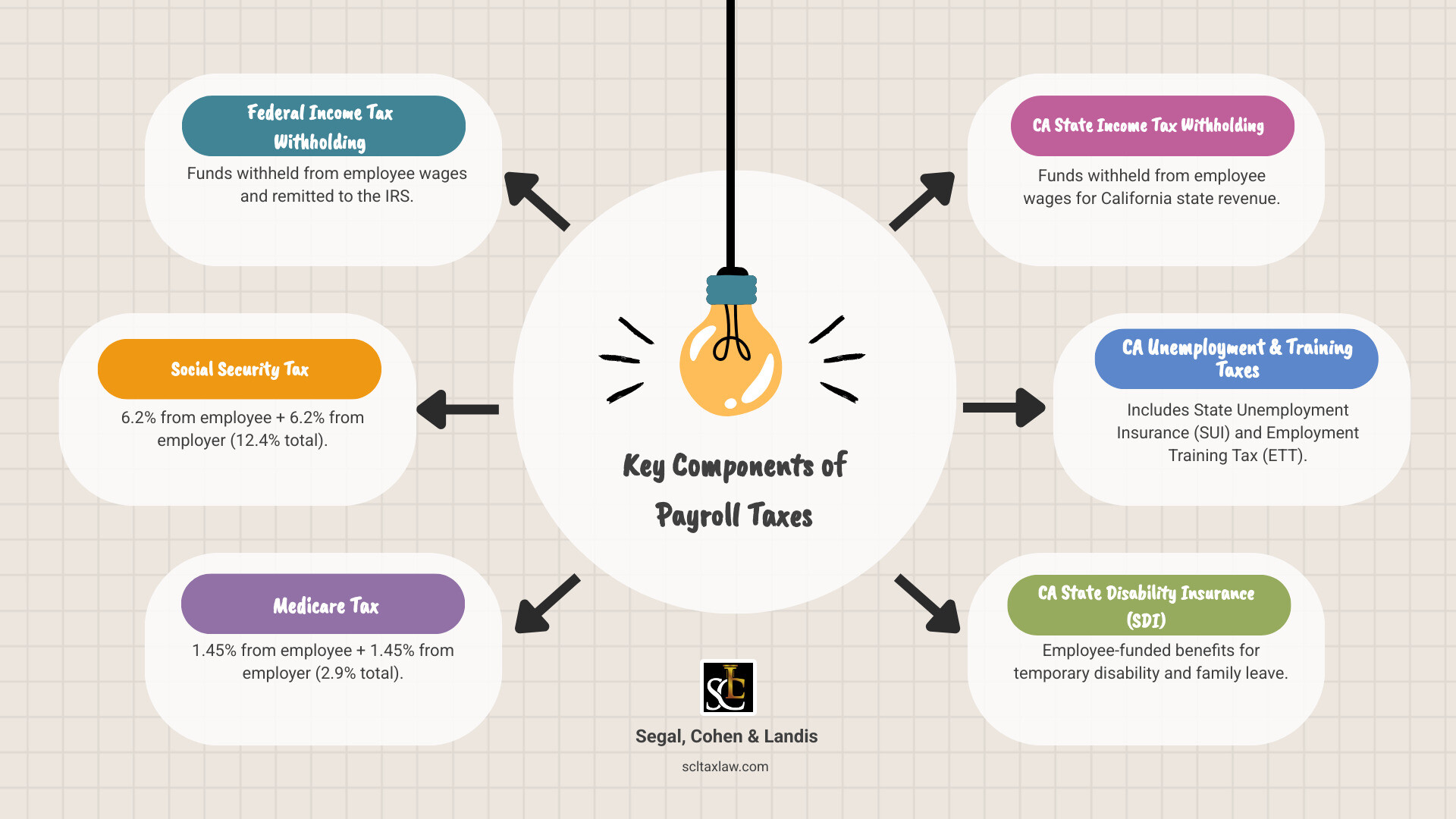
Payroll taxes are a fundamental responsibility for any business with employees, and for good reason. They are the federal and state taxes that employers must withhold from employee wages (income tax, Social Security, and Medicare) and also contribute themselves (matching Social Security and Medicare, plus employer-paid California UI and ETT; California SDI is generally withheld from employees). These funds are crucial for government programs, and the system relies on employers acting as trustees.
When a business fails to meet its payroll tax obligations, the stakes are incredibly high. We’ve seen countless Los Angeles businesses face daunting challenges, often stemming from common issues like:
- Cash Flow Issues: During tough times, it’s tempting for businesses to use payroll tax funds, which are readily available, to cover other immediate operational expenses like rent or vendor payments. This is a dangerous gamble, as the IRS views these “trust fund” taxes with extreme seriousness.
- Bookkeeping Errors: Simple mistakes in calculations, filing, or depositing can quickly snowball into significant problems. Incompetent or dishonest employees can also mishandle payroll tax responsibilities, sometimes hiding their errors from business owners, leading to unexpected liabilities down the line.
- Worker Misclassification: Incorrectly classifying employees as independent contractors is a rampant issue, especially in California. This often leads to businesses inadvertently failing to withhold and pay required payroll taxes, which the IRS and California Employment Development Department (EDD) will eventually uncover.
The consequences of these failures are severe. The IRS, and state agencies like the EDD, are known for their aggressive approach to collecting unpaid payroll taxes. Unlike other tax debts, payroll tax issues can threaten the very existence of a business and the personal assets of its owners.
Severe Penalties and Accruing Interest
Ignoring payroll tax obligations can lead to a cascade of financial penalties and interest that can quickly outstrip the original tax debt. These include:
- Failure-to-Deposit (FTD) Penalty: This is often the first penalty assessed. If payroll taxes are not deposited on time via the Electronic Federal Tax Payment System (EFTPS), the IRS can impose penalties ranging up to 15% of the unpaid amount under IRC Section 6656. The deposit schedule can be as frequent as the day after employees are paid, making timely action critical.
- Failure-to-File Penalty: Even if you can’t pay, you must still file your payroll tax returns (e.g., Form 941) on time. Failure to do so can result in penalties of up to 25% of the unpaid tax, as per IRC Section 6651.
- Failure-to-Pay Penalty: This penalty is assessed on any unpaid taxes that are not covered by the FTD or failure-to-file penalties.
- Interest Calculation: On top of all penalties, interest accrues daily on any unpaid taxes and penalties. This means your debt can grow exponentially, sometimes exceeding the original tax amount. We’ve seen cases where the penalties and interest combined were larger than the initial payroll taxes owed.
The IRS takes these failures very seriously because payroll taxes are funds withheld from employees’ wages that belong to the government. When these funds are not remitted, it’s not just a debt; it’s seen as a breach of trust. For a deeper understanding of these consequences, you can read our guide on Consequences of Unpaid Payroll Taxes and Solutions with a Payroll Tax Attorney.
Aggressive IRS Collection Actions
The IRS has potent tools at its disposal to collect delinquent payroll taxes, and they are not shy about using them. These collection actions can be initiated swiftly and without prior court approval, posing an immediate threat to your business and personal finances:
- IRS Tax Lien: A federal tax lien is a legal claim against your property (including real estate, personal property, and even future assets) when you neglect or fail to pay a tax debt. This public record can severely damage your credit, prevent you from selling or refinancing property, and make it difficult to secure loans.
- IRS Tax Levy: More aggressive than a lien, a levy allows the IRS to seize your property to satisfy a tax debt. This can include:
- Bank Account Seizure: The IRS may levy bank accounts under applicable procedures, generally after notice and an opportunity for a hearing, with statutory exceptions. Bank levies can disrupt business operations.
- Wage Garnishment: The IRS may levy wages of the taxpayer who owes an assessed tax liability, subject to applicable notice, hearing, and exemption rules. Employees’ wages are not levied merely because their employer owes payroll taxes.
- Asset Seizure: This can extend to business equipment, accounts receivable, and even personal property if you’re deemed personally liable.
- Business Shutdown: In extreme cases of persistent non-compliance, the IRS has the authority to shut down a business to prevent further accumulation of unpaid trust fund taxes.
These actions highlight why addressing payroll tax problems promptly and effectively is not just good business practice, but essential for survival.
How a Los Angeles Payroll Tax Attorney Can Resolve Your IRS & EDD Issues
Los Angeles: Review the relevant notices, filing history, records, and deadlines before choosing a response. Evaluate professional assistance according to the facts, applicable law, and agreed scope of representation.
Review the relevant notices, filing history, records, and deadlines before choosing a response. Evaluate professional assistance according to the facts, applicable law, and agreed scope of representation.
- Stopping Collection Actions: One of our immediate priorities is to halt aggressive collection actions like liens, levies, and wage garnishments. We communicate directly with the IRS or EDD, intervening to protect your assets and provide breathing room for a strategic resolution.
- Review the relevant notices, filing history, records, and deadlines before choosing a response. Evaluate professional assistance according to the facts, applicable law, and agreed scope of representation.
- Review the relevant notices, filing history, records, and deadlines before choosing a response. Evaluate professional assistance according to the facts, applicable law, and agreed scope of representation. Related resources: challenging an IRS decision.
- Review the relevant notices, filing history, records, and deadlines before choosing a response. Evaluate professional assistance according to the facts, applicable law, and agreed scope of representation.

Crafting a Resolution Strategy for Your Tax Debt
Review the relevant notices, filing history, records, and deadlines before choosing a response. Evaluate professional assistance according to the facts, applicable law, and agreed scope of representation.
| Resolution Option | Description | Eligibility & Key Considerations |
|---|---|---|
| IRS Offer in Compromise | A settlement with the IRS that allows you to resolve your tax debt for less than the full amount owed. | Best for those with significant financial hardship. The IRS evaluates your ability to pay, income, expenses, and asset equity. Acceptance is not guaranteed. |
| Installment Agreement | A payment plan with terms determined by the applicable program and remaining collection period. Most current IRS Simple Payment Plans allow up to ten years. | Suitable for businesses that can’t pay in full immediately but can over time. For current Simple Payment Plans, a business with trust fund taxes generally qualifies at $25,000 or less, except an out-of-business sole proprietorship at $50,000 or less; a business without trust fund taxes generally has a $50,000 limit. Current filing and payment requirements also apply. Interest and penalties continue to accrue. |
| IRS Currently Not Collectible (CNC) | A temporary collection classification subject to criteria that depend on the taxpayer and entity. Operating corporations have specific current-compliance and collectible-asset requirements. | For severe financial hardship where you cannot afford any payment. The IRS will revisit your financial situation periodically. The tax debt, penalties, and interest continue to grow. |
The available route depends on the business entity, current compliance, assets, collection status, and any responsible-person liability. Review notices and deadlines promptly, and assess the applicable requirements before choosing a resolution option.
Have questions about this topic? Talk to an IRS attorney today.
Segal, Cohen & Landis, P.C. — Beverly Hills. Serving clients nationwide.

Samuel Landis, Esq.
LL.M. (Tax) · Selected to Super Lawyers®
Sam Landis is a Beverly Hills IRS tax attorney specializing in IRS collection defense, audit representation, and international tax compliance for foreign nationals and US expats.