

Why Dallas Business Owners Need a Payroll Tax Attorney Now
A payroll tax attorney Dallas specialist helps business owners resolve serious IRS payroll tax issues, including unpaid taxes, audits, Trust Fund Recovery Penalties, and aggressive collection actions. If you’re facing IRS notices, are behind on deposits, or have been identified as a “responsible person,” it’s time to hire an attorney.
An experienced attorney can negotiate with the IRS, defend against penalties, and protect you from personal liability. The IRS treats unpaid payroll taxes as theft and pursues collection more aggressively than income tax debt. This is because the funds you withhold from employee paychecks for federal income tax, Social Security, and Medicare belong to your employees and the government. Failing to remit these “trust funds” using Form 941 can lead to severe consequences.
Penalties and interest compound rapidly, and the IRS can file liens, seize bank accounts, and even pursue criminal charges. For Dallas business owners, a temporary cash flow problem can quickly become a six-figure tax debt, putting both your business and personal assets at risk.
This guide discusses payroll tax attorney dallas guide. Review the applicable rules and facts, and verify the qualifications and scope of any proposed representation.
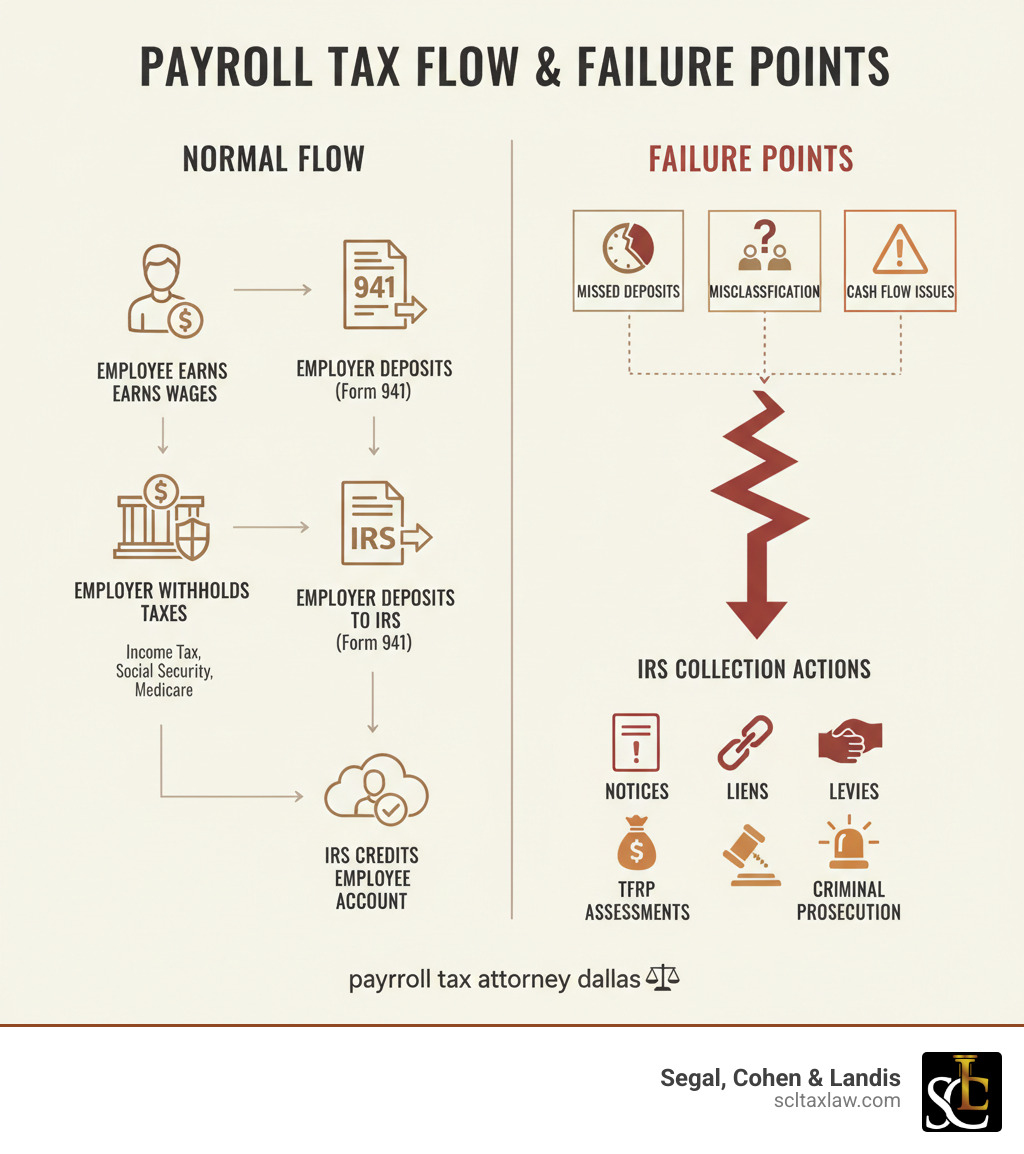
The High Stakes of Payroll Tax Non-Compliance in Dallas
When your Dallas business falls behind on payroll taxes, you’re not dealing with an understanding creditor. The IRS views this as theft of government funds and acts accordingly. The money withheld from employee paychecks is held in trust; it was never yours. This is why the IRS moves fast and hits hard, putting your business and personal assets at risk. A payroll tax attorney Dallas businesses trust can step between you and the IRS, protecting your rights while working toward a resolution.
Penalties and Consequences for Failure to Pay
Missing a payroll tax deposit triggers immediate penalties that can reach 15% of the unpaid tax, plus compounding daily interest. The IRS can file a federal tax lien after just one missed quarter, which can restrict access to financing. Bank levies generally require prior notice and an opportunity for a hearing, subject to statutory exceptions. In extreme cases of willful failure, the IRS can pursue criminal prosecution.
There’s a saying we often share with clients: “When you are facing tax issues and disputes with the IRS, these matters are like having a disease. If they are not properly addressed and treated, they will not go away and can possibly become worse.” Ignoring IRS notices only makes the problem grow. For more details, see our guide on the Consequences of Unpaid Payroll Taxes and Solutions with a Payroll Tax Attorney.

Payroll Tax Debt vs. Income Tax Debt
The IRS prioritizes payroll tax debt over income tax debt. The reason is trust fund taxes—the federal income, Social Security, and Medicare taxes you withhold from employees. This money never belonged to your business. The IRS gives employees credit for these taxes even if you never pay them, leaving the government to cover the shortfall. This is why the IRS is far more likely to shut down a business over unpaid payroll taxes. Collection actions are faster, harsher, and escalate more quickly to personal liability. Our Business Tax Problems Ultimate Guide covers the full spectrum of these challenges.
How the IRS Pursues Collection
The IRS collection process escalates systematically. It begins with automated notices demanding payment. If ignored, your case is assigned to a Revenue Officer, a real person with significant authority to collect the debt. They can show up at your business, demand financial records, and investigate your personal finances. Next, they may file a federal tax lien on all your assets, making it difficult to sell property or get loans. Bank levies and, in severe cases, the seizure and sale of business assets can follow. Facing a Revenue Officer without an experienced payroll tax attorney Dallas representative puts you at a severe disadvantage.

Common Payroll Tax Problems and the Trust Fund Recovery Penalty (TFRP)
Most payroll tax problems don’t start with bad intentions. They often stem from common business challenges that spiral out of control. Cash flow issues are a primary culprit. A business owner might “borrow” from withheld tax funds to cover an urgent expense, intending to pay it back quickly. This temporary fix often becomes a massive, unmanageable debt.
Another dangerous issue is the misclassification of employees as independent contractors. If the IRS determines your contractors are actually employees, you could face years of back payroll taxes, penalties, and interest. A single disgruntled worker filing Form SS-8 can trigger a costly audit. Just having a “contractor agreement” is not enough to satisfy the IRS. These problems can feel overwhelming, but you are not alone. Learn more in our article on Payroll Tax Problems: Understanding Your Liability and the Need for Tax Attorneys.
Understanding the Trust Fund Recovery Penalty (TFRP)
The Trust Fund Recovery Penalty (TFRP), authorized by IRC Section 6672, may impose liability equal to unpaid employee income-tax withholding and the employee share of Social Security and Medicare on responsible persons who act willfully. Ownership alone is insufficient. See the IRS guidance on the TFRP.
The IRS can bypass the corporate shield—even if the business is bankrupt—and pursue your personal assets, like your home and savings. If you’re facing this threat, contacting a payroll tax attorney Dallas firm is critical. Learn more about Personal Responsibility for Payroll Tax Liability.
Who is a “Responsible Person”?
The IRS casts a wide net when defining a “responsible person.” It’s not just the owner or CEO. It can be anyone with the duty and authority to collect and pay the taxes, including:
- Officers and Directors
- Bookkeepers and Accountants with significant financial control
- Anyone with check-signing authority
The IRS must also prove “willful failure to pay.” ‘Willful’ simply means you knew the taxes were due and either intentionally disregarded the duty or were plainly indifferent to it, such as choosing to pay other creditors instead. The IRS uses interviews (Form 4180) to determine responsibility, and what you say can be used against you. An experienced payroll tax attorney Dallas specialist can represent you in these interviews, dispute the ‘responsible person’ status, and protect you from devastating personal liability.
How a Payroll Tax Attorney Dallas Can Be Your Solution
When facing IRS payroll tax problems, you don’t have to go it alone. A dedicated payroll tax attorney Dallas professional acts as your advocate and shield. We handle all IRS communications, translating their demands and presenting your case effectively.
Review the relevant notices, filing history, records, and deadlines before choosing a response. Evaluate professional assistance according to the facts, applicable law, and agreed scope of representation. Related resources: Tax Services.
Key Services Offered by a Payroll Tax Attorney
A specialized payroll tax attorney Dallas firm offers a range of solutions to resolve your tax problems:
- IRS Audit Representation: We manage the entire audit process, from document preparation to challenging auditor findings.
- Penalty Abatement: We negotiate to reduce or eliminate penalties by demonstrating reasonable cause or using other relief provisions.
- Review the relevant notices, filing history, records, and deadlines before choosing a response. Evaluate professional assistance according to the facts, applicable law, and agreed scope of representation.
- Installment Agreements: We negotiate affordable monthly payment plans that your business can sustain.
- Review the relevant notices, filing history, records, and deadlines before choosing a response. Evaluate professional assistance according to the facts, applicable law, and agreed scope of representation.
- Trust Fund Recovery Penalty (TFRP) Defense: We aggressively defend you against personal liability, challenging ‘responsible person’ status and claims of ‘willfulness.’
Resolving an IRS Payroll Tax Audit
An IRS payroll tax audit, especially one focused on worker classification, can be invasive. We manage the entire process for you. We start by reviewing your records, preparing all documentation, and handling all communications with the auditor. This protects you from inadvertently saying something that could harm your case.
Review the relevant notices, filing history, records, and deadlines before choosing a response. Evaluate professional assistance according to the facts, applicable law, and agreed scope of representation. Related resources: IRS Audit Defense Strategies: Navigating the Audit Process with a Payroll Tax Attorney.
Choosing and Working with Your Dallas Tax Attorney
Choosing the right payroll tax attorney Dallas professional is critical. This is a highly specialized field, and you need an expert who focuses on IRS tax controversy, not a general practice attorney. A key benefit of hiring a tax attorney is attorney-client privilege, which legally protects your conversations and allows you to be completely candid subject to its scope and exceptions. A Dallas-based attorney also brings local knowledge of IRS offices and personnel, which can be invaluable during negotiations. Before hiring, verify their credentials, such as a Texas law license and an advanced degree like an LL.M. in Taxation.
What to Look For in a Dallas Payroll Tax Attorney
Request written engagement terms describing the scope of work, billing method, rates, retainer and additional costs. Fees vary by matter; confirm the terms before retaining counsel. Related resources: Handling Payroll Taxes: What to Know and How a Payroll Tax Attorney Can Help.
Preparing for Your Initial Consultation
A productive consultation starts with preparation. The more organized you are, the faster we can help. We are here to find solutions, not to judge. To make the most of our meeting, please gather the following:
- All IRS Correspondence: Every notice, letter, and form you have received.
- Payroll Tax Returns: Filed Form 941s for the periods in question. Let us know about any unfiled returns.
- Business Financials: Recent profit and loss statements, balance sheets, and bank statements.
- List of Responsible Individuals: Anyone with financial authority (officers, bookkeepers, check-signers) for TFRP defense.
- Your Questions: Write down your concerns so you don’t forget to ask.
This consultation is your opportunity to find the right fit for your case. Contact us for a consultation and let’s start working toward a solution.
Frequently Asked Questions about Dallas Payroll Tax Attorneys
Facing payroll tax issues brings many questions. Here are answers to the most common ones we hear from Dallas business owners.
When should I contact a payroll tax attorney in Dallas?
The best time is now. Don’t wait for the problem to get worse. You should call a payroll tax attorney Dallas specialist immediately if:
- You receive your first IRS notice about payroll taxes.
- You are falling behind on payroll tax deposits.
- You are facing an IRS audit, especially regarding worker classification.
- An IRS Revenue Officer has contacted you.
- The IRS suggests you may be held personally liable under the Trust Fund Recovery Penalty.
Early intervention is key. As we say, “tax issues… if they are not properly addressed and treated, they will not go away and can possibly become worse.”
What are the potential outcomes of working with a payroll tax attorney?
An experienced attorney opens up resolution options you can’t access alone. Potential outcomes include:
- Reduced or eliminated penalties through penalty abatement negotiations.
- A manageable installment agreement that fits your business’s cash flow.
- An Offer in Compromise to settle the debt for less than the full amount.
- Release of liens and levies, freeing up your assets and bank accounts.
- Protection from personal liability by defending against the TFRP.
Our goal is to ensure your business survives and thrives after resolving its tax issues.
How can I proactively avoid payroll tax problems?
Prevention is the best strategy. Protect your business by taking these steps:
- Use a separate bank account exclusively for withheld payroll taxes. Treat these funds as untouchable.
- Consider a reputable payroll service to handle deposits and reporting, but remember you are still ultimately responsible.
- Conduct regular internal financial reviews to catch issues early.
- Correctly classify workers. When in doubt, consult a professional about the employee vs. independent contractor distinction.
- Stay informed about changing federal and state payroll tax laws.
For more tips, read our guide on Resolving Payroll Tax Issues: Expert Advice for Small Business Owners.
Conclusion
Payroll tax problems are a serious threat to any Dallas business. The IRS views unpaid payroll taxes as theft and pursues collection with extreme aggression. The consequences can be devastating: crippling penalties, business closure, and personal liability that puts your home and savings at risk.
Contact Segal, Cohen & Landis to discuss the tax matter, relevant notices and deadlines, and available response options. Confirm the qualifications of the proposed representative and the scope of the engagement.
Don’t wait for the problem to escalate. Take the first step toward peace of mind today. Get help from an experienced Dallas Tax Attorney who will fight for you.
Related guidance: Payroll Tax Attorney.
Have questions about this topic? Talk to an IRS attorney today.
Segal, Cohen & Landis, P.C. — Beverly Hills. Serving clients nationwide.

Samuel Landis, Esq.
LL.M. (Tax) · Selected to Super Lawyers®
Sam Landis is a Beverly Hills IRS tax attorney specializing in IRS collection defense, audit representation, and international tax compliance for foreign nationals and US expats.