


Why Payroll Tax Fraud Can Destroy Your Business and Your Freedom
A payroll tax fraud lawyer is a specialized attorney who defends individuals and businesses facing allegations or criminal charges for willfully failing to collect, account for, or pay over employment taxes to the IRS. Here’s what you need to know:
When You Need a Payroll Tax Fraud Lawyer:
- IRS Criminal Investigation (IRS-CI) agents contact you or visit your business
- You receive a grand jury subpoena related to payroll taxes
- The IRS proposes or assesses a civil Trust Fund Recovery Penalty (TFRP), which requires responsible-person status and willfulness and is separate from a criminal charge
- You’re charged with violations under 26 U.S.C. Section 7202 (willful failure to pay over employment taxes)
- Your business is under audit for suspected payroll tax fraud schemes
What They Can Do:
- Challenge the IRS’s claim that your actions were “willful” (intentional)
- Negotiate with federal prosecutors before criminal charges are filed
- Contest your status as a “responsible person” for TFRP purposes
- Represent you during IRS interviews, audits, and criminal proceedings
- Reduce or eliminate civil penalties and negotiate payment plans
Payroll tax noncompliance can have serious consequences. Potential civil and criminal issues depend on the conduct, applicable law and facts; obtain advice specific to the matter.
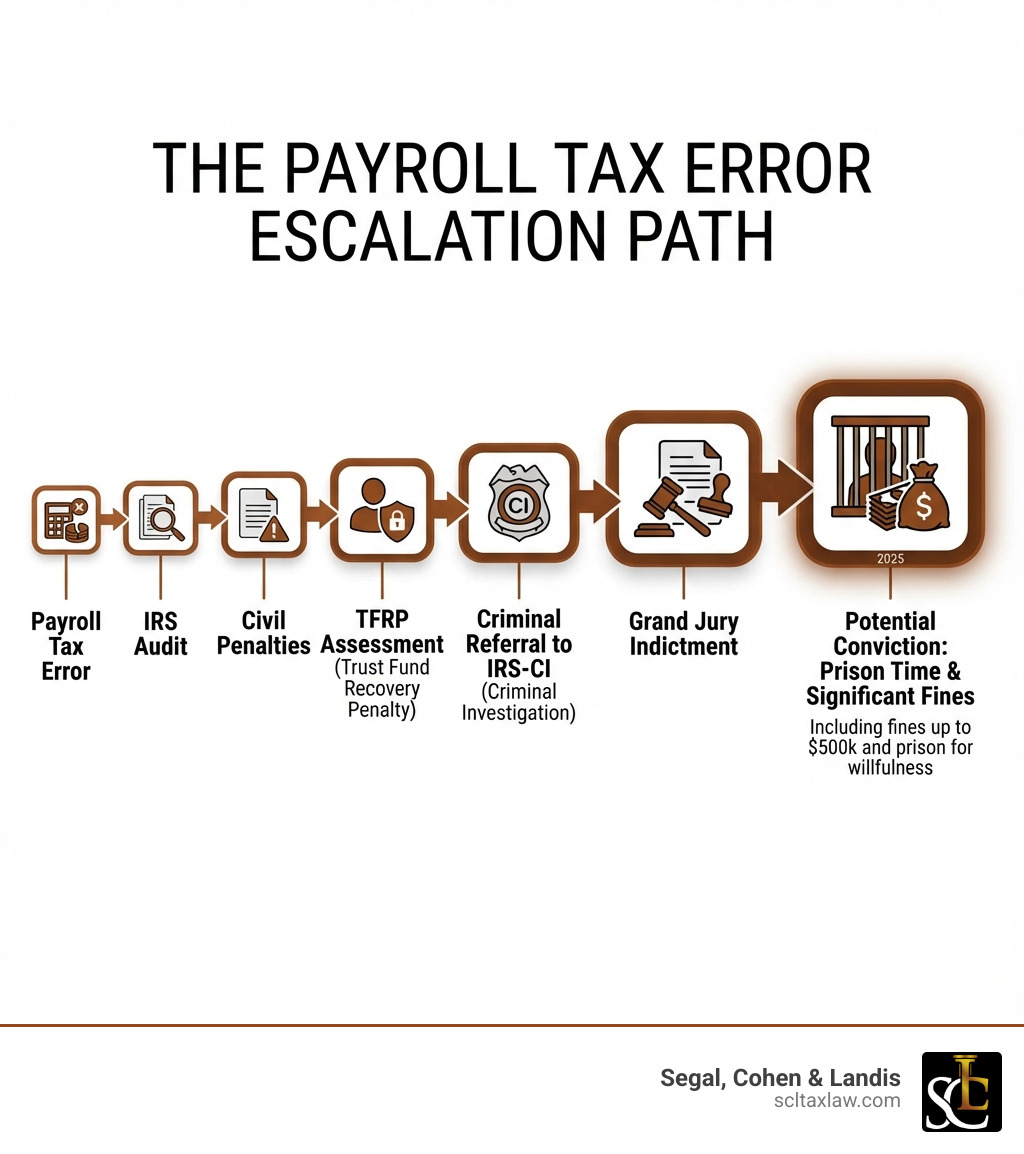
What starts as a missed payroll tax deposit or a classification error can quickly escalate. The IRS doesn’t just pursue civil penalties—they refer serious cases to IRS-CI for criminal prosecution. Business owners have been sentenced to years in federal prison for schemes involving misclassified workers, off-the-books payments, or simply using withheld taxes to cover operating expenses instead of remitting them to the government.
The difference between a civil penalty and a criminal charge often comes down to one word: willfulness. Did you knowingly and intentionally fail to pay over employment taxes? The IRS will look at patterns—repeated failures to deposit, paying other creditors first, or using trust fund taxes as a “loan” from the government. If they believe you acted willfully, you’re facing potential prison time, not just fines.
This is why having an experienced legal advocate is critical from the moment you suspect trouble. Whether you’re dealing with a routine audit that’s taking a dangerous turn, a Trust Fund Recovery Penalty assessment that could cost you everything, or an actual criminal investigation, the right legal strategy can mean the difference between resolution and prosecution.
This guide discusses payroll tax fraud lawyer. Review the applicable rules and facts, and verify the qualifications and scope of any proposed representation.
What Constitutes Payroll Tax Fraud?
Payroll tax fraud occurs when an employer or “responsible person” willfully fails to collect, accurately report, or remit employment taxes to the government. These aren’t just any taxes; they are “trust fund taxes” – money withheld from employees’ paychecks for federal income tax, Social Security, and Medicare. Employers hold these funds in trust on behalf of their employees until they are paid over to the IRS. When these funds are not properly remitted, the IRS views it as stealing from the employees and the U.S. Treasury.
The key element that lifts a mistake to fraud is “willful intent.” This means a voluntary and intentional violation of a known legal duty. It’s not enough to be negligent or careless; for criminal charges, the IRS and Department of Justice (DOJ) must prove that the individual or business knowingly and deliberately failed to meet their payroll tax obligations.
Review the relevant notices, filing history, records, and deadlines before choosing a response. Evaluate professional assistance according to the facts, applicable law, and agreed scope of representation. Related resources: IRS Overview of Payroll Taxes; More info about Payroll Tax Problems.
Common Payroll Tax Fraud Schemes
Payroll tax fraud manifests in various forms, often driven by a desire to cut costs or divert funds. The most common scenarios or schemes that lead to payroll tax fraud allegations include:
- Misclassifying Employees: Treating employees as independent contractors to avoid paying payroll taxes (Social Security, Medicare, and unemployment taxes). While seemingly a small difference, the IRS aggressively pursues cases where this is done intentionally to evade taxes.
- Paying “Under the Table”: Paying employees in cash and off the books, without reporting wages or withholding taxes. This is a clear attempt to conceal income and avoid tax obligations.
- Pyramiding: A scheme where a business withholds taxes from employees but fails to remit them to the IRS, instead using the funds for operating expenses. When the IRS catches on, the business might cease operations, only to restart under a new name, continuing the cycle of non-payment. This is a red flag for criminal intent.
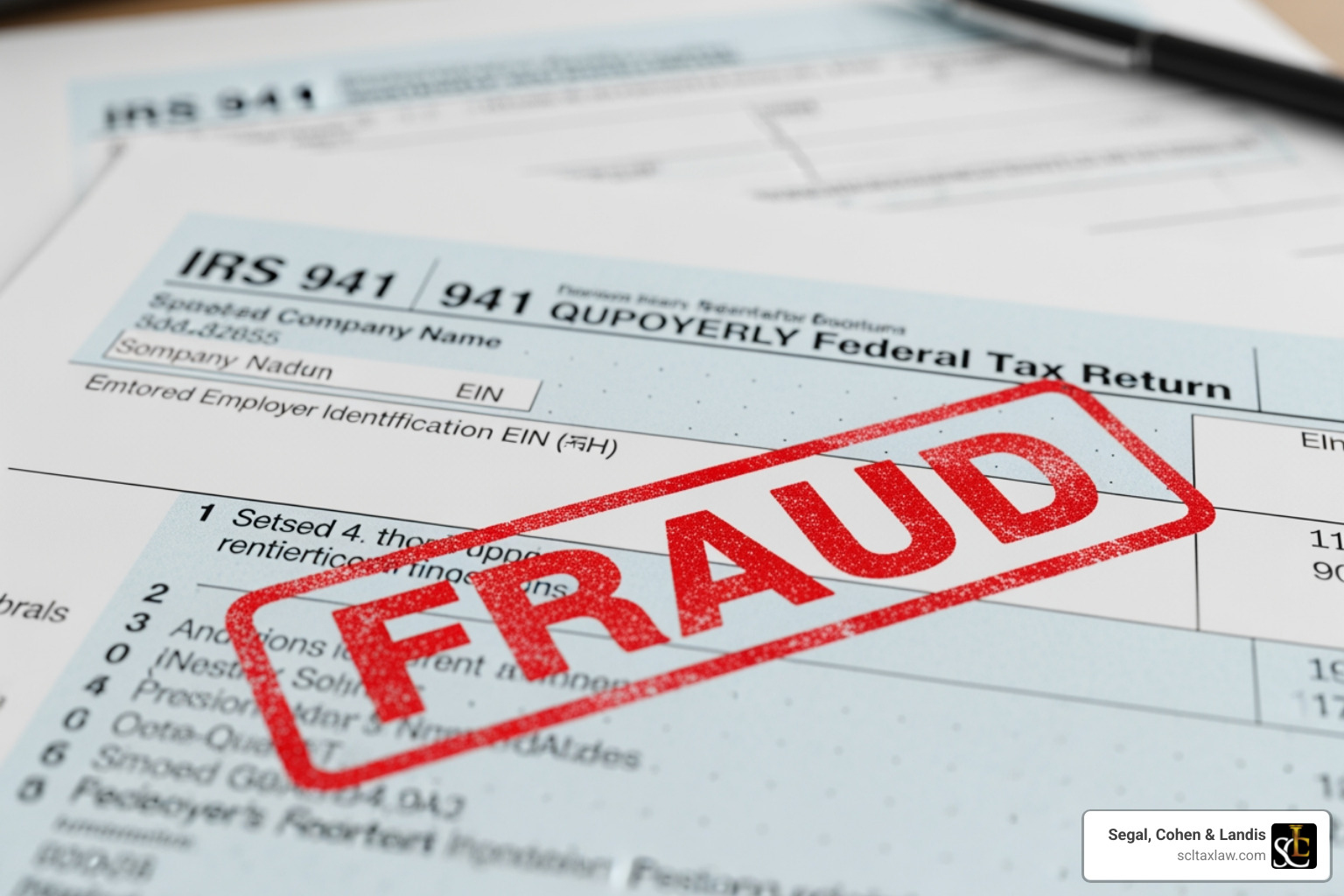
- Filing False Payroll Tax Returns: Submitting incorrect information on forms like IRS Form 941 (Employer’s Quarterly Federal Tax Return) to understate tax liabilities.
- Unreliable Third-Party Payers: Using payroll service providers or professional employer organizations (PEOs) that collect payroll taxes from clients but fail to remit them to the IRS. Businesses can still be held liable, even if a third party was at fault, especially if due diligence was not exercised.
- Claiming Fake Tax Credits or Deductions: Attempting to reduce tax bills or get refunds using credits or deductions the business doesn’t qualify for. The IRS, IRS CI, and DOJ are currently collaborating to uncover and prosecute fraudulent Employee Retention Credit (ERC) claims.
The IRS View: “Borrowing” from the Government
The IRS takes a particularly dim view of employers who withhold taxes from their employees’ paychecks but then fail to remit those funds to the government. Their stance is unequivocally clear: this is not a loan, and it is certainly not “borrowing” from the government. IRS Commissioner Mark W. Everson once stated, “Failure to pay employment taxes is stealing from the employees of the business.”
When an employer uses these withheld funds for other purposes – perhaps to cover operating costs, pay other creditors, or even for personal enrichment – the IRS interprets this as a deliberate misuse of trust funds. This is especially true if the employer continues this practice over time, despite knowing their obligations. Such actions are a direct path to criminal investigation, as they clearly demonstrate the “willfulness” required for fraud charges.
Review the relevant notices, filing history, records, and deadlines before choosing a response. Evaluate professional assistance according to the facts, applicable law, and agreed scope of representation. Related resources: Consequences of Unpaid Payroll Taxes and Solutions with a Payroll Tax Attorney.
The IRS Investigation and Prosecution Process
Review the relevant facts, documents, filing requirements, and deadlines before choosing a response. Confirm professional qualifications and the agreed scope of assistance; outcomes depend on the applicable law and circumstances.
Review the notice, disputed issues, supporting records and applicable procedures for the particular matter. Do not assume a particular selection probability, financial result or completion time.
Review the relevant notices, filing history, records, and deadlines before choosing a response. Evaluate professional assistance according to the facts, applicable law, and agreed scope of representation. Related resources: Role of IRS Criminal Investigation; More info about IRS Audit Defense Strategies.

Warning Signs of a Criminal Investigation
How do you know if you’re merely facing a civil audit or if the IRS suspects criminal activity? The shift from a civil examination to a criminal investigation is a critical distinction, and recognizing the warning signs is paramount. These can include:
- IRS Agent Visits: If IRS Special Agents from the Criminal Investigation Division (rather than Revenue Agents or Officers) contact you or visit your home or business, this is a clear indication of a criminal investigation. Special Agents often identify themselves as such.
- Grand Jury Subpoenas: Receiving a grand jury subpoena, especially one requesting extensive documents or testimony, means a federal prosecutor and grand jury are actively investigating.
- Interviews with Employees or Third Parties: If IRS agents are questioning your employees, former employees, or business associates about your financial practices, it suggests a broader, more serious inquiry.
- Search Warrants: The execution of a search warrant at your home or business is an undeniable sign of a criminal investigation.
- Seizure of Records: Agents seizing your financial records or computers, particularly without extensive prior communication, indicates a criminal probe.
- “Audit Hold”: If a civil audit suddenly goes quiet, or you’re told your case is on “hold” without clear explanation, it might mean it’s been referred to IRS-CI.
These signs are not to be taken lightly. If you encounter any of them, it is crucial to immediately cease communication with the IRS and contact a payroll tax fraud lawyer.
From Civil Audit to Criminal Charges
The path from a civil payroll tax issue to criminal charges often involves several escalating steps:
- IRS Revenue Officers: Initially, a business might deal with IRS Revenue Officers concerning unpaid payroll taxes. They typically focus on collection and ensuring future compliance.
- Referral to IRS-CI: If Revenue Officers uncover evidence of willful intent, such as repeated failures to pay, diversion of funds, or elaborate schemes, they will refer the case to IRS-CI. This is where the criminal investigation truly begins.
- IRS-CI Investigation: IRS-CI Special Agents will conduct a thorough investigation, gathering evidence, interviewing witnesses, and building a case. Their goal is to prove “willfulness” beyond a reasonable doubt.
- Grand Jury Proceedings: If IRS-CI believes they have a strong case, they will refer it to the Department of Justice (DOJ) Tax Division. A federal prosecutor will then present evidence to a grand jury, which decides whether there is probable cause to issue an indictment. Grand jury proceedings are secret, and the target of the investigation typically does not have a right to be present or represented by counsel during the proceedings.
- Indictment Process: If the grand jury finds probable cause, an indictment is issued, formally charging the individual or business with criminal tax fraud. This leads to an arrest and formal court proceedings. The DOJ Tax Division is heavily involved in prosecuting these cases.
Review the relevant notices, filing history, records, and deadlines before choosing a response. Evaluate professional assistance according to the facts, applicable law, and agreed scope of representation.
Civil vs. Criminal: Understanding the Severe Consequences
The consequences of payroll tax non-compliance can range from significant civil penalties to severe criminal charges, including imprisonment. The applicable statute and required elements control the distinction. Civil TFRP liability also requires willfulness, so that word alone does not distinguish civil liability from a criminal offense.
Civil Penalties are typically assessed when there’s negligence, carelessness, or a failure to comply without intent to defraud. These are financial penalties, usually a percentage of the unpaid tax, plus interest. They can include penalties for failure to deposit, failure to file, and failure to pay. Civil tax fraud penalties themselves can be up to 75% of the unpaid amount.
Criminal Charges, on the other hand, are reserved for cases where the IRS and DOJ can prove beyond a reasonable doubt that the individual or business acted willfully, meaning they voluntarily and intentionally violated a known legal duty to evade or defeat the tax. The burden of proof is much higher for criminal cases.
Here’s a comparison:
| Feature | Civil liability | Criminal charges |
|---|---|---|
| Purpose | Assess tax, interest, or applicable civil penalties. | Prosecute conduct satisfying the elements of a criminal offense. |
| Trust fund taxes | The TFRP requires responsibility and willfulness. | A civil TFRP assessment does not establish a criminal offense; prosecutors must prove the criminal elements beyond a reasonable doubt. |
Related guidance: Criminal Tax Defense Attorney.
Have questions about this topic? Talk to an IRS attorney today.
Segal, Cohen & Landis, P.C. — Beverly Hills. Serving clients nationwide.

Samuel Landis, Esq.
LL.M. (Tax) · Selected to Super Lawyers®
Sam Landis is a Beverly Hills IRS tax attorney specializing in IRS collection defense, audit representation, and international tax compliance for foreign nationals and US expats.