


Why Finding the Right Tax Attorney Near You Matters
When facing serious problems with tax authorities like an IRS audit, back taxes, or criminal investigations, a tax attorney near me search is a common first step. The stakes are high and the tax code is complex, making qualified legal help essential.
If you’re searching for a qualified tax attorney in your area, here’s what to look for:
- Verified Specialization – A Certified Tax Law Specialist designation is a strong indicator of expertise.
- Relevant Experience – The attorney should have a proven track record with your specific issue.
- Attorney-Client Privilege – Attorney-client privilege generally protects confidential legal-advice communications, subject to exceptions. Certain tax practitioners have limited statutory privilege for qualifying noncriminal tax advice.
- Tax Court Representation – Attorneys and nonattorneys admitted under Tax Court Rule 200 can represent taxpayers in Tax Court.
- Local Knowledge – Familiarity with federal (IRS) and state (FTB, CDTFA) authorities is crucial.
The demand for tax attorneys is growing, reflecting increasing tax complexity. A single audit error can be financially devastating; for instance, a $200,000 underreported gross receipt could lead to over $100,000 in taxes, penalties, and interest.
Contact Segal, Cohen & Landis to discuss the tax matter, relevant notices and deadlines, and available response options. Confirm the qualifications of the proposed representative and the scope of the engagement.
What Services Does a Tax Attorney Offer?
Review the relevant notices, filing history, records, and deadlines before choosing a response. Evaluate professional assistance according to the facts, applicable law, and agreed scope of representation.
More info about our tax services.
Proactive Tax Planning
Proactive tax planning is a smart strategy for individuals and businesses to legally minimize tax burdens.
For individuals, this includes sophisticated estate planning to ensure wealth transfers efficiently, advice on major life events like selling a business or retirement, and strategies for high-net-worth families.
For businesses, we advise on corporate reorganizations, mergers and acquisitions, and tax-efficient structures to support growth. The best time to involve a tax attorney is before making major financial decisions, not after.
Reactive Tax Resolution
Review the relevant notices, filing history, records, and deadlines before choosing a response. Evaluate professional assistance according to the facts, applicable law, and agreed scope of representation.
When the IRS uses aggressive collection actions, we step in to negotiate Offers in Compromise, installment agreements, and fight tax liens and levies. The IRS can seize assets without a court judgment, making experienced representation critical.
Contact Segal, Cohen & Landis to discuss the tax matter, relevant notices and deadlines, and available response options. Confirm the qualifications of the proposed representative and the scope of the engagement.
Learn about IRS Representation.
5 Steps to Find the Best Tax Attorney for Your Needs

Finding the right tax attorney near me can be challenging. This practical, step-by-step guide will help you vet professionals and distinguish true specialists from general practitioners.
Step 1: Verify Specialization and Credentials
In California, fewer than 0.2% of attorneys are Certified Taxation Law Specialists, a credential awarded by the State Bar’s Board of Legal Specialization. This certification signifies passing a specialized exam, extensive experience, continuing education, and favorable peer reviews—it’s the gold standard. Also look for an LL.M. in Taxation (a master’s degree in tax law) and years of focused experience. Ask attorneys what percentage of their practice is dedicated solely to tax issues.
Step 2: Evaluate Experience with Your Specific Issue
Tax law is not one-size-fits-all. The best attorney for estate planning may not be the right choice for a criminal tax defense. Ensure the attorney has experience with your specific problem, whether it’s negotiating offers in compromise for back taxes or defending against a CDTFA sales tax audit. Ask for their track record with similar cases, including outcomes. A qualified attorney will provide concrete examples of their success.

Insights for Business Tax Issues.
Step 3: Assess Reputation and Read Client Reviews
Reputation provides insight that credentials alone cannot. Read client testimonials on multiple platforms to see how the attorney communicates and delivers results during stressful times. Peer reviews are also valuable for understanding an attorney’s standing in the legal community. Always check the attorney’s record with the state bar association for any disciplinary actions. A top tax attorney near me will have a consistent history of positive feedback highlighting clear communication and successful outcomes.
Step 4: Understand the Fee Structure
Request written engagement terms describing the scope of work, billing method, rates, retainer and additional costs. Fees vary by matter; confirm the terms before retaining counsel.
Read about the average costs of hiring a tax attorney.
Step 5: Schedule an Initial Consultation

The initial consultation is your chance to interview the attorney. Come prepared with relevant documents (audit notices, tax returns) and specific questions. Pay attention to their communication style. A good attorney explains complex issues clearly and listens to your concerns. You should leave with a clear understanding of their proposed strategy, expected costs, and a sense of confidence in their ability to help. Trust your instincts—if it doesn’t feel right, continue your search for the right tax attorney near me.
Tax Attorney vs. Other Tax Professionals: Knowing Who to Hire
CPAs, enrolled agents, and tax attorneys are not interchangeable. Understanding the key differences between a tax attorney near me and other professionals is crucial for protecting your finances and legal rights. The distinction lies in their legal authority, the confidentiality they can offer, and their ability to represent you in serious disputes.
| Aspect | Tax Attorney | Tax Accountant / CPA | Tax Preparer |
|---|---|---|---|
| Scope of Work | Legal analysis, complex planning, litigation | Financial accounting, basic planning, tax return prep | Basic tax return preparation |
| Confidentiality | Attorney-Client Privilege (broad and strong) | Limited privilege (IRS only, weaker than attorney) | No privilege |
| Representation | Tax Court, Federal Court, Appeals, Criminal Cases | Limited representation before IRS, no court | Limited representation before IRS, no court |
| Primary Role | Advocacy, dispute resolution, legal interpretation | Compliance, financial reporting, basic tax advice | Form completion, data entry |
When You Need a Tax Attorney
You need a tax attorney when your situation involves legal risk. The key advantages are:
- Attorney-Client Privilege: This generally protects confidential legal-advice communications, subject to exceptions; it does not automatically protect underlying facts or preexisting records. CPAs and preparers have limited or no privilege, meaning the IRS could compel them to testify against you.
- Tax Court Litigation: Attorneys and nonattorneys admitted under Rule 200 can represent taxpayers in U.S. Tax Court litigation.
- Criminal Investigations: If you face investigation for tax fraud or evasion, legal defense is non-negotiable.
- Aggressive Collections: An attorney can defend you against IRS actions like liens, levies, and wage garnishments.
- Complex Disputes: Situations like “dual determination” assessments (personal liability for business taxes) or voluntary disclosures for unreported income require legal expertise.
When You Need Other Tax Professionals
For routine matters, other professionals are more cost-effective.
- CPAs / Tax Accountants: Hire them for annual tax return preparation, bookkeeping, and basic tax planning advice. They are experts in compliance and financial reporting.
- Tax Preparers / Enrolled Agents: Use them for straightforward tax return preparation, especially for simple W-2 income.
The key is to recognize when a financial issue becomes a legal one. If your CPA recommends consulting an attorney, take their advice. We often collaborate with our clients’ CPAs, combining their financial expertise with our legal strategy for the best possible outcome.
Frequently Asked Questions about Finding a Tax Attorney Near Me

We know that reaching out for legal help with tax problems can feel overwhelming. Here are answers to the most common concerns we hear from people searching for a tax attorney near me.
How much does a tax attorney near me typically cost?
Request written engagement terms describing the scope of work, billing method, rates, retainer and additional costs. Fees vary by matter; confirm the terms before retaining counsel.
An Overview of Fees for Los Angeles Tax Attorneys.
What are the benefits of choosing a specialized tax law firm?
A specialized tax law firm like Segal, Cohen & Landis offers several advantages:
- Deep Expertise: We focus exclusively on tax law, staying current on all changes in legislation and agency procedures.
- Review the relevant notices, filing history, records, and deadlines before choosing a response. Evaluate professional assistance according to the facts, applicable law, and agreed scope of representation.
- Verify current qualifications and experience relevant to the matter. Discuss the available response options and confirm the scope and terms of the proposed engagement.
- Resources: We invest in advanced research tools and professional development to provide customized strategies that ensure you pay only your fair share of tax.
When should I hire a tax attorney near me instead of handling it myself?
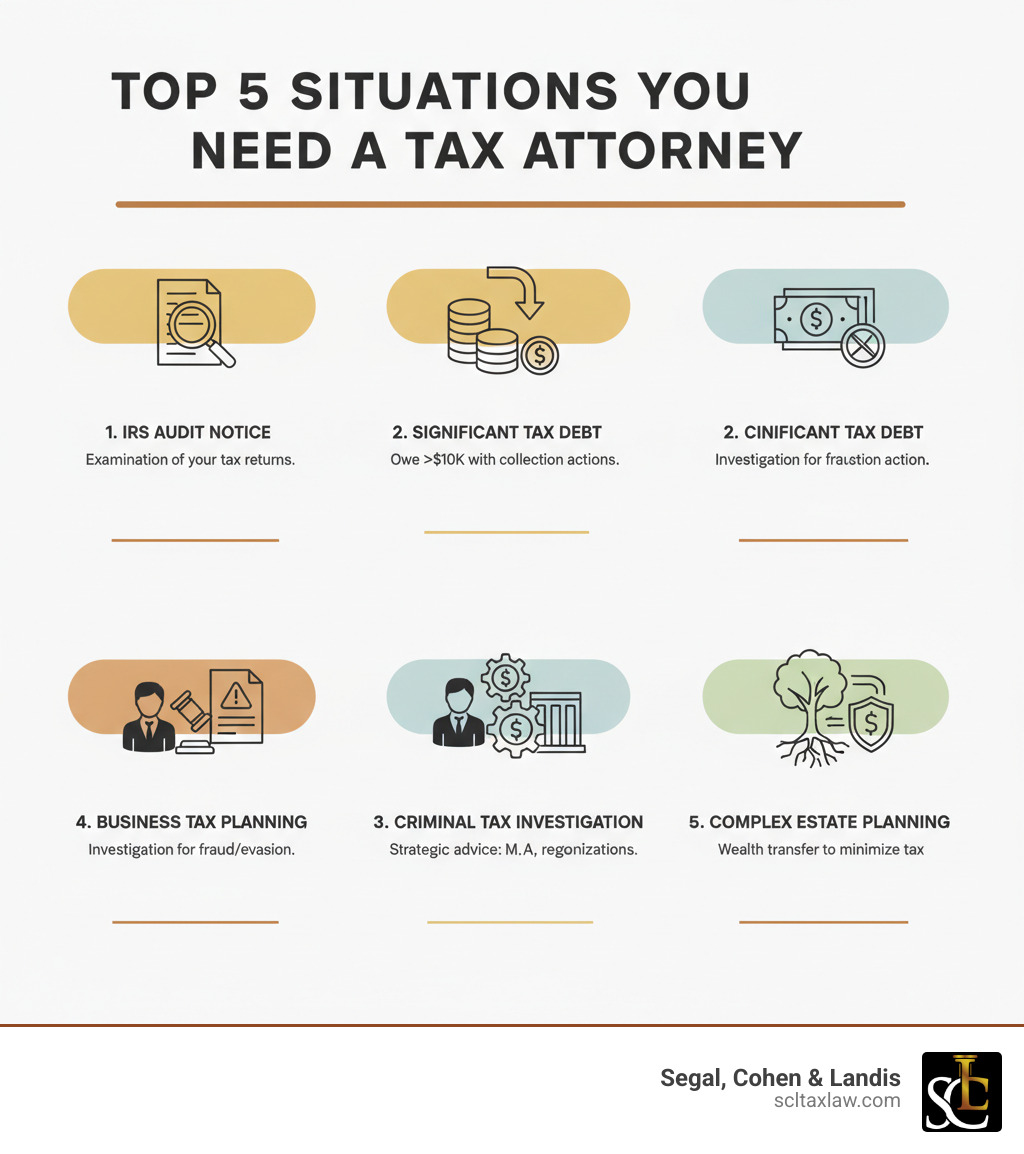
While it’s tempting to handle tax issues yourself to save money, certain situations require a professional. You should hire a tax attorney near me if you are:
- Receiving an audit notice, especially one suggesting a criminal investigation.
- Facing criminal charges for tax fraud or evasion.
- Dealing with significant tax debt (over $10,000), as collection actions can be severe.
- Disagreeing with an IRS or state tax agency decision and need to file an appeal or go to tax court.
- Making a voluntary disclosure for unreported income.
- Navigating complex business or estate tax planning.
Handling these issues alone can lead to costly mistakes, increased penalties, or even criminal charges. Expert representation provides peace of mind and better outcomes.
Conclusion
Choosing the right tax attorney near me is critical for resolving tax issues and protecting your financial future. This guide has shown you how to verify credentials, evaluate experience, check reputations, understand fees, and use consultations to find the right expert.
The stakes are high—an IRS audit, significant debt, or a criminal investigation can threaten your assets and freedom. A qualified tax attorney provides expert advocacy and the vital protection of attorney-client privilege.
Contact Segal, Cohen & Landis to discuss the tax matter, relevant notices and deadlines, and available response options. Confirm the qualifications of the proposed representative and the scope of the engagement.
Review the relevant notices, filing history, records, and deadlines before choosing a response. Evaluate professional assistance according to the facts, applicable law, and agreed scope of representation.
Find a local tax attorney at one of our locations.
Have questions about this topic? Talk to an IRS attorney today.
Segal, Cohen & Landis, P.C. — Beverly Hills. Serving clients nationwide.

Samuel Landis, Esq.
LL.M. (Tax) · Selected to Super Lawyers®
Sam Landis is a Beverly Hills IRS tax attorney specializing in IRS collection defense, audit representation, and international tax compliance for foreign nationals and US expats.