

What Every American Abroad Must Know About the Expat Tax Filing Deadline
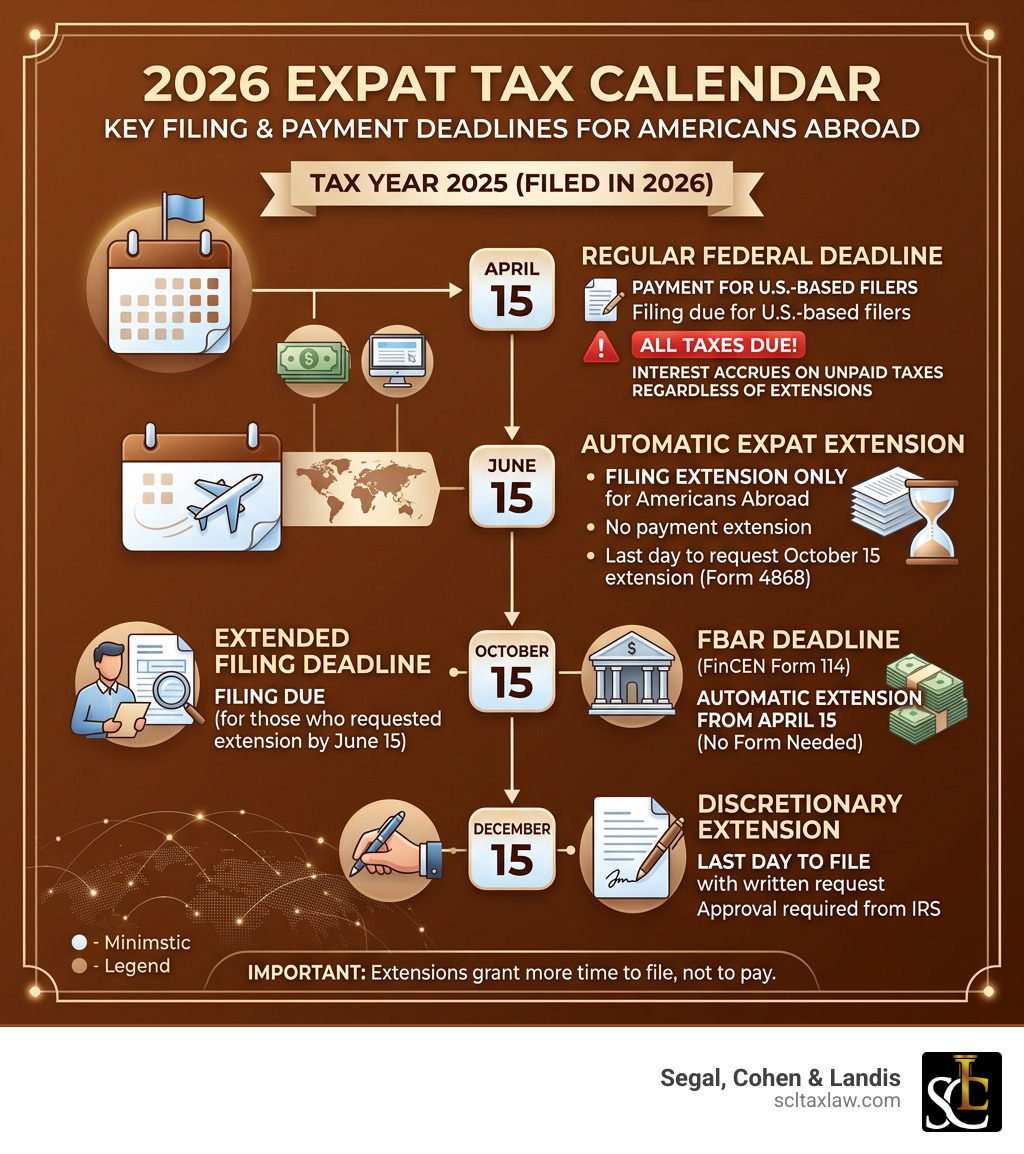
The expat tax filing deadline is one of the most misunderstood obligations for Americans living overseas. Here is a quick look at the key dates for the 2025 tax year (filed in 2026):
| Deadline | Date | What It Covers |
|---|---|---|
| Regular federal deadline | April 15, 2026 | Filing + payment for U.S.-based filers |
| Automatic expat extension | June 15, 2026 | Qualifying automatic extension to file and pay; interest generally runs from April 15 |
| Extended deadline (Form 4868) | October 15, 2026 | Filing only — must request by June 15 |
| Discretionary extension | December 15, 2026 | Filing only — written request required |
| FBAR (FinCEN Form 114) | October 15, 2026 | Auto-extended from April 15 — no form needed |
Qualifying automatic abroad extensions generally extend filing and payment to June 15, but interest runs from the regular April due date. Later filing extensions generally do not extend payment.
Living abroad does not exempt U.S. citizens or green card holders from filing a federal tax return. The IRS taxes worldwide income, no matter where you live or work. But the rules around when you must file — and what happens if you miss a date — are more layered than most people realize.
Miss the wrong deadline, and you could face a 5% monthly failure-to-file penalty (up to 25% of unpaid tax), FBAR penalties under annually adjusted rules, and interest at rates that change quarterly. Nonwillful FBAR reporting violations are measured per report, not per account. The stakes are real.
Review the relevant notices, filing history, records, and deadlines before choosing a response. Evaluate professional assistance according to the facts, applicable law, and agreed scope of representation.
Understanding the Federal Expat Tax Filing Deadline for 2026
For most Americans living in the States, April 15 is the date etched in stone. However, for those of us living abroad, the calendar looks a bit different. The IRS recognizes that living in a foreign country adds layers of complexity to gathering documents and navigating local tax seasons.
According to the IRS filing requirements for citizens abroad, U.S. citizens and green card holders must file a federal tax return regardless of where they reside, provided their income meets the filing threshold. For the 2025 tax year (filed in 2026), a single filer under 65 typically must file if their gross income exceeds $15,750. Even if you qualify for the Foreign Earned Income Exclusion (FEIE), which allows you to exclude up to $130,000 of foreign earnings for 2025, you are still required to file a return to claim that benefit. For more detailed insights, you can review our tax guidance for Americans living abroad.
The Automatic Two-Month Extension
If you are a U.S. citizen or resident alien and your “tax home” and “abode” are outside the United States and Puerto Rico on the regular April 15 deadline, you are granted an automatic two-month extension to file your return. In 2026, this moves your expat tax filing deadline to June 15.
This extension also applies to military personnel serving outside the U.S. and Puerto Rico. To claim this extension, you don’t need to file a special form in advance. Instead, you must attach a statement to your tax return when you file, explaining that you met the criteria for being abroad on the regular due date. As noted in the IRS June 15 deadline reminder, this is a “use it or lose it” benefit—if you don’t attach the statement, the IRS may hit you with late-filing penalties.
Filing vs. Payment: The Interest Trap
The qualifying automatic abroad extension generally covers both filing and payment through June 15, 2026, but interest runs from the regular April 15 due date. A later Form 4868 extension generally extends filing only.
If you wait until June 15 to pay your tax bill, the IRS will charge interest from the original April 15 due date. IRS interest rates change quarterly and generally compound daily; check the rate applicable to the period at issue. The failure-to-pay penalty must be evaluated under the applicable payment extension and penalty rules; do not treat the qualifying June extension as filing-only. To avoid this “interest trap,” we always recommend estimating your tax liability and making a payment by April 15, even if you don’t plan to file the actual paperwork until June.
Extensions Beyond the June 15 Expat Tax Filing Deadline
Sometimes, two extra months just isn’t enough. If you are still waiting on foreign tax statements or complex business documents, you can request additional time.
Review the relevant notices, filing history, records, and deadlines before choosing a response. Evaluate professional assistance according to the facts, applicable law, and agreed scope of representation. Related resources: help with unfiled tax returns; application for extension of time to file.
Requesting the Discretionary December 15 Extension
There is a “secret” third extension that many taxpayers (and even some tax preparers) aren’t aware of. The IRS allows for a discretionary additional two-month extension, pushing the final expat tax filing deadline to December 15.
This extension is not automatic and cannot be requested via a standard form. Instead, you must send a physical letter to the IRS by October 15, explaining the “reasonable cause” for needing more time. The IRS has the discretion to grant or deny this request, so it should only be used as a last resort for truly complex situations.
How to Use Form 2350 for the Expat Tax Filing Deadline
Form 2350 is a specialized extension specifically for expats who expect to qualify for the Foreign Earned Income Exclusion (FEIE) but haven’t yet met the residency requirements.
To qualify for the FEIE, you must pass either the “Bona Fide Residence Test” (living abroad for an entire uninterrupted tax year) or the “Physical Presence Test” (being physically present in a foreign country for 330 full days in a 12-month period). If your 12-month period hasn’t finished by the June or October deadlines, Form 2350 allows you to extend your filing date until 30 days after you expect to meet the requirements. This ensures you don’t have to file a return and pay tax, only to amend it later once you qualify for the exclusion.
FBAR and FATCA: Reporting Deadlines for Foreign Assets

The expat tax filing deadline isn’t just about the 1040. If you have money in foreign bank accounts, you likely have separate reporting requirements that carry some of the steepest penalties in the tax code.
The most common requirement is the FBAR (FinCEN Form 114). This must be filed if the aggregate value of all your foreign financial accounts exceeded $10,000 at any time during the calendar year. This is a “total” threshold—if you have three accounts with $4,000 each, you have triggered the requirement. You must file this electronically through the BSA e-filing portal. For a deeper dive into these rules, see our guide to foreign bank account reporting.
Avoiding Penalties for Missing the FBAR Expat Tax Filing Deadline
Technically, the FBAR is due on April 15. However, FinCEN currently grants an automatic six-month extension to October 15. You do not need to file a separate extension form to receive this extra time.
Missing this deadline is a major risk. Nonwillful civil FBAR reporting violations are measured per report, with an inflation-adjusted maximum and a reasonable-cause exception. The willful civil maximum can be the greater of the inflation-adjusted statutory dollar amount or 50% of the account balance at the violation. Willfulness depends on the actual facts. You can read the official FinCEN FBAR due date guidance for more specifics.
FATCA Thresholds and Form 8938
While the FBAR is a Treasury Department requirement, Form 8938 (FATCA) is an IRS requirement filed with your tax return. The thresholds for expats are much higher than for U.S. residents.
For the 2025 tax year, if you are living abroad and filing as “Single,” you must file Form 8938 if your foreign assets are worth more than $200,000 on the last day of the year (or $300,000 at any point during the year). For “Married Filing Jointly,” the thresholds are $400,000 at year-end or $600,000 at any point. Specified assets include not just bank accounts, but also foreign stock, interests in foreign entities, and foreign pension plans. Staying compliant is vital, so we recommend reviewing our resource on compliance under FATCA.
Business Deadlines and Specialized International Forms
Expat entrepreneurs face an even more complex calendar. If you own a foreign corporation or a U.S. entity while living abroad, your deadlines may fall earlier than the individual expat tax filing deadline.
| Entity Type | Form | Deadline (Calendar Year) |
|---|---|---|
| Partnership | Form 1065 | March 16, 2026 for calendar-year 2025 returns; normally the 15th day of the third month, adjusted for weekends and holidays |
| S-Corporation | Form 1120-S | March 16, 2026 for calendar-year 2025 returns; normally the 15th day of the third month, adjusted for weekends and holidays |
| C-Corporation | Form 1120 | April 15 |
| Foreign Trust | Form 3520-A | March 16 |
For calendar-year partnerships and S-corps, the 2025 return deadline generally falls on March 16, 2026 because March 15 is a Sunday. This deadline is critical because these are “pass-through” entities. The IRS wants these returns filed early so the income data can flow to the owners’ individual returns. You can learn more about Form 1065 and how it impacts your filing. Additionally, if you receive large gifts from foreign persons or interact with foreign trusts, you must be aware of the IRS Form 3520 reporting requirements.
Foreign Corporations and Form 1120-F
If you operate a foreign corporation that has income effectively connected with a U.S. trade or business, you must file Form 1120-F. The deadline for this form depends on whether the corporation maintains an office in the U.S. If it does, the deadline is April 15. If it does not, the deadline is June 15. You can find more technical details about Form 1120 on the IRS website.
Trust and Gift Reporting: Form 3520-A
Foreign grantor trusts have a unique deadline: March 16. Form 3520-A is the annual information return of a foreign trust with at least one U.S. owner. The penalty for failing to file this form is the greater of $10,000 or 5% of the gross value of the trust assets treated as owned by the U.S. person. This penalty applies even if no tax is actually owed.
State Taxes and Estimated Payments for Expats
Just because you left the U.S. doesn’t mean your state did. Some “sticky” states (like California, Virginia, New Mexico, and South Carolina) make it very difficult to break residency. If you are still considered a resident of a state, you may owe state taxes on your worldwide income, regardless of the federal expat tax filing deadline.
Furthermore, if you expect to owe more than $1,000 in U.S. tax for the year, you are generally required to make quarterly estimated tax payments. For the 2025 tax year, those dates are:
- Q1: April 15, 2025
- Q2: June 16, 2025
- Q3: September 15, 2025
- Q4: January 15, 2026
Review the relevant notices, filing history, records, and deadlines before choosing a response. Evaluate professional assistance according to the facts, applicable law, and agreed scope of representation. Related resources: California state tax resolution services.
Do State Deadlines Follow Federal Extensions?
This is a common point of confusion. Many states automatically grant an extension if you have a federal extension, but not all of them do. For example, some states require you to file a separate state extension form or pay the estimated state tax by the April deadline to avoid penalties.
The South Dakota v. Wayfair impact has also changed how states view “economic nexus,” meaning business owners abroad might have state filing requirements they never anticipated. Always check the specific rules for your “home” state to ensure you aren’t missing a secondary deadline.
Frequently Asked Questions about Expat Tax Deadlines
Can I e-file my U.S. tax return from abroad?
Yes, most expats can and should e-file. It is the fastest way to get a confirmation that the IRS has received your return. You can use IRS Free File options if your income is below a certain threshold, or work with an authorized provider. If you must file a paper return, the mailing address for expats is typically the IRS center in Austin, Texas (Department of the Treasury, Internal Revenue Service, Austin, TX 73301-0215).
What are the penalties for missing an expat tax filing deadline?
The primary penalty is the Failure to File penalty, which is 5% of the unpaid taxes for each month or part of a month that a tax return is late. This penalty caps at 25%. If your return is over 60 days late, for returns due in 2026 the minimum generally is the lesser of $525 or 100% of the unpaid tax. The dollar minimum is adjusted annually. You can find failure to file penalty details on the IRS website. If you are owed a refund, there is generally no penalty for filing late—but you only have three years to claim that refund.
Are there special extensions for military in combat zones?
Yes. Members of the military serving in designated combat zones or contingency operations get a deadline extension of at least 180 days after they leave the zone. This extension applies to filing, paying, and even audits. This also extends to spouses in most cases. Additionally, the IRS provides tax relief in disaster situations for those affected by FEMA-declared disasters, which can sometimes push deadlines back by several months.
Conclusion
Navigating the expat tax filing deadline requires more than just a calendar—it requires a strategy. Between the automatic June extension, the October FBAR deadline, and the potential for a December discretionary extension, there are many ways to stay compliant, but even more ways to fall behind.
Review the relevant notices, filing history, records, and deadlines before choosing a response. Evaluate professional assistance according to the facts, applicable law, and agreed scope of representation.
Don’t let the complexity of living abroad turn into a tax nightmare. Contact us today for expert IRS foreign filing services and let us take the stress out of your tax season.
Have questions about this topic? Talk to an IRS attorney today.
Segal, Cohen & Landis, P.C. — Beverly Hills. Serving clients nationwide.

Samuel Landis, Esq.
LL.M. (Tax) · Selected to Super Lawyers®
Sam Landis is a Beverly Hills IRS tax attorney specializing in IRS collection defense, audit representation, and international tax compliance for foreign nationals and US expats.