

What Is a Tax Law Advocate — and Do You Need One?
A tax law advocate is a licensed professional — such as a tax attorney, enrolled agent, or CPA — who represents taxpayers in disputes with the IRS or state tax authorities, working to protect your rights and resolve tax problems on your behalf.
Quick answer: Here’s what a tax law advocate can do for you:
| Situation | How a Tax Law Advocate Helps |
|---|---|
| IRS notice or audit | Reviews your case, responds to the IRS, and protects your rights |
| Back taxes or unpaid debt | Negotiates payment plans, settlements, or debt forgiveness |
| Wage garnishment or levy | Works to stop or release IRS enforcement actions |
| Unfiled returns | Brings you back into compliance while minimizing penalties |
| Financial hardship | Pursues Currently Not Collectible status or Offer in Compromise |
There are two main types of tax advocates: the free, government-run Taxpayer Advocate Service (TAS) — an independent organization within the IRS — and private tax law firms that represent you directly in complex disputes.
Knowing which one to use can be the difference between a fast resolution and years of frustration.
The IRS is not on your side. It has enormous power to garnish your wages, seize your bank accounts, and place liens on your property — often without a court order. If you’re dealing with a serious tax problem, waiting rarely makes things better. As one tax attorney puts it: ignoring a tax problem doesn’t make it go away — it makes it worse.
In fiscal year 2024 alone, the TAS received over 256,000 new cases and fielded more than 1.1 million calls from taxpayers in crisis. Those numbers show just how many people are overwhelmed by the tax system — and how urgently they need help.
tax law advocate: Review the relevant notices, filing history, records, and deadlines before choosing a response. Evaluate professional assistance according to the facts, applicable law, and agreed scope of representation.
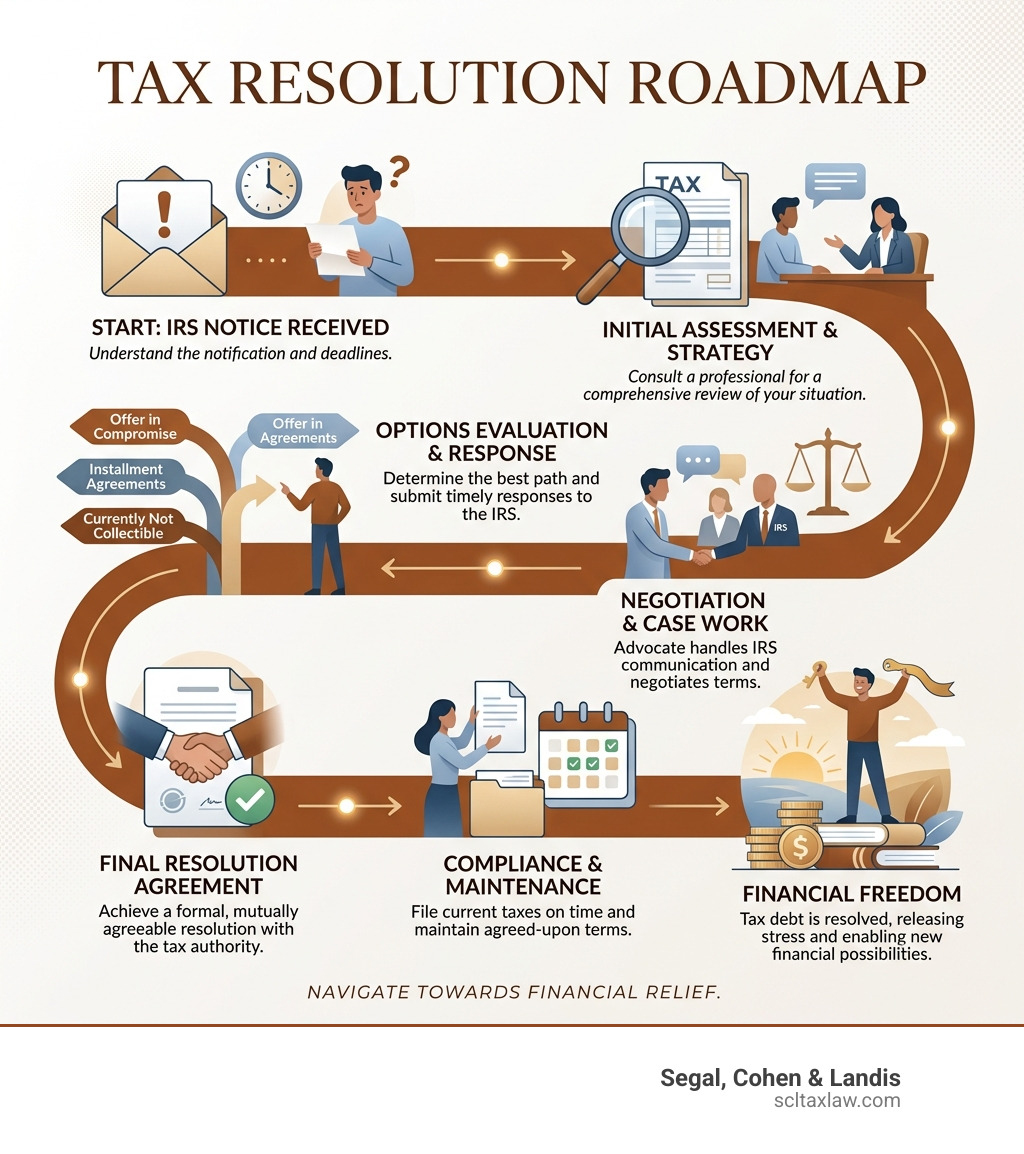
Understanding the Role of a Tax Law Advocate
When you are staring down a stack of IRS notices, it can feel like you’re shouting into a void. A tax law advocate serves as your voice, ensuring that the tax authorities actually listen. At its core, tax advocacy is about enforcing the Taxpayer Bill of Rights. These are ten fundamental protections embedded in the tax code that guarantee you the right to be informed, the right to quality service, and the right to a fair and just tax system.
An advocate’s job is to navigate the “Taxpayer Roadmap”—the complex web of IRS processing, from filing and processing to collection and appeals. Whether you are searching for a Taxation Advocate Near Me or dealing with a national issue, these professionals act as a buffer between you and the aggressive collection tactics of the government. They handle the phone calls, the paperwork, and the high-stakes negotiations so you don’t have to.
The National Taxpayer Advocate and Systemic Change
While individual advocates help people one-on-one, there is also a “big picture” version of advocacy. The National Taxpayer Advocate (NTA), currently Erin M. Collins, leads the Taxpayer Advocate Service (TAS). The NTA doesn’t just look at individual files; she identifies “systemic” issues—problems that affect thousands or even millions of taxpayers at once.
Every year, the NTA submits a report to Congress identifying the at least 10 most serious problems facing taxpayers. For example, in the 2024 Annual Report, the NTA made 69 recommendations for legislative changes to improve tax administration. This high-level advocacy ensures that the IRS is held accountable for its failures, such as processing delays or faulty automated systems.
The Taxpayer Advocate Service (TAS): Free Federal Assistance
If you are struggling with an IRS issue and cannot afford private representation, the Taxpayer Advocate Service | Internal Revenue Service is a vital resource. TAS is an independent organization within the IRS. Think of them as the “internal affairs” of the tax world—they are paid by the government but their mandate is to protect you from the government.
To get started with TAS, taxpayers typically submit Form 911, which is a “Request for Taxpayer Advocate Service Assistance.” Once submitted, you can generally expect a response within 30 days.
TAS vs. Private Tax Law Advocates
| Feature | Taxpayer Advocate Service (TAS) | Private Tax Law Advocate |
|---|---|---|
| Cost | Always Free | Fee-based |
| Eligibility | Must meet “hardship” or “systemic” criteria | Anyone can hire them |
| Scope | Qualifying financial hardship, systemic tax problems and taxpayer-rights issues | Strategy, litigation, aggressive negotiation |
| Speed | Dependent on IRS backlogs | Can act immediately (e.g., 48-hour garnishment release) |
| Legal Privilege | Limited | Full Attorney-Client Privilege |
Qualifying for TAS Intervention
Not everyone with a tax question qualifies for TAS help. To get them to take your case, you generally need to prove one of the following:
- Financial Hardship: You are facing an immediate threat of losing your home, having your utilities shut off, or being unable to buy basic necessities.
- IRS Delays: You have tried to resolve your issue through normal IRS channels and have received no response or the IRS has missed its own deadlines.
- Procedural Failures: The IRS is not following its own rules or is violating your rights under the Taxpayer Bill of Rights.
State-Level Advocacy and Local Offices
While the TAS handles federal IRS issues, many states have their own versions of this service. For example, the New York Office of the Taxpayer Rights Advocate provides independent reviews for state-level tax disputes. Similarly, in California, the Franchise Tax Board (FTB) has its own advocacy programs.
These state offices often mirror the federal TAS but focus on state-specific issues like state income tax, sales tax, or payroll tax. If you live in a state like California or New York, you may need a tax law advocate who understands the nuances of both the IRS and the state taxing authorities.
Private Tax Resolution: Strategies for Complex Controversies

While TAS is a great “safety net,” there are times when you need a “sword” rather than just a shield. This is where a private Tax Attorney Near Me comes in. Private firms are not bound by the same bureaucratic restrictions as government employees. We can be more aggressive, more strategic, and more focused on your specific financial goals.
One of the biggest advantages of a private tax attorney is attorney-client privilege. Unlike Enrolled Agents or CPAs, Qualifying confidential legal communications may be privileged, subject to applicable limits and exceptions. The protection does not extend automatically to underlying facts or preexisting records. This is crucial if your tax controversy involves potential criminal allegations or sensitive business disclosures.
Defending Your Assets with a Private Tax Law Advocate
When the IRS decides to collect, they don’t ask nicely. They use “enforcement actions” like bank levies and wage garnishments.
- Bank Levies: The IRS can freeze your bank account and take every penny up to the amount you owe. Once a levy is placed, you typically have a 21-day window to negotiate a release before the bank sends the money to the IRS.
- Wage Garnishments: The IRS can take a significant portion of your paycheck before you even see it.
A private tax law advocate can often stop these actions much faster than the TAS. In some cases, we can secure a tax levy release or stop a wage garnishment within 48 to 72 hours by establishing a resolution plan immediately.
Choosing the Right Private Tax Law Advocate
Not all tax resolution companies are created equal. In fact, the industry is unfortunately known for “fly-by-night” operations that make big promises they can’t keep. When choosing an advocate, look for these credentials:
- BBB Rating: An Verify current professional credentials and any required court admission. A Better Business Bureau rating may provide additional consumer information but is not a legal qualification requirement.
- Licensed Professionals: Ensure your case is handled by a licensed Tax Attorney or Enrolled Agent, not just a salesperson.
- Local Expertise: If you are in California, look for the Best Tax Lawyers in California who understand the local state tax environment.
- Red Flags: Avoid companies that “guarantee” a specific settlement amount before they’ve even seen your financial records. No one can guarantee an IRS outcome.
Key IRS Relief Programs and Settlement Options
The IRS actually has several programs designed to help people who are genuinely unable to pay their debt. A skilled tax law advocate knows how to package your financial story to qualify for these programs.
The Fresh Start Initiative
Launched to help taxpayers catch up, this program made it easier to set up installment agreements and expanded the criteria for the Offer in Compromise (OIC) program.
Penalty Abatements
Sometimes, the debt isn’t the problem—it’s the interest and penalties that have snowballed. You may qualify for “First-Time Abatement” if you have a clean history for the past three years, or “Reasonable Cause” abatement if a life event (like an illness or natural disaster) prevented you from paying on time.
Currently Not Collectible (CNC)
If paying federal tax would prevent you from meeting basic, reasonable living expenses, request an IRS review of your financial circumstances. Currently Not Collectible status delays most collection; the debt remains due, interest and applicable penalties continue, refunds may be offset, and the IRS may still file a Notice of Federal Tax Lien. Eligibility and later review depend on the facts.
Negotiating Installment Agreements
Most people can’t pay a $50,000 tax bill in one lump sum. An installment agreement allows you to pay your debt over time in monthly chunks.
- Streamlined Agreements: Easier to set up if you owe under a certain threshold.
- Partial Payment Installment Agreements: You pay a monthly amount that you can afford, even if it won’t pay off the full debt before the statute of limitations expires.
A solid compliance strategy is required here; you must stay current on all future tax filings and payments to keep your agreement active.
Offer in Compromise (OIC) and Debt Forgiveness
The IRS Offer in Compromise is the “holy grail” of tax resolution. It allows you to settle your tax debt for less than the full amount you owe.
The IRS calculates your “Reasonable Collection Potential” (RCP) by looking at your assets (home equity, cars, bank accounts) and your future remaining income. If your offer is higher than what the IRS thinks they could ever collect from you, they may accept it. However, the IRS is notoriously picky—acceptance rates fluctuate, and a poorly prepared OIC will be rejected almost immediately. This is where a tax law advocate‘s experience in financial disclosure is invaluable.
Frequently Asked Questions about Tax Advocacy
How long does it take to resolve tax debt through an advocate?
It depends on the complexity. A simple installment agreement can be set up in a few days. A complex Offer in Compromise or an audit defense can take 6 to 12 months, or even longer if the IRS is experiencing backlogs. Private advocates can often move faster than the TAS because they can bypass certain bureaucratic steps.
Can a tax advocate stop an active wage garnishment?
Yes. By contacting the IRS and proposing an immediate alternative (like an installment agreement or proof of financial hardship), an advocate can often get a garnishment released within a few days.
What is the difference between TAS and a private tax attorney?
Qualifying financial hardship, systemic tax problems and taxpayer-rights issues
Conclusion
Tax problems are heavy. They keep you up at night, strain your relationships, and cast a shadow over your business. But you don’t have to carry that weight alone. Whether you utilize the free resources of the Taxpayer Advocate Service or hire a private tax law advocate, the most important step is to stop ignoring the notices.
Review the relevant notices, filing history, records, and deadlines before choosing a response. Evaluate professional assistance according to the facts, applicable law, and agreed scope of representation.
Don’t let a tax mistake define your future. Start your journey with our Tax Services today and let us be your voice at the table. We will investigate your case, protect your rights, and work tirelessly toward the financial freedom you deserve.
Have questions about this topic? Talk to an IRS attorney today.
Segal, Cohen & Landis, P.C. — Beverly Hills. Serving clients nationwide.

Samuel Landis, Esq.
LL.M. (Tax) · Selected to Super Lawyers®
Sam Landis is a Beverly Hills IRS tax attorney specializing in IRS collection defense, audit representation, and international tax compliance for foreign nationals and US expats.