


Understanding the Different Types of IRS Audits: What You Need to Know
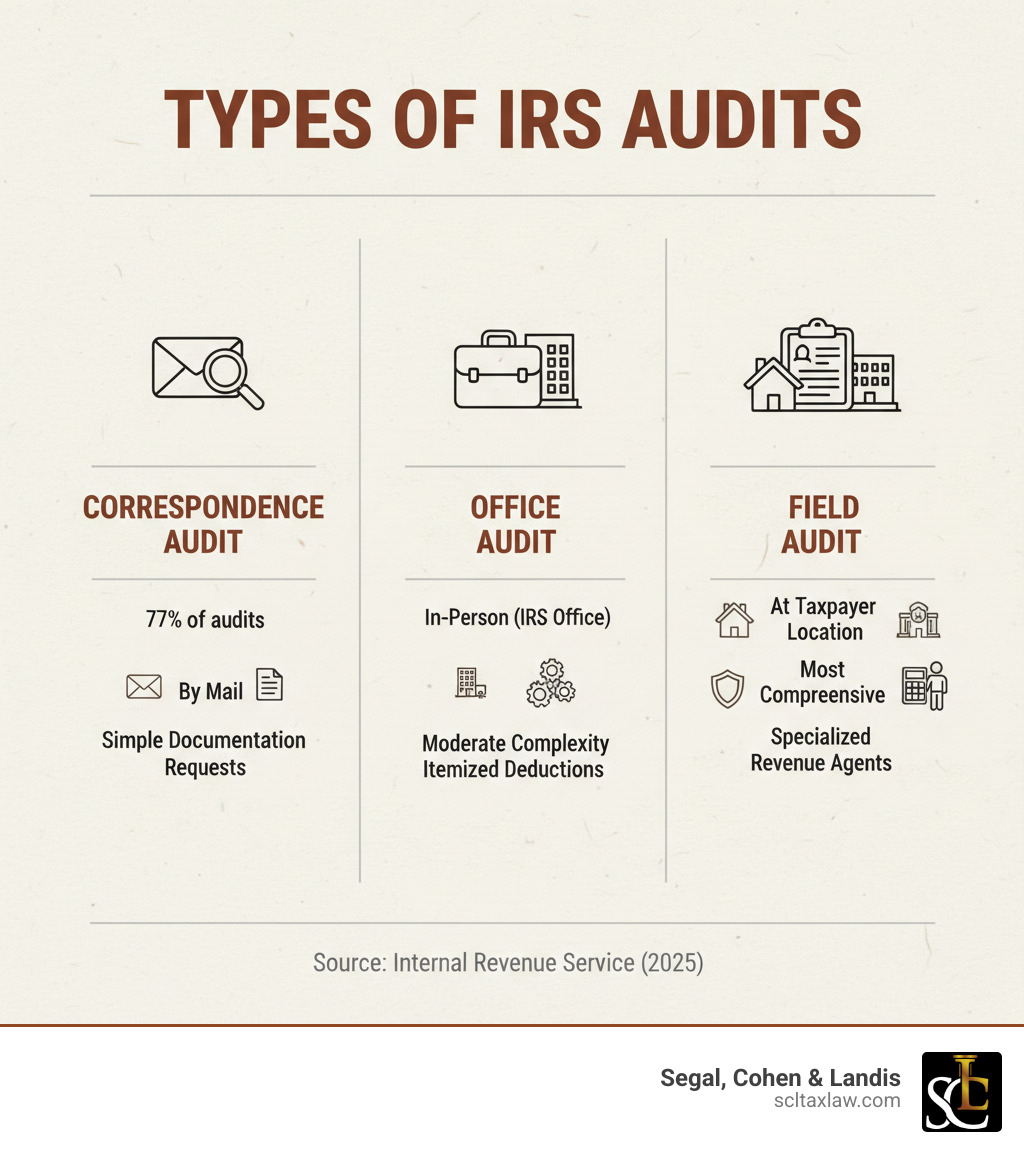
Receiving an IRS audit letter can be stressful, but understanding the types of IRS audits helps you respond appropriately. The IRS conducts three main types of audits, formally known as examinations:
- Mail examinations are one IRS audit format. The format does not determine the outcome of a particular case.
- Office Audit: An in-person examination at an IRS office for more complex matters like itemized deductions or business profits/losses.
- Field Audit: The most comprehensive audit, where an IRS agent visits your location for an in-depth review of financial records.
An audit is a review to verify your tax return is accurate. Selection doesn’t automatically mean there’s a problem; returns are chosen by computer screening, random selection, or links to other audited taxpayers. While audits can result in recommended taxes, over 14,000 recently ended with a refund to the taxpayer.
Review the relevant notices, filing history, records, and deadlines before choosing a response. Evaluate professional assistance according to the facts, applicable law, and agreed scope of representation.
How the IRS Selects Returns and Initiates an Audit
Why does the IRS choose a specific tax return for review? It can be statistics, random chance, or a specific question that needs answering.
Audit Selection Methods
The IRS uses several methods to identify returns for the different types of IRS audits:
- The DIF Score: The Discriminant Function (DIF) system is a key selection tool. It assigns a numeric score to your return by comparing it to statistical norms. A high score, often from unusually high deductions or expenses for your income level, flags the return for a closer look.
- Random Selection: Some returns are chosen by chance for the National Research Program. The IRS uses this data to update its formulas and understand compliance trends. Being randomly selected doesn’t imply you did anything wrong.
- Related Examinations: If you have business or financial ties to another taxpayer who is being audited, your return may be examined to ensure consistency.
- Information Matching: The IRS matches information from third parties (like W-2s and 1099s) to your return. A mismatch is a common trigger for an examination.
Certain items, like the home office deduction, large business losses on Schedule C, or amended returns, can also increase audit risk. However, selection for an audit doesn’t mean the IRS suspects cheating. Many audits result in no change, and some even lead to a refund. For more on risk factors, see our article on Are you at risk of an IRS audit and how far back can the IRS go?
How the IRS Notifies Taxpayers About an Audit
Knowing how the IRS makes contact is critical to avoid scams.
The IRS always initiates an audit by mail. You will receive a letter via the U.S. Postal Service. The IRS will never start an audit with a phone call, email, or text message. They will also never demand immediate payment via gift cards, threaten to call law enforcement, or contact you through social media.
Once an audit is underway, the IRS may follow up by phone, but the first contact will always be a physical letter.
Verifying IRS Employees and Understanding “Audit vs. Examination”
If an IRS employee visits you, you have the right to confirm their identity.

Revenue agents who conduct audits (also called examinations) carry two forms of ID: a pocket commission and an HSPD-12 card. Ask to see both. Criminal Investigation (CI) special agents, who investigate tax crimes, are the only armed IRS employees and present law enforcement credentials. If a CI agent contacts you, the matter is serious. You can confirm any agent’s identity using the Employee Verification Tool on the IRS website.
The terms “audit” and “examination” are used interchangeably by the IRS to describe a review of your tax return and financial records.
The Main Types of IRS Audits Explained
Let’s explore the core types of IRS audits you might face, each with a different level of intensity.
Correspondence Audit (Mail Audit)
Mail examinations are one IRS audit format. The format does not determine the outcome of a particular case.
The IRS will send a letter requesting documentation to support specific items on your return, such as charitable contributions, medical expenses, or education credits. You respond by mailing copies of the requested documents (never send originals). The process is often straightforward, as shown in this video on mail audits from the IRS.
One common notice related to this process is the CP2000. While not technically an audit, it’s a computer-generated letter sent when income reported on your return doesn’t match third-party information (e.g., from your employer). You typically have 30 days to respond. Always use certified mail to prove you responded on time.
Even though these audits seem simple, they can expand if not handled carefully. Stick to providing only what is asked.
Office Audit
If your tax issues are too complex for mail, the IRS may schedule an office audit. This is an in-person meeting at a local IRS office.
Office audits are more involved than mail audits but less extensive than field audits. They often focus on specific areas like:
- Itemized deductions (Schedule A)
- Business profit or loss (Schedule C)
- Rental income and expenses (Schedule E)
You’ll receive a letter with the appointment details and a list of documents to bring. Organization is key. Bringing a qualified tax professional (an attorney, CPA, or Enrolled Agent) is a smart move. They can communicate with the auditor on your behalf and help control the flow of information, which can be critical to a favorable outcome.
Field Audit
The field audit is the most comprehensive and intimidating of the types of IRS audits. If you receive notice of one, it’s time to take it very seriously.
Instead of you going to the IRS, an experienced revenue agent comes to your home, business, or accountant’s office. This allows the agent to observe your operations firsthand. The scope is typically broad, often covering multiple tax years, and is common for businesses or high-net-worth individuals.
The agent will conduct an intensive review of your financial records, including ledgers, bank statements, and contracts. They may also interview employees and request a tour of your business to verify assets and operations.
Our strongest advice: Never handle a field audit alone. Professional representation is essential. An experienced attorney acts as a buffer between you and the IRS, protecting your rights and ensuring only relevant information is disclosed. This makes an enormous difference in both the process and the outcome.
Other IRS Reviews and Special Programs
Not every IRS letter signifies a full audit. The IRS uses automated checks to catch simple mistakes, which differ from the traditional types of IRS audits.
Automated Programs vs. Other Types of IRS Audits
These automated programs are computer-driven and focus on specific issues rather than a full review by an examiner.

- The Information Returns Program (IRP) is the most common. It matches data from third-party forms (like W-2s and 1099s) to your tax return. A mismatch generates a CP2000 notice, which proposes a tax adjustment. These notices aren’t always correct, and you have the right to respond and explain any discrepancies.
- The Unallowable Items Program flags deductions or credits that appear to violate tax law, such as claiming a personal expense as a business deduction.
- The Mathematical/Clerical Error Program corrects obvious mistakes like addition errors or incorrect use of tax tables, as defined by the tax code. The IRS can assess tax immediately, but you have 60 days to request an abatement if you disagree.
While simpler to resolve than a full audit, these automated notices should be taken seriously and responded to promptly.
The TCMP Audit: A Deep Dive into One of the Rarest Types of IRS Audits
Among the rarest and most intensive examinations is the National Research Program (NRP) audit. Very few taxpayers ever face one.
A NRP examination isn’t about suspected wrongdoing. Instead, the IRS uses your return as a research sample to gather data on national taxpayer compliance. This information helps the IRS update its DIF scores—the formulas used to select returns for regular audits.
Despite being for research, the experience is incredibly thorough. An examiner reviews every single line of your tax return, requiring documentation for everything. The level of detail can be overwhelming, demanding receipts, bank statements, and logs for even minor items.
Given the intensity, professional representation is essential for a NRP examination. The good news is they are extremely rare. If you receive a NRP examination notice, contact a qualified tax attorney immediately to help manage the process.
Navigating the Audit: Your Rights and Next Steps
Facing an IRS audit can be daunting, but you have more power than you think. Understanding your rights and the next steps can make the process manageable.
Understanding Your Rights and the Audit Timeline
The IRS must follow specific rules, and you are protected by a set of fundamental rights.

The Taxpayer Bill of Rights is your shield, guaranteeing your right to be informed, to quality service, to privacy, and to challenge the IRS’s position. Among these, the right to representation is one of your most powerful tools. You can authorize an attorney, CPA, or Enrolled Agent to handle all communications with the IRS during any of the types of IRS audits. This changes the dynamic in the taxpayer’s favor.
Understanding the statute of limitations is also crucial. Generally, the IRS has three years after filing or the deemed filing date to assess additional tax, subject to exceptions and extensions. This is why you should keep tax records for at least three years.
Exceptions exist: the window extends to six years if you substantially understate your gross income (by more than 25%). If you file a fraudulent return or never file at all, there is no statute of limitations.
An audit’s duration varies. A simple correspondence audit might take weeks, while a complex field audit could last months or even years. For more on this, see our article on IRS Audit Defense Strategies: Navigating the Audit Process with a Payroll Tax Attorney.
What to Do If You Disagree with the Findings
Disagreeing with an auditor’s findings is your right. The initial conclusions are not final, and you have several avenues to challenge them.
- Request a conference with the auditor’s manager. A fresh perspective can often resolve disputes without further escalation.
- File an appeal with the IRS Office of Appeals. This independent office impartially reviews disputed cases. After receiving a “30-day letter” proposing changes, you can file an appeal to present your case.
- Use mediation. The IRS offers Alternative Dispute Resolution (ADR) services where a neutral third party helps you and the IRS find common ground.
- Seek judicial review. If you can’t reach an agreement, you can go to court. After receiving a “Notice of Deficiency,” you have 90 days to petition the U.S. Tax Court. Alternatively, you can pay the tax and sue for a refund in U.S. District Court.
Deadlines are strict, and the procedures are complex. Professional legal representation is invaluable to ensure every deadline is met and every argument is properly presented. Learn more in our guide on What to do when you disagree with an IRS audit.
Frequently Asked Questions about IRS Audits
After reviewing the different types of IRS audits, some common questions often remain. Here are concise answers to the most frequent ones.
What is the most common type of IRS audit?
Mail examinations are one IRS audit format. The format does not determine the outcome of a particular case.
How long does the IRS have to audit my tax return?
There are specific time limits, known as the statute of limitations, for how far back the IRS can look.
- The general rule is three years from the date you filed your tax return or the due date, whichever is later.
- The period extends to six years if you have substantially understated your gross income (by more than 25%).
- There is no time limit if you file a fraudulent return or fail to file a return at all.
In practice, most audits focus on returns filed within the last two years.
Does receiving an audit notice mean I’m in trouble?
No, receiving an audit notice does not automatically mean you are in trouble or have done something wrong. Many audits are routine and result in no change to your tax liability. Some even result in a refund.
Your return may have been selected for several reasons that have nothing to do with wrongdoing:
- Random selection: Your return was chosen by chance as part of a research program.
- Computer screening: An algorithm flagged your return because it differed from statistical norms, prompting a human review.
- Simple verification: The IRS just needs to confirm information you reported.
The key is to take the notice seriously and respond appropriately, but you shouldn’t immediately assume the worst.
Conclusion
An IRS audit notice is serious, but it doesn’t have to be a nightmare. By understanding the different types of IRS audits—from mail and office audits to comprehensive field audits—you can steer the process with confidence. We’ve covered how returns are selected, what your rights are, and how to challenge findings you disagree with.
Many audits are resolved with no change, and some even result in refunds. The key is a prompt, accurate response and knowing when to seek professional help.
Review the relevant notices, filing history, records, and deadlines before choosing a response. Evaluate professional assistance according to the facts, applicable law, and agreed scope of representation.
If you’ve received an audit notice, don’t face the IRS alone. Reach out to us today to learn more about our IRS Audit Representation services. We’ll review your case, explain your options, and stand by your side every step of the way.
Have questions about this topic? Talk to an IRS attorney today.
Segal, Cohen & Landis, P.C. — Beverly Hills. Serving clients nationwide.

Samuel Landis, Esq.
LL.M. (Tax) · Selected to Super Lawyers®
Sam Landis is a Beverly Hills IRS tax attorney specializing in IRS collection defense, audit representation, and international tax compliance for foreign nationals and US expats.