

Navigating San Diego Offshore Tax Issues: FBAR and FATCA Requirements
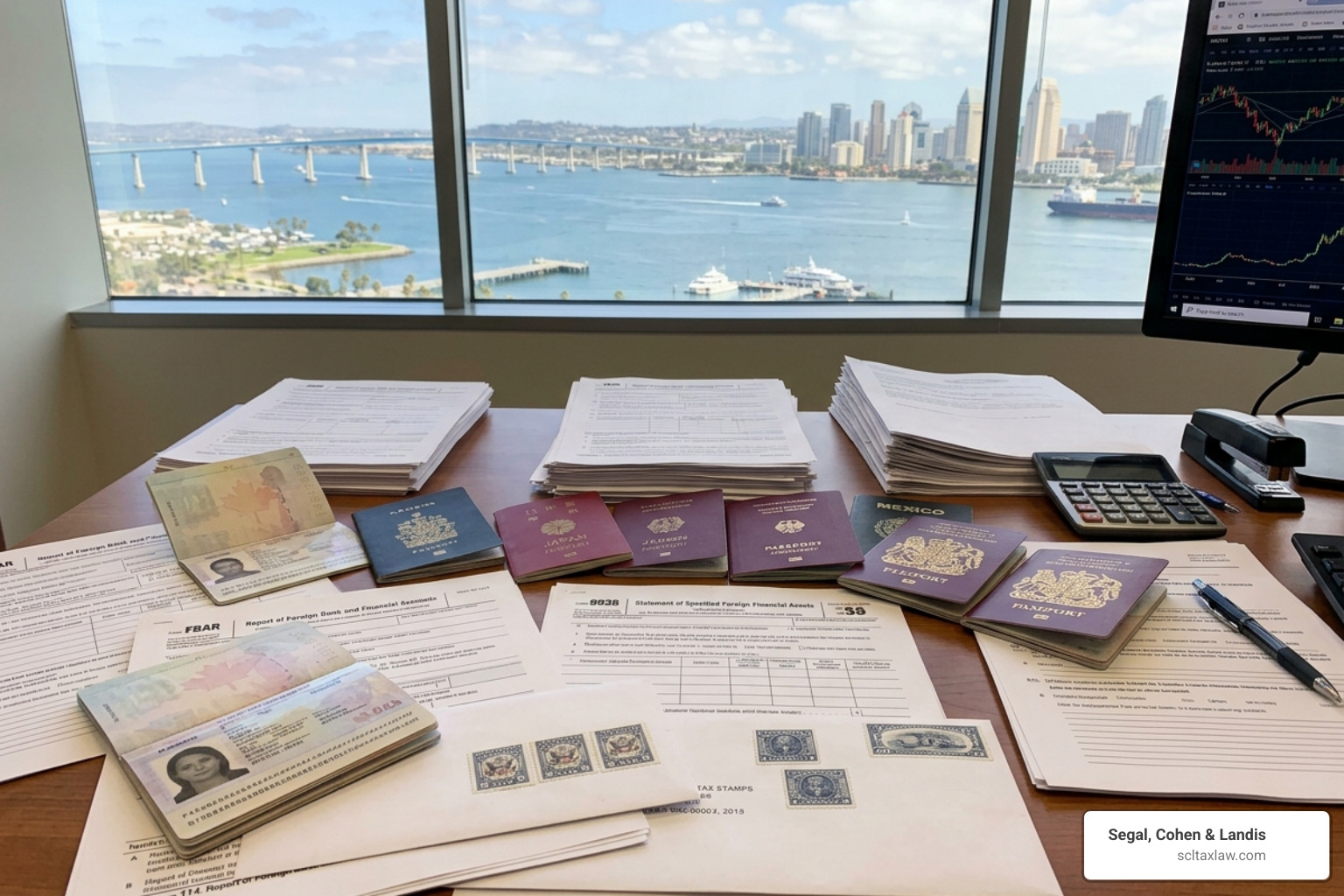
An offshore financial footprint can include a foreign retirement account, inherited assets or overseas investments. Different U.S. tax and information-reporting rules apply to each asset and owner. FBAR and Form 8938 are important but distinct reports; neither automatically covers every overseas asset, and directly held foreign real estate is generally outside both reports.
The FBAR (FinCEN Form 114)
The Report of Foreign Bank and Financial Accounts (FBAR) is an information report filed with the Financial Crimes Enforcement Network (FinCEN), separate from an income-tax return. A U.S. person generally must file when financial interests in or signature or other authority over reportable foreign financial accounts have an aggregate value exceeding $10,000 at any time in the calendar year, subject to exceptions.
For example, five reportable foreign accounts with $3,000 each at the same time total $15,000 and exceed the aggregate threshold; dividing funds between accounts does not avoid reporting. Reportable accounts can include bank and brokerage accounts, certain mutual funds and cash-value insurance or annuity accounts. Review ownership, location and exceptions. See our guides to Foreign Bank Account Reporting and the FBAR and foreign accounts.
FATCA (Form 8938)
Under FATCA, specified individuals and certain domestic entities may have to file Form 8938 for specified foreign financial assets exceeding applicable thresholds. Both FBAR and Form 8938 can cover financial accounts; Form 8938 also reaches certain non-account assets, such as directly held foreign stock and interests in foreign entities. Exceptions apply, and an individual not required to file an income-tax return generally need not file Form 8938.
| Feature | FBAR (FinCEN 114) | FATCA (Form 8938) |
|---|---|---|
| Threshold | More than $10,000 aggregate at any time | Depends on filing status, residence and valuation date |
| Where to File | FinCEN (Online) | Attached to the required income-tax return |
| Assets Included | Reportable foreign financial accounts; ownership or authority rules apply | Specified foreign financial accounts and certain non-account assets |
| Deadline | Generally April 15, with automatic extension to October 15; applicable relief may change dates | Same as your Income Tax Return |
Defining the ‘U.S. Person’ and Reporting Thresholds
One of the most complex aspects of San Diego Offshore Tax Issues is determining who actually counts as a “U.S. person.” Many residents believe that if they aren’t citizens, they don’t have to report. This is a dangerous assumption.
The FBAR definition of U.S. person includes the following categories, subject to the governing residency and entity rules:
- U.S. Citizens: Regardless of where in the world they live.
- U.S. Residents: Individuals meeting the applicable residency definition, including qualifying lawful permanent residents.
- Substantial Presence: Certain noncitizens meet the weighted-day residency test; excluded days, exceptions and the specific reporting regime must be considered.
- Domestic Entities: Qualifying U.S. corporations, partnerships, limited liability companies, trusts and estates.
A noncitizen living in California may still have foreign-asset reporting obligations. Form 8938 has its own definition of specified person, and foreign gifts and foreign-trust transactions involve separate Form 3520 rules. Gifts or bequests from qualifying nonresident individuals or foreign estates generally become reportable when the aggregate exceeds $100,000, including required aggregation of related donors. Foreign corporate or partnership gifts have a separate, annually adjusted threshold. Foreign-trust distributions are not governed by that gift threshold, and penalty rules differ. See our guides to Form 3520 and tax treatment of non-U.S. citizens.
The High Cost of Non-Compliance: Willful vs. Non-Willful Penalties
Civil FBAR penalties depend on the facts and applicable law. Willfulness is not limited to an admitted intent to hide money; recklessness and willful blindness can matter. A claim of ignorance does not itself establish nonwillfulness or reasonable cause.
Non-Willful Penalties
Nonwillful civil FBAR reporting violations are assessed per report rather than per account under the Supreme Court’s Bittner decision. The statutory maximum is adjusted for inflation; applicable reasonable-cause protection and administrative mitigation require separate analysis. Multiple reporting years can produce separate exposure, but a mistake does not automatically establish a penalty.
Willful Penalties
For a willful civil FBAR violation, the statutory maximum can be the greater of the inflation-adjusted dollar amount or 50% of the relevant account balance at the time of the violation. Actual assessment depends on the law, evidence and applicable administrative guidance; this is not an automatic penalty for every late filing.
Multiple years can create substantial exposure, but mechanically multiplying 50% by the number of years does not predict the assessed penalty. IRS guidance includes mitigation and aggregate-penalty considerations. Criminal liability requires separate legal elements and procedures. For current administration, consult the IRS FBAR manual; the older academic discussion of tax evasion is background reading, not authority for a current penalty calculation.

Common Triggers for San Diego Offshore Tax Issues
Information reporting, agency inquiries and third-party records can identify unreported accounts. Do not assume an offshore account is confidential from tax authorities.
- FATCA/KYC Letters: Certain foreign financial institutions have FATCA reporting obligations, directly or through intergovernmental arrangements, subject to exceptions. A request for a tax ID or W-9 does not prove the IRS already knows about a particular account. Respond accurately and review any actual agency contact.
- John Doe Summonses: Subject to legal procedures, the IRS may seek information identifying taxpayers whose names are not yet known, including through financial institutions or exchanges.
- Third-Party Information: Information from other agencies or informants can identify noncompliance; any whistleblower award has separate statutory requirements.
- Digital-Asset Records: Exchange, transaction and other records may help establish ownership and taxable activity; a digital wallet does not guarantee anonymity.
To understand the full scope of these triggers, review A Taxpayers Guide to Compliance Under FATCA.
Resolution Strategies: IRS Voluntary Disclosure and Streamlined Procedures
Address missing filings promptly, but choose a procedure only after reviewing eligibility, willfulness and any prior IRS contact. An existing examination can bar streamlined procedures or make a voluntary disclosure untimely; it does not mean every form of relief disappears.
IRS Voluntary Disclosure Practice (VDP)
VDP is an option for qualifying taxpayers with criminal exposure from willful tax or tax-related violations. It requires a timely, truthful and complete disclosure, cooperation, and payment or an approved full-pay arrangement. It does not guarantee immunity, a fixed penalty or acceptance, and does not cover illegal-source income. Prior examination, investigation or specific third-party information can make a disclosure untimely. See our voluntary disclosure overview and information for international China clients.
Streamlined Filing Compliance Procedures
Streamlined procedures are for eligible taxpayers who can certify that covered failures resulted from nonwillful conduct, including negligence, inadvertence, mistake or a good-faith misunderstanding of the law. Certification must reflect the actual facts; these procedures provide no blanket immunity from investigation.
- Streamlined Domestic Offshore: Eligible taxpayers who fail the foreign nonresidency test generally must have filed required returns for the three covered years. The procedure involves three years of amended returns and required information returns, six years of delinquent FBARs, payment of tax and interest, and a 5% miscellaneous offshore penalty. The penalty uses the highest aggregate year-end value of assets subject to it across the covered periods, not simply one account’s balance.
- Streamlined Foreign Offshore: Eligible taxpayers must satisfy specific nonresidency and nonwillfulness conditions; both spouses must meet the applicable nonresidency test for joint returns. The procedure generally requires three years of delinquent or amended returns, six years of delinquent FBARs, and tax plus interest. Specified penalties are waived when all conditions are met, subject to exceptions; living abroad alone does not qualify a person, and already assessed penalties are not automatically abated.
Delinquent FBAR Submission
If FBARs are missing, follow current IRS and FinCEN late-filing instructions and explain the delay. Penalty treatment and any available relief depend on the actual facts and applicable conditions; filing late or being outside an audit does not itself assure penalty-free treatment.

Choosing the Right Path for San Diego Offshore Tax Issues
Disclosure options depend on the facts, and a false nonwillfulness certification can create serious risk. Obtain advice from a qualified professional, particularly where criminal exposure may exist; no dual attorney-CPA credential is legally required for every case. Review the proposed adviser’s role and relevant experience. We also provide information on disclosure services for international Japan clients.
California State Considerations: FTB and CDTFA Voluntary Disclosure
Federal compliance does not resolve California tax obligations automatically. The Franchise Tax Board (FTB) and California Department of Tax and Fee Administration (CDTFA) administer different taxes and disclosure procedures. Review California filing and payment obligations separately.
Separate California Disclosure Programs
Do not assume that an individual California resident qualifies for a general FTB offshore amnesty. The FTB voluntary disclosure program has its own eligibility limits. CDTFA separately administers in-state and out-of-state use-tax disclosure programs with specific criteria; they are not FTB income-tax programs. Check the relevant agency’s current requirements before registering or submitting a disclosure, since prior filings, contact or registration may affect eligibility.
Corporate Water’s-Edge Elections
A California water’s-edge election concerns the scope of a corporate combined report. It generally limits which affiliated foreign corporations are included, subject to statutory inclusions and other rules; it is not a universal exclusion of foreign income, an individual offshore-account election or a guarantee against double taxation. Review the FTB water’s-edge instructions. The linked policy commentary is not official filing guidance. Our California tax services overview describes a separate service context.
Frequently Asked Questions about Offshore Compliance
What should I do if I receive a FATCA/KYC letter from my bank?
Read the request, verify its legitimacy and respond accurately. A bank’s FATCA or customer-identification request does not itself prove an IRS examination or an impending disclosure of your particular account. Review your reporting history and any agency contact before choosing a corrective procedure.
Can I report foreign pensions or cryptocurrency through voluntary disclosure?
Omitted foreign pension or digital-asset income and required information reports should be reviewed. Available corrective procedures depend on the taxpayer, asset, transaction, treaty and eligibility conditions. Do not infer an account’s foreign location from an exchange’s brand, or assume every pension requires an election or qualifies for deferral.
Why is attorney-client privilege important for offshore tax cases?
The limited federal tax-practitioner privilege does not cover criminal tax matters. Attorney-client privilege may protect confidential communications seeking legal advice, but exceptions and waiver rules apply. It does not automatically protect underlying records or every discussion. Discuss the purpose and limits of confidentiality with counsel before sharing sensitive information.
Conclusion: Review Reporting and Correction Options
Offshore accounts remain subject to applicable tax and reporting rules. Review current requirements, keep appropriate records and address any omissions promptly; compliance planning cannot guarantee financial security or a particular enforcement outcome.
San Diego Offshore Tax Issues: Review the relevant notices, filing history, records, and deadlines before choosing a response. Evaluate professional assistance according to the facts, applicable law, and agreed scope of representation.
If an offshore account or omitted filing needs attention, gather the records and track any notice deadlines. Contact a San Diego tax attorney to discuss applicable reporting and correction options; professional assistance does not guarantee eligibility or an enforcement outcome.
Have questions about this topic? Talk to an IRS attorney today.
Segal, Cohen & Landis, P.C. — Beverly Hills. Serving clients nationwide.

Samuel Landis, Esq.
LL.M. (Tax) · Selected to Super Lawyers®
Sam Landis is a Beverly Hills IRS tax attorney specializing in IRS collection defense, audit representation, and international tax compliance for foreign nationals and US expats.