


Why Finding the Right Offer in Compromise Attorney Could Save You Thousands
An offer in compromise attorney can help you settle your IRS tax debt for less than you owe, but finding the right one is critical. A qualified attorney should specialize in tax controversy, have a proven history with OIC cases, and be transparent about fees and potential outcomes. Avoid anyone who guarantees “pennies on the dollar” results or uses high-pressure sales tactics.
An Offer in Compromise (OIC) may resolve tax for less than the full amount when the requirements for the applicable offer ground are met. Review time varies with the facts and processing. Incomplete or noncompliant offers may be returned, while a substantive rejection has separate appeal rights.
offer in compromise attorney: Review the relevant notices, filing history, records, and deadlines before choosing a response. Evaluate professional assistance according to the facts, applicable law, and agreed scope of representation.
First, Understand the OIC Landscape
Before seeking an offer in compromise attorney, understand the tax resolution landscape. An Offer in Compromise (OIC) is an agreement with the IRS to settle your tax debt for less than the full amount owed. It’s a powerful tool for those facing genuine financial hardship, offering a fresh start from a crushing tax burden.

However, an OIC isn’t for everyone. The IRS’s goal is to collect what you can reasonably pay. If you can pay your debt in full over time, an Installment Agreement, which spreads payments over up to 72 months, is the more likely option. For those who truly cannot afford basic living expenses, a Currently Not Collectible status may temporarily pause collections. Understanding these distinctions is the first step. For more information about our tax services and these options, we’re here to help.
Are You Eligible for an Offer in Compromise?
The IRS has strict initial requirements. Before your offer is even considered, you must:
- Have filed all required tax returns.
- Be current on estimated tax payments for the current year.
- Have made all required federal tax deposits for the current and past two quarters (for employers).
- Not be in an open bankruptcy proceeding.
The IRS offers a helpful Offer in Compromise Pre-Qualifier Tool to help you gauge your eligibility. You must prove that paying in full would cause significant financial hardship.
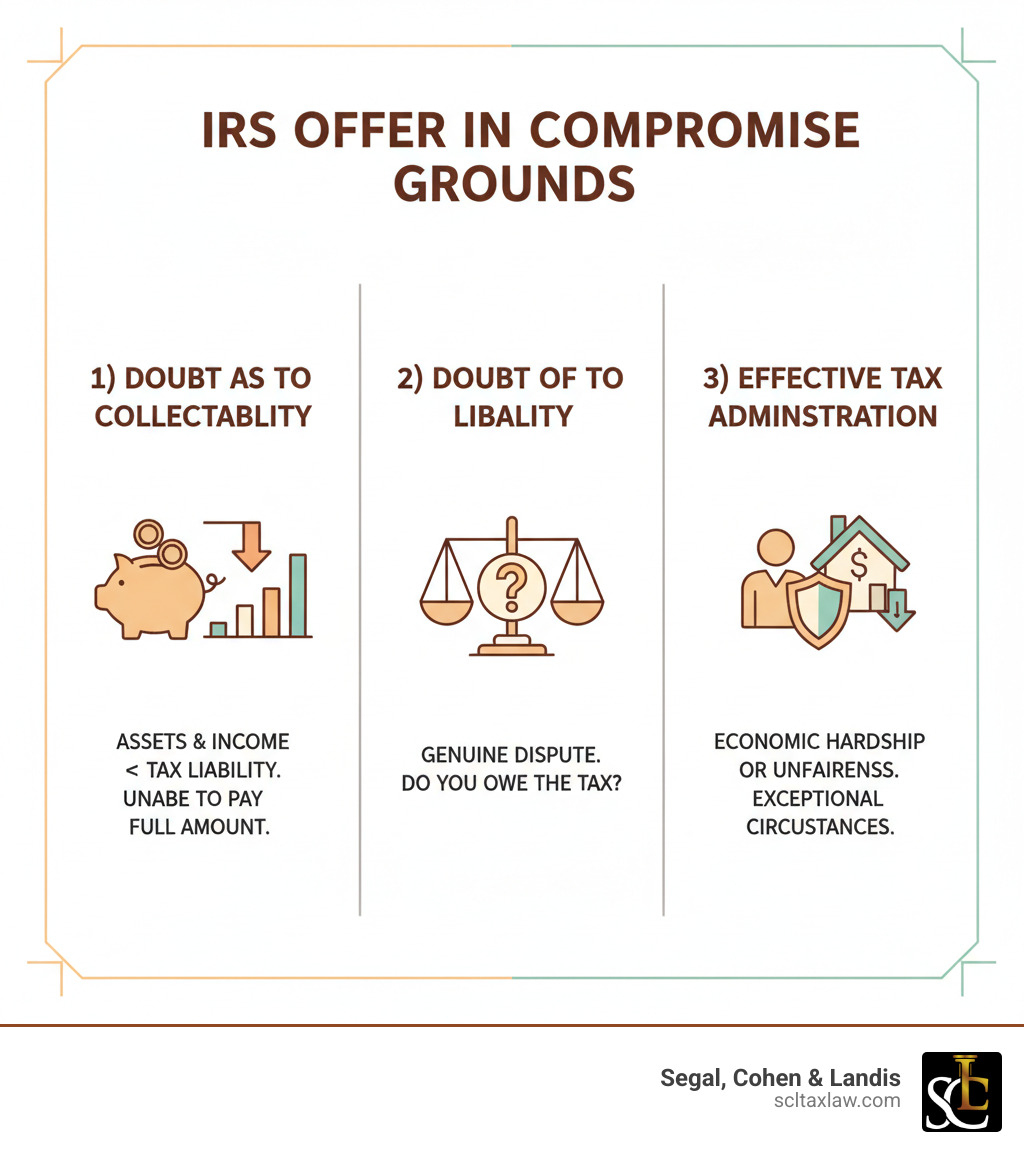
The Three Grounds for an OIC
Your OIC must be based on one of three specific legal grounds:
- Doubt as to Collectability: This is the most common reason. It means your income and assets are not enough to cover your full tax liability after accounting for necessary living expenses.
- Doubt as to Liability: This applies when there’s a legitimate dispute over whether you owe the tax at all. You must demonstrate that the original tax assessment was incorrect. This type of OIC uses a specific form (656-L) and does not require an application fee.
- Effective Tax Administration: This covers exceptional cases where, even if you could technically pay, doing so would create an economic hardship or be unfair due to unique circumstances, such as a serious long-term illness.
Comparing Offer in Compromise vs. IRS Installment Agreement
Choosing the right path is crucial. Here’s a quick comparison:
| Feature | Offer in Compromise (OIC) | IRS Installment Agreement |
|---|---|---|
| Debt Amount Settled | Less than the full amount owed | Full amount owed |
| Impact on Credit | Less damaging than standard creditor forgiveness; a Notice of Federal Tax Lien may be filed during evaluation | Generally neutral, but a tax lien may still be filed if debt is large |
| Eligibility | Must demonstrate inability to pay in full or financial hardship; specific grounds required | Must be able to pay full amount over time (up to 72 months) |
| Future Compliance | Strict 5-year compliance period (file & pay all future taxes) | Must stay current on all future tax obligations |
| Complexity | Very high; requires extensive documentation and negotiation; low acceptance rate | Moderate; relatively straightforward application |
| Fees | $205 application fee (unless low-income or Doubt as to Liability); initial payment required | Setup fees depend on the payment method and taxpayer eligibility; low-income waivers or reimbursement may apply. |
| Process Length | Varies with the facts and IRS processing. | Quicker to set up |
An OIC is for situations where paying in full is impossible or would create genuine hardship. If you can afford to pay over time, an installment agreement is the expected route.
The Critical Role of an Offer in Compromise Attorney
OIC eligibility and collection-potential calculations require careful review. A qualified representative can help prepare the correct forms and supporting documents, including Form 656 and the applicable financial statement for collectibility offers. A genuine liability dispute uses separate Form 656-L procedures. Representation does not guarantee acceptance.
Review the relevant notices, filing history, records, and deadlines before choosing a response. Evaluate professional assistance according to the facts, applicable law, and agreed scope of representation. Related resources: tax services.
Calculating Your “Reasonable Collection Potential” (RCP)
The core of your OIC is the “Reasonable Collection Potential” (RCP). This is the minimum amount the IRS will accept, calculated based on your assets and future income. The formula is essentially: Net Realizable Equity in Assets + (Monthly Income – Allowable Living Expenses) x Future Months.
The IRS values your assets (home, car, bank accounts) at a “Quick Sale Value” (around 80% of market value) and subtracts loans. For income, they subtract “allowable living expenses” based on strict national and local standards, not your actual spending. This is a major sticking point. The IRS might only allow for one car payment or a food budget far below your actual costs. The difference is considered money you could pay to the IRS.
How a Qualified Offer in Compromise Attorney Maximizes Your Chances
An experienced offer in compromise attorney earns their fee by strategically navigating the RCP calculation and building a compelling case. They help by:
- Presenting a Strategic Case: Framing your financial situation to meet IRS criteria while highlighting your inability to pay.
- Ensuring Accurate Financials: Compiling the mountain of required documents (bank statements, pay stubs, asset valuations) to ensure your application is complete and error-free.
- Arguing for Higher Living Expenses: Justifying deviations from the strict IRS expense standards based on your unique circumstances, such as high medical costs or regional living expenses.
- Handling All IRS Communication: Managing all correspondence and negotiations, protecting you from saying something that could harm your case.
- Avoiding Common Pitfalls: Check compliance, complete the correct forms and provide the requested documentation so the IRS can evaluate the offer.
Review the relevant notices, filing history, records, and deadlines before choosing a response. Evaluate professional assistance according to the facts, applicable law, and agreed scope of representation. Related resources: About Us.
The Dangers of “Tax Relief” Scams
Be wary of “tax relief” companies that prey on desperate taxpayers with unrealistic promises. Legitimate offer in compromise attorneys will never guarantee a specific result, like settling for “pennies on the dollar,” before reviewing your case.
Red flags include:
- High-pressure sales tactics and claims of “limited-time” offers.
- Unrealistic promises of total debt forgiveness.
- Unclear fee structures or large upfront fees before any work is done.
- Lack of direct attorney contact. Many of these companies are sales operations, not law firms.
Review the relevant notices, filing history, records, and deadlines before choosing a response. Evaluate professional assistance according to the facts, applicable law, and agreed scope of representation.
How to Vet and Choose the Right OIC Attorney

Choosing the right offer in compromise attorney is one of the most important financial decisions you’ll make. You need a specialist who lives and breathes IRS tax resolution, not a general practitioner. A skilled attorney can be the difference between acceptance and rejection.
Key Qualifications and Experience
When evaluating attorneys, look for a proven track record. Key qualifications include:
- Specialization in tax controversy and IRS settlements.
- Years of direct experience handling OIC cases.
- Verifiable credentials, including bar admissions and professional memberships.
- Former IRS experience, which provides invaluable insider knowledge.
- Positive client testimonials and reviews.
Review the relevant notices, filing history, records, and deadlines before choosing a response. Evaluate professional assistance according to the facts, applicable law, and agreed scope of representation.
Critical Questions to Ask During a Consultation
Use your consultation to interview the attorney. Ask these critical questions:
- What is your success rate with OIC cases? They can’t guarantee a result, but they should be able to discuss their track record.
- How will you determine my offer amount? A qualified attorney will explain the Reasonable Collection Potential (RCP) calculation in detail.
- What are your fees and payment structure? Get a clear, upfront breakdown of all costs, including the IRS application fee.
- Who will be my primary point of contact? Ensure you’ll have direct access to the attorney handling your case.
- What are the potential risks or challenges in my case? An honest attorney will identify potential obstacles and explain their strategy for addressing them.
What to Expect During the OIC Process with an Attorney
Once you hire an attorney, the process generally follows these steps:
- Initial Assessment: A deep dive into your tax and financial history to confirm an OIC is your best option.
- Document Gathering: Your attorney will provide a detailed checklist for all required financial records, such as bank statements, pay stubs, and asset valuations.
- Form Preparation: Your attorney will carefully prepare the required IRS forms, including Form 656 (the offer itself) and Form 433-A (OIC) (your financial statement).
- Application Submission: The complete package, including forms, documents, the application fee, and your initial payment, is submitted to the IRS.
- IRS Communication and Negotiation: Your attorney can manage communications within the authorized matters, respond to information requests and present supported positions. The IRS may still require your participation. The outcome and review time depend on the facts, requested information and processing.
Navigating the OIC Journey: From Application to Resolution

Once your offer in compromise attorney submits your application, the waiting period begins. Knowing what to expect during the 7- to 12-month review process can help you stay prepared.
During the IRS Review
While your OIC is pending, the IRS generally suspends most collection activities, like levies and wage garnishments, providing you with crucial breathing room. However, they may still file a Notice of Federal Tax Lien, which is a standard procedure that secures the government’s interest. Your attorney can explain the implications of a lien.
The statutory 24-month deemed-acceptance rule has exclusions, including periods when liability is disputed in court; an offer’s pending, returned or withdrawn status matters. Your attorney can monitor correspondence and deadlines while the IRS reviews the offer. For a deeper dive, see our guide: The IRS Offer in Compromise: A Taxpayer’s Guide to Settlement with the IRS.
If Your Offer is Rejected or Returned
It’s important to understand the difference between a “returned” and a “rejected” offer.
- A returned OIC means there was a procedural error, such as a missing form, fee, or failure to file all tax returns. It cannot be appealed, but you can correct the issue and resubmit it.
- A rejection means the IRS reviewed your financials and determined you did not qualify. This could be because they calculated your ability to pay as higher than your offer.
A rejection is not the final word. You have 30 days to appeal the decision to the IRS Independent Office of Appeals. An experienced offer in compromise attorney is critical for navigating the appeals process effectively.
Life After an Accepted OIC
Receiving an acceptance letter is a huge victory, but it comes with responsibilities. You must first pay the agreed-upon offer amount, either as a lump sum (paid within five months) or through a periodic payment plan (typically over 24 months).
Most importantly, you must adhere to a strict five-year compliance period. This means you must file all future tax returns and pay all future taxes on time and in full. If you fail to comply, the IRS can void the OIC, reinstate your original full tax debt with penalties and interest, and resume aggressive collection actions. Staying compliant is essential to protecting your fresh start.
Frequently Asked Questions about OICs
Even with a better understanding of the OIC process, you likely still have questions. Here are answers to some of the most common ones we hear. For more, please visit our FAQ page.
Can an Offer in Compromise be used for state tax debts as well as federal?
No. A federal OIC accepted by the IRS only covers your federal tax debt. State tax debts are entirely separate. Most states have their own OIC programs with different rules, forms, and eligibility criteria. If you owe both federal and state taxes, you must file separate offers with each agency. An experienced offer in compromise attorney can help you manage both processes simultaneously.
What happens to federal tax liens after an OIC is accepted?
The IRS does not immediately release a federal tax lien upon accepting your offer. The lien remains in place until you have fulfilled all terms of the agreement, which means paying the full offer amount. Once you’ve made all payments and met all compliance terms, the IRS will release the lien.
What are the most common reasons an OIC is returned by the IRS?
An OIC is often “returned” for procedural errors before it’s even reviewed. This is different from a “rejection.” The most common reasons for a return include:
- Failure to file all required tax returns.
- Not being current on estimated tax payments or federal tax deposits.
- Being in an open bankruptcy proceeding.
- Missing the application fee or initial payment.
- Submitting incomplete or improperly filled-out forms.
An attorney ensures your application is complete and correct, avoiding these simple but costly mistakes.
Conclusion
Carrying the weight of tax debt is a significant burden, but there is a path forward. The Offer in Compromise program can provide real relief, but its eligibility, financial and procedural requirements need careful review. Incomplete or noncompliant offers may be returned; substantive rejections have separate appeal rights.
An experienced offer in compromise attorney is essential to maximizing your chances of success. They know how to calculate your offer, argue for reasonable expenses, and handle all negotiations with the IRS. They also protect you from predatory “tax relief” scams that make false promises.
Review the relevant notices, filing history, records, and deadlines before choosing a response. Evaluate professional assistance according to the facts, applicable law, and agreed scope of representation.
You’ve taken the first step by educating yourself. Now, take the next one.
Contact us to discuss your IRS Offer in Compromise today. Let’s review your situation and map out your path to financial freedom.
Have questions about this topic? Talk to an IRS attorney today.
Segal, Cohen & Landis, P.C. — Beverly Hills. Serving clients nationwide.

Samuel Landis, Esq.
LL.M. (Tax) · Selected to Super Lawyers®
Sam Landis is a Beverly Hills IRS tax attorney specializing in IRS collection defense, audit representation, and international tax compliance for foreign nationals and US expats.