


Why an Offer in Compromise Attorney Can Be Your Path to Tax Debt Relief
An Offer in Compromise attorney is a tax law specialist who helps taxpayers negotiate with the IRS to settle their tax debt for less than the full amount owed. If you’re drowning in tax debt and can’t afford to pay, an OIC attorney can evaluate your financial situation, prepare your application, and advocate for the lowest possible settlement.
What an Offer in Compromise Attorney Does:
- Evaluates your eligibility for the IRS Offer in Compromise program
- Calculates your Reasonable Collection Potential (RCP) to determine the lowest acceptable offer
- Prepares and submits all required forms and documentation (Form 656, Form 433-A or 433-B)
- Negotiates with IRS examiners to maximize your chances of acceptance
- Handles appeals if your offer is rejected
- Ensures compliance with all requirements during the 5-year post-acceptance period
Tax problems can arise from many life events, such as a medical crisis, job loss, or business failure, quickly creating overwhelming debt. The IRS Offer in Compromise (OIC) program is for taxpayers with genuine financial hardship, but the application is notoriously complex.
An Offer in Compromise depends on the applicable requirements and taxpayer’s circumstances. Review the notice and available procedures; acceptance and timing are not guaranteed.
An OIC attorney understands IRS criteria, knows how to calculate living expenses, and can present your case in the strongest light, making the difference between rejection and a fresh financial start.
This guide discusses offer in compromise attorney guide. Review the applicable rules and facts, and verify the qualifications and scope of any proposed representation.
The path to settling your tax debt starts with understanding if you are a candidate for an OIC and why professional representation dramatically increases your chances of success.
Review the relevant facts, documents, filing requirements, and deadlines before choosing a response. Confirm professional qualifications and the agreed scope of assistance; outcomes depend on the applicable law and circumstances.
Handy Offer in compromise attorney terms:
What is an Offer in Compromise?
An Offer in Compromise (OIC) is an IRS agreement allowing you to settle tax debt for less than the full amount owed. It’s a lifeline for those with significant tax debts they cannot afford to pay. The IRS approves an OIC when the offer represents the most they can expect to collect from you.
The OIC program is a rigorous process for those with genuine financial hardship. Acceptance provides a fresh start, but submission only begins the evaluation; it doesn’t guarantee approval.
It’s important to distinguish an OIC from other tax resolution options, such as an installment agreement:
| Feature | Offer in Compromise (OIC) | Installment Agreement |
|---|---|---|
| Purpose | Settle tax debt for less than the full amount owed. | Pay the full amount owed over an extended period (typically up to 72 months). |
| Eligibility | Requires inability to pay full amount, financial hardship, or disputed liability. | Generally available to any taxpayer who can’t pay immediately but can pay over time. |
| Basis for Acceptance | Doubt as to Collectibility, Doubt as to Liability, or Effective Tax Administration. | Agreement to pay the full balance, plus penalties and interest. |
| Financial Review | Extensive review of income, expenses, assets, and future earning potential. | Less stringent, primarily focuses on ability to make monthly payments. |
| Outcome | Reduced tax debt, providing a “fresh start.” | Full payment of original tax debt. |
| Complexity | Highly complex application process, often benefits from professional assistance. | Simpler application, generally can be set up directly with the IRS. |
Businesses can also use an OIC to resolve significant back taxes. The process involves specific forms (like Form 433-B) and business-related financial considerations.
Understanding the OIC is the first step to resolution. The IRS generally has ten years to collect a tax debt, but filing an OIC extends this collection statute of limitations. For more details, see the IRS Offer in Compromise guide.
The Three Grounds for an OIC
The IRS requires a legitimate reason for an OIC, which must fall into one of three categories:
- Doubt as to Collectibility: This is the most common basis. It applies when your assets and income are less than the full tax debt, and you genuinely cannot pay the full amount. The IRS assesses your “reasonable collection potential” (RCP) to see if your offer is the most they can collect. If full payment would prevent you from meeting basic living expenses, this may apply.
- Doubt as to Liability: This applies when you dispute whether you owe the tax or believe the amount is incorrect. It’s not about an inability to pay, but a legal dispute over the tax itself. You must present compelling evidence to show a genuine dispute exists.
- Effective Tax Administration (ETA): This applies when you can technically pay, but doing so would cause significant economic hardship or be unfair due to exceptional circumstances (e.g., severe illness, disability). The IRS considers your age, health, and dependents. For example, an ETA OIC might be appropriate if full payment would lead to homelessness or prevent critical medical care for a dependent.
You can find more details on the IRS website about OIC grounds.
Are You a Candidate? OIC Eligibility and Calculations
Understanding eligibility is the first step. The IRS has strict criteria; failing to meet them leads to rejection, wasting time and effort.

Basic eligibility criteria include:
- Filed All Tax Returns: You must have filed all required federal tax returns.
- Made Required Estimated Payments: You must be current with estimated tax payments for the current year.
- Made Required Federal Tax Deposits (for Businesses): Business owners must have made all required federal tax deposits for the current and two preceding quarters.
- Not in Open Bankruptcy: You cannot be in an open bankruptcy proceeding.
- An active examination or innocent-spouse matter can affect use of the IRS prequalifier and evaluation of an offer. Review the current tool limitations and actual case status rather than treating them as universal statutory disqualifications.
- If a matter has been referred to the Department of Justice, review the referral and applicable compromise authority before proceeding. Do not assume that the ordinary IRS application process can resolve a DOJ-referred matter.
The IRS’s Offer in Compromise Pre-Qualifier tool offers a preliminary assessment, but it doesn’t guarantee acceptance or replace an attorney’s evaluation. If you have back taxes, you must become compliant with all filing requirements before applying for an OIC.
Understanding Reasonable Collection Potential (RCP)
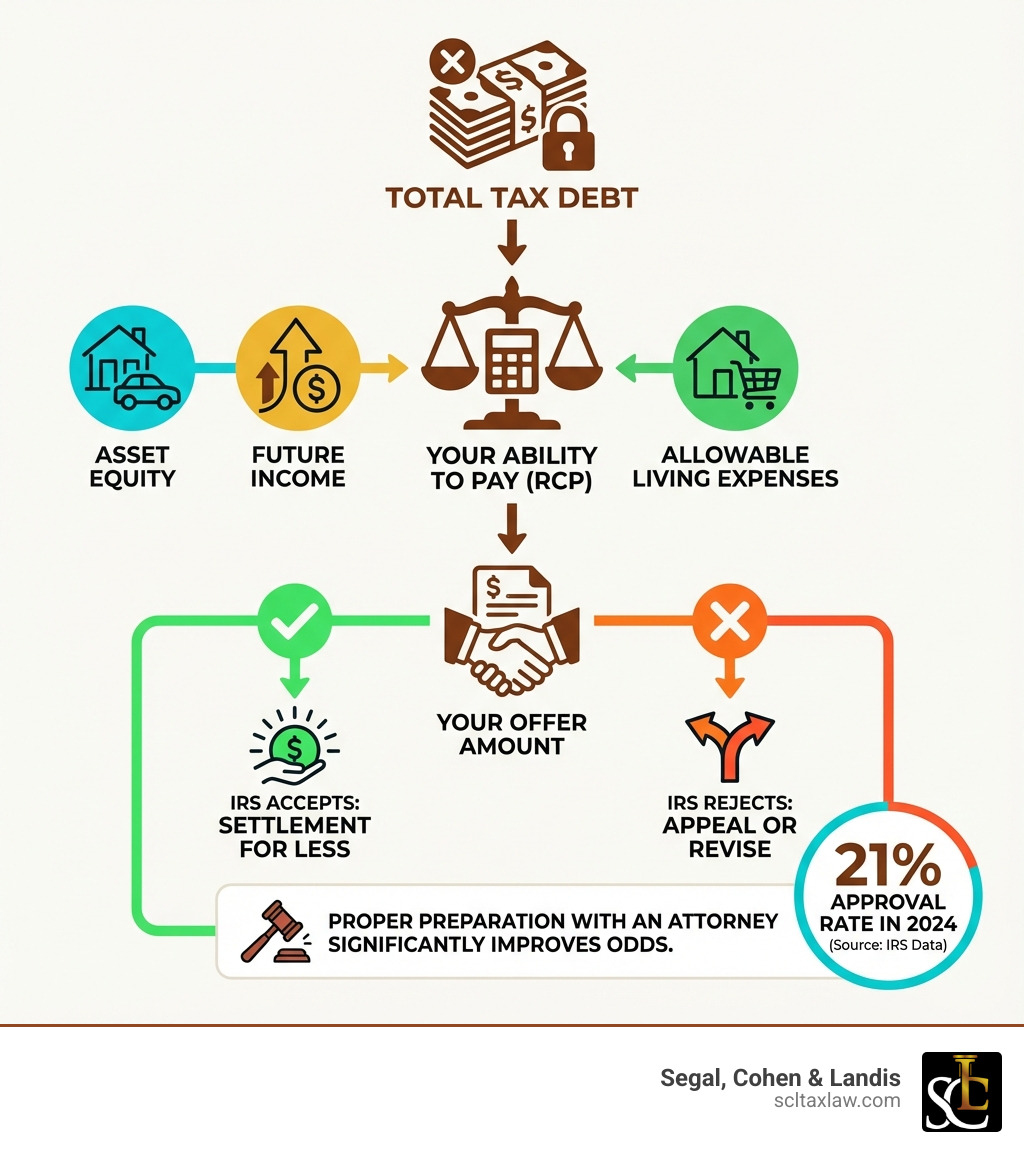
For an OIC based on “Doubt as to Collectibility,” your Reasonable Collection Potential (RCP) is key. RCP is the maximum amount the IRS believes it can collect from you. Your offer must meet or exceed this amount. You won’t qualify if you can pay the full debt through an installment agreement.
The RCP formula has two main components:
- Net Realizable Equity in Assets: This is the “quick sale value” (typically 80% of fair market value) of your assets (cash, real estate, vehicles, etc.) minus secured debts and exemptions.
- Future Income: This is your gross monthly income minus allowable living expenses, multiplied by 12 or 24 months, depending on your payment choice.
The IRS wants to know what it could get by seizing assets and future income. An Offer in Compromise attorney helps calculate an accurate RCP to create a fair and defensible offer.
Calculating Allowable Living Expenses
Calculating allowable living expenses is often contentious. The IRS uses standardized national and local expense standards for what it deems “reasonable and necessary,” rather than your actual spending.
These standards cover:
- Housing and Utilities: Localized standards cover rent/mortgage, property taxes, insurance, and utilities.
- Food and Clothing: National standards apply, varying by household size and income.
- Transportation Costs: Covers car payments, insurance, maintenance, and public transportation, with specific monthly limits.
- Out-of-Pocket Health Care: A standard allowance per household member for medical costs, with a higher amount for those over 65.
The challenge is that IRS standards are often lower than actual costs, especially in expensive areas. Any spending above these limits is typically considered disposable income unless an Offer in Compromise attorney can successfully argue for an exception due to special circumstances.
You can review current IRS expense guidelines to see these figures.
The OIC Application Process: A Step-by-Step Guide
The OIC application process is detailed, lengthy, and requires meticulous attention.

The application timeline is typically 7-12 months but can be longer. A rare statutory rule states that if the IRS fails to decide on an OIC within two years, it’s automatically accepted (excluding time in appeals).
Doubt as to liability uses Form 656-L and does not require the $205 application fee or an initial payment. Collectibility and effective tax administration offers use the separate Form 656 process, including its applicable financial forms, fees and payment requirements.
All tax returns must be filed and current before you submit an OIC. Address any unfiled tax returns first.
Required Documentation
The IRS requires extensive financial documentation to evaluate your OIC. You will need to gather:
- IRS Form 656, Offer in Compromise: The main form for your offer amount and terms. More info at Form 656, Offer in Compromise.
- IRS Form 433-A (OIC) for individuals: Your Collection Information Statement. Access Form 433-A (OIC) for individuals here.
- IRS Form 433-B (OIC) for businesses: The financial information form for business tax debts.
- Bank statements: Typically for the past 3-6 months.
- Pay stubs: To verify income.
- Asset valuations: Documentation for real estate, vehicles, investments, etc.
- Proof of expenses: Bills for utilities, medical costs, insurance, etc.
- Tax returns: Copies of filed tax returns.
The number of forms and fees depends on the tax types. For example, individual and business tax debts usually require two separate Form 656 applications, each with its own fee and payment. An Offer in Compromise attorney can guide you through these requirements.
Choosing a Payment Option
You must choose one of two payment options for your offer:
- Lump Sum Cash Offer: Submit a nonrefundable 20% payment with your offer (low-income exception applies). Pay the rest in five or fewer payments within five months of acceptance.
- Periodic Payment Offer: Submit the first payment with your offer (low-income exception applies) and continue making monthly payments during the IRS review. If accepted, pay the balance in monthly installments over a period up to 24 months.
Initial and ongoing payments are non-refundable and are applied to your tax debt if the offer is rejected. An Offer in Compromise attorney can help you choose the best payment option for your situation.
The Critical Role of an Offer in Compromise Attorney
The IRS Offer in Compromise program is complex and full of pitfalls, making an experienced Offer in Compromise attorney invaluable.
The OIC process is a legal negotiation with trained IRS agents. Without a professional who understands tax law and negotiation strategies, you are at a significant disadvantage.
A tax attorney provides several advantages:
- Navigating Complexity: OIC application forms require detailed financial disclosure, and errors can lead to rejection.
- Maximizing Acceptance Chances: With a low acceptance rate, an attorney significantly improves your chances by ensuring your application is complete, accurate, and compelling.
- IRS Communication: An attorney acts as your representative, handling all communications and shielding you from stressful interactions with the IRS.
- Legal Protection: An attorney protects your rights, ensuring the IRS adheres to its own procedures.
For a comprehensive look at how we can assist, explore our full range of tax services.
How an Offer in Compromise Attorney Strengthens Your Case
Contact Segal, Cohen & Landis to discuss the tax matter, relevant notices and deadlines, and available response options. Confirm the qualifications of the proposed representative and the scope of the engagement.
- Review the relevant notices, filing history, records, and deadlines before choosing a response. Evaluate professional assistance according to the facts, applicable law, and agreed scope of representation.
- Arguing for Higher Allowable Expenses: We argue for expense allowances that exceed IRS standards when justified, presenting evidence for “variance requests” to lower your disposable income and RCP.
- Review the relevant notices, filing history, records, and deadlines before choosing a response. Evaluate professional assistance according to the facts, applicable law, and agreed scope of representation.
- Negotiating with the IRS Examiner: We handle all negotiations with the IRS examiner, advocating for you and countering unfavorable assessments.
- Handling Complex Financial Situations: An attorney is essential for accurately representing complex finances involving businesses, multiple income streams, or intricate assets.
What to Expect When Working with an Offer in Compromise Attorney
Review the relevant notices, filing history, records, and deadlines before choosing a response. Evaluate professional assistance according to the facts, applicable law, and agreed scope of representation.
- Initial Consultation: We discuss your financial situation and goals to determine if an OIC is your best option.
- Financial Analysis: We conduct a deep review of your finances to build the strongest case.
- Review the relevant notices, filing history, records, and deadlines before choosing a response. Evaluate professional assistance according to the facts, applicable law, and agreed scope of representation.
- Review the relevant notices, filing history, records, and deadlines before choosing a response. Evaluate professional assistance according to the facts, applicable law, and agreed scope of representation.
- Ongoing Case Management: We manage your case from start to finish, handling all IRS communications and negotiations while keeping you informed.
After You Apply: Navigating IRS Decisions and Compliance
An offer accepted for processing generally restricts new levies while pending, subject to exceptions. An existing continuous levy may remain in place; filing an offer does not automatically release a wage or bank levy.
Be aware the IRS may still file a Notice of Federal Tax Lien to protect its interest, which doesn’t mean your OIC will be rejected. Learn more in our guide on tax liens. Also, any tax refunds due before OIC acceptance will be applied to your tax debt.
If Your OIC is Rejected
If your OIC is rejected, the IRS will send a letter explaining why and outlining your right to appeal.
You have 30 days to file an appeal with the IRS Independent Office of Appeals. An Offer in Compromise attorney is instrumental in preparing a strong appeal, which you can learn more about in our guide to the IRS appeals process.
Other options after a rejection include:
- Submitting a Revised Offer: You may be able to submit a new offer with stronger documentation.
- Exploring Other Tax Relief Options: Consider an installment agreement, penalty abatement, or “Currently Not Collectible” status.
If Your OIC is Accepted
If your OIC is accepted, you must adhere to the agreement’s terms, which include a 5-year compliance period. During this time, you must:
- Timely File and Pay Future Taxes: File all tax returns on time and pay new tax liabilities in full.
- Make Agreed-Upon Payments: Make all payments of the accepted offer amount as scheduled.
Failure to comply results in a default. The IRS will then reinstate your original tax debt, plus penalties and interest. An Offer in Compromise attorney helps you understand these obligations to stay compliant and secure your fresh start.
Frequently Asked Questions about OICs
Here are answers to common questions about OICs.
How much does an Offer in Compromise typically settle for?
There is no typical settlement amount. The accepted offer is based entirely on your unique Reasonable Collection Potential (RCP)—what the IRS believes it can collect from your assets and future income after allowable living expenses.
Review the available options and applicable requirements for the particular matter. Outcomes depend on the facts and law; another taxpayer’s result does not predict yours. Confirm the scope of the proposed engagement.
What happens if the IRS doesn’t respond to my OIC in two years?
Under IRC 7122(f), if the IRS does not make a determination on your OIC within two years of receipt, it is automatically accepted. This rare outcome excludes any time your case spends in appeals.
Can an OIC stop IRS collection actions like wage garnishment?
An offer accepted for processing generally restricts new levies while pending, subject to exceptions. An existing continuous levy may remain in place; filing an offer does not automatically release a wage or bank levy. See wage garnishment.
Conclusion
Review the relevant facts, documents, filing requirements, and deadlines before choosing a response. Confirm professional qualifications and the agreed scope of assistance; outcomes depend on the applicable law and circumstances.
Review the available options and applicable requirements for the particular matter. Outcomes depend on the facts and law; another taxpayer’s result does not predict yours. Confirm the scope of the proposed engagement.
If you’re struggling with tax liabilities, don’t face the IRS alone. Take the first step. Contact us for a consultation to see how an Offer in Compromise attorney can help secure your financial future.
Have questions about this topic? Talk to an IRS attorney today.
Segal, Cohen & Landis, P.C. — Beverly Hills. Serving clients nationwide.

Samuel Landis, Esq.
LL.M. (Tax) · Selected to Super Lawyers®
Sam Landis is a Beverly Hills IRS tax attorney specializing in IRS collection defense, audit representation, and international tax compliance for foreign nationals and US expats.