


When Tax Debt Becomes a Crisis: Understanding Your Path Forward
Receiving an IRS notice about unpaid taxes can be stressful, but you have options. IRS tax debt resolution offers multiple official programs to help taxpayers resolve their obligations based on their financial circumstances. These include payment plans, settling for less than you owe (Offer in Compromise), and temporary relief from collections (Currently Not Collectible status).
Ignoring the problem will only make it worse. Interest compounds daily, late-filing and late-payment penalties have separate rates and caps, while other penalties may differ, and the IRS has powerful collection tools like wage garnishments, bank levies, and property seizures. However, the IRS prefers to work with taxpayers to find a solution.
Understanding your options is the first step toward regaining control. This guide walks you through the landscape of IRS tax debt resolution, from the consequences of non-payment to the details of each program. You’ll learn how to identify the right path for your specific financial situation and avoid predatory companies that prey on desperate taxpayers.
IRS tax debt resolution: Review the relevant notices, filing history, records, and deadlines before choosing a response. Evaluate professional assistance according to the facts, applicable law, and agreed scope of representation.
Understanding the Consequences of Unpaid Taxes
Ignoring a tax debt is a mistake. The IRS has extensive collection powers, but they would rather work with you than pursue aggressive enforcement. The collection process follows a predictable timeline, giving you opportunities to resolve the debt before it escalates.
The IRS Collection Process Timeline
The IRS generally has 10 years from the date of assessment to collect what you owe, known as the Collection Statute Expiration Date. However, this clock can pause if you request an installment agreement, file for bankruptcy, or submit an Offer in Compromise, extending the collection period.
Here’s how the process typically unfolds:
- The Federal Tax Lien: If you don’t pay after receiving notices, a lien automatically attaches to all your property (house, car, bank accounts). The IRS may then file a public Notice of Federal Tax Lien, which damages your credit and makes it nearly impossible to get loans or sell property without first paying the IRS. Learn more about The Federal Tax Lien: A Staple of IRS Enforcement Action.
- The Notice of Intent to Levy: This is your final warning before the IRS seizes your assets. A levy is the actual seizure of property, whereas a lien is just a claim against it. You have a right to appeal after receiving this notice.
- Seizure of Assets: If you don’t act, the IRS can garnish your wages, levy your bank account, or even take your car or retirement funds. While some assets are exempt, these protections are limited. The Federal Tax Levy: A Harbinger of Exaction details how levies work.
- Passport Revocation: For 2026, seriously delinquent federal tax debt generally exceeds $66,000, including applicable penalties and interest, and must meet the certification conditions. Certain debts and relief arrangements are excluded. The IRS certifies eligible debt; the State Department makes passport denial or revocation decisions. See our guide on IRS Passport Restrictions.
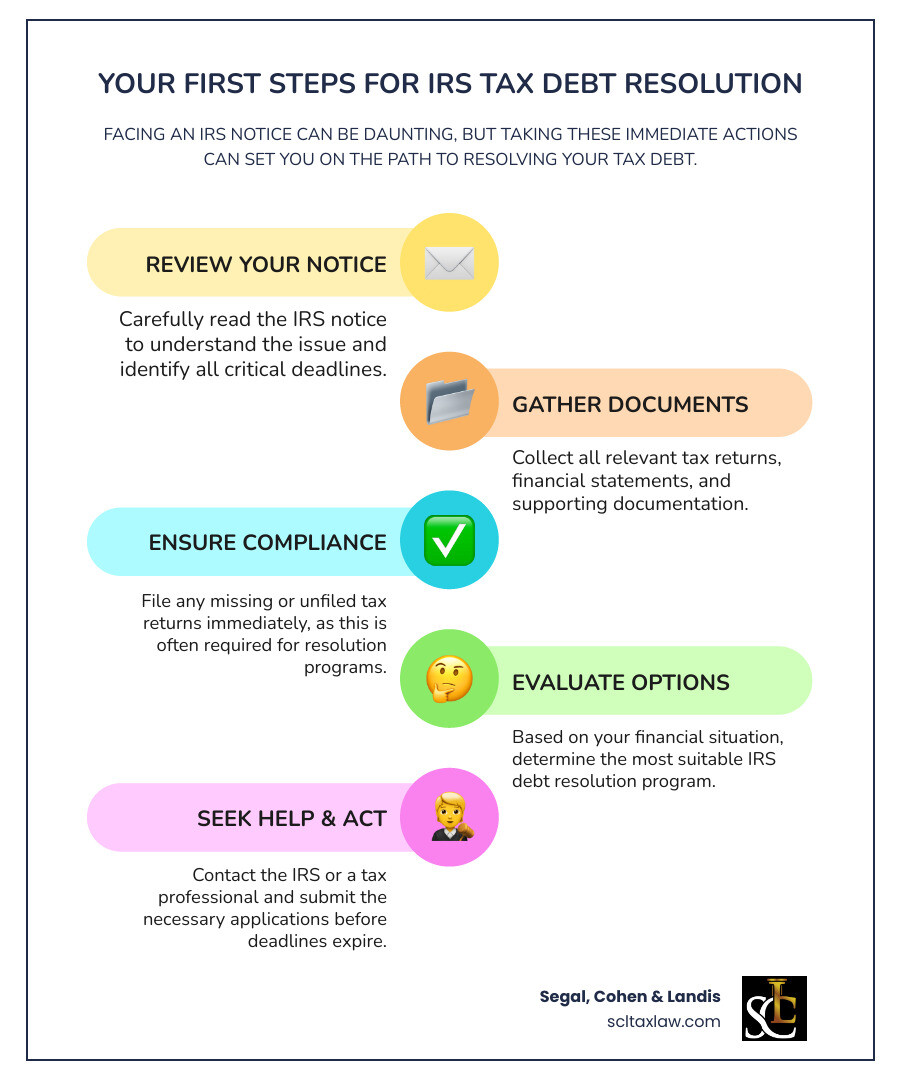
Filing all missing tax returns is a critical first step, even if you can’t pay. It shows good faith and opens the door to resolution options. For more guidance, see What to do when you owe back taxes? Expert insights from an IRS tax law firm.
Penalties and Interest Explained
Your tax debt grows daily due to penalties and interest.
- Failure-to-File Penalty: Generally five percent of unpaid tax for each month or part of a month the return is late, up to 25 percent. Coordination with the failure-to-pay penalty and a minimum late-filing penalty may apply. File on time even if you cannot pay.
- Failure-to-Pay Penalty: Generally 0.5 percent of unpaid tax for each month or part of a month, up to 25 percent. A qualifying installment agreement or an applicable levy notice may change the rate.
- Interest: Interest compounds daily on both your unpaid tax and penalties. The IRS rarely waives interest. You can learn more at IRS Interest Accrual and Abatement.
Penalties can sometimes be removed through penalty abatement if you have a reasonable cause (like a serious illness or natural disaster) or qualify for first-time relief. Don’t ignore IRS notices about penalties; they explain your rights and options. Reduce IRS Tax Penalties explores these options. The IRS also provides guidance on Responding to a Notice.
The Offer in Compromise (OIC): A Deep Dive into Settling Your Tax Debt
An Offer in Compromise (OIC) is a legitimate IRS tax debt resolution program that allows qualifying taxpayers to settle their tax debt for less than the full amount owed. The IRS may accept an OIC if it’s unlikely they can collect the full amount, or if doing so would cause you significant financial hardship.
For a collectibility offer, the IRS generally requires an offer meeting reasonable collection potential, subject to applicable exceptions. Meeting that amount does not guarantee acceptance; the IRS reviews eligibility, financial information and the facts. Related guidance: IRS Offer in Compromise; Offer in Compromise Complete Guide.
Who is Eligible for an Offer in Compromise?
To be eligible for an OIC, you must meet several key requirements:
- You must have filed all required tax returns.
- You must have made all required estimated tax payments for the current year.
- You cannot be in an open bankruptcy proceeding.
- Business owners must be current on federal tax deposits. For help, see Resolving Payroll Tax Issues: Expert Advice for Small Business Owners.
The IRS offers a free Offer in Compromise Pre-Qualifier Tool to help you get a preliminary idea of whether you might qualify.
The OIC Application Process and Costs
Applying for an OIC requires meticulous detail. The application includes Form 656, Offer in Compromise, and a detailed financial disclosure on Form 433-A (OIC) for individuals or Form 433-B (OIC) for businesses. You must provide documentation for your income, expenses, assets, and debts.
A collectibility offer generally requires a nonrefundable $205 application fee and initial payment. Qualifying low-income individuals are exempt from the fee and the initial and ongoing offer payments; liability offers use separate rules. The IRS reviews income, allowable expenses and asset equity to determine collection potential. An offer may be rejected if full payment is reasonably available through another arrangement. Our Offer in Compromise Application Guide can help you prepare an application.
OIC Payment Options and Post-Acceptance
If your offer is accepted, you have two payment options:
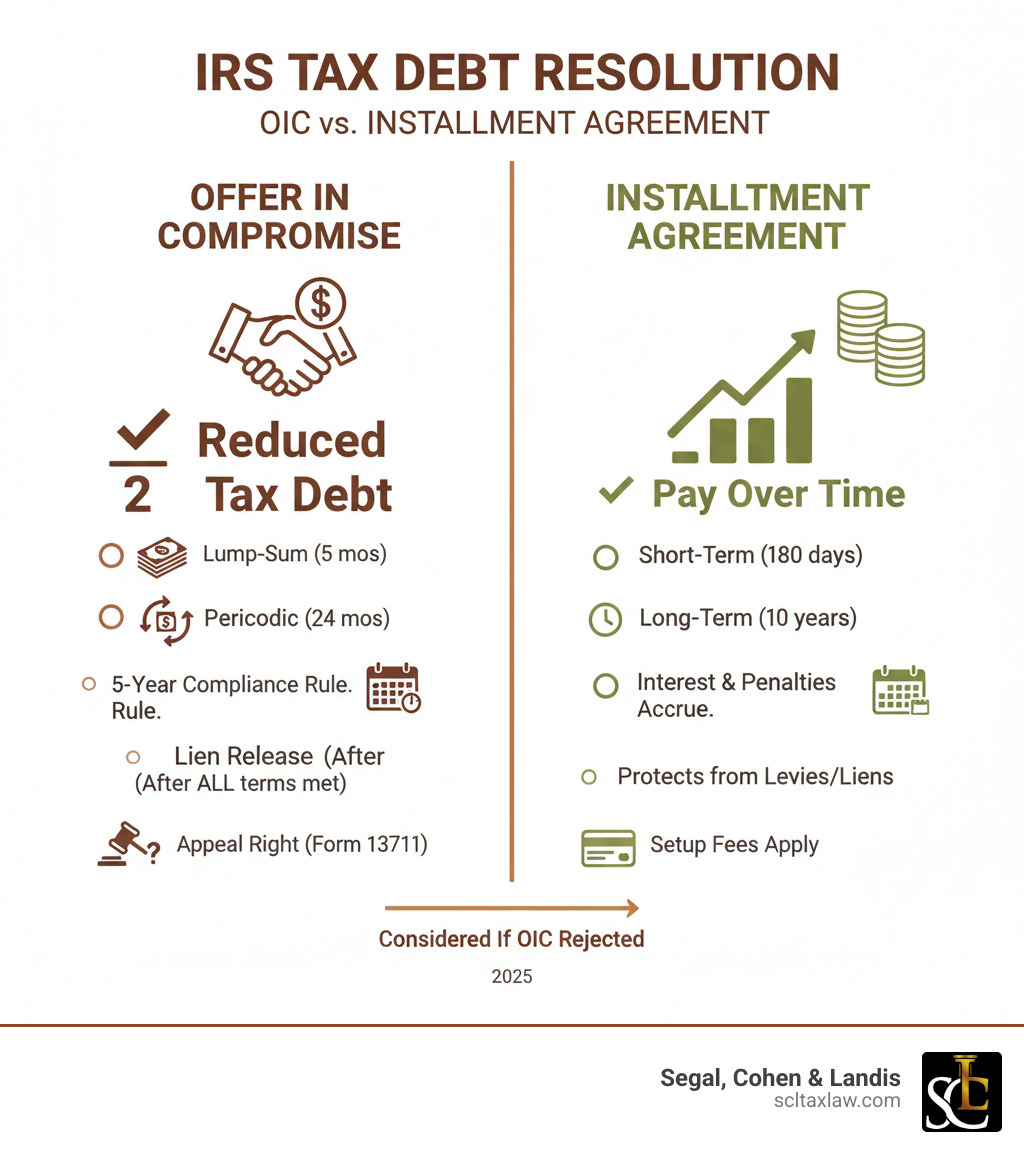
- Lump-Sum Cash Offer: Pay the offer amount in five or fewer payments within five months. This requires a 20% initial payment with your application.
- Periodic Payment Offer: Pay the offer amount in monthly installments over 6 to 24 months. You must make these payments while the IRS considers your offer.
After acceptance, you must comply with future filing and payment requirements for five years. A default may reinstate the original debt. Lien release generally follows fulfillment of the offer payment terms, rather than waiting for the entire five-year future-compliance period. A substantive rejection generally carries a 30-day appeal period. See What happens if an Offer in Compromise is rejected? and Challenging IRS Collection Action via the Collection Due Process Appeal.
Key Alternatives for IRS Tax Debt Resolution
An Offer in Compromise isn’t for everyone. The IRS offers several other IRS tax debt resolution tools that may be a better fit for your situation. The goal is to find a solution that resolves your debt while allowing you to maintain your quality of life. For a full overview, see Understanding Tax Debt Relief Options: How an IRS Tax Law Firm Can Guide You and What to do if you owe the IRS but can’t pay.

IRS Payment Plans (Installment Agreements)
For many taxpayers, an installment agreement is the most practical path. It allows you to pay your debt over time in monthly installments, protecting you from aggressive collection actions like levies.
- Short-Term Payment Plan: Gives you up to 180 days to pay a balance under $100,000. This is ideal if you just need a few months to gather the funds.
- Long-Term Payment Plan: Eligible individual Simple Payment Plans generally require a balance of $50,000 or less and allow payment within the remaining collection period, usually up to ten years. Filing and payment compliance and other criteria apply. Online setup fees depend on the payment method, with qualifying low-income waivers or reimbursement rules.
While interest and penalties still accrue, a payment plan provides stability and prevents the disruption of a bank levy or wage garnishment. For those who can’t afford the standard payment, an IRS Partial Pay Installment Arrangements: An Overlooked IRS Resolution Alternative may be an option.
Currently Not Collectible (CNC) Status
If paying your tax debt would prevent you from affording basic living expenses like housing and food, you may qualify for Currently Not Collectible (CNC) status. This temporarily delays most collection, but the debt remains, interest and applicable penalties continue, refunds may be offset, and liens may remain or be filed. The IRS may review whether your ability to pay has improved. Collection expiration depends on the assessment date and applicable suspensions or extensions; CNC does not guarantee that you can wait out the debt. Learn more at IRS Currently Not Collectible Status.
Other Avenues for IRS Tax Debt Resolution
Several specialized strategies can provide significant relief in specific circumstances:
- Penalty Abatement: The IRS may remove penalties if you had a reasonable cause for failing to file or pay, or if you qualify for first-time relief. This can dramatically reduce your total debt. See our IRS Penalty Abatement Complete Guide and guide to Reduce IRS Tax Penalties.
- Innocent Spouse Relief: If you filed a joint return, you may be relieved of responsibility for tax debt caused by your spouse or ex-spouse without your knowledge. This is a complex area, and our Innocent Spouse Relief Attorney page provides comprehensive information.
- Discharging Tax Debt in Bankruptcy: In limited cases, older income tax debts can be discharged in bankruptcy. This is subject to strict timing rules and does not apply to all types of tax debt. For more details, read about Discharging Tax Debt in Bankruptcy.
Avoiding Scams and Finding Legitimate Help
When facing tax debt, it’s easy to fall for predatory “tax relief companies” that make unrealistic promises. These “offer in compromise mills” often charge large upfront fees for outcomes they can’t deliver, leaving you in a worse position. The Federal Trade Commission warns about these scams in its guide, Trouble Paying Your Taxes?. Only the IRS can approve debt reduction, and no one can guarantee a specific result.
When you need professional help, seek out qualified tax attorneys, Enrolled Agents (EAs), or Certified Public Accountants (CPAs). Our Tax Debt Attorney Los Angeles Guide can help you find qualified representation in the LA area.
Red Flags of ‘Tax Relief Mills’
Be wary of companies that exhibit these warning signs:
- Demand large upfront fees before doing any work.
- Guarantee specific outcomes, like settling for “pennies on the dollar.”
- Use high-pressure sales tactics to get you to sign immediately.
- Won’t disclose their professional credentials (attorney, EA, or CPA).
- Charge for free IRS forms available on IRS.gov.
- Discourage you from communicating directly with the IRS.
If you encounter these practices, file a complaint with the FTC at Report problems with a tax relief company.
The Role of a Qualified Tax Attorney
For complex IRS tax debt resolution issues, a qualified tax attorney provides significant advantages.
- Expertise: We have deep knowledge of the ever-changing tax code and IRS procedures, allowing us to identify the best strategies for your case.
- Representation: We handle all IRS communications and negotiations on your behalf, protecting you from stress and confusion. The attorney-client privilege also ensures your discussions are confidential.
- Protection: We ensure your taxpayer rights are upheld and challenge the IRS when they overstep their authority.
- Review the relevant notices, filing history, records, and deadlines before choosing a response. Evaluate professional assistance according to the facts, applicable law, and agreed scope of representation.
Review the relevant notices, filing history, records, and deadlines before choosing a response. Evaluate professional assistance according to the facts, applicable law, and agreed scope of representation. Related resources: LA Tax Attorney Ultimate Guide.
Conclusion: Taking Control of Your Financial Future
Facing your tax debt is the most important step you can take. As we’ve covered, the IRS offers real IRS tax debt resolution solutions, including the Offer in Compromise, Installment Agreements, and Currently Not Collectible status. The key is to take action. Ignoring IRS notices only leads to more penalties, interest, and aggressive collection actions like liens and levies.
Once you face the problem, you can start working toward a solution that fits your budget and circumstances. Moving forward, proactive tax planning is your best defense. Review your W-4 withholding annually or make quarterly estimated payments if you’re self-employed to avoid future debt.
Navigating IRS tax debt resolution is complex, and mistakes can be costly. Choosing the wrong option or missing a deadline can have serious consequences. This is where professional guidance becomes invaluable.
Review the relevant notices, filing history, records, and deadlines before choosing a response. Evaluate professional assistance according to the facts, applicable law, and agreed scope of representation.
Your financial future doesn’t have to be defined by tax debt. With the right strategy, you can resolve this problem and move forward. Ready to take the first step? Contact us for a consultation on your tax debt issues and let’s map out your path to resolution.
Have questions about this topic? Talk to an IRS attorney today.
Segal, Cohen & Landis, P.C. — Beverly Hills. Serving clients nationwide.

Samuel Landis, Esq.
LL.M. (Tax) · Selected to Super Lawyers®
Sam Landis is a Beverly Hills IRS tax attorney specializing in IRS collection defense, audit representation, and international tax compliance for foreign nationals and US expats.