

Checked October 1, 2026: The IRS states that Automatic Exemption from Penalty (AEP) begins in summer 2026 for eligible 2025 annual returns and 2026 quarterly returns, and subsequent periods. It applies automatically when eligible original returns finish processing and the required compliance history is met. FTA remains a requested remedy for eligible assessed penalties. Other penalties, tax and applicable interest remain due.

Why You Need To Act Now On IRS Tax Penalties
IRS penalties and applicable interest can increase an unpaid balance. The amount depends on the penalty, unpaid tax and elapsed time.
Here’s what you need to know right now:
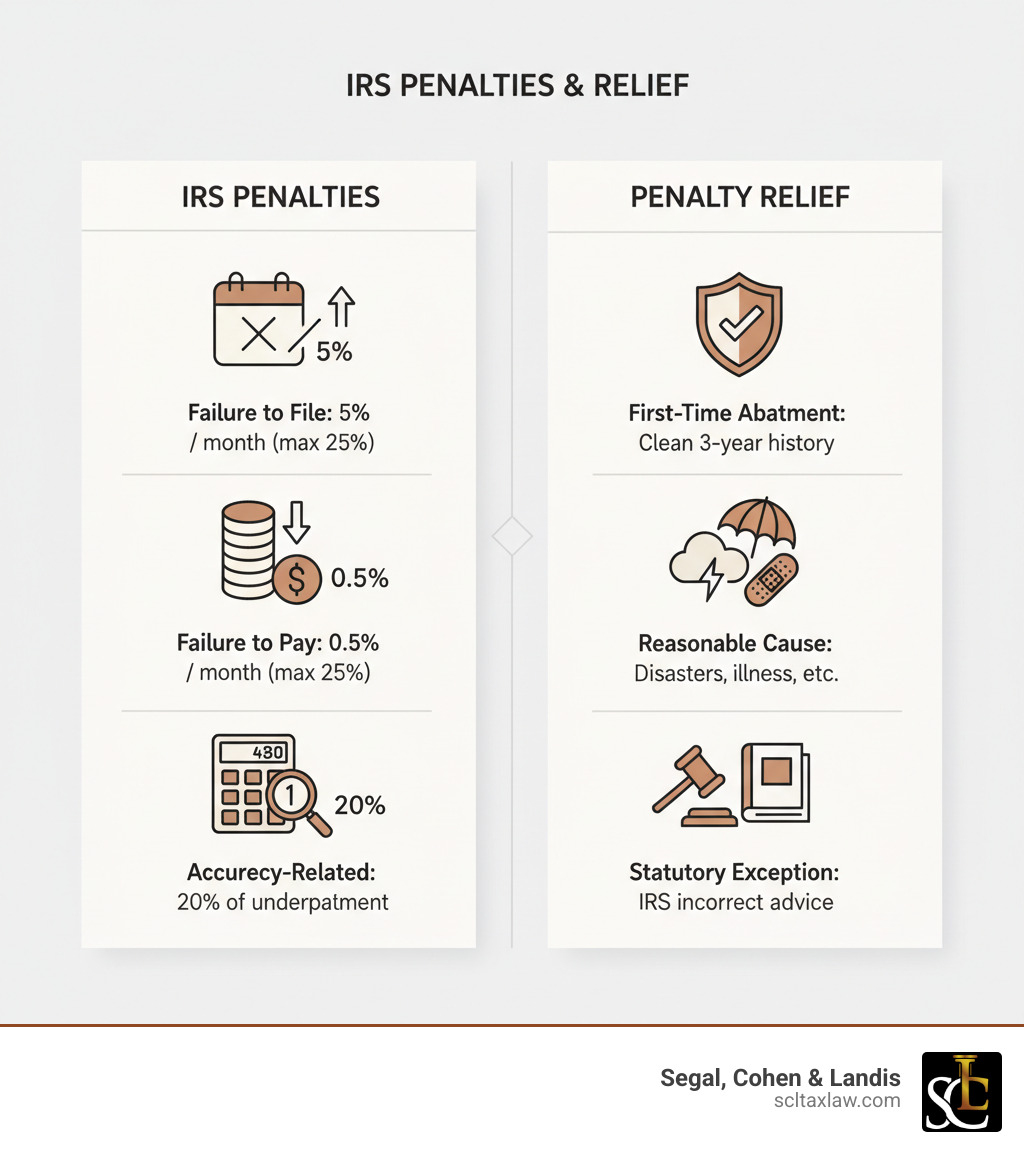
- Common Penalties – Failure to File (5% per month), Failure to Pay (0.5% per month), Failure to Deposit, and Accuracy-Related (20%)
- Three Main Relief Options – First-Time Penalty Abatement, Reasonable Cause, and Statutory Exception
- How to Request Relief – Call the IRS using the number on your notice or submit Form 843 in writing
- If your denial letter provides appeal rights, follow its instructions and deadline; the period is generally 30 days from the letter date.
- Interest Matters – When penalties are removed, related interest automatically goes away too
The IRS may forgive penalties if you had a good reason for non-compliance, and many taxpayers with a clean three-year history qualify for first-time penalty abatement. But you must act fast, as penalties grow every month you wait.
Review the relevant notices, filing history, records, and deadlines before choosing a response. Evaluate professional assistance according to the facts, applicable law, and agreed scope of representation.
Understanding The Most Common IRS Penalties
The IRS uses penalties to enforce tax laws, and they can be assessed for many reasons, from filing late to understating income. Understanding which penalty you’re facing is the first step to reduce IRS tax penalties.
Failure to File Penalty
The Failure to File Penalty is 5% of your unpaid taxes for each month your return is late, capped at 25%. If you’re over 60 days late, the minimum penalty is the lesser of $485 (for returns due in 2024) or 100% of the tax owed. This is covered in IRC 6651(a)(1). If you have Unfiled Tax Returns, this is a primary concern.
Failure to Pay Penalty
The Failure to Pay Penalty is 0.5% of unpaid taxes per month, also capped at 25% of your unpaid balance. If both the failure to file and failure to pay penalties apply in one month, the total is limited to 5%. Always file on time, even if you can’t pay. This penalty is detailed in IRC 6651(a)(2). Explore strategies in What to do if you owe the IRS but can’t pay.
Failure to Deposit Penalty
For businesses required to make federal tax deposits (like payroll taxes), the Failure to Deposit Penalty applies if you miss a deadline or deposit incorrectly. The rate ranges from 2% to 15% of the undeposited amount. The IRS is strict about this penalty because it involves trust fund taxes withheld from employees.
Accuracy-Related Penalty
An accuracy-related penalty may apply to negligence or a substantial understatement of income tax; the applicable standard and defenses depend on the penalty.
Underpayment of Estimated Tax
For individuals, the usual safe harbor requires timely payments based on the smaller of 90% of current-year tax or 100% of prior-year tax. The prior-year return must cover 12 months. The prior-year percentage is generally 110% when prior-year AGI exceeds $150,000, or $75,000 if married filing separately. Other exceptions and special rules may apply.
For a broader look at tax challenges, visit our guide on IRS Tax Problems.
Penalties vs. Interest: What’s the Difference?
Penalties are punishments for not following tax rules. Interest is the government’s charge for the unpaid tax balance, similar to interest on a loan.
Crucially, interest also accrues on penalties. This compounding effect can cause your debt to grow quickly.
Here’s the key: while interest abatement is rare, getting a penalty removed also eliminates the associated interest. This multiplier effect makes pursuing penalty abatement a powerful strategy. Learn more in our article on IRS Interest Accrual and Abatement.
Key Strategies To Reduce IRS Tax Penalties
The IRS has established three main paths to penalty relief. Understanding these is your key to successfully reduce IRS tax penalties. Not all penalties are eligible for every type of relief, as outlined on the IRS Penalty Relief page.

First-Time Penalty Abatement (FTA)
First-Time Penalty Abatement is an administrative waiver for taxpayers who have a clean compliance history but made a mistake. It’s the simplest path to relief.
The IRS requires timely filing of the same return type for the prior three years, or 12 consecutive quarters, and no assessed penalty other than estimated-tax penalties, unless later abated for reasonable cause or IRS error. Prior FTA relief is not equivalent to reasonable-cause relief. Business deposit-history and EFTPS-avoidance restrictions also apply. Review the actual return type, period and account history; a generic clean-record summary is not enough.
Reasonable Cause
Reasonable cause applies when you exercised ordinary business care but couldn’t meet your tax obligations due to circumstances beyond your control. This is evaluated case-by-case.
Valid reasons include natural disasters, serious illness or death, or the inability to obtain records. Strong documentation is crucial; you’ll need evidence like hospital records, court documents, or FEMA reports to support your claim.
Reasons that don’t work typically include lack of funds, forgetting, or ignorance of the law. Relying on a tax professional also doesn’t absolve you of the responsibility to file and pay on time, a principle established in the Supreme Court case United States v. Boyle. There are narrow exceptions, such as receiving specific bad advice that led to an accuracy-related penalty.
Our IRS Penalty Abatement services can help you build a strong case for reasonable cause.
Statutory Exception
This is the least common path, applying when a specific law entitles you to relief. The most common example is relying on incorrect written advice from the IRS. Verbal advice does not count. This path often requires careful legal analysis to apply correctly.
The Step-by-Step Process For Requesting Penalty Relief
Knowing the process for asking the IRS to reduce IRS tax penalties makes it far less intimidating.

Initial Step: Read Your IRS Notice Carefully
Your IRS notice contains critical information: the penalty type, the reason it was assessed, the amount, and deadlines. Read it thoroughly, as it’s your roadmap for the next steps. Sometimes, a simple error is revealed that can be resolved with a quick phone call.
How to Request Relief: Phone vs. Written Submission
You can request relief by phone or in writing, depending on your situation.
Requesting by Phone
For straightforward cases like First-Time Penalty Abatement, calling the number on your IRS notice can be effective. Be prepared with your notice and a clear, concise explanation for why you qualify for relief. Be aware that wait times can be long.
Written Request
Follow the notice and current claim instructions. Some requests can be made by phone or letter; Form 843 is available for specified penalty refund or abatement requests and has important exclusions. Related guidance: Form 843 Instructions.
Tips for a Successful Request to Reduce IRS Tax Penalties
- Be clear and concise: State your case clearly and stick to the essential facts.
- Be honest: Never exaggerate or provide false information.
- Provide strong evidence: Back up your claims with documentation.
- Address missing returns and unpaid tax promptly, and check the criteria for the particular relief requested. Eligible failure-to-pay penalties may be abated while tax remains unpaid, although additional penalties can accrue.
- Be polite and professional: A respectful tone can go a long way.
For complex cases, professional IRS Audit Representation can be invaluable.
What To Do If Your Penalty Relief Request Is Denied
If the IRS denies your request to reduce IRS tax penalties, don’t give up. A denial is not the final word; it’s often just the start of the process.
Appealing the IRS Decision
You have the right to appeal a denial to the IRS Office of Appeals, an independent body that reviews cases with fresh eyes. You typically have 30 days from the date on your denial notice to file a written protest. This is a firm deadline.
Address the actual denial reasons and the applicable basis for relief, including administrative eligibility, reasonable cause, statutory exceptions or an incorrect assessment. Related guidance: Challenging IRS Collection Action via the Collection Due Process Appeal.
The Role of the Taxpayer Advocate Service
If you’re facing significant financial hardship due to the penalties or have been unable to resolve your issue through normal channels, the Taxpayer Advocate Service (TAS) can help. TAS is an independent organization within the IRS that protects taxpayer rights.
A TAS advocate can intervene on your behalf, communicate with the IRS, and help resolve your case fairly. They have the authority to suspend certain IRS actions while they investigate. You can contact them if penalties are preventing you from affording basic necessities like housing, food, or medical care.
You can reach out to TAS directly through their website at Taxpayer Advocate Service, or we can help you determine if your situation qualifies.
Avoiding Future Penalties And Knowing When To Get Help
The best way to reduce IRS tax penalties is to prevent them. Simple habits can save you thousands.
- File on time, even if you can’t pay. The failure-to-file penalty is much harsher than the failure-to-pay penalty.
- Pay what you can by the deadline to reduce the balance subject to penalties and interest.
- Set up a payment plan like an installment agreement or see if you qualify for an Offer in Compromise Featured Article.
- Adjust your withholding or make estimated payments to avoid underpayment penalties.
- Keep good records to support your tax filings and any future relief requests.
- Use qualified tax help to steer complex tax laws.
When to Seek Professional Help to Reduce IRS Tax Penalties

While you can handle simple cases yourself, professional help is wise in certain situations.
- The penalty amounts are large. The cost of professional help is often a fraction of the potential savings.
- Your situation is complex, involving issues like fraud allegations or multiple unfiled returns.
- Your request was denied. An attorney can build a stronger case for an appeal.
- You’re facing collection actions like a Tax Levy Featured Article or a Tax Lien Featured Article. Time is critical in these cases.
- You want peace of mind. A professional can manage IRS communications and let you focus on your life.
Review the relevant notices, filing history, records, and deadlines before choosing a response. Evaluate professional assistance according to the facts, applicable law, and agreed scope of representation.
Conclusion
IRS penalties are serious, but they are not final. You can challenge them and often win. As this guide has shown, you have powerful options to reduce IRS tax penalties, including First-Time Penalty Abatement, Reasonable Cause, and Statutory Exceptions. You also know the process for requesting relief, appealing a denial, and getting help from the Taxpayer Advocate Service.
The most important takeaway is that you have options and the power to act. The IRS grants relief to taxpayers who make a compelling case. However, penalties and interest grow every month, so prompt action is critical. Don’t let confusion or intimidation prevent you from seeking the relief you deserve.
Review the relevant notices, filing history, records, and deadlines before choosing a response. Evaluate professional assistance according to the facts, applicable law, and agreed scope of representation.
Ready to take control? Contact us today for expert help with IRS Penalty Abatement. Let’s work together to reduce your tax burden and get you back on solid ground.
FTA replacement milestone: IRS fact sheet FS-2026-12 separately states that FTA is unavailable for original returns with due dates on or after January 1, 2027, and is replaced by AEP. This is distinct from the summer-2026 rollout for eligible 2025 annual and 2026 quarterly returns. During the transition, check processing status and contact the IRS if an assessed penalty appears despite potential eligibility.
Have questions about this topic? Talk to an IRS attorney today.
Segal, Cohen & Landis, P.C. — Beverly Hills. Serving clients nationwide.

Samuel Landis, Esq.
LL.M. (Tax) · Selected to Super Lawyers®
Sam Landis is a Beverly Hills IRS tax attorney specializing in IRS collection defense, audit representation, and international tax compliance for foreign nationals and US expats.