

Administrative relief checked October 1, 2026: IRS Automatic Exemption from Penalty (AEP) began rolling out in summer 2026 for eligible 2025 annual returns and 2026 quarterly returns. IRS guidance separately replaces First-Time Abatement (FTA) for original returns due January 1, 2027 or later; this is distinct from the summer-2026 rollout. Eligible failure-to-file, failure-to-pay and failure-to-deposit penalties have return-specific compliance tests. The lookback generally covers the same return type for three prior annual periods or twelve prior quarterly periods; prior penalties removed for reasonable cause or IRS error do not necessarily disqualify the taxpayer. Estimated-tax, event-based and information-return penalties have different rules. Check current IRS criteria and the actual notice; relief is not guaranteed.
Why Tax Penalty Abatement Help Can Save You Thousands
Tax penalty abatement help can reduce or eliminate IRS penalties if you meet certain criteria. Here are your main options:
Quick Relief Options:
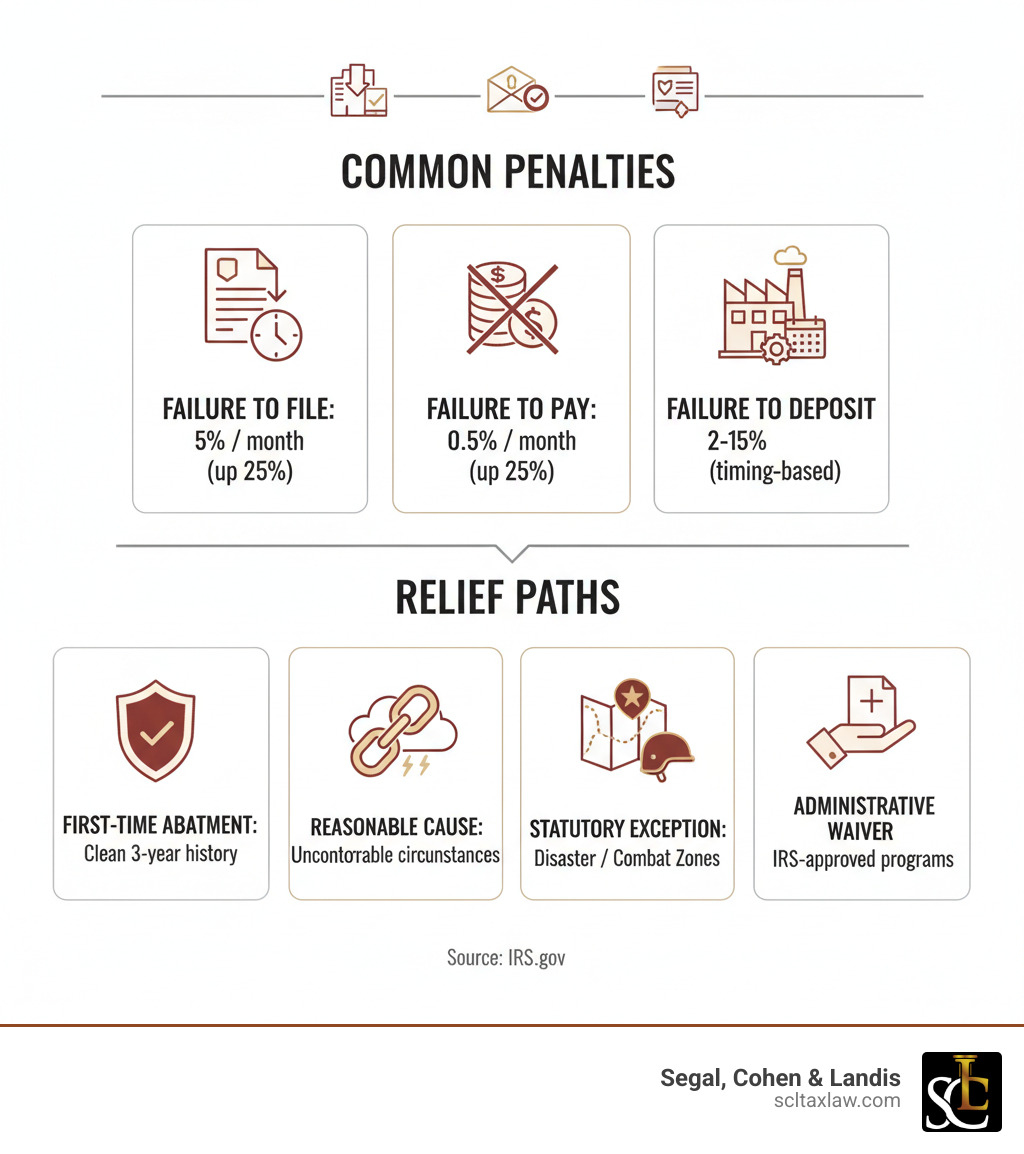
- First-Time Penalty Abatement (FTA) – For a clean 3-year compliance history and all required returns filed.
- Reasonable Cause – For circumstances beyond your control (e.g., illness, disaster).
- Statutory Exception – For being in a federal disaster area, combat zone, or receiving incorrect IRS advice.
- Administrative Waiver – For special IRS relief programs (like the pandemic relief for 4.7 million taxpayers).
Common Penalties You Can Abate:
- Failure to File (5% per month, up to 25%)
- Failure to Pay (0.5% per month, up to 25%)
- Failure to Deposit (for employers)
The IRS assesses billions in penalties annually, but many can be reduced or removed. Don’t accept every penalty at face value.
Understanding your options for late filing, late payment, or error penalties is the first step. While the process seems intimidating, the IRS offers clear relief paths, some accessible with a simple phone call.
This guide explains tax penalty abatement options. Eligibility and relief depend on the applicable requirements and the taxpayer’s circumstances.
Simple guide to Tax penalty abatement help terms:
- Tax debt attorney Los Angeles
- Tax debt relief Los Angeles
Understanding the Basics of IRS Penalty Abatement
An IRS penalty notice can be alarming, but you don’t always have to pay the full amount. The IRS has established processes for removing or reducing them through tax penalty abatement help. Let’s cover the basics.
What is Tax Penalty Abatement?
Tax penalty abatement is the formal process of getting the IRS to reduce or remove penalties. If you’ve already paid, you may get a refund. This is a legitimate part of the tax system that many taxpayers qualify for but don’t use. For example, the IRS provided an administrative waiver of $1 billion in penalty relief to 4.7 million taxpayers during the pandemic.
A major benefit is that when a penalty is abated, any interest that accumulated on that penalty is also removed, which can lead to significant savings.
Review the relevant notices, filing history, records, and deadlines before choosing a response. Evaluate professional assistance according to the facts, applicable law, and agreed scope of representation. Related resources: IRS Penalty Abatement Complete Guide; reduce IRS Tax Penalties.
The Most Common Penalties You Can Abate
While the IRS has over 150 penalties, most taxpayers only encounter a few, all of which are eligible for abatement.
The Failure to File Penalty applies if you don’t file your return by the due date. It’s 5% of your unpaid tax for each month the return is late, up to 25%. The legal basis is in IRC 6651(a)(1).
The Failure to Pay Penalty applies if you file on time but don’t pay on time. This penalty is 0.5% of the unpaid tax per month, also capped at 25%. If both penalties apply in the same month, the combined rate is capped at 5%. This is codified in IRC 6651(a)(2).
The Failure to Deposit Penalty affects employers who miss deadlines for depositing employment taxes. Penalties range from 2% to 15% depending on the delay, as outlined in IRC 6656.
Accuracy-related penalties apply to substantial understatements of tax or negligence. These can be abated by showing good faith and reasonable cause for the error.
All these common penalties are eligible for abatement. In the next section, we’ll explore the four main avenues for relief.
The Four Main Avenues for Penalty Relief
The IRS offers four main paths for tax penalty abatement help, recognizing that mistakes happen. Your situation will determine which path is right for you. For a general overview, visit our page on IRS Penalty Abatement.
First-Time Penalty Abatement (FTA)
If you have a clean tax history, FTA is the easiest path to relief. To qualify, check required filing/payment compliance and the same return type’s prior-three-year or twelve-quarter history, including the IRS exceptions for prior reasonable-cause or IRS-error relief. FTA covers the common Failure to File, Failure to Pay, and Failure to Deposit penalties. You can often request it with a simple phone call to the IRS. Once you use FTA, you must maintain a clean three-year record to use it again. For details, see the IRS page on Penalty Relief due to First Time Abate or Other Administrative Waiver.
Reasonable Cause
If you don’t qualify for FTA, you can argue for reasonable cause. This requires showing you exercised ordinary business care but couldn’t comply due to circumstances beyond your control.
Valid reasons include:
- Death or serious illness of the taxpayer or an immediate family member
- Natural disasters like fires or floods
- Inability to obtain necessary records
Reasons that generally do not qualify include ignorance of the law, lack of funds, simple mistakes, or delegating the timely-filing duty to a tax professional. For accuracy-related penalties, reasonable cause and good faith may include qualifying reliance on a competent advisor when all needed facts were supplied. The IRS provides guidance on Penalty Relief for Reasonable Cause.
Statutory Exceptions and Administrative Waivers
These are two other relief categories.
Statutory exceptions are written into tax law for specific situations, such as:
- Receiving incorrect written advice from the IRS
- Being in a federally declared disaster area
- Serving in a combat zone
Administrative waivers are offered by the IRS to groups of taxpayers, often due to IRS system issues. The pandemic penalty relief program is a prime example. The IRS announces these waivers in news releases. Learn more about Administrative penalty relief on the IRS website.
Table: Comparing First-Time Abatement vs. Reasonable Cause
Since First-Time Abatement and Reasonable Cause are the two relief options you’re most likely to use, here’s a quick comparison:
| Feature | First-Time Abatement (FTA) | Reasonable Cause |
|---|---|---|
| Basis for Relief | Administrative waiver for a clean compliance history. | Factual circumstances beyond taxpayer’s control, good faith effort. |
| Compliance History | Required: No penalties in the prior 3 years (or qualifying prior penalties were removed for reasonable cause or IRS error), all returns filed. | Not a strict requirement, but good history helps. |
| Documentation Needed | Minimal, often just a phone call confirming eligibility. | Extensive documentation required (medical records, disaster declarations, etc.). |
| Penalties Covered | Failure to File, Failure to Pay, Failure to Deposit. | Failure to File, Failure to Pay, Failure to Deposit, Accuracy-Related, etc. (broader range). |
| Application Ease | Generally easier, often resolved by phone. | More complex, usually requires written request with supporting evidence. |
| Frequency | One-time administrative waiver (with a 3-year lookback). | Can be requested multiple times if circumstances warrant. |
Your Step-by-Step Guide to Requesting Tax Penalty Abatement Help
Requesting tax penalty abatement help is more straightforward than you might think. Proper preparation is key to success.

Step 1: Choose Your Method and Prepare Your Case
First, decide whether to request relief by phone or by mail. A phone call is often fastest for simple First-Time Abatement (FTA) requests. A written request is better for reasonable cause arguments, as it allows you to include supporting documents.
Before contacting the IRS, gather your Taxpayer Identification Number, the IRS notice number, and the relevant tax year.
If your penalties are part of a larger issue with back taxes, our guide on what to do when you owe back taxes? Expert insights from an IRS tax law firm can provide context.
Step 2: How to Formally Request Tax Penalty Abatement Help
To request abatement, you can call the IRS or submit a written request.
By Phone: Use the number on your IRS notice. If your request is approved, record the agent’s name and ID number, and ask for written confirmation.
By Mail: A letter or IRS Form 843 is best for complex cases. Clearly state the tax year and penalty you want abated. Explain your situation in detail and attach copies (never originals) of supporting documents like medical records or disaster declarations.
When using Form 843, fill out your personal information, the tax period, the penalty type and amount, and use Line 8 for your detailed explanation, attaching a separate statement if needed. For more guidance, visit our page on IRS Form 843.
Step 3: Understanding and Requesting Interest Relief
When the IRS abates a penalty, they also automatically abate the interest that accrued on that penalty. This can lead to significant savings without a separate request.
In rare cases, you can also request interest abatement if the interest was caused by an unreasonable error or delay by the IRS itself. This is a more complex process that requires showing the IRS was at fault.
For a comprehensive look, see our resource on IRS Interest Accrual and Abatement and the IRS guidance on interest on unpaid taxes.
What to Do If Your Penalty Relief Request is Denied

A denial of your tax penalty abatement help request is not the final word. You have the right to appeal, but you must act quickly.
Appealing to the IRS Independent Office of Appeals
Your first step is to appeal to the Independent Office of Appeals, an impartial branch within the IRS. Your denial letter will explain the reason for the denial and your appeal rights. You generally have 30 days from the date on the letter to file a formal written protest.
Your protest should state why you disagree and include any new evidence or arguments. CDP generally requires a qualifying lien or levy notice and a timely request; an unpaid penalty alone does not establish access. Underlying-liability challenges have additional limits. A CDP hearing provides a formal setting to discuss your case with an Appeals Officer and temporarily halts most collection activities. Learn more about Challenging IRS Collection Action via the Collection Due Process Appeal.
The Independent Office of Appeals provides a fresh review of your case. For more on the process, see our IRS Appeals page.
Escalating Your Case to Court
Whether judicial review is available depends on the penalty, notice and applicable statutory jurisdiction; an unsuccessful appeal alone does not establish a court route. This is a significant step that usually requires legal representation.
- U.S. Tax Court: A timely petition requires an applicable statutory route, such as a qualifying deficiency or CDP determination. Not every assessable penalty or abatement denial permits this route.
- U.S. District Court & U.S. Court of Federal Claims: These courts require you to pay the penalty first and then sue for a refund. This “pay first, litigate later” rule makes them less accessible for many taxpayers.
Navigating court proceedings is complex. Our article on what to do when you disagree with an IRS audit offers more insight into IRS disputes.
Where to Find Additional Resources and Professional Help
While you can handle some penalty issues yourself, professional tax penalty abatement help is crucial in many situations.
When to Seek Professional Tax Penalty Abatement Help
Consider hiring a professional for:
- Complex cases: Situations involving multiple penalties or tax years. An expert knows how to build the strongest case.
- High-dollar penalties: The cost of professional help is often a fraction of the potential savings.
- Denied requests: An attorney can identify weaknesses in your original request and build a stronger appeal.
- IRS audits: If penalties arise from an audit, you need comprehensive IRS Audit Representation.
- Feeling overwhelmed: Contact Segal, Cohen & Landis (SCL) to discuss the tax matter, relevant notices and deadlines, and available response options. Confirm the qualifications of the proposed representative and the scope of the engagement.
For free or low-cost help, you can also contact the Taxpayer Advocate Service or a Low Income Taxpayer Clinic if you meet income requirements.
At Segal, Cohen & Landis, our Tax Services provide clear, effective solutions for all tax issues.
Key IRS Resources for Taxpayers
The IRS provides several useful resources:
- The IRS Penalty Handbook is the technical manual used by IRS employees to evaluate penalty relief.
- Publication 556 explains your examination and appeal rights.
- The IRS website has a “Penalty Relief” section with current information and forms.
When facing IRS Tax Problems, having reliable information and expert support is critical.
Conclusion
The key takeaway is that IRS penalties are not set in stone. The IRS provides legitimate relief programs like First-Time Abatement and Reasonable Cause for taxpayers in your situation.
Never accept a penalty notice at face value. Before paying, review your options. Did you have a clean tax record? Did circumstances beyond your control cause the issue? Review the account for automatic AEP relief where applicable, and follow the proper request procedure for other relief. I’ve seen countless taxpayers pay penalties they could have abated simply because they didn’t know their rights.
Moving forward, maintaining good tax compliance is your best defense against future penalties.
Contact Segal, Cohen & Landis to discuss the tax matter, relevant notices and deadlines, and available response options. Confirm the qualifications of the proposed representative and the scope of the engagement.
If you’re facing an IRS penalty, you don’t have to steer it alone. An experienced Los Angeles Tax Attorney can make the difference between paying thousands and having your penalties removed.
Contact us for expert tax penalty help today. We will review your case, explain your options, and handle the entire process to achieve the best possible outcome.
Have questions about this topic? Talk to an IRS attorney today.
Segal, Cohen & Landis, P.C. — Beverly Hills. Serving clients nationwide.

Samuel Landis, Esq.
LL.M. (Tax) · Selected to Super Lawyers®
Sam Landis is a Beverly Hills IRS tax attorney specializing in IRS collection defense, audit representation, and international tax compliance for foreign nationals and US expats.