
Administrative relief checked October 1, 2026: IRS Automatic Exemption from Penalty (AEP) began rolling out in summer 2026 for eligible 2025 annual returns and 2026 quarterly returns. IRS guidance separately replaces First-Time Abatement (FTA) for original returns due January 1, 2027 or later; this is distinct from the summer-2026 rollout. Eligible failure-to-file, failure-to-pay and failure-to-deposit penalties have return-specific compliance tests. The lookback generally covers the same return type for three prior annual periods or twelve prior quarterly periods; prior penalties removed for reasonable cause or IRS error do not necessarily disqualify the taxpayer. Estimated-tax, event-based and information-return penalties have different rules. Check current IRS criteria and the actual notice; relief is not guaranteed.
Why IRS Penalties Aren’t Always Permanent
IRS Form 843 is your official tool for requesting a refund or abatement of certain taxes, penalties, interest, and fees. If you’ve been hit with IRS penalties or overpaid specific taxes, this form lets you ask the IRS to reduce what you owe or refund what you overpaid.
Quick Answer: What is Form 843 Used For?
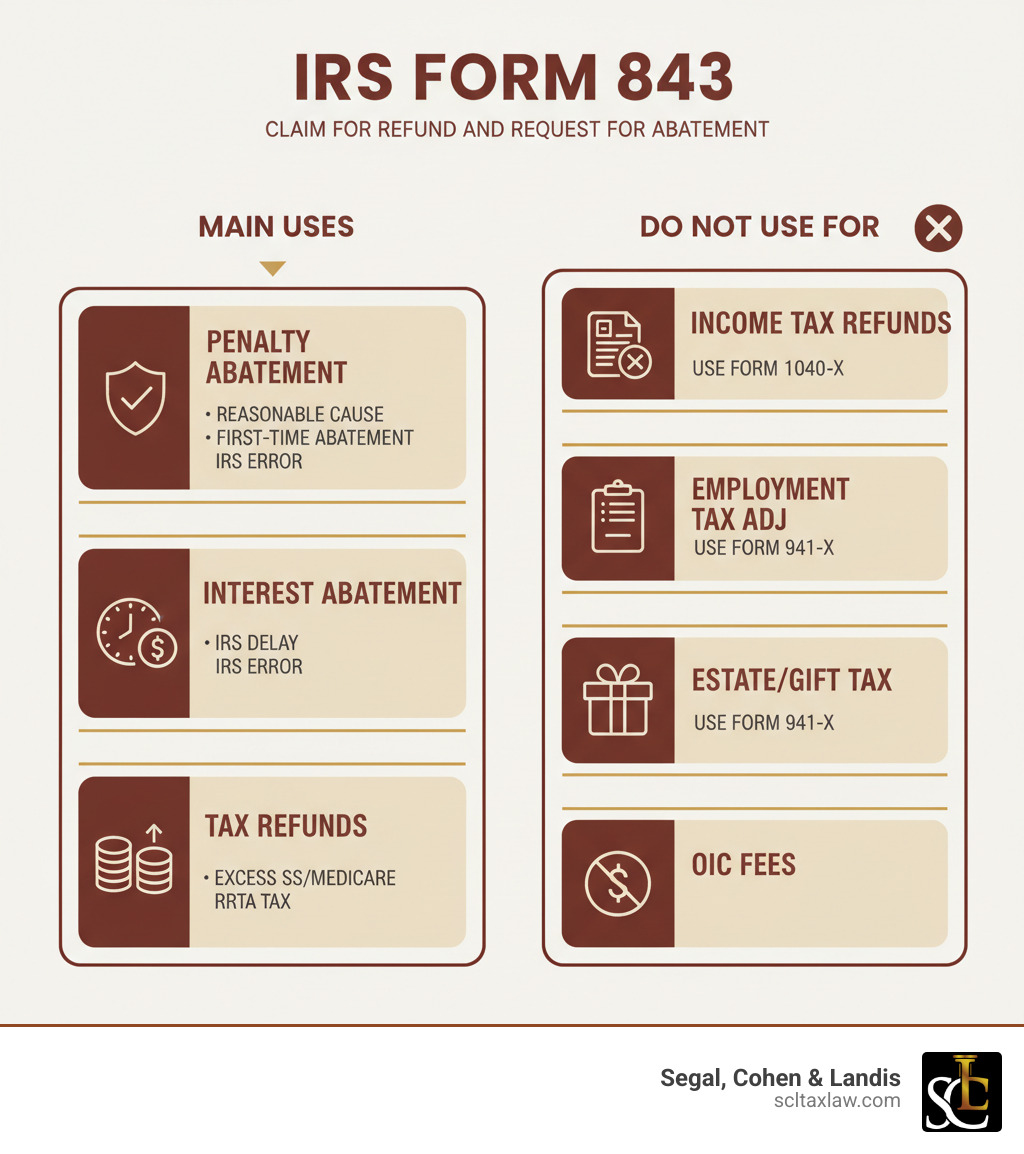
- Request penalty abatement (e.g., failure-to-file or failure-to-pay)
- Claim refunds for excess Social Security, Medicare, or RRTA tax
- Abate interest charged due to IRS error or delay
- Request refunds of certain fees (e.g., branded prescription drug fees)
- NOT for income tax refunds (use Form 1040-X instead)
Key Requirements:
- For a credit or refund claim, generally file within 3 years after filing the original return or 2 years after paying the tax, whichever is later. Statutory exceptions and request-specific rules may apply; identify the rule for your particular claim.
- File a separate form for each tax year and tax type.
- Provide detailed explanations and supporting documentation.
Review the relevant notices, filing history, records, and deadlines before choosing a response. Evaluate professional assistance according to the facts, applicable law, and agreed scope of representation.
What is IRS Form 843 and When Should You Use It?
When you receive an IRS notice with penalties, IRS Form 843 is your formal way of saying, “I think there’s been a mistake, and here’s why.” Form 843, Claim for Refund and Request for Abatement, is an official appeal for specific tax issues that can save you money by securing a refund or reducing what you owe.

Defining Form 843: Claim for Refund and Request for Abatement
Form 843 allows you to formally request that the IRS either give you money back (a refund) or reduce a charge on your account (an abatement). You can use it to request abatement of penalties like failure-to-file, failure-to-pay, or failure-to-deposit. It also covers specialized penalties like the Trust Fund Recovery Penalty.
For interest, Form 843 is your tool when interest accrued because of an IRS error or unreasonable delay, not because you were late paying. For taxes, it covers certain excise and other non-income taxes. You can also use it for fees like the branded prescription drug fee.
Review the relevant notices, filing history, records, and deadlines before choosing a response. Evaluate professional assistance according to the facts, applicable law, and agreed scope of representation. Related resources: IRS Penalty Abatement.
Situations Where Form 843 is NOT the Answer
Using the wrong form can delay your claim or get it rejected. IRS Form 843 is powerful but has specific uses.
The biggest mistake is using Form 843 to fix errors on an income tax return. To correct a Form 1040, 1040-SR, or 1040-NR, you must use Form 1040-X. For corporate income tax, use Form 1120-X.
Similarly, employers needing to adjust employment tax returns (like FICA or income tax withholding) must use forms like 941-X, 943-X, or 944-X. Form 843 also does not cover estate tax, gift tax, or fees for an Offer in Compromise. For certain excise taxes, you’ll need specific forms like Form 8849 or Form 720-X.
| Feature | IRS Form 843 | Form 1040-X (or 1120-X) |
|---|---|---|
| Primary Use | Refund/abatement of penalties, interest, certain fees, excess SS/Medicare/RRTA tax, non-income taxes | Amend individual (or corporate) income tax returns to claim refunds or make corrections |
| Taxes Covered | Non-income taxes, penalties, interest, specific fees | Income tax |
| Example Scenario | Requesting abatement of a late-filing penalty due to reasonable cause | Correcting an error in reported income or deductions on a past income tax return |
| What it cannot do | Amend income tax returns | Abate penalties or interest on non-income taxes, or refund specific fees |
The bottom line: Form 843 is for penalties, interest, certain fees, and excess Social Security/Medicare taxes, not for fixing your income tax return.
Qualifying for Relief: Common Reasons to File Form 843
Let’s explore the common reasons for filing IRS Form 843. The IRS needs a valid reason to waive a penalty, so a solid case with the right proof is key.
Requesting Penalty Abatement
This is a primary use for IRS Form 843. Many penalties can be reduced or removed if you can show “reasonable cause” or qualify under special IRS policies.
“Reasonable cause” is your valid excuse. If you can show you tried to meet your tax duties but couldn’t due to circumstances beyond your control, the IRS may waive the penalty. Common reasons include:
- A death, serious illness, or unavoidable absence in your immediate family.
- A casualty, disaster, or other disturbance that disrupted your ability to comply.
- Inability to obtain necessary records despite your best efforts.
- Reliance on incorrect written advice from the IRS.
You must provide a detailed explanation on Form 843 and attach supporting documents. This is where experienced help can make a huge difference.
Another option is the First Time Penalty Abatement (FTA) policy. This can wipe out penalties for failure to file, pay, or deposit. You may qualify if:
- You have a clean compliance history for the prior three tax years.
- You’ve filed all required returns (or an extension).
- You’ve paid, or arranged to pay, the tax you owe.
Since the failure-to-pay penalty continues to grow, it often makes sense to pay the tax first, then request FTA. For more details, see the Service’s First Time Penalty Abatement policy.
Abating Interest Due to IRS Error or Delay
Sometimes, interest accrues because of an IRS mistake. Under IRC Section 6404(e), you can ask the IRS to remove interest that grew due to an unreasonable error or delay by an IRS employee performing a “ministerial act” (a routine procedural step) or a “managerial act” (an administrative task).
The key is that the IRS’s delay must be “unreasonable,” and you cannot have contributed to it. This relief generally applies to income, estate, and gift taxes. You’ll need to explain the tax period, when you learned of the error, and why the IRS should remove the interest. For a deeper dive, see our page on IRS Interest Accrual and Abatement.
Other Specific Claims Using IRS Form 843
IRS Form 843 is also useful for a few other situations:
- Excess Social Security, Medicare, or RRTA Tax Withholding: Multiple-employer excess Social Security generally belongs on the income-tax return as a credit. One-employer Social Security or Medicare overcollection requires asking the employer for correction first; Form 843 may then apply if it is not adjusted. Follow the distinct tier 2 RRTA rules. You’ll need your W-2s and a statement from your employer.
- Net Interest Rate of Zero: If you had overlapping periods of tax underpayment and overpayment, you can ask the IRS to apply a net interest rate of zero. This prevents you from being charged interest on an underpayment for the time it was covered by an overpayment.
- Taxpayers with Disabilities: If a disability prevented you from responding to an IRS notice on time, leading to penalties, you can use Form 843 to request abatement under the “reasonable cause” provision.
A Step-by-Step Guide to Completing and Filing Your IRS Form 843
Completing IRS Form 843 requires precision, as small mistakes can lead to rejection or delays. Let’s walk through the key steps.

How to Fill Out IRS Form 843 Line by Line
Before you start, download the IRS 843 form and read the official instructions.
First, enter your name, address, and SSN or EIN. For joint returns, include both spouses’ information.
- Line 1: Enter the tax period (e.g., “December 31, 2023” for a calendar year).
- Line 2: Enter the exact dollar amount you are requesting as a refund or abatement.
- Line 3: For a refund claim, enter each payment date as instructed.
- Line 4: Check the box for the type of tax or fee (Employment, Excise, etc.).
- Line 5: Enter the type of return you originally filed (e.g., Form 941).
- Line 6: Find the penalty’s Internal Revenue Code (IRC) section number on your IRS notice and enter it here (e.g., IRC 6651 for failure-to-file).
- Line 7: Check the box that best describes the reason for your claim (e.g., “Reasonable cause”).
- Line 8: This is the most critical part. Provide a clear, detailed explanation for why your claim should be approved. Explain your reasonable cause, detail the IRS error, or show your calculations. Attach additional pages if needed. The more clarity you provide, the better your chances.
Finally, sign and date the form. An unsigned form is invalid. For joint returns, both spouses must sign.
Gathering Your Evidence: Required Supporting Documentation
An IRS Form 843 claim without supporting documents will likely fail. The IRS needs evidence to approve your request.
- Proof of payment (canceled checks, bank statements) for any amount you’re claiming as a refund.
- Copies of all relevant IRS notices related to your claim.
- Copies of all W-2s for the tax year if claiming excess Social Security or Medicare tax withholding.
- Your original written request and the IRS’s incorrect written response if claiming erroneous advice.
- Calculations or spreadsheets showing how you arrived at your refund amount.
- Specific evidence for reasonable cause, such as medical records for an illness or a death certificate for a death in the family.
- Form 2848, Power of Attorney, if a representative is filing for you.
- Form 1310, Statement of Person Claiming Refund Due a Deceased Taxpayer, if filing for a deceased person.
Be accurate. Consequences of an improper claim depend on the applicable statutory rules; check them before filing.
Deadlines and Mailing Addresses
Missing a deadline can cause your claim to be rejected. For a credit or refund claim using IRS Form 843, the general filing deadline is the later of these two dates, subject to statutory exceptions and rules specific to the request:
- 3 years from the date you filed the original return.
- 2 years from the date you paid the tax.
Where do you send the form? If you’re responding to a specific IRS notice, use the address on that notice. Otherwise, you’ll mail it to the IRS service center where you would file a current return for that type of tax. Addresses can change, so always check the official IRS page on where to file Form 843 before mailing. We recommend sending all forms via certified mail with a return receipt requested to have proof of filing.
After You File: What to Expect from the IRS
After filing IRS Form 843, it’s time to wait. Understanding the IRS review process can help you prepare for the next steps.
The IRS Review Process
Once received, your Form 843 enters the IRS system for review. An examiner will check your claim, documentation, and calculations against tax law. The IRS may send a letter requesting additional information; respond quickly and completely to avoid delays.
Processing times vary from a few months to much longer, depending on complexity and IRS backlogs. If you are requesting penalty abatement but haven’t paid the underlying tax, the failure-to-pay penalty and interest will continue to accrue. It can make financial sense to pay the tax first to stop this accumulation while your claim is pending.
Section 6676 generally imposes a 20% penalty on an excessive income-tax refund or credit claim unless reasonable cause is established, subject to coordination rules. For claims made after July 4, 2025, the statute also covers employment taxes. This is not an automatic penalty on every Form 843 request. If the IRS approves your request, the relief depends on the claim and its determination.
What Happens If Your Form 843 Claim is Denied?
If the IRS denies your claim, it’s not the end of the road. You will receive a statutory notice of claim disallowance explaining the rejection and your appeal rights.
Your first option is to appeal the decision with the IRS Office of Appeals, an independent body that can often settle disputes. If appeals fail, or if six months pass with no IRS action, you can file a refund suit in federal court. You generally have two years from the date of the disallowance notice to file suit in either the U.S. District Court or the U.S. Court of Federal Claims.
Navigating a denied claim and potential litigation requires sophisticated tax knowledge. At Segal, Cohen & Landis (SCL), we have successfully represented thousands of clients in these situations. If you’re facing complex IRS Tax Problems, we can help. For more information, see IRS Publication 556, Examination of Returns, Appeal Rights, and Claims for Refund.
Frequently Asked Questions about Form 843
Here are answers to common questions about IRS Form 843.
Can I use Form 843 to amend my income tax return?
No. This is a common and costly mistake. IRS Form 843 is not for amending income tax returns. To correct an individual income tax return (Form 1040), you must use Form 1040-X. For corporate returns, use Form 1120-X. Form 843 is strictly for non-income tax issues like penalties, interest, certain fees, and excess Social Security withholding.
How long do I have to file Form 843?
For credit/refund claims, the general limitation is the later of these dates, subject to statutory exceptions and rules specific to the request:
- 3 years from the date you filed your original return.
- 2 years from the date you paid the tax.
Identify the rule applicable to your specific request and act before its deadline.
Do I have to file a separate form for each tax year or penalty?
Yes. You must file a separate IRS Form 843 for each tax period and for each type of tax or fee you are disputing. For example, if you are requesting penalty abatement for two different years, you must file two separate forms. This system helps the IRS process each claim accurately and independently.
Conclusion: Taking Control of Your Tax Situation
IRS Form 843 is your official pathway to challenging unfair penalties, correcting overpayments, and seeking relief from certain interest charges. A successful claim hinges on three pillars: accuracy in completing the form, thorough documentation to support your case, and strict adherence to deadlines.
While understanding the form is empowering, navigating the IRS system successfully requires experience and precision. A small mistake in your explanation or a missing document can derail an otherwise valid claim.
Review the relevant notices, filing history, records, and deadlines before choosing a response. Evaluate professional assistance according to the facts, applicable law, and agreed scope of representation.
Tax penalties and interest don’t have to be permanent. You have rights and options, and you don’t have to face the IRS alone. Get expert help with IRS Penalty Abatement and let us put our three decades of experience to work for you.
Have questions about this topic? Talk to an IRS attorney today.
Segal, Cohen & Landis, P.C. — Beverly Hills. Serving clients nationwide.

Samuel Landis, Esq.
LL.M. (Tax) · Selected to Super Lawyers®
Sam Landis is a Beverly Hills IRS tax attorney specializing in IRS collection defense, audit representation, and international tax compliance for foreign nationals and US expats.