

Understanding the Purpose of Form 843
Before we dive deep into the specific zip codes and street addresses, it is vital to understand exactly what this form does—and what it doesn’t do. At Segal, Cohen & Landis, we often see taxpayers try to use Form 843 for the wrong reasons, which leads to immediate rejection by the IRS.
IRS Form 843 is officially titled the “Claim for Refund and Request for Abatement.” In plain English, “abatement” means asking the IRS to cancel or reduce a tax, penalty, or interest charge. According to the official About Form 843 guidance, you should use this form to:
- Request Penalty Relief: This is the most common use. If you were hit with a penalty for late filing or late payment but had a “reasonable cause” (like a natural disaster or serious illness), you use this form to ask for IRS Penalty Abatement.
- Claim Refunds on Specific Taxes: This includes overpaid social security taxes, Medicare taxes withheld in error, or certain excise taxes.
- Address IRS Errors: If the IRS caused an unreasonable delay or error in performing a “managerial” or “ministerial” act (procedural steps that don’t involve judgment), you can request an abatement of the resulting interest.
- Erroneous Written Advice: If you relied on written advice from an IRS employee that turned out to be wrong, you can use Form 843 to request relief from the resulting penalties.
Crucial Note: Do not use Form 843 to claim a refund for income tax. If you need to change your 1040, you must use Form 1040-X. Using the wrong form is a surefire way to end up at the bottom of the IRS priority pile.
Where to Mail IRS Form 843 Based on Your Claim
The question of where to mail IRS Form 843 is not answered by a single location. The IRS operates various service centers across the country, and they route Form 843 based on the type of tax or fee you are disputing.
If you send your request for a penalty abatement to the office that handles estate taxes, it will eventually be forwarded, but you might add months to an already long waiting period. We recommend following these general rules to ensure your claim lands on the right desk.
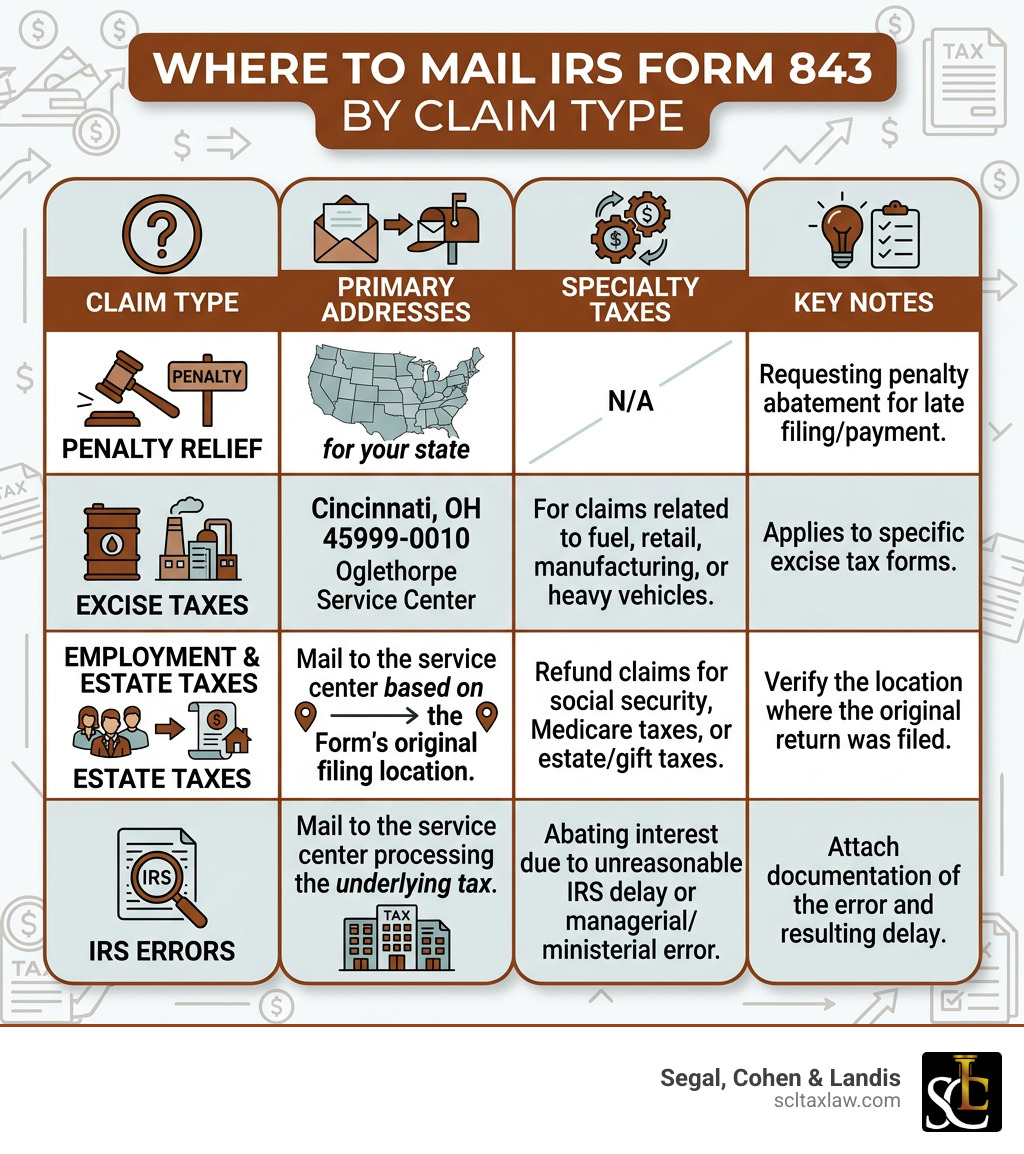
Mailing Addresses for Form 843 in Response to an IRS Notice
If you are filing Form 843 because you received a specific letter or notice in the mail (such as a penalty notice), the IRS makes it relatively simple: Look at the notice itself.
Most IRS notices have a return address in the top left or right corner. According to the official Where to file (for Form 843) instructions, you should mail your completed form directly to the address shown on that notice. This ensures the agent already familiar with your case file receives your request.
There is one very specific exception: Letter 4658. This letter relates to the Branded Prescription Drug Fee. If you are responding to this specific letter, you must mail your form to:
- Internal Revenue Service
- Mail Stop 4921 BPDF
- 1973 N. Rulon White Blvd.
- Ogden, UT 84201-0051
Pro Tip: For Branded Prescription Drug Fee claims, the IRS requires you to write “Branded Prescription Drug Fee” in large, clear letters across the top of the form.
Where to Mail IRS Form 843 for Estate and Gift Tax Claims
Estate and gift tax matters are handled by a specialized branch of the IRS. If your claim relates to Form 706 (Estate Tax) or Form 709 (United States Gift Tax), the standard regional service centers will not process it.
Regardless of where you live—whether you are in Los Angeles, Chicago, or New York—all Form 843 claims related to estate and gift taxes must be sent to the Florence, Kentucky facility:
- Internal Revenue Service Center
- Attn: E&G, Stop 824G
- 7940 Kentucky Drive
- Florence, KY 41042-2915
This centralized processing ensures that specialists in the complex field of “Estate & Gift” (E&G) taxation review your abatement or refund request.
Special Instructions for Nonresident Aliens and Specific Fees
Certain nonresident students may qualify for an exemption from Social Security and Medicare taxes on eligible authorized employment. Visa purpose, residency, employment and exceptions must be reviewed; the five-calendar-year residency rule does not automatically exempt all wages.
If your employer withheld these taxes in error and refuses to refund them, you can turn to the IRS. For these specific employment tax refunds, nonresident aliens should mail Form 843 to:
- Department of the Treasury
- Internal Revenue Service Center
- Ogden, UT 84201-0038
When filing for this refund, you cannot simply send the form alone. Our Tax Penalty Abatement Complete Guide emphasizes that documentation is king. You must attach:
- A copy of your W-2.
- A copy of your visa and I-94.
- Form 8316 (a statement asserting you requested a refund from your employer and were denied).
- Copies of your I-20 (for F-1) or DS-2019 (for J-1).
For Form 8300 penalty refund or abatement claims, follow the current Form 843 instructions, which specify Internal Revenue Service, Attn: CTR Operations, P.O. Box 32621, Detroit, MI 48232, unless the actual notice provides controlling instructions.
Essential Steps for Mailing Your Form 843 Claim
Knowing where to mail IRS Form 843 is only half the battle. How you package and send that mail determines whether the IRS accepts your claim or ignores it.
First, remember the “One Form, One Tax” rule. Generally, you must file a separate Form 843 for each tax period (year or quarter) and each type of tax. If you are asking for a penalty abatement for three different years, you need three separate forms.
Required Attachments and Supporting Evidence
The IRS will not take your word for it. If you are claiming “Reasonable Cause” for a penalty, you must attach evidence. This might include:
- Hospital records or doctor’s letters.
- Death certificates of immediate family members.
- Insurance reports for natural disasters.
- Copies of the erroneous written advice you received from the IRS.
Using Certified Mail
Keep reliable evidence of timely filing and delivery. Certified or registered mail and eligible IRS-designated private delivery services can provide evidence under the applicable rules.
Address Changes
If you move after mailing your form, the IRS might send your refund check or approval letter to your old house. To prevent this, file Form 8822 (Change of Address) to ensure their records are updated.
Net Interest Rate Zero
If you are requesting a “net interest rate of zero” (which happens when you have an underpayment and an overpayment that overlap), you should mail your request to the service center where you filed your most recent return. Write “Request for Net Interest Rate of Zero per Rev. Proc. 2000-26” at the top of the form.
Frequently Asked Questions about Form 843 Mailing
Can Form 843 be e-filed or must it be mailed?
As of the current tax year, Form 843 must be mailed. There is no electronic filing option for this specific form. Because it often requires extensive physical attachments (like medical records or letters of explanation), the IRS still relies on paper processing for these claims. This is why using the correct mailing address is so critical.
How long does it take to receive a refund after mailing Form 843?
Form 843 processing can vary with the claim and required review. Check current IRS guidance and any correspondence for the claim; do not assume a fixed six-month completion time. Related guidance: IRS refund statistics.
What should I do if my address changes after mailing Form 843?
If you move, do not assume the post office’s mail forwarding will catch your IRS correspondence. You should immediately file Form 8822 (for individuals) or Form 8822-B (for businesses) and mail it to the IRS. This ensures that if the IRS approves your abatement or issues a refund check, it arrives at your new doorstep.
Conclusion
Determining where to mail IRS Form 843 is a small but pivotal step in resolving your tax issues. Whether you are responding to a notice, seeking a refund of erroneously withheld social security taxes, or asking for penalty relief, sending your paperwork to the correct service center is the difference between a resolution and a rejection.
Review the relevant notices, filing history, records, and deadlines before choosing a response. Evaluate professional assistance according to the facts, applicable law, and agreed scope of representation. Related resources: IRS Penalty Abatement.
Review the relevant notices, filing history, records, and deadlines before choosing a response. Evaluate professional assistance according to the facts, applicable law, and agreed scope of representation. Related resources: Contact us today for more info about IRS Form 843 services.
Have questions about this topic? Talk to an IRS attorney today.
Segal, Cohen & Landis, P.C. — Beverly Hills. Serving clients nationwide.

Samuel Landis, Esq.
LL.M. (Tax) · Selected to Super Lawyers®
Sam Landis is a Beverly Hills IRS tax attorney specializing in IRS collection defense, audit representation, and international tax compliance for foreign nationals and US expats.