

Why Los Angeles Tax Issues Need Fast, Coordinated Action
Los Angeles tax issues can involve four separate systems at once: the IRS, California Franchise Tax Board, Los Angeles County, and the City of Los Angeles. If you receive a notice, do not ignore it. Read the deadline, preserve the records behind the return or tax bill, and respond to the correct agency promptly.
Common problems include:
- IRS audits, liens, levies, and wage garnishments
- California income-tax assessments and FTB collection actions
- City Business Tax registration or AB63 notices for 1099 workers and small businesses
- County property-tax assessments, delinquent bills, and transfer-tax questions
Los Angeles has no separate city personal income tax. But residents and business owners may still face California income tax rates up to 13.3%, local sales taxes, County property taxes, and City taxes tied to business activity, rentals, hotels, utilities, parking, or qualifying property sales. An IRS resolution also does not automatically settle an FTB balance or a City Business Tax filing problem.
Review the relevant notices, filing history, records, and deadlines before choosing a response. Evaluate professional assistance according to the facts, applicable law, and agreed scope of representation.
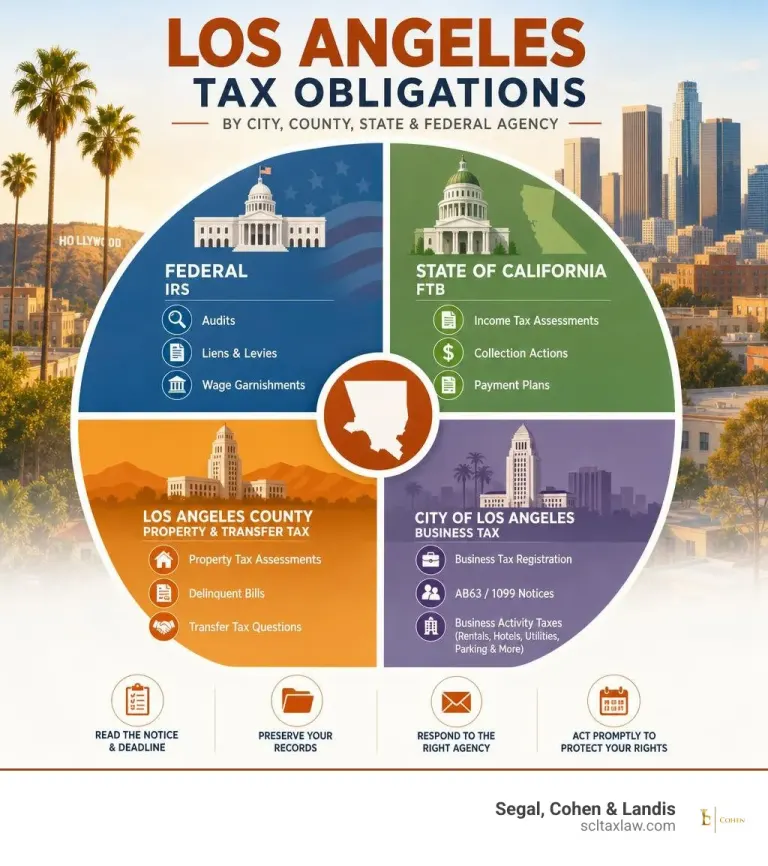
Simple guide to Los Angeles tax issues terms:
Navigating Complex Los Angeles Tax Issues Across City, County, and State Jurisdictions
Operating a business or living as a high earner in Southern California means dealing with overlapping municipal and regional rules. Navigating local tax legislation requires understanding that local ordinances function independently from Sacramento or Washington, D.C. For comprehensive background on baseline rates, reviewing a Los Angeles Tax Guide 2026: California Income Tax, LA Business Tax & Property Tax reveals why the cumulative tax burden in the region remains among the highest in the country.
The combined sales tax rate in Los Angeles County is 10.25%, a figure significantly higher than the national baseline of around 7.0%. When you combine high sales transaction taxes with municipal gross receipts assessments, professional service fees, and state-level levies, a business can quickly fall out of compliance across multiple jurisdictions simultaneously. Many business owners and professionals choose to partner with experienced counsel to navigate LA taxes effectively before routine filings turn into active enforcement disputes.

Understanding the Multi-Tier Tax Burden in Los Angeles
Taxpayers in the City of Los Angeles are subject to a complex, multi-tiered fiscal framework. While the IRS administers federal revenue, California imposes a top individual state income tax rate of 13.3%—the highest in the United States. Beyond income and county-level sales taxes, the City of Los Angeles enforces specialized municipal taxes administered by the Los Angeles Office of Finance.
These specialized municipal assessments include:
- Utility Users Tax (UUT): Levied on charges for electricity, gas, and communication services.
- Commercial Tenant’s Occupancy Tax: Imposed on tenants renting commercial space within city limits.
- Transient Occupancy Tax (TOT): Collected on hotel and short-term occupancy stays.
- Parking Occupancy Tax: Assessed on fees paid for parking in auto parks and commercial structures.
| Jurisdiction / Agency | Primary Tax Type | Key Rates & Thresholds | Filing & Enforcement Mechanism |
|---|---|---|---|
| City of Los Angeles (Office of Finance) | Business Tax (LABT), UUT, TOT, Measure ULA | $1.01–$4.25 per $1,000 gross receipts; Measure ULA at 4% to 5.5% | Annual renewals due end of February; AB63 data matching; municipal liens |
| Los Angeles County (Treasurer & Tax Collector) | Property Tax, Aircraft Property Tax | 1.0% base levy + voter bonds (effective ~1.25%); personal property assessments | Secured installments due Nov 1 / Feb 1; unsecured aircraft liens and tax sales |
| State of California (FTB, CDTFA, EDD) | State Personal & Corporate Income Tax, Sales Tax, Payroll | Top individual income rate of 13.3%; combined 10.25% sales tax | Notice of Proposed Assessment; state tax liens; earnings withholding orders |
| Federal Government (IRS) | Federal Income, Self-Employment, Estate, Gift | Progressive brackets up to 37%; international information returns | Statutory Notices of Deficiency; federal tax liens; up to 75% wage levies |
Resolving Los Angeles Tax Issues Involving the City Business Tax and AB63
Under Los Angeles Municipal Code (LAMC) Section 21.00, any individual or entity engaging in business activity within city limits must obtain a Business Tax Registration Certificate (BTRC) and pay an annual gross receipts tax. For general professions and occupations—such as attorneys, consultants, architects, and independent contractors—the standard business tax rate is $4.25 per $1,000 of gross receipts.
Two important exemptions protect smaller earners:
- Small Business Exemption: Businesses with total worldwide gross receipts of $100,000 or less are exempt from the tax, provided they file a timely annual renewal by the end of February.
- Creative Artist Exemption: Under LAMC Section 21.29(b), qualifying creative artists (including writers, directors, musicians, and performers) who earn $300,000 or less in gross receipts from creative activities are exempt from the city business tax upon timely filing.
If you fail to register, the city identifies you through the AB63 program. Under California Assembly Bill 63, the Franchise Tax Board shares state tax return data—specifically Schedule C forms and 1099 filings reporting an LA address—with the City of Los Angeles.
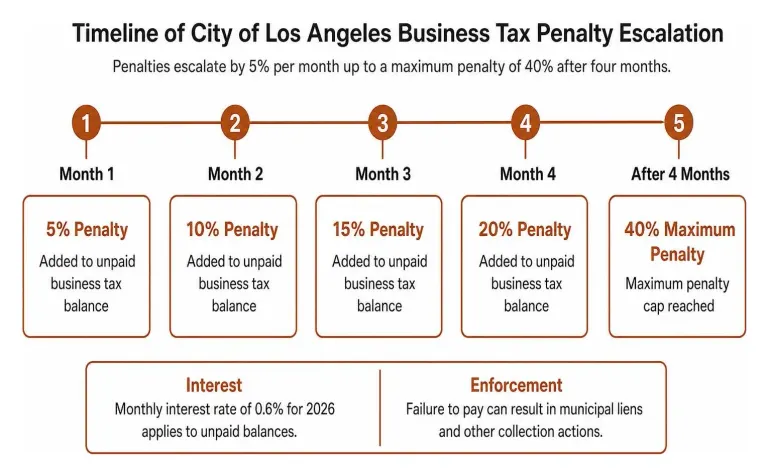
Delinquencies carry heavy consequences. Penalties escalate by 5% per month up to a maximum penalty of 40% after four months, alongside a monthly interest rate of 0.6% for 2026. If you receive an AB63 notice, seeking guidance from Business Tax Attorneys in Los Angeles ensures you establish your proper business classifications, claim retroactive small business exemptions, or negotiate structured installment agreements.
Real Estate, Measure ULA, and Luxury Asset Enforcement in LA County
Los Angeles real estate and luxury personal property are subject to intense scrutiny by the Los Angeles County Assessor and the Treasurer and Tax Collector. From million-dollar real estate transactions to high-end private assets hangared at local airports, local authorities have expanded enforcement efforts to close revenue gaps.
Recent public filings highlight this aggressive posture. Major enforcement initiatives documented in Bezos, Judge Judy, Rihanna: L.A. County goes after private jets illustrate how the county pursues delinquent personal property taxes on luxury assets. Whether dealing with aircraft parked at Van Nuys Airport or reviewing your annual real estate bill, decoding your LA property tax bill is crucial to identifying errors before penalties attach.
Managing High-Value Property and Luxury Asset Los Angeles Tax Issues
Measure ULA, commonly referred to as the “mansion tax,” imposes a substantial documentary transfer tax on high-value real estate transactions within the municipal boundaries of the City of Los Angeles. Unlike marginal income tax brackets, Measure ULA applies to the entire gross sales price:
- Measure ULA applies to certain property transfers above its indexed thresholds. The applicable threshold depends on the transaction date; consult the current City of Los Angeles schedule before calculating the tax.
- 5.5% Transfer Tax: Applied to property transfers valued at $10 million or higher.
The tax is legally the seller’s responsibility and applies equally to residential and commercial transactions. Crucially, Measure ULA applies strictly within the City of Los Angeles, not across all 88 incorporated cities within Los Angeles County. A transaction in Beverly Hills, West Hollywood, or Malibu is exempt from Measure ULA, whereas an identical sale across city lines in Bel Air or Brentwood incurs the full assessment.
Simultaneously, the county assesses an annual personal property tax on general aviation aircraft and luxury yachts based on assessed fair market value. Failure to file annual property statements can lead to unannounced tax bills, tax liens, and seizure proceedings. Consulting a dedicated Property Tax Attorney Los Angeles provides the legal representation needed to challenge inaccurate assessments and manage high-value asset disputes.
Proposition 13, Proposition 19, and Avoiding Property Tax Scams
Real property in California is governed primarily by Proposition 13, which caps the base property tax rate at 1.0% of assessed value, with annual inflationary increases limited to 2.0% unless a change of ownership or new construction occurs. Because of this, long-term homeowners often pay property taxes on valuations far below current market value, while recent homebuyers face assessments reflecting full modern purchase prices.
Proposition 19 introduced key changes to this structure:
- Base-Year Transfers: Homeowners aged 55 or older, severely disabled individuals, or wildfire victims may transfer the taxable base-year value of their primary residence to a replacement residence anywhere in California up to three times.
- Inheritance Limitations: Parent-to-child property transfers are now subject to strict market reassessment unless the child uses the home as their primary residence within one year, and the property value does not exceed the parental base value by more than $1 million.
These complex rules make property owners targets for fraudulent schemes. County agencies recently warned residents about solicitations claiming that a nonexistent federal “Form 1098-SR” can freeze local property taxes. As detailed in the official notice County Officials Warn Property Owners About Fake Property Tax Relief Scam, property tax administration occurs exclusively through county assessors and treasurers, not the federal government.
High-Risk IRS Audit Triggers and California FTB Enforcement
The federal Internal Revenue Service maintains a major enforcement presence in Southern California, operating out of its campus at 300 N. Los Angeles Street. Simultaneously, the California Franchise Tax Board monitors compliance using automated cross-referencing technology. Keeping informed through the FTB’s official Tax News portal shows how aggressively state regulators pursue discrepancies. If you are facing an audit, working with an experienced Los Angeles IRS tax attorney helps protect your rights and limit examination scope.
Entertainment Industry and Gig Economy Audit Exposure
The entertainment industry and gig economy feature complex compensation models that frequently trigger IRS and FTB examinations. Common structures under review include:
- Loan-Out Corporations: Personal service corporations used by actors, directors, musicians, and writers to manage compensation, residuals, and royalties. Auditors routinely scrutinize the balance between W-2 salary and corporate distributions, as well as business expense deductions.
- Schedule C Expenses: Independent contractors and gig economy workers reporting large deductions for travel, meals, equipment, home offices, and vehicle expenses relative to gross income.
- International Reporting Compliance: LA’s diverse, global population means many taxpayers hold foreign financial accounts. Failing to file the Foreign Bank and Financial Accounts Report (FBAR) or Form 3520 (for foreign trusts and gifts) can result in civil penalties starting at $10,000 per violation.
If federal auditors flag your return, an IRS audit attorney LA can step in to maintain attorney-client privilege, manage agency interactions, and challenge unsubstantiated assessments.
Why Resolving IRS Debt Does Not Settle Franchise Tax Board Liabilities
A frequent misconception among California taxpayers is that resolving an IRS liability automatically settles state tax debts. The FTB operates independently under the California Revenue and Taxation Code.
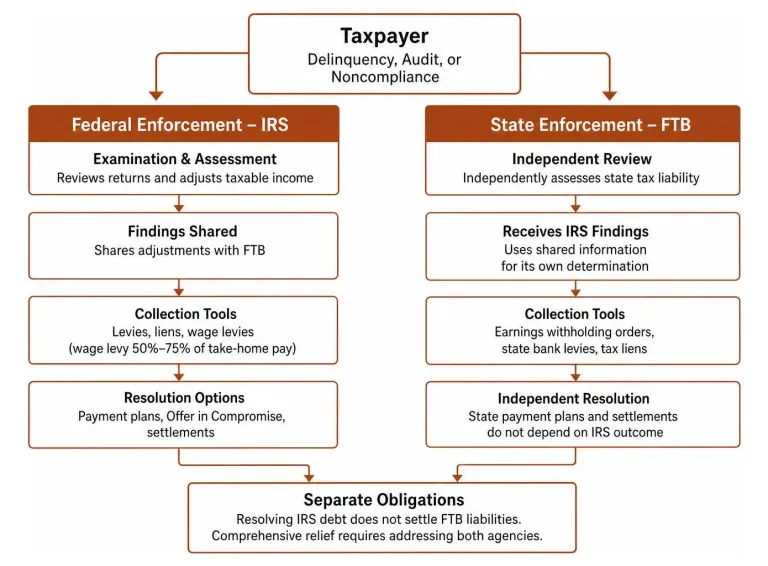
A wage levy generally reaches wages above the applicable exempt amount. The calculation depends on filing status, dependents, pay period and other income. Related guidance: California state tax resolution services.
Strategic Action Steps for Delinquencies, Audits, and Agency Notices
Receiving a formal tax delinquency or examination notice demands prompt action. Ignoring official correspondence accelerates automated collection enforcement, leading to tax liens, bank levies, and wage garnishments. Partnering with a skilled Tax Defense Attorney LA ensures that strict procedural deadlines are met and legal defenses are asserted immediately.

Responding to City, State, and Federal Collection Notices
Each taxing authority operates under specific administrative timelines:
- City of Los Angeles AB63 Notices: You typically have 30 days to respond with historical gross receipts data, proof of employee status, or applications for small business/creative artist exemptions.
- FTB Notice of Proposed Assessment (NPA): You must file a formal written protest within 60 days of the notice date to preserve your administrative appeal rights before the assessment becomes final.
- IRS Statutory Notice of Deficiency (90-Day Letter): You have exactly 90 days from the mailing date to file a petition with the United States Tax Court. Missing this deadline strips you of prepayment judicial review.
When a levy is issued, legal counsel can often negotiate an emergency release within 24 to 72 hours by demonstrating severe financial hardship or proposing an immediate resolution framework.
Relief Programs, Installment Agreements, and Penalty Abatement
Both state and federal agencies provide administrative avenues for tax resolution:
- Offer in Compromise (OIC): Allows qualifying taxpayers to settle their total tax liability for an amount based on their true reasonable collection potential.
- Currently Not Collectible (CNC) Status: Halts active collection actions when a taxpayer demonstrates that paying would cause immediate financial hardship.
- Federal and California penalty relief have separate criteria. FTB one-time penalty abatement is available only to eligible individuals for specified penalties for tax years beginning in 2022 or later, once in a lifetime, subject to state filing and payment requirements.
- Installment Agreements: Establishes structured, monthly payment arrangements with the IRS, FTB, or City of Los Angeles Office of Finance.
Navigating these programs effectively requires reviewing essential Los Angeles tax relief options tailored to your specific financial and legal circumstances.
Frequently Asked Questions About Los Angeles Taxes
Does the City of Los Angeles impose a local personal income tax?
No. The City of Los Angeles does not levy a personal city income tax on wages like New York City does. However, Los Angeles residents remain subject to California’s progressive personal income tax rates, which reach up to 13.3%. Additionally, self-employed individuals and independent contractors working in Los Angeles must register for and pay the Los Angeles City Business Tax on their gross receipts unless they qualify for a specific exemption.
Who pays the Measure ULA mansion tax and how is it calculated?
Under municipal guidelines, the seller pays the Measure ULA real property transfer tax upon the sale of real estate located within the City of Los Angeles. The tax is calculated at 4% of the total gross value on transactions between $5 million and $10 million, and 5.5% on sales of $10 million or greater. The tax applies to the entire transaction value, not just the portion exceeding the threshold, and applies only to properties within City of LA boundaries.
How does the City of Los Angeles detect unregistered 1099 contractors?
The City of Los Angeles detects unregistered independent contractors and small businesses through the AB63 tax enforcement program. Under state law, the California Franchise Tax Board shares state tax records—including 1099 miscellaneous income and Schedule C business activities—with the LA Office of Finance. The city cross-references this data with municipal business tax accounts and issues retroactive tax assessments covering up to three prior years of unfiled business activity.
Conclusion
Review the relevant notices, filing history, records, and deadlines before choosing a response. Evaluate professional assistance according to the facts, applicable law, and agreed scope of representation. Related resources: contact Segal, Cohen & Landis for a confidential case evaluation.
Have questions about this topic? Talk to an IRS attorney today.
Segal, Cohen & Landis, P.C. — Beverly Hills. Serving clients nationwide.

Samuel Landis, Esq.
LL.M. (Tax) · Selected to Super Lawyers®
Sam Landis is a Beverly Hills IRS tax attorney specializing in IRS collection defense, audit representation, and international tax compliance for foreign nationals and US expats.