


Why Finding the Right Lien Attorney Matters
Lien attorneys near me are legal professionals who specialize in handling property liens—legal claims that creditors place on your assets when you owe them money. If you’re searching for immediate help, here’s what you need to know:
How to Find a Qualified Lien Attorney:
- Search for specialists in your state – Lien laws vary significantly by jurisdiction, so local expertise is essential
- Look for attorneys with specific experience – Tax liens, mechanic’s liens, and judgment liens each require different knowledge
- Verify their credentials – Check reviews, bar association records, and client testimonials
- Schedule consultations – Most attorneys offer free initial meetings to discuss your case
- Ask about their approach – Understand whether they focus on negotiation, litigation, or both
Common situations requiring a lien attorney:
- A creditor has filed a lien against your home or business property
- The IRS or state tax authority has placed a tax lien on your assets
- You need to file a mechanic’s lien to secure payment for work performed
- A lien is preventing you from selling or refinancing your property
- You’re facing foreclosure due to an unpaid lien
Lien rights and notice, recording, and enforcement deadlines depend on the jurisdiction, lien type, project, claimant, and triggering event. Check the governing law and actual dates promptly; generic residential, commercial, or public-project numbers cannot establish your deadline.
Contact Segal, Cohen & Landis to discuss the tax matter, relevant notices and deadlines, and available response options. Confirm the qualifications of the proposed representative and the scope of the engagement.
Understanding Liens: Why You Might Need an Attorney
A lien is a legal claim or right against assets that are typically used as collateral to satisfy a debt. Think of it as a creditor’s way of saying, “You owe us money, and we have a claim on your property until that debt is settled.” This claim essentially “encumbers” the property, making it difficult or impossible to sell or refinance without addressing the lien first. This legal interest often arises from a loan transaction and security agreement, but it can also be a statutory right, like a mechanic’s lien or a tax lien.

Why would someone need a lien attorney near me? The simple answer is complexity. Liens are governed by intricate laws that vary significantly not just by state, but also by the type of lien. What seems like a straightforward debt can quickly escalate into a legal quagmire if not handled correctly. A valid lien placed on real estate can become a major defect on the title, potentially delaying or even derailing real estate transactions.
Liens can be broadly categorized as voluntary or involuntary. A mortgage, for example, is a voluntary lien—you agree to it when you take out a loan to buy a home. Involuntary liens, on the other hand, are placed on your property without your consent, often due to unpaid debts like taxes or services rendered. These involuntary liens, especially, can come as a shock and require immediate legal attention.
Whether you’re a property owner facing an unexpected lien or a contractor trying to secure payment for your hard work, understanding your rights and obligations is crucial. That’s where an experienced lien attorney comes in. We can help you steer these complex legal waters, providing clarity and strategic guidance. To dig deeper into the fundamental concept of a lien, we invite you to explore our comprehensive guide, What is a Lien?.
Common Types of Property Liens
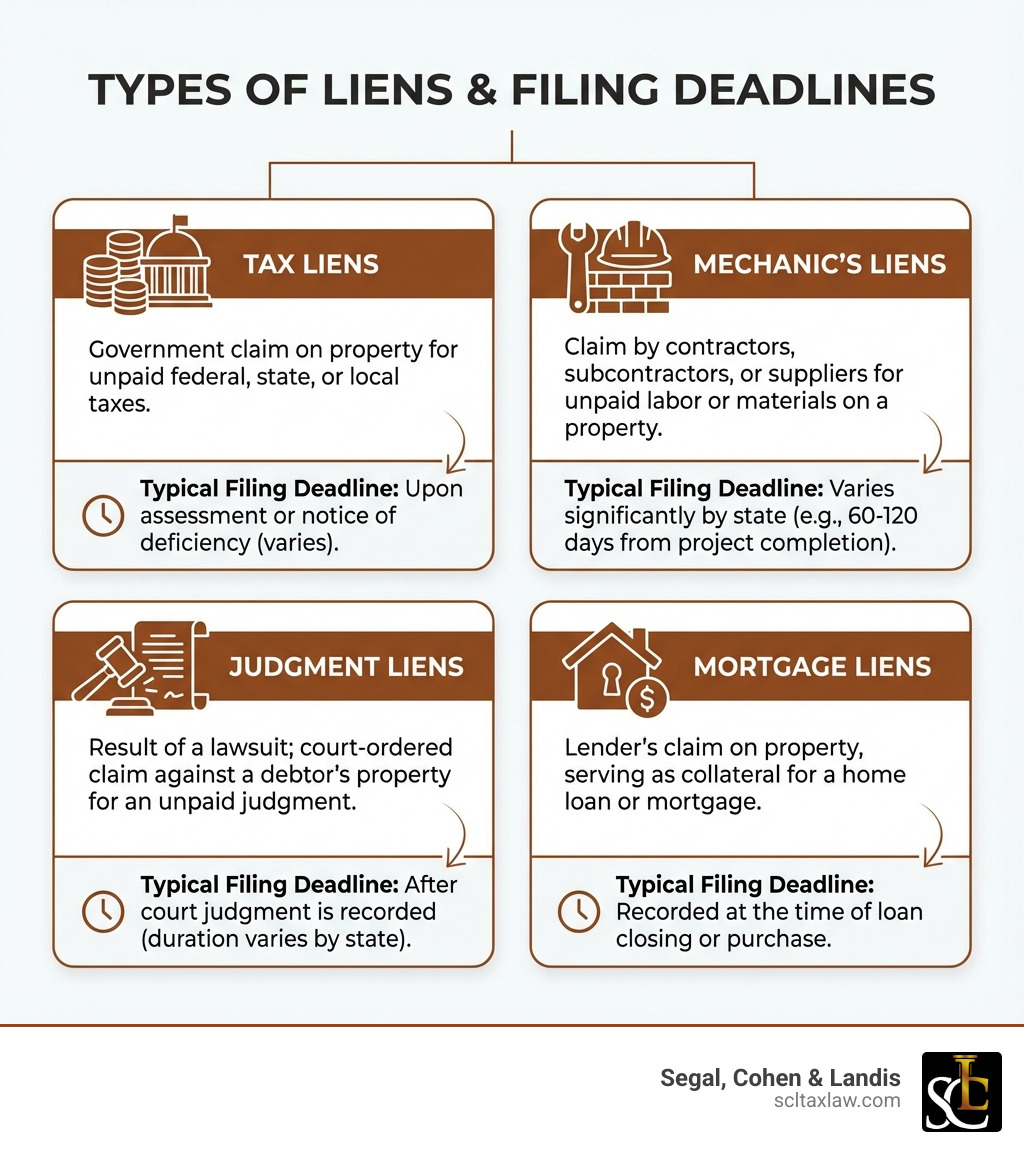
The world of liens is diverse, with each type carrying its own set of rules and implications. Understanding these distinctions is the first step toward effective resolution.
Here are some of the most common types of liens you might encounter:
- Lien rights and notice, recording, and enforcement deadlines depend on the jurisdiction, lien type, project, claimant, and triggering event. Check the governing law and actual dates promptly; generic residential, commercial, or public-project numbers cannot establish your deadline.
- Judgment Liens: When a creditor sues you and wins, the court issues a judgment. If you don’t pay the judgment, the creditor can often convert it into a judgment lien, which attaches to your property. This gives them a legal claim against your assets to satisfy the debt.
- Homeowners’ Association (HOA) Liens: If you own property in a community governed by an HOA and fail to pay your dues or assessments, the HOA can place a lien on your property. These liens can escalate quickly, as HOAs often have significant power under state laws.
- Mortgage Liens: This is perhaps the most common type of voluntary lien. When you take out a mortgage to purchase real estate, the lender places a lien on the property. This gives the lender the right to foreclose on your home if you fail to make your loan payments.
Each of these liens has unique requirements for filing, perfection, and enforcement. An attorney specializing in liens can guide you through the specific nuances applicable to your situation.
A Closer Look at Tax Liens
Among the most formidable types of liens are tax liens, which can be imposed by federal, state, or local governments when taxes go unpaid. These liens are particularly serious because they often take priority over other creditors, even those whose claims were established earlier.
- Federal Tax Liens: The Internal Revenue Service (IRS) files a federal tax lien when you owe back taxes. This lien attaches to virtually all your property—real estate, personal property, and even future assets—and serves as a public notice that the government has a legal claim to your assets. The IRS is known as an aggressive creditor, and a federal tax lien should never be taken lightly. It can significantly impact your ability to sell property, obtain credit, or even maintain business operations. Understanding the reasons behind an IRS lien and its broad implications is crucial. To gain a deeper understanding, read our article, Unraveling the Mystery of IRS Tax Liens. For an in-depth look at its enforcement, see The Federal Tax Lien – A Staple of IRS Enforcement Action.
- State Tax Liens: Similar to federal tax liens, state tax authorities can also place liens on your property for unpaid state income taxes, sales taxes, or other state-specific levies. These operate much like federal liens, serving as a claim against your assets until the state tax debt is resolved.
The impact of a tax lien can be far-reaching, hindering financial transactions and potentially leading to collection actions. If you’re facing a tax lien, seeking assistance from lien attorneys near me who specialize in tax law is not just recommended, it’s often essential to protect your financial well-being.
The Role of a Lien Attorney: Services and Solutions
Whether you’re a creditor trying to secure payment or a property owner battling an unexpected claim, a lien attorney offers a wide array of services designed to protect your interests. We act as your legal advocate, navigating the complexities of lien law on your behalf.

Topics to discuss with the proposed representative and expressly address in the engagement include:
- Lien Filing: For creditors, we ensure that liens are properly prepared, perfected, and filed according to strict statutory requirements. This includes advising on the correct content, timing, and notice procedures to ensure your lien is valid and enforceable.
- Lien Removal: Discuss the work needed for your circumstances and confirm that the proposed representative has the relevant qualifications and that the engagement covers it.
- Dispute Resolution: Discuss the work needed for your circumstances and confirm that the proposed representative has the relevant qualifications and that the engagement covers it.
- Litigation: Discuss the work needed for your circumstances and confirm that the proposed representative has the relevant qualifications and that the engagement covers it.
- Foreclosure: For lienholders, we can initiate the legal process of foreclosure to force the sale of the property and satisfy the debt. For property owners, we defend against wrongful foreclosure actions.
The goal is always to achieve the best possible outcome for our clients, whether that means securing rightful payment or clearing your property title.
For Creditors: Filing and Protecting Your Lien Rights
As a creditor, securing payment for your services or materials is paramount. Mechanic’s liens, in particular, are powerful tools for contractors, subcontractors, and suppliers. However, their effectiveness hinges entirely on strict adherence to legal procedures.
Topics to discuss with the proposed representative and expressly address in the engagement include:
- Ensuring Lien Perfection: Perfecting a lien means taking all necessary legal steps to make it valid and enforceable. This typically involves providing proper notice to the debtor and/or the public, often through recording documents with the county recorder’s office. Different types of liens have different perfection methods; for instance, mechanic’s liens and tax liens on land are usually perfected by recording documents and giving notice to the owner.
- Lien rights and notice, recording, and enforcement deadlines depend on the jurisdiction, lien type, project, claimant, and triggering event. Check the governing law and actual dates promptly; generic residential, commercial, or public-project numbers cannot establish your deadline.
- Advising on Notice Requirements: Correct and timely notice is a cornerstone of a valid lien. For example, some jurisdictions require a “Notice of Furnishing” to be served within a specific timeframe (e.g., 21 days) from the start of a project.
- Ensuring Filing Accuracy: Errors in the content or documentation of a lien can lead to its invalidation. We carefully prepare and review all documents to ensure accuracy and compliance.
- Assisting with the Foreclosure Process: If payment is still not received, we can guide you through the legal process of foreclosing on the lien, which may ultimately lead to the sale of the property to satisfy your debt.
- Avoiding Slander of Title: Discuss the work needed for your circumstances and confirm that the proposed representative has the relevant qualifications and that the engagement covers it.
- Providing State-Specific Guidance: Discuss the work needed for your circumstances and confirm that the proposed representative has the relevant qualifications and that the engagement covers it.
Identify the lien type, relevant jurisdiction and applicable notices. Confirm that the proposed adviser is qualified for this matter and that the engagement covers the particular dispute or filing work needed.
For Property Owners: Challenging and Removing a Lien
Finding a lien on your property can be distressing, especially if it’s unexpected or seems unjust. It can complicate your ability to sell, refinance, or even simply enjoy your property. Our lien attorneys near me are here to help you understand the legal implications and develop a strategy for resolution.
Topics to discuss with the proposed representative and expressly address in the engagement include:
- Disputing Validity: We can investigate the lien to determine if it was filed correctly, if the underlying debt is legitimate, or if statutory deadlines and notice requirements were met. If a lien is incorrect or invalid due to errors in filing or documentation, we can challenge it.
- Negotiating Strategies: Often, the most efficient path to resolution is through negotiation. We can engage with the lienholder to reach a settlement, potentially for a reduced amount, or establish a payment plan that works for you.
- Satisfying the Debt: If the debt is legitimate, the most direct way to remove a lien is to satisfy the debt. We can help negotiate payoff terms and ensure that once the debt is paid, you receive proper documentation.
- Obtaining and Filing a Lien Release: Once the debt is resolved, it’s crucial to obtain written proof of the lien release from the creditor and ensure it is promptly filed with the county recorder’s office. This officially clears your property title.
- Lien Subordination: Especially relevant for tax liens, lien subordination is a strategy where the IRS or state tax authority agrees to let another creditor’s claim take priority over theirs. This can be incredibly useful if you need to refinance your property, as it allows you to secure new financing. Our article on Selling Property Subject to a Federal Tax Lien offers more insights.
- Addressing Contested Liens: If a lien is contested—meaning you dispute its legitimacy or amount—the removal process becomes more complex, often requiring legal action. We can represent you in these more challenging scenarios, including serving the lien holder with a “Notice to Commence Suit” to force them to take legal action or abandon their claim.
- Tax Lien Resolution: Discuss the work needed for your circumstances and confirm that the proposed representative has the relevant qualifications and that the engagement covers it. Related resources: Tax Lien Resolution.
Our goal is to alleviate the stress of a lien on your property, ensuring your rights are protected and your property title is clear.
Finding and Hiring the Best Lien Attorneys Near Me
When you’re facing a lien issue, the stakes can be high. Your property, your credit, and your financial stability could all be on the line. That’s why finding the right lien attorneys near me is not just about convenience; it’s about securing expert legal guidance custom to your specific situation and local laws.
The search for the best legal representation involves considering specialized experience, understanding potential costs, and recognizing the critical importance of local expertise in navigating state-specific lien laws. We pride ourselves on providing clear, simple, and warm advice, helping you through what can often be an intimidating legal process.
What to Look for in a Qualified Lien Attorney
Not all attorneys are created equal, especially when it comes to the highly specialized field of lien law. Here’s what we believe you should prioritize when seeking qualified legal counsel:
- Contact Segal, Cohen & Landis to discuss the tax matter, relevant notices and deadlines, and available response options. Confirm the qualifications of the proposed representative and the scope of the engagement.
- Reputation and Client Reviews: Check client testimonials and independent rating platforms. Positive reviews often highlight an attorney’s communication skills, responsiveness, and ability to achieve favorable outcomes.
- Clear Communication: Legal matters can be confusing. A good attorney will explain complex concepts in simple, understandable terms, keep you informed every step of the way, and respond promptly to your questions.
- Strategic Approach: Does the attorney offer a clear strategy for your case? Do they explain the potential outcomes and risks? Your choice of attorney can mean the difference between a successful resolution and an outcome that will financially strain you, your family, and your business for many years.
Understanding the Costs of Hiring Lien Attorneys Near Me
While cost is a factor in any legal decision, it’s important to view it as an investment in protecting your assets and resolving your lien issue effectively. The costs associated with hiring a lien attorney can vary based on the complexity of your case, the attorney’s experience, and the duration of the legal process.
Typically, costs might include:
- Attorney Fees: These can be structured in various ways, such as hourly rates, flat fees for specific services (like preparing a lien release), or retainer agreements where you pay an upfront amount for services over a period.
- Court Costs: If your case goes to court, there will be filing fees and other administrative charges.
- Recording Fees: When a lien is filed or released, there are fees associated with recording these documents with the county recorder’s office.
Confirm consultation terms, fees and the scope of any proposed work before scheduling or retaining counsel.
Navigating State-Specific Lien Laws with local lien attorneys near me
One of the most critical aspects of lien law is its localized nature. Lien laws, including their statutes of limitations, notice periods, and rules for lien priority, can differ significantly from one state to another, and even between municipalities. This makes local expertise invaluable.
Lien rights and notice, recording, and enforcement deadlines depend on the jurisdiction, lien type, project, claimant, and triggering event. Check the governing law and actual dates promptly; generic residential, commercial, or public-project numbers cannot establish your deadline.
An attorney familiar with the specific laws in your area can:
- Ensure Compliance: We ensure all documents are filed correctly and within the prescribed timeframes, adhering to local statutory requirements.
- Understand Local Procedures: Discuss the work needed for your circumstances and confirm that the proposed representative has the relevant qualifications and that the engagement covers it.
- Advise on Lien Priority: We can help you understand how your lien (or a lien against you) stands in line with other claims on the same property, which is crucial in cases involving multiple creditors.
- Strategize Effectively: Local knowledge allows us to develop more effective strategies, whether that involves negotiation with local parties or litigation in local courts.
Identify the lien type, relevant jurisdiction and applicable notices. Confirm that the proposed adviser is qualified for this matter and that the engagement covers the particular dispute or filing work needed.
Frequently Asked Questions about Lien Attorneys
Review the relevant notices, filing history, records, and deadlines before choosing a response. Evaluate professional assistance according to the facts, applicable law, and agreed scope of representation.
How quickly should I act if a lien is filed against my property?
Lien rights and notice, recording, and enforcement deadlines depend on the jurisdiction, lien type, project, claimant, and triggering event. Check the governing law and actual dates promptly; generic residential, commercial, or public-project numbers cannot establish your deadline.
Contacting a qualified lien attorney near me as soon as you become aware of a lien allows us to assess its validity, explore your options, and take timely steps to protect your assets and prevent further complications.
Can a lien be placed on my property without me knowing?
A federal statutory tax lien can arise after assessment, demand and nonpayment without a publicly filed lien notice. A Notice of Federal Tax Lien is a separate filing that gives public notice to creditors; other liens follow their own governing rules.
However, in the hustle and bustle of life, it’s easy to miss such notices or be unaware of public record filings. This is particularly true for involuntary liens, such as mechanic’s liens or tax liens, which don’t require your direct consent. An experienced lien attorney can conduct thorough title searches and property record reviews to identify any existing or potential liens, helping you stay informed and proactive.
What is the difference between a tax lien and a tax levy?
This is a crucial distinction, especially when dealing with the IRS or state tax authorities. While both are tools for collecting unpaid taxes, they serve different functions:
- Tax Lien: A tax lien is a legal claim against your property (real estate, personal property, and even financial assets) that is filed by the government to secure payment of a tax debt. It’s essentially a public notice that the government has a claim to your assets, and it encumbers your property, making it difficult to sell or transfer. Think of it as a cloud over your property title.
- Tax Levy: A tax levy is a much more aggressive collection action. It is the actual seizure of your property or assets to satisfy a tax debt. While a lien is a claim, a levy is the act of taking. This can include seizing funds from your bank accounts (bank restraints), garnishing your wages, or taking possession of other property. The federal tax levy, in particular, is a powerful and often sudden enforcement action. For a detailed explanation, read The Federal Tax Levy – A Harbinger of Exaction.
Review the relevant notices, filing history, records, and deadlines before choosing a response. Evaluate professional assistance according to the facts, applicable law, and agreed scope of representation.
Conclusion: Take the Next Step to Resolve Your Lien Issue
Dealing with liens can be a daunting experience, whether you’re a creditor fighting for deserved payment or a property owner defending against an unexpected claim. We’ve explored the various types of liens, from mechanic’s and judgment liens to the particularly challenging federal and state tax liens, and highlighted the critical role that a skilled lien attorney plays in navigating these complex legal landscapes. From ensuring proper filing and perfection for creditors to challenging validity and negotiating removal for property owners, expert legal guidance is indispensable.
lien attorneys near me: Review the relevant notices, filing history, records, and deadlines before choosing a response. Evaluate professional assistance according to the facts, applicable law, and agreed scope of representation.
Don’t let a lien dictate your financial future. Take control by seeking professional legal assistance. We are here to help you understand your rights, explore your options, and work towards a favorable resolution.
Resolve your tax lien issues today
Have questions about this topic? Talk to an IRS attorney today.
Segal, Cohen & Landis, P.C. — Beverly Hills. Serving clients nationwide.

Samuel Landis, Esq.
LL.M. (Tax) · Selected to Super Lawyers®
Sam Landis is a Beverly Hills IRS tax attorney specializing in IRS collection defense, audit representation, and international tax compliance for foreign nationals and US expats.