
When Back Taxes Feel Impossible to Pay, These Programs Can Help
A back tax forgiveness program is a formal IRS or state tax authority option that lets qualifying taxpayers reduce, settle, or restructure what they owe — often for significantly less than the full balance.
Here are the main programs available:
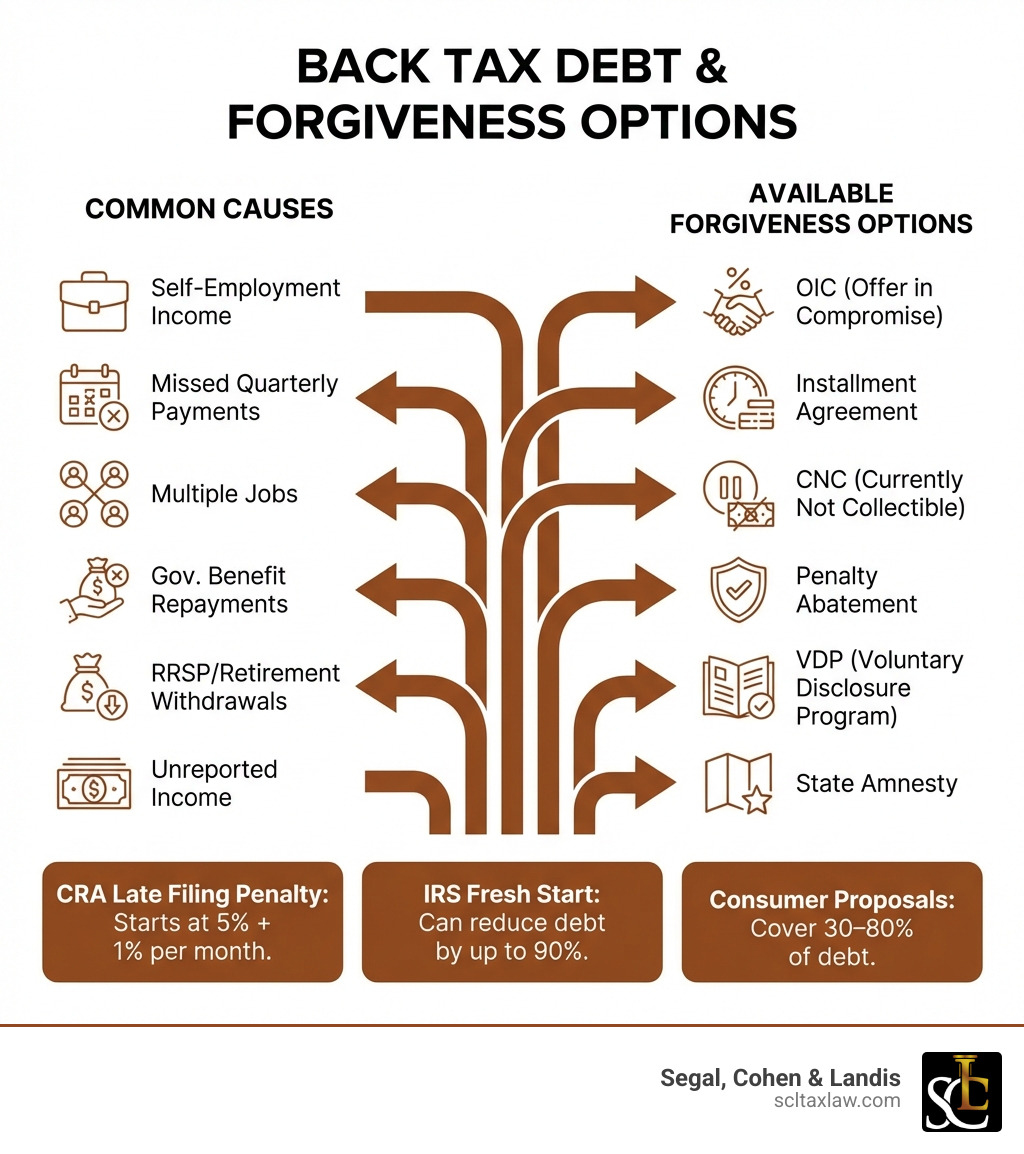
| Program | What It Does | Best For |
|---|---|---|
| Offer in Compromise (OIC) | Settle debt for less than you owe | Taxpayers who can’t pay in full |
| Installment Agreement | Pay over time under the applicable agreement; most qualifying Simple Payment Plan taxpayers have up to 10 years, subject to the collection period | Those who need structured payments |
| Currently Not Collectible (CNC) | Temporarily pause collections | Severe financial hardship |
| Penalty Abatement | Remove or reduce penalties | First-time non-compliance or reasonable cause |
| Voluntary Disclosure Program (VDP) | Timely qualifying disclosure may affect prosecution recommendations; no immunity guarantee | Eligible taxpayers with timely, truthful and complete disclosures under current IRS rules |
| Historical Illinois Tax Amnesty (closed) | Limited-time penalty and interest waiver | Taxpayers with outstanding state tax debt |
If you owe back taxes and can’t pay the full amount, you are not alone — and you have real options.
Millions of taxpayers fall behind each year. The reasons vary: missed quarterly payments, unexpected income, an RRSP withdrawal, a government benefit repayment like CERB, or simply a difficult year financially. The average Canadian household now carries $1.73 in debt for every dollar of disposable income. In the U.S., the IRS actively pursues billions in unpaid taxes, with over 300 criminal cases alone tied to erroneous Employee Retention Credit claims.
This U.S. guide addresses IRS and applicable state tax procedures. Relief depends on the governing program and the taxpayer’s facts.
This guide walks you through every major back tax forgiveness program available — how they work, who qualifies, and how to apply.
back tax forgiveness program: Review the relevant notices, filing history, records, and deadlines before choosing a response. Evaluate professional assistance according to the facts, applicable law, and agreed scope of representation.
Understanding the IRS Fresh Start and Back Tax Forgiveness Program Options

When we talk about a back tax forgiveness program, we are often referring to the IRS Fresh Start program. Launched in 2011, this initiative isn’t just one single application; it is a comprehensive set of policy changes designed to make it easier for taxpayers to pay back taxes and avoid tax liens.
The primary goal of the Fresh Start initiative is to help individuals and small businesses resolve their tax liabilities without the crushing weight of aggressive collection tactics. Under this umbrella, the IRS expanded access to streamlined installment agreements. For instance, if you owe $50,000 or less, you may qualify for a payment plan that lasts up to 72 months without having to provide a detailed financial statement to the IRS.
However, the IRS doesn’t just hand out “forgiveness” to everyone who asks. They use collection financial standards to determine how much a taxpayer can reasonably afford to pay for basic living expenses like food, clothing, and housing. Any income left over after these “allowable” expenses is what the IRS expects you to put toward your tax debt.
Eligibility Criteria for a Back Tax Forgiveness Program
To even be considered for any form of relief, you must meet strict compliance requirements. This means:
- All tax filings must be up to date: You cannot negotiate a settlement if you have unfiled returns from previous years.
- Current on withholdings/estimated payments: You must show that you are staying current with your tax obligations for the current year.
- Financial Disclosure: For more advanced programs, you will need to provide a full picture of your assets, income, and monthly expenses.
There is often confusion regarding the IRS Fresh Start vs OIC details. While Fresh Start made the Offer in Compromise (OIC) more accessible by changing how “future income” is calculated, they are distinct paths. Fresh Start is the broad initiative; OIC is the specific mechanism for settling for less than the full amount.
Consequences of Ignoring Back Tax Debt
This U.S. guide addresses IRS and applicable state tax procedures. Relief depends on the governing program and the taxpayer’s facts.
- Wage Garnishment: The IRS can take a significant portion of your paycheck before it ever hits your bank account.
- Tax Liens: A public record attached to your property (like your home), which can make it nearly impossible to sell or refinance.
- Asset Seizure: In extreme cases, the government can seize bank accounts, vehicles, or other property.
- Passport Restrictions: If you owe more than a certain threshold (over $66,000 for 2026, subject to the statutory definition of seriously delinquent tax debt and applicable exclusions for the IRS), they can certify your debt to the State Department, which can lead to the denial or revocation of your passport.
IRS levies are governed by federal collection rules. Review the actual notices, applicable exceptions and available release grounds when considering tax levies.
How to Settle Debt for Less via Offer in Compromise (OIC)
The “holy grail” of tax resolution is the Offer in Compromise. This is the only true back tax forgiveness program that allows you to settle your principal tax debt for a fraction of what you owe.
Review the relevant notices, filing history, records, and deadlines before choosing a response. Evaluate professional assistance according to the facts, applicable law, and agreed scope of representation. Related resources: complete guide to IRS OIC.
The RCP is a formula: (Value of your assets) + (Your remaining monthly income multiplied by 12 or 24 months). If your offer equals or exceeds this number, you have a chance. According to recent IRS Offer in Compromise official page data, some qualifying taxpayers have settled their federal debts for as little as 10% to 20% of the original balance. However, the OIC eligibility guide is strict; if the IRS believes you can pay the debt in full via an installment plan, they will reject your offer.
The Role of Bankruptcy in Tax Resolution
Many people are surprised to learn that bankruptcy can actually discharge certain tax debts. This isn’t a “forgiveness program” in the traditional sense, but it is a powerful legal tool.
- Chapter 7: Can completely wipe out income tax debt if it meets specific rules (the “3-2-240” rules regarding how long ago the return was due and filed).
- Chapter 13: Allows you to pay back a portion of your taxes over a 3-to-5-year plan, often stopping further interest and penalties.
Tax debt is considered “unsecured debt” in many bankruptcy proceedings, similar to credit card debt. However, payroll taxes and fraud-related debts are generally non-dischargeable. For a deeper dive, see our resolving back taxes guide.
State-Level Amnesty and Forgiveness Programs
Don’t forget about the state! Many states offer their own versions of a back tax forgiveness program.
- Illinois Tax Amnesty ran from October 1 through November 17, 2025, and is closed. The IRS Employee Retention Credit Voluntary Disclosure Program also closed; its second round required repayment of 85% of the credit. These historical programs are not current application options. See 2025 Illinois Tax Amnesty details.
- California: The Golden State has its own OIC program and specialized California state tax resolution services for those dealing with the Franchise Tax Board (FTB).
Penalty Abatement and Taxpayer Relief Provisions
Sometimes, the “forgiveness” you need isn’t for the tax itself, but for the massive penalties that have ballooned the balance. This is where IRS penalty abatement services come in.
The IRS offers First-Time Penalty Abatement for taxpayers who have a clean track record for the three years prior to the slip-up. If you don’t qualify for that, you can argue “Reasonable Cause.” This includes things like:
- Death or serious illness in the family.
- Natural disasters (fire, flood, etc.).
- Inability to obtain records.
- Erroneous advice from a tax professional.
IRS penalty relief depends on the particular penalty and available reasonable-cause, administrative or statutory grounds. Form 843 is appropriate for certain claims; interest abatement follows separate limited requirements.
Using the Voluntary Disclosure Program (VDP) to Correct Errors
A timely, qualifying voluntary disclosure may influence the IRS prosecution recommendation, but requires cooperation and payment arrangements and does not guarantee immunity. See IRS Voluntary Disclosure Program.
The IRS Voluntary Disclosure Practice requires a timely, truthful and complete eligible disclosure, cooperation and payment arrangements. It does not guarantee immunity.
Addressing Erroneous Employee Retention Credit (ERC) Claims
Illinois Tax Amnesty ran from October 1 through November 17, 2025, and is closed. The IRS Employee Retention Credit Voluntary Disclosure Program also closed; its second round required repayment of 85% of the credit. These historical programs are not current application options. See IRS ERC Voluntary Disclosure details.
Illinois Tax Amnesty ran from October 1 through November 17, 2025, and is closed. The IRS Employee Retention Credit Voluntary Disclosure Program also closed; its second round required repayment of 85% of the credit. These historical programs are not current application options.
Step-by-Step Guide to Applying for Tax Relief
Navigating a back tax forgiveness program requires a clinical, organized approach. Here is how we handle it for our clients:
| Step | Action | Purpose |
|---|---|---|
| 1 | Compliance Check | File all missing returns and secure IRS transcript retrieval. |
| 2 | Financial Analysis | Use Form 433-A to map out every dollar of income and every asset. |
| 3 | Select Program | Choose between OIC, Installment Agreement, or CNC based on the RCP formula. |
| 4 | Gather Documentation | Collect 3-6 months of bank statements, pay stubs, and utility bills. |
| 5 | Submit & Negotiate | File the paperwork and prepare for the IRS to counter-offer. |
If you are overwhelmed, seeking expert help for back taxes early can save you months of back-and-forth with IRS agents.
Common Mistakes When Applying for a Back Tax Forgiveness Program
We see these errors constantly, and they almost always lead to an immediate rejection:
- Incomplete Forms: Leaving even one line blank on an OIC application can get the whole package sent back.
- Missing Deadlines: If the IRS asks for more info and you don’t provide it within 10-30 days, your case is closed.
- Understating Assets: The IRS has access to databases you wouldn’t believe. If you “forget” a bank account or a second car, they will find it and likely deny your relief for lack of good faith.
- Ignoring Notices: Thinking the problem will go away is the fastest way to a bank levy. Review our guide on what to do when you owe back taxes for a better strategy.
Proactive Strategies to Prevent Future Tax Debt
Once you’ve secured a back tax forgiveness program, you must stay “clean” for five years (in the case of an OIC) or you lose the relief.
- Adjust Withholdings: If you are a W-2 employee, use the IRS withholding estimator to ensure enough tax is coming out of your check.
- Quarterly Estimated Payments: If you are self-employed, pay your taxes every three months. It’s much easier to pay $2,000 four times a year than $8,000 all at once in April.
- Separate Business Accounts: Never commingle personal and business funds. This makes payroll tax management much simpler.
Frequently Asked Questions about Back Tax Forgiveness
Can I really settle my tax debt for pennies on the dollar?
Yes, but it is not a “get out of jail free” card. It is a mathematical determination. If you have $100,000 in equity in your home and owe $50,000 in taxes, the IRS will not settle for pennies because they can eventually get the full amount from your home. It is best for those with low assets and low income.
How long does the back tax forgiveness application process take?
An Offer in Compromise usually takes 6 to 12 months for the IRS to investigate. A streamlined installment agreement can be set up in a single phone call or online session. Penalty abatement requests typically take 60 to 90 days.
Will applying for a forgiveness program stop a wage garnishment?
Usually, yes. Once you submit a formal request like an OIC or an Installment Agreement, the IRS typically pauses “active” collection efforts like garnishments while they evaluate your application. However, if you’ve ignored previous notices, you may need a tax debt lawyer to make a specific request to release the levy.
Conclusion
Tax debt can feel like a shadow following you everywhere, but a back tax forgiveness program offers a way back into the light. Whether it’s an Offer in Compromise to settle for less, a penalty abatement to wipe away fees, or a streamlined payment plan to get the IRS off your back, the key is to stop hiding and start filing.
Review the relevant notices, filing history, records, and deadlines before choosing a response. Evaluate professional assistance according to the facts, applicable law, and agreed scope of representation.
Review the relevant notices, filing history, records, and deadlines before choosing a response. Evaluate professional assistance according to the facts, applicable law, and agreed scope of representation. Related resources: Settle your back taxes today.
Have questions about this topic? Talk to an IRS attorney today.
Segal, Cohen & Landis, P.C. — Beverly Hills. Serving clients nationwide.

Samuel Landis, Esq.
LL.M. (Tax) · Selected to Super Lawyers®
Sam Landis is a Beverly Hills IRS tax attorney specializing in IRS collection defense, audit representation, and international tax compliance for foreign nationals and US expats.