
Who Qualifies for the IRS Fresh Start Program?
IRS Fresh Start qualification depends on meeting several key requirements across filing compliance, debt amount, income, and financial hardship. Here is a quick summary:
| Requirement | Standard Threshold |
|---|---|
| Total tax debt | $50,000 or less |
| Income (single filers) | Program-specific financial analysis |
| Income (married filing jointly) | Program-specific financial analysis |
| Tax returns | All required returns must be filed |
| Payment history | No missed IRS payments |
| Self-employed income decline | No standalone 25% income-decline eligibility test |
| Bankruptcy | No open bankruptcy proceedings |
If you have received an IRS notice about back taxes, penalties, or a potential lien, the pressure can feel immediate and overwhelming. The IRS Fresh Start Program exists specifically for situations like yours — but getting approved is not automatic.
The program is not a single form you fill out. It is a collection of IRS relief policies that includes installment agreements, penalty abatement, Offers in Compromise, and lien relief. Each option has its own set of rules. And if you miss even one requirement — like a missing tax return or a lapse in estimated payments — your application can be denied.
The stakes are real. In 2021, the IRS accepted only 15,154 out of 49,285 Offer in Compromise applications. That is a rejection rate of nearly 70%. Knowing exactly what qualifies you — before you apply — makes a significant difference.
IRS fresh start qualification: Review the relevant notices, filing history, records, and deadlines before choosing a response. Evaluate professional assistance according to the facts, applicable law, and agreed scope of representation.
What is the IRS Fresh Start Program and Is It Legitimate?
We often hear from clients who are skeptical when they first hear about “tax forgiveness.” To set the record straight: Yes, the Internal Revenue Service Fresh Start Program is a legitimate and official initiative. It wasn’t created by a marketing firm; it was launched by the U.S. government in 2011 to help taxpayers who were drowning in debt following the economic downturn.
It is important to understand that “Fresh Start” is an umbrella term for a series of policy changes. Instead of creating a brand-new law, the IRS modified existing programs—like payment plans and settlements—to make them more accessible. These changes were designed to protect your taxpayer rights while ensuring the government collects what is reasonably possible without causing you total financial ruin.
Think of it as a “fast lane” for tax resolution. If you meet the irs fresh start qualification criteria, you can often bypass the more aggressive collection tactics the IRS usually employs. For more detailed background, you can read more info about the IRS Fresh Start Program on our dedicated resource page.
Core Requirements for IRS Fresh Start Qualification

Before we dive into the specific math of your bank account, we need to look at your “taxpayer health.” The IRS won’t even look at a Fresh Start application if you aren’t in “compliance.” This means you must have filed all required tax returns for previous years. If you have unfiled returns, that is the very first hurdle we must clear together.
Beyond filing, the IRS looks at three core pillars for irs fresh start qualification:
- Filing Compliance: Every single tax return you were legally required to file must be in the IRS system.
- Current Compliance: You must be staying current with this year’s taxes. If you are an employee, your withholdings must be correct. If you are a business owner, your estimated payments must be up to date.
- Bankruptcy Status: Generally, you cannot be in an active bankruptcy proceeding. The IRS usually pauses its own collection actions during bankruptcy, which makes you ineligible for Fresh Start programs until the bankruptcy case is closed or dismissed.
While many people focus solely on the debt amount, your payment history also matters. The IRS is much more likely to grant a “streamlined” agreement if you haven’t defaulted on previous IRS payment plans. However, even if you have a rough history, options like Currently Not Collectible status or an Offer in Compromise (OIC) may still be on the table if we can prove significant financial hardship.
| Feature | Streamlined Installment Agreement | Offer in Compromise (OIC) |
|---|---|---|
| Primary Goal | Pay full debt over time (up to 72 months) | Settle debt for less than total owed |
| Financial Disclosure | Minimal for debts under $50,000 | Extensive (Forms 433-A/B) |
| Approval Rate | Very High (if criteria met) | Moderate (approx. 30%) |
| Impact on Debt | Full payment + interest/penalties | Can reduce debt by up to 90% |
Income and Debt Limits for IRS Fresh Start Qualification
The “magic number” most people hear is $50,000. If your total federal tax debt (including interest and penalties) is $50,000 or less, you qualify for a “streamlined” installment agreement. This is a massive benefit because it allows you to set up a 72-month payment plan without having to provide the IRS with a detailed, invasive financial statement.
Eligibility depends on the specific payment plan, compromise, hardship or penalty-relief program and the taxpayer’s financial and compliance circumstances
The IRS uses its Collection Financial Standards and verified income, assets and necessary expenses in collection financial analysis. Income-tax standard deductions do not themselves establish financial hardship or allowable collection expenses. See 2026 tax updates.
Self-Employed IRS Fresh Start Qualification Standards
If you work for yourself, the IRS knows your income isn’t a steady line—it’s a roller coaster. Because of this, there are special considerations for self-employed irs fresh start qualification.
The most significant rule for freelancers and small business owners is the “25% Rule.” If you can prove that your business income has declined by 25% or more, you may qualify for additional penalty relief. To stay eligible, you must:
- Be current on all federal tax deposits for the current and past two quarters.
- Provide proof of steady income, even if it varies month-to-month.
- Have a total tax debt of $50,000 or less to stay in the “streamlined” lane.
If your debt is higher, don’t panic. We often look into IRS partial pay alternatives for our self-employed clients. This allows you to pay what you can realistically afford based on your business’s net income, rather than a fixed number the IRS pulls from a table. For a deeper dive into the settlement side of things, check out our Offer in Compromise guide.
Primary Relief Solutions and Application Steps
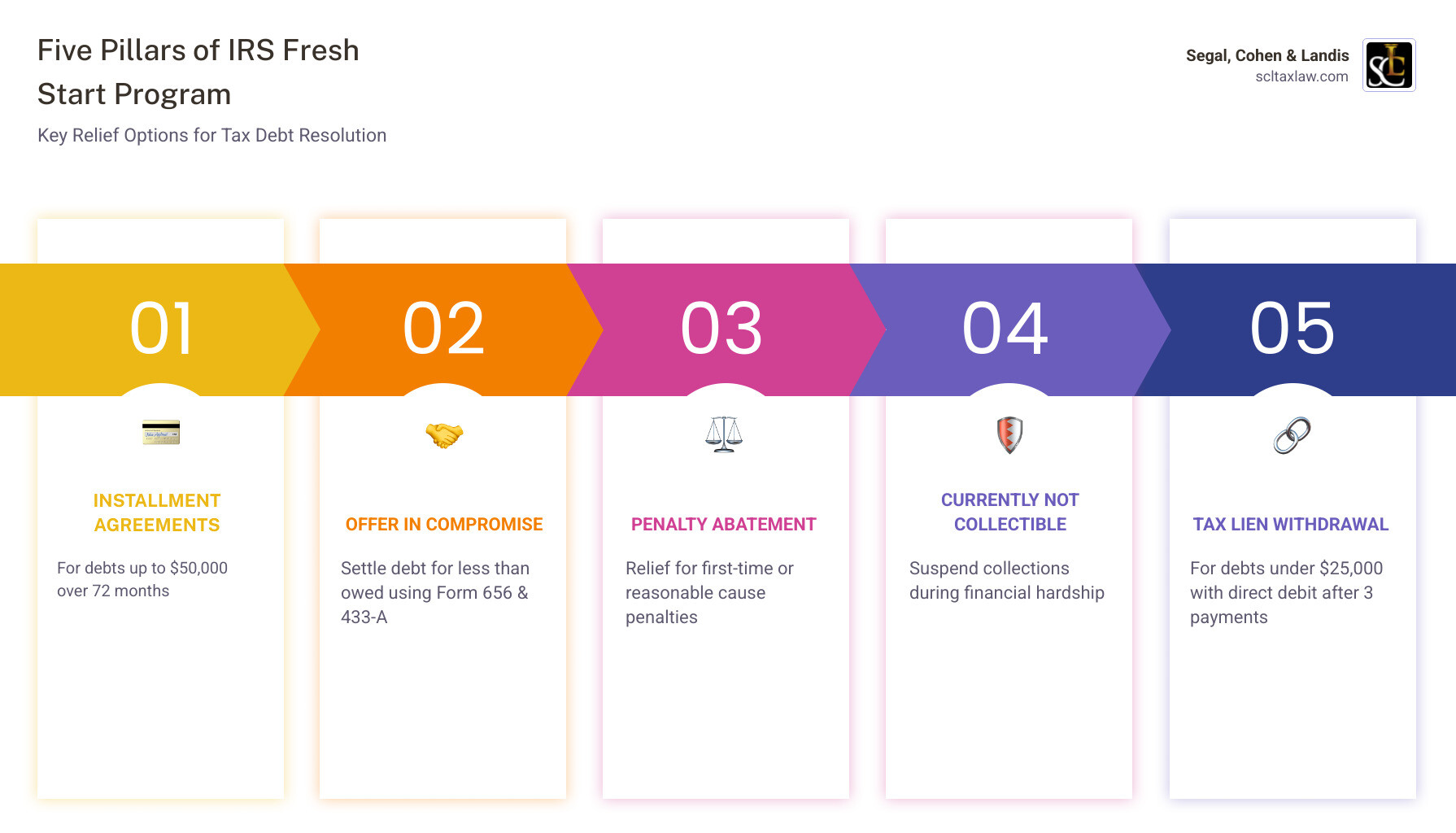
Once we determine you meet the basic irs fresh start qualification, the next step is choosing the right tool for the job. You don’t just “apply for Fresh Start”—you apply for a specific program within it. Here are the primary paths:
- Installment Agreements (IA): This is the most common path. You use Form 9465 to request a monthly payment plan. If you owe under $50,000, you can usually do this online.
- Offer in Compromise (OIC): This is the “settle for less” option. It is much harder to get. You must submit Form 656 and a very detailed financial statement. The IRS will look at your assets, future income potential, and basic living expenses. In some cases, taxpayers settle for 10% to 20% of their total debt.
- Penalty Abatement: If you have a good reason for falling behind (like a natural disaster, serious illness, or a death in the family), you can use Form 843 to ask the IRS to remove the penalties.
Your Application Checklist: To make the process smoother, we recommend gathering these records immediately:
- Last 3-6 months of bank statements.
- Documentation of all monthly expenses (rent/mortgage, utilities, food, medical).
- Proof of current income (pay stubs or profit/loss statements).
- A list of all assets (cars, real estate, retirement accounts).
- Records of any “extraordinary” circumstances (medical bills or proof of income decline).
Benefits of the Initiative and Lien Relief
One of the biggest (and most overlooked) benefits of the Fresh Start Program is how it handles tax liens. A federal tax lien is a public notice that the government has a legal claim to your property. It can ruin your credit and make it impossible to sell a home or get a car loan.
Under the Fresh Start rules, the IRS raised the threshold for filing a lien from $5,000 to $10,000. This means if you owe $8,000, the IRS generally won’t file a public lien notice against you, provided you stay in communication.
Even better, if a lien has already been filed, you can often get it withdrawn. If you owe $25,000 or less and enter into a Direct Debit Installment Agreement, you can request a lien withdrawal after making just three consecutive payments. This is a game-changer for restoring your credit.
Other benefits include:
- 72-Month Payment Windows: Giving you six full years to pay off the debt.
- Collection Suspension: Once an OIC or IA application is being processed, the IRS generally stops aggressive collection actions like wage garnishments.
- Currently Not Collectible (CNC): If paying federal tax would prevent you from meeting basic, reasonable living expenses, request an IRS review of your financial circumstances. Currently Not Collectible status delays most collection; the debt remains due, interest and applicable penalties continue, refunds may be offset, and the IRS may still file a Notice of Federal Tax Lien. Eligibility and later review depend on the facts. Related guidance: Currently Not Collectible status.
Frequently Asked Questions About IRS Fresh Start Qualification
Can I qualify if I have unfiled tax returns?
No. This is a hard “no” from the IRS. You must be in filing compliance to be eligible for any Fresh Start relief. However, we can help you prepare and file those back returns as part of the application process. Once the returns are processed, your irs fresh start qualification can be evaluated.
What happens if my Fresh Start application is denied?
Don’t lose hope. Rejections often happen because of simple paperwork errors or because the IRS believes you can afford to pay more than you offered. An Offer in Compromise rejection generally has a 30-day appeal deadline using Form 13711. Installment agreement rejection or termination uses the applicable collection appeal procedure; follow the actual notice and its deadline.. This is where professional representation becomes critical—we can review the IRS’s reasoning, correct the errors, and present a stronger case to the Office of Appeals.
Does the program automatically remove tax liens?
No, it is not automatic. You must proactively request a lien withdrawal using Form 12277 once you meet the requirements (such as paying the debt in full or successfully entering a qualifying direct debit payment plan).
Conclusion
Navigating the irs fresh start qualification process can feel like walking through a minefield. One wrong step or one missing document can lead to a rejection and the resumption of aggressive IRS collections. But you don’t have to do this alone.
Review the relevant notices, filing history, records, and deadlines before choosing a response. Evaluate professional assistance according to the facts, applicable law, and agreed scope of representation.
Review the relevant notices, filing history, records, and deadlines before choosing a response. Evaluate professional assistance according to the facts, applicable law, and agreed scope of representation. Related resources: contact our tax attorneys.
Automatic Exemption from Penalty transition: For covered returns with an original due date on or after January 1, 2027, AEP replaces FTA. This is distinct from the summer-2026 rollout for eligible original 2025 annual returns and 2026 quarterly returns. Eligibility depends on covered return and penalty types, prior same-form compliance history, current filing and payment compliance, and applicable exclusions. Consult the current IRS AEP guidance.
Related guidance: IRS Fresh Start Program Help.
Have questions about this topic? Talk to an IRS attorney today.
Segal, Cohen & Landis, P.C. — Beverly Hills. Serving clients nationwide.

Samuel Landis, Esq.
LL.M. (Tax) · Selected to Super Lawyers®
Sam Landis is a Beverly Hills IRS tax attorney specializing in IRS collection defense, audit representation, and international tax compliance for foreign nationals and US expats.