

The IRS Fresh Start Program: What It Is and Who It Can Help
The Fresh start tax program is a real, official IRS initiative — but it works very differently from what you’ve probably heard in radio ads or TV commercials.
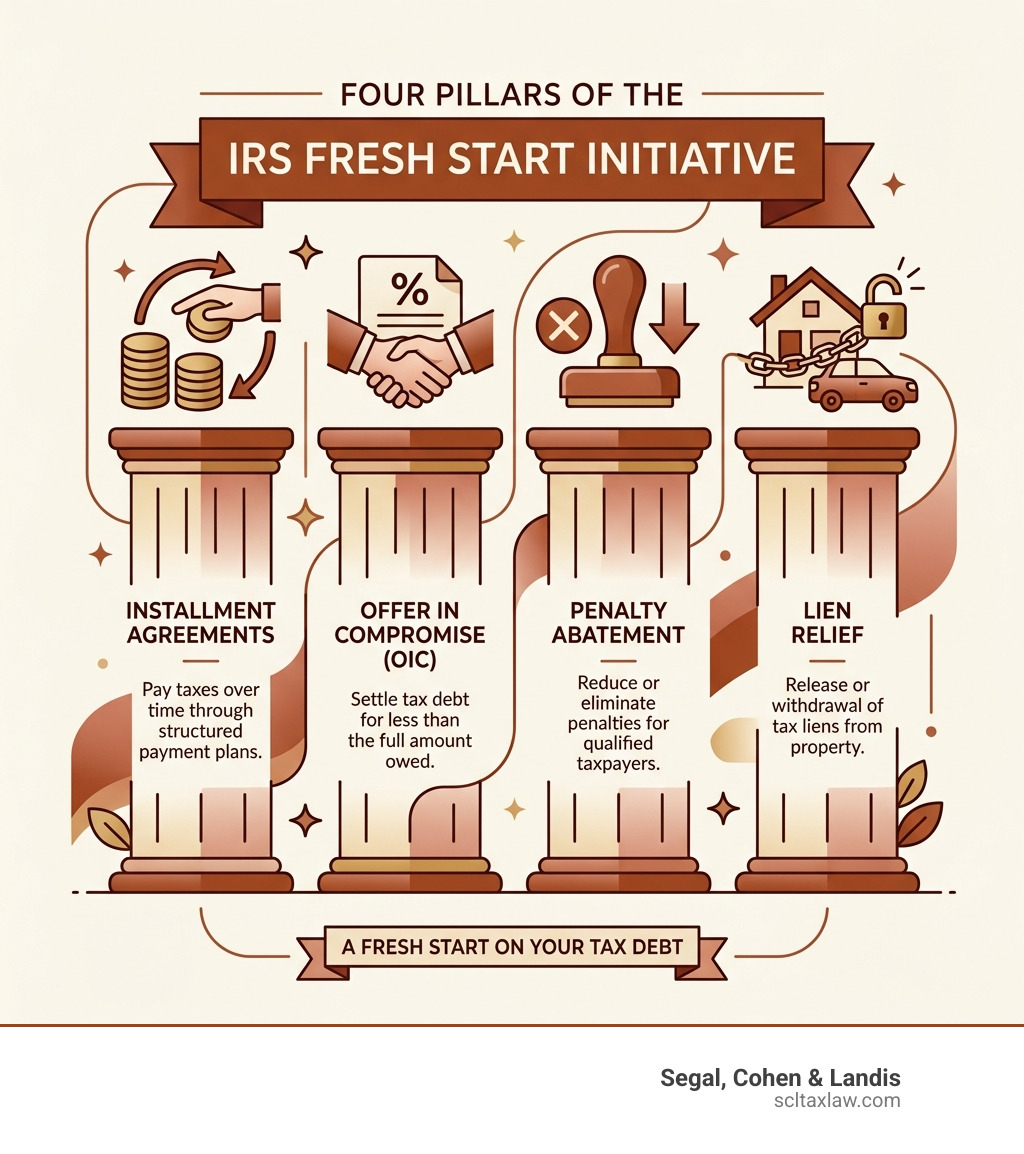
Here’s a quick overview of what it actually offers:
| Relief Option | What It Does | Best For |
|---|---|---|
| Streamlined Installment Agreement | Pay over up to 72 months | Debts under $50,000 |
| Offer in Compromise (OIC) | Settle for less than you owe | Severe financial hardship |
| Penalty Abatement | Reduce or eliminate penalties | First-time or hardship cases |
| Tax Lien Relief | Raise lien threshold to $10,000 | Protecting credit and assets |
Launched in 2011 by the IRS and U.S. Department of the Treasury, the program expanded access to existing debt relief tools — it did not create a magic way to erase your taxes overnight.
If you’re drowning in back taxes, unfiled returns, or IRS collection notices, this program may offer a real path forward. But qualifying isn’t automatic, and the rules are more specific than the ads suggest.
Fresh start tax program: Review the relevant notices, filing history, records, and deadlines before choosing a response. Evaluate professional assistance according to the facts, applicable law, and agreed scope of representation.
What is the IRS Fresh Start Program?
At its core, the Fresh start tax program (also known as the Fresh Start Initiative) is not a single law passed by Congress. Instead, it is a collection of administrative policy changes implemented by the IRS to help struggling taxpayers. Think of it as the IRS “loosening the belt” on its collection practices to make it easier for people to get back into compliance without losing everything they own.
The program was first formalized in 2011 and significantly broadened in 2012. It operates under the authority granted to the IRS for compromises, installment agreements, and tax lien filings. By recalibrating these administrative thresholds, the IRS aimed to move away from aggressive seizures and toward sustainable payment plans. According to the IRS Fresh Start Program Helps Taxpayers Who Owe the IRS, the goal is to provide a “fresh start” for both individuals and small businesses.
For a deeper dive into the history, you can read More info about the IRS Fresh Start Program.
Is the Fresh Start Tax Program Real?
Yes, it is 100% legitimate. However, there is a massive gap between the IRS’s actual guidelines and the “fake news” ads you see on late-night TV. Many tax relief companies use the term as a marketing hook to lure people into calling toll-free numbers, promising they can settle debt for “pennies on the dollar” regardless of their situation.
The reality? The IRS doesn’t hand out debt forgiveness like candy. While the Fresh start tax program makes it easier to qualify for relief, you still have to prove your case. Settlement is based on your “Reasonable Collection Potential”—a fancy way of saying the IRS will only take less if they are convinced they can’t get the full amount from you before the clock runs out.
Recent Updates for 2025 and 2026
As we look toward 2025 and 2026, the program remains a cornerstone of IRS collections. Recent updates focus on inflation adjustments and faster processing. For the 2025 tax year (returns filed in 2026), the standard deduction is set to increase to $31,500 for those married filing jointly and $15,750 for single filers. There is also an expanded senior deduction of up to $6,000 for those aged 65 and older.
IRS collection financial analysis uses its Collection Financial Standards and verified financial circumstances. Income-tax deductions do not automatically increase allowable collection expenses.
Core Relief Options Under the Fresh Start Tax Program
The program isn’t a “one-size-fits-all” solution. It is divided into several “tracks” depending on how much you owe and your financial health.

Streamlined Installment Agreements
This is the most common path. Before the Fresh Start changes, getting a payment plan was like pulling teeth—you had to provide a full financial history if you owed more than $25,000. Under the current Fresh start tax program rules, the IRS raised this threshold to $50,000.
If you owe $50,000 or less (including tax, interest, and penalties), you can often set up a “streamlined” agreement without handing over your bank statements or a list of your assets. You simply agree to pay the balance over a term of up to 10 years for most qualifying Simple Payment Plan taxpayers, subject to the applicable collection period and current eligibility rules. This is a huge win for taxpayers who want to avoid the intrusive “financial colonoscopy” that the IRS usually performs.
Tax Lien Thresholds and Withdrawal
A federal tax lien is like a giant red flag on your public record. It tells the world—and your creditors—that the government has a legal claim to your property. Under the Fresh Start Initiative, the IRS raised the threshold for filing a Notice of Federal Tax Lien (NFTL) from $5,000 to $10,000.
Even better, if you enter into a Direct Debit Installment Agreement and keep your balance under $25,000, you can request to have the lien withdrawn after making a few consecutive payments. Withdrawal may affect access to credit, but does not guarantee a credit-score change and make it easier to buy a house or get a loan. For those in specific states, you may also find state-level equivalents, such as those detailed by the Fresh Start Tax Assistance Program in Maryland.
For more details on protecting your property, check out More info about tax lien assistance.
Penalty Abatement and Hardship Relief
The IRS collects billions of dollars annually in penalties. Sometimes, the penalties and interest end up being larger than the original tax bill! The Fresh start tax program emphasizes “First-Time Abatements” (FTA) for taxpayers who have a clean record for the past three years.
If you don’t qualify for FTA, you can still seek relief through “Reasonable Cause”—such as a death in the family, a natural disaster, or a serious illness. During the expansion of the program, the IRS even offered specific penalty relief for unemployed wage earners who were out of work for 30 consecutive days. You can learn More info about penalty abatement on our site.
Eligibility and Requirements for the Fresh Start Tax Program
To get the IRS to play ball, you have to follow their rules. You can’t just ask for a “Fresh Start” while ignoring your current tax obligations.
Compliance and Filing Status
This is the golden rule: You must be “current” to be considered. This means you must have filed all required tax returns for the past six years. If you have unfiled returns, the IRS will generally refuse to talk about debt relief until those forms are processed.
Additionally, if you are self-employed, you must be current on your estimated tax payments. If you are an employee, your withholdings must be correct so you don’t end up owing even more next year. The IRS calls this “staying in the system.” If you have old returns gathering dust, we can help you get caught up; see More info about unfiled tax returns for guidance.
Financial Hardship Criteria
For the more aggressive relief options, like an Offer in Compromise, you have to prove that paying the full amount would cause an “economic hardship.” The IRS defines this as being unable to pay for basic living expenses like food, shelter, and medical care.
An income decline may affect the financial analysis, but a 25% decline is not a standalone current Offer in Compromise eligibility test. We use the following table to help our clients understand the difference in documentation requirements:
| Feature | Streamlined Agreement | Full Financial Disclosure (OIC/CNC) |
|---|---|---|
| Debt Limit | $50,000 or less | No limit |
| Financial Form | Not usually required | Form 433-A or 433-F required |
| Asset Review | No | Yes (Home equity, cars, 401k) |
| Verification | None | Bank statements, pay stubs, bills |
For more on these rules, visit Meeting the Fresh Start Program Requirements.
How the Fresh Start Program Differs from an Offer in Compromise (OIC)
Many people think the Fresh start tax program is an Offer in Compromise. In reality, an OIC is just one tool under the Fresh Start umbrella.
The Offer in Compromise (OIC) Process
An Offer in Compromise is the “holy grail” of tax relief. It allows you to settle your debt for less than you owe. Under the Fresh Start updates, the IRS changed how they calculate your future income. They used to look at four or five years of future earnings; now, they generally only look at 12 to 24 months. This makes it much easier to qualify than it was a decade ago.
However, it still requires a mountain of paperwork, including Form 656 and Form 433-A. You also have to pay a $205 application fee (unless you meet low-income guidelines). You can find more about state-specific offers, like the one in California, at Make an offer on your tax debt.
To learn more about the differences, check out What is the Difference Between the IRS Fresh Start Program and an Offer in Compromise?
Choosing the Right Path
Choosing between an installment agreement and an OIC depends on your “Reasonable Collection Potential” (RCP). If the IRS thinks they can get all their money by taking a small monthly payment for the next 10 years (the statutory limit for collections), they will likely reject your OIC.
Review the relevant notices, filing history, records, and deadlines before choosing a response. Evaluate professional assistance according to the facts, applicable law, and agreed scope of representation. Related resources: More info about Offer in Compromise.
How to Apply: Forms, Steps, and Common Pitfalls
Applying for the Fresh start tax program is a bit like navigating a maze where the walls move. One wrong turn, and you’re back at the start with a fresh levy on your bank account.
Required IRS Forms and Documentation
Depending on the track you choose, you’ll need specific forms:
- Installment Agreements: Form 9465.
- Offer in Compromise: Form 656 and 433-A (OIC).
- Hardship (Currently Not Collectible): Form 433-F.
- Lien Withdrawal: Form 12277.
You’ll also need to gather “proof” of your life: three to six months of bank statements, pay stubs, utility bills, and proof of any medical expenses. If you’re overwhelmed, the IRS provides a starting point at Get help with tax debt.
For a step-by-step breakdown, see IRS Fresh Start Initiative – Everything You Need to Know.
Avoiding Scams and “Tax Relief Mills”
We have all seen the ads: “The IRS has a new secret program! Call now!” These “tax relief mills” often charge huge upfront fees, file a generic OIC that they know will be rejected, and then disappear.
True tax resolution requires a licensed professional—a tax lawyer, CPA, or Enrolled Agent—who can sign a Power of Attorney and speak directly to the IRS on your behalf. If a company promises a result before looking at your tax transcripts, run the other way. If the IRS denies your request, you have the right to appeal, but you need someone who knows the More info about IRS appeals process.
Frequently Asked Questions about Fresh Start Relief
Is the Fresh Start Program still available in 2025?
Yes. While it was launched years ago, it is an ongoing set of policies. The thresholds for streamlined agreements ($50,000) and liens ($10,000) are still in effect and are part of the standard operating procedure for IRS revenue officers today.
What happens if I don’t qualify for Fresh Start?
If paying federal tax would prevent you from meeting basic, reasonable living expenses, request an IRS review of your financial circumstances. Currently Not Collectible status delays most collection; the debt remains due, interest and applicable penalties continue, refunds may be offset, and the IRS may still file a Notice of Federal Tax Lien. Eligibility and later review depend on the facts. Related guidance: More info about Currently Not Collectible status.
When is the best time to apply for tax relief?
The best time was yesterday; the second best time is today. The longer you wait, the more interest and penalties accrue. More importantly, the IRS is more likely to grant relief if you come to them before they have to come to you with a wage garnishment or a bank levy.
Conclusion
The Fresh start tax program is a powerful set of tools, but it isn’t a “get out of jail free” card. It requires strategy, meticulous documentation, and a deep understanding of IRS manual procedures. Whether you are in Los Angeles, Chicago, or any of our other service locations across the United States, the team at Segal, Cohen & Landis is here to help.
Review the relevant notices, filing history, records, and deadlines before choosing a response. Evaluate professional assistance according to the facts, applicable law, and agreed scope of representation.
If you’re ready to take the first step toward financial freedom, explore our Tax Resolution Services California or contact us today for a consultation.
Related guidance: IRS Fresh Start Program Help.
Have questions about this topic? Talk to an IRS attorney today.
Segal, Cohen & Landis, P.C. — Beverly Hills. Serving clients nationwide.

Samuel Landis, Esq.
LL.M. (Tax) · Selected to Super Lawyers®
Sam Landis is a Beverly Hills IRS tax attorney specializing in IRS collection defense, audit representation, and international tax compliance for foreign nationals and US expats.