
When Tax Debt Feels Impossible to Escape, the IRS Fresh Start Program Can Help
The irs fresh start program application is your formal request to the IRS for relief from tax debt you cannot pay in full — and it’s one of the most powerful tools available to struggling taxpayers today.
Here’s how to apply for the IRS Fresh Start Program in 5 steps:
- File all unfiled tax returns — you must be current on all required filings before the IRS will consider any relief
- Assess your total tax debt — determine whether you owe $50,000 or less (the streamlined threshold) or more
- Choose the right relief option — Installment Agreement, Offer in Compromise, Penalty Abatement, or another pathway
- Gather your financial documents — income records, bank statements, asset valuations, and expense documentation
- Complete and submit the correct IRS forms — such as Form 9465, Form 656, or Form 433-A depending on your situation
If you owe back taxes and the IRS is sending notices — or has already threatened a lien or levy — you are not alone. Millions of Americans fall behind on taxes every year, and the IRS Fresh Start Initiative was created specifically to give those people a realistic path forward. Launched in 2011 and still fully active in 2025 and 2026, Fresh Start is not a single application form. It’s an umbrella of relief programs — each with different rules, forms, and outcomes.
The right option for you depends on how much you owe, your current income, and your financial hardship. Understanding which path fits your situation is the single most important step before you submit anything to the IRS.
Review the relevant notices, filing history, records, and deadlines before choosing a response. Evaluate professional assistance according to the facts, applicable law, and agreed scope of representation.
Eligibility Requirements for an IRS Fresh Start Program Application

Before you dive into the paperwork, we need to make sure you actually fit the criteria the IRS has set. Think of this as the “admission requirements” for the program. The IRS isn’t known for being overly generous, but the Fresh Start Initiative did significantly lower the hurdles for everyday people.
One of the most critical factors is your total debt amount. Generally, if you owe $50,000 or less, you fall into a “streamlined” category that makes your irs fresh start program application much simpler. If you owe more than that, don’t panic — you can still qualify, but the IRS will want a much more intimate look at your bank accounts and assets.
Tax compliance is the second major hurdle. You cannot be “missing in action” with your filings. Every year, millions of Americans fail to file, pay or properly report what they owe. If you have Back Taxes from previous years that haven’t even been filed yet, the IRS will reject your application immediately. We always tell our clients: you have to get “legal” before you can get relief.
The IRS uses Collection Financial Standards and verified income, assets and necessary expenses for collection financial analysis. Income-tax deductions do not automatically determine allowable collection expenses. See IRS is using updated tax figures. See What to do if you owe the IRS but can’t pay.
Qualifying for the Fresh Start Initiative
To keep your application on track, you must meet these specific benchmarks:
- No Active Bankruptcy: If you are currently in an open bankruptcy proceeding, the IRS will not process a Fresh Start request.
- Filing History: You must have filed all required tax returns for at least the last six years.
- Current Payments: If you are self-employed, you must be current on your estimated tax payments for the current year. If you have employees, you must have made all federal tax deposits.
- Income Decline: While not always required for payment plans, A decline in income may affect verified ability to pay, but a 25% decline is not a standalone current Offer in Compromise eligibility test for more aggressive relief, like an Offer in Compromise.
One of the best “hidden” benefits of the IRS Fresh Start Program is the increased tax lien threshold. Previously, the IRS would slap a public tax lien on your property if you owed just $5,000. Under Fresh Start, that threshold was raised to $10,000, and in many cases, we can help you get a lien withdrawn entirely if you set up a direct debit payment plan.
Relief Options Under the Fresh Start Initiative
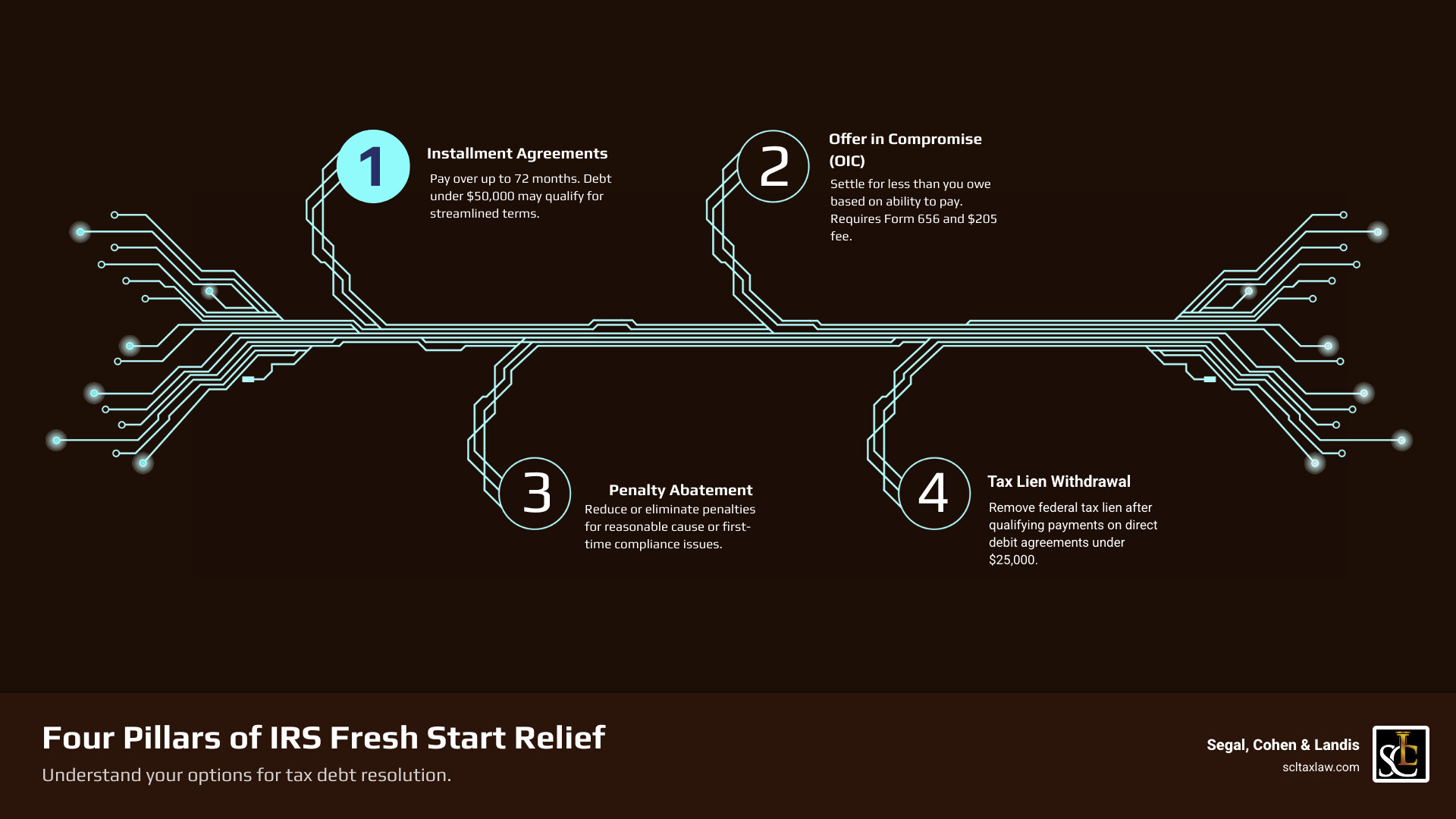
The Fresh Start Initiative isn’t a “one size fits all” deal. It’s more like a menu of options. Depending on your financial health, we might recommend one over the other.
| Feature | Installment Agreement (IA) | Offer in Compromise (OIC) |
|---|---|---|
| Goal | Pay full debt over time | Settle for less than total owed |
| Debt Limit | Up to $50,000 (Streamlined) | No specific limit, based on ability to pay |
| Timeframe | Up to 72 months | Usually settled within 2 years |
| Financial Disclosure | Minimal for streamlined | Full disclosure of all assets/income |
| Cost | Set user fees | $205 application fee + initial payment |
For some, an IRS Partial Pay Installment Arrangement is the perfect middle ground — you pay what you can afford monthly until the IRS’s time to collect (usually 10 years) runs out. Others may qualify for penalty abatement, where the IRS agrees to “forgive” the late fees and interest that have piled up. In extreme cases, taxpayers have settled their debt for 10% to 20% of their total debt through an OIC.
Streamlined Installment Agreements
If you owe $50,000 or less, the Streamlined Installment Agreement is often the path of least resistance. You can use Form 9465 to request this.
potentially eligible to request lien-notice withdrawal if all separate requirements are met, including a qualifying taxpayer, a balance of $25,000 or less, full payment within 60 months or the collection period, three consecutive direct debit payments, compliance and applicable default conditions
Offer in Compromise (OIC)
This is the “holy grail” of tax relief, but it’s also the most difficult to get. An OIC allows you to settle your tax debt for less than the full amount you owe. To apply, you’ll need Form 656 and a very thick stack of supporting documents.
The IRS will calculate your “Reasonable Collection Potential” (RCP). This is a fancy way of saying they look at your equity in assets (homes, cars, bank accounts) and your future income. If the amount you offer is more than what the IRS thinks they could ever collect from you, they might accept it. Our Offer in Compromise Complete Guide goes into more detail, but remember: there is a $205 non-refundable application fee unless you qualify for the low-income waiver.
Step-by-Step Guide to the Application Process
Applying for Fresh Start isn’t just about signing a form; it’s about building a case. Think of yourself as a defense attorney, and your financial life is the evidence.
Step 1: The Documentation Phase Before you touch a single IRS form, gather your “proof.” You will need the last three to six months of bank statements, pay stubs, mortgage statements, and utility bills. If you are applying for an OIC or a complex payment plan, you must fill out Form 433-A. This form is a “financial snapshot” that tells the IRS everything you own and everything you earn.
Step 2: Use the Tools Don’t guess if you qualify. The IRS provides an Offer in Compromise Pre-Qualifier Tool that can give you a baseline idea of your eligibility. However, keep in mind that this tool is basic. It doesn’t account for the nuances that an Offer in Compromise Attorney Guide or a professional review would catch.
Step 3: Choose Your Form
- For a payment plan: Use Form 9465.
- For a settlement: Use Form 656 and Form 433-A (OIC).
- For penalty relief: Use Form 843.
- For lien removal: Use Form 12277.
Gathering Required Forms for the IRS Fresh Start Program Application
Precision is everything. If you leave a line blank or forget a signature, the IRS will send the whole package back to you, and the collection clock will keep ticking. Here is your mandatory checklist:
- Form 656: The actual contract for the settlement.
- Form 433-A (OIC) or 433-F: Your detailed financial statement.
- Form 843: Use this if you are specifically asking for Penalty Abatement.
- Application Fee: A check for $205 (unless you meet low-income guidelines).
- Initial Payment: If you’re doing a lump-sum OIC, you must include 20% of your offer amount. If you’re doing periodic payments, you must include your first monthly payment.
- Proof of Income: Copies of pay stubs or profit/loss statements if you’re self-employed.
- Asset Valuations: Recent statements for 401(k)s, IRAs, and property appraisals.
Submitting and Monitoring Your IRS Fresh Start Program Application
Once you mail your package (always use certified mail!), the waiting game begins. For an OIC, the IRS has a “24-month rule.” If they don’t make a decision on your offer within two years of receiving it, the offer is automatically accepted.
While your application is under review, the IRS generally suspends collection activities. This means they won’t garnish your wages or seize your bank account while they are considering your request. However, interest and penalties will continue to accrue, so it’s in your best interest to ensure the application is perfect the first time.
If your application is rejected, don’t lose hope. You have a 30-day window to file an appeal. The IRS Appeals process allows an independent officer to review your case and determine if the original agent made a mistake.
Frequently Asked Questions
Can the Fresh Start Program really forgive my tax debt?
Yes and no. The IRS rarely uses the word “forgiveness.” Instead, they use “settlement” or “compromise.” Through an IRS Offer in Compromise, you can significantly reduce the total amount you owe. We have seen cases where taxpayers settled six-figure debts for a fraction of the cost. Additionally, penalty abatement can “forgive” the extra charges added to your bill, though you will still owe the original tax.
What is the difference between Fresh Start and Currently Not Collectible (CNC) status?
Fresh Start is about resolving the debt through payments or settlements. CNC status is a “pause button.” If you can prove that paying even a dollar to the IRS would prevent you from paying for basic necessities like food or rent, the IRS will place you in Currently Not Collectible status. They stop asking for money, but the debt doesn’t go away, and interest keeps growing. It’s a temporary hardship deferral, not a permanent solution. For more, see our guide on the difference between the IRS Fresh Start Program and an Offer in Compromise.
What are the common mistakes to avoid during the application?
The biggest mistake is unfiled returns. We can’t stress this enough: the IRS will not help you if you aren’t compliant. Other pitfalls include:
- Missing Documentation: If you claim you spend $1,000 a month on medical bills but don’t provide receipts, the IRS will disqualify that expense.
- Undervaluing Assets: If the IRS finds out you “forgot” to mention a boat or a second car, they may hit you with fraud penalties.
- Future Compliance: An accepted Offer in Compromise requires compliance with its payment terms and five years of future filing and payment compliance. Other relief programs have their own requirements. If you file late or owe money next year, your entire agreement could be defaulted.
Conclusion
Navigating an irs fresh start program application can feel like walking through a minefield, but it is one of the most effective ways to reclaim your financial life. Whether you are in Los Angeles, Chicago, Dallas, or anywhere across the United States, the rules remain the same: be honest, be thorough, and be compliant.
Review the relevant notices, filing history, records, and deadlines before choosing a response. Evaluate professional assistance according to the facts, applicable law, and agreed scope of representation. Related resources: IRS Fresh Start Program.
Related guidance: IRS Fresh Start Program Help.
Have questions about this topic? Talk to an IRS attorney today.
Segal, Cohen & Landis, P.C. — Beverly Hills. Serving clients nationwide.

Samuel Landis, Esq.
LL.M. (Tax) · Selected to Super Lawyers®
Sam Landis is a Beverly Hills IRS tax attorney specializing in IRS collection defense, audit representation, and international tax compliance for foreign nationals and US expats.