
Criminal Tax Attorney Detroit: Your Shield Against Federal Charges
The IRS Criminal Investigation Division (CID) investigates potential criminal violations of tax and related financial laws. An investigation does not itself establish guilt. Qualified counsel can advise on rights, responses and potential defenses.
If you find yourself in the crosshairs, a criminal tax attorney Detroit is your only real shield. Navigating tax fraud issues requires a specialized understanding of both the Internal Revenue Code and federal criminal procedure. Unlike a standard accountant or a general defense lawyer, a tax attorney understands the nuances of IRS audit representation and how to prevent a civil dispute from spiraling into a felony indictment.
Identifying Triggers for a Criminal Tax Investigation
How does a normal Detroit business owner end up with a federal subpoena? Most investigations aren’t random. They are triggered by specific red flags that signal “willful” intent to defraud the government.
- Whistleblower Tips: The IRS Whistleblower Program is a massive motivator for disgruntled employees, ex-spouses, or business partners. If someone reports you and the IRS collects, that whistleblower can receive up to 30% of the proceeds.
- Unreported Income: Large cash deposits, “off-the-books” payments, or lifestyle choices that don’t match reported income often catch the eye of IRS data analytics.
- Potential fraud indicators can lead to further review; they do not alone establish a crime or an automatic criminal referral. Obtain legal advice before responding where criminal exposure may be involved.
- Criminal Activity: Sometimes, a tax investigation is a “tag-along” to other charges like health care fraud, public corruption, or narcotics.
If you suspect you are being watched, it is vital to determine if you are at risk for IRS tax fraud charges before the Special Agents arrive at your door.
The Role of Former Government Attorneys in Your Defense
In tax defense, “insider” knowledge isn’t just a buzzword—it’s a tactical necessity. Many of the top defense firms in the Michigan area are staffed by former IRS Chief Counsel attorneys or former Special Assistant U.S. Attorneys.
Why does this matter? Because they have sat on the other side of the table. They know exactly how the DOJ Tax Division builds a case and what evidence they need to secure a conviction. This experience allows your defense team to anticipate the prosecution’s next move, identify weaknesses in their forensic accounting, and engage in high-level negotiations to have an investigation “discontinued” before an indictment is ever unsealed.
Tax Evasion vs. Civil Disputes: The Line Between Negligence and Fraud
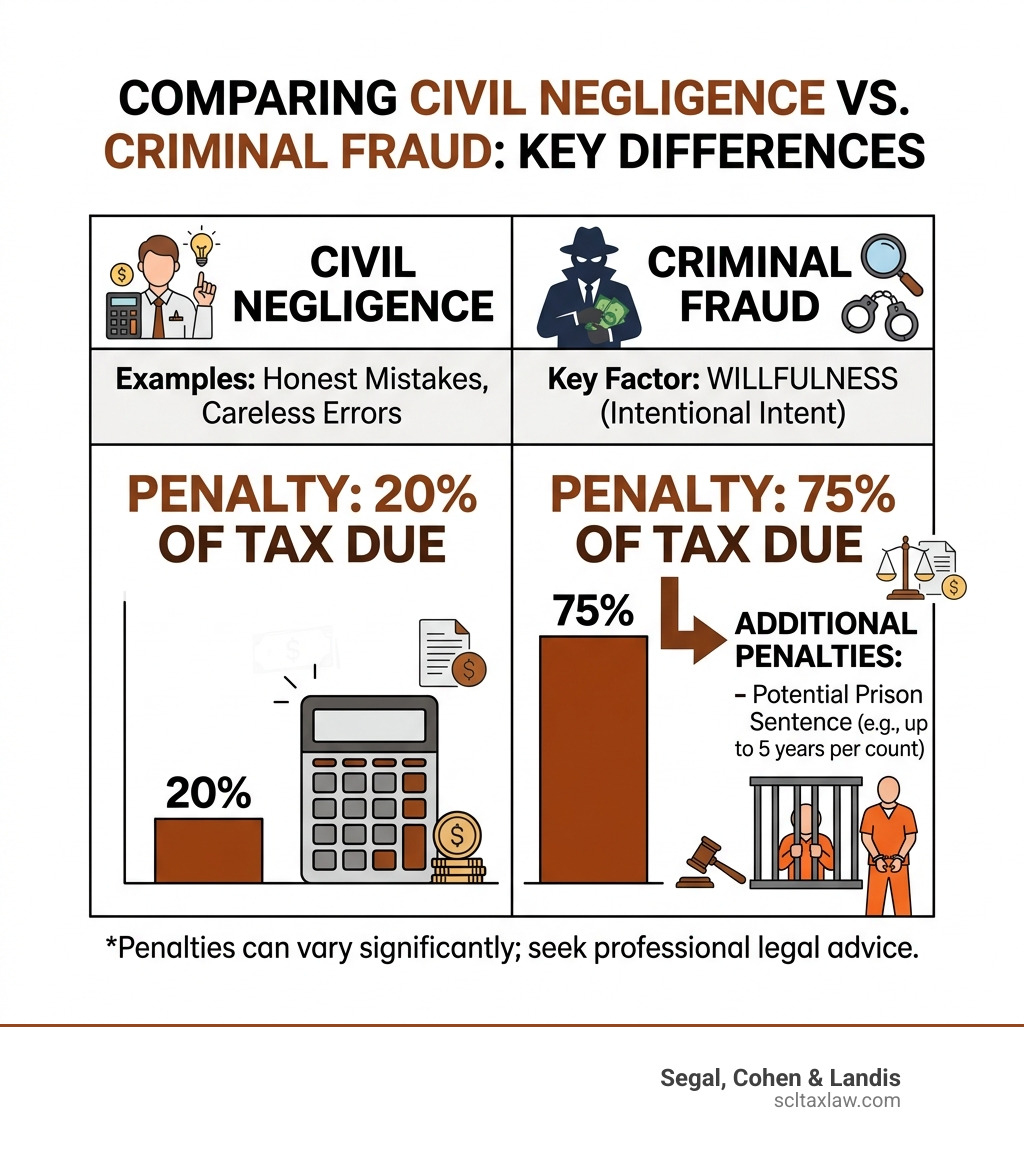
One of the most common questions we hear is: “I made a mistake on my taxes; am I going to jail?” The answer usually depends on one word: Willfulness.
The IRS distinguishes between “honest mistakes” (negligence) and “intentional wrongdoing” (fraud). Negligence might cost you a 20% penalty on top of the tax you owe. The civil fraud penalty generally equals 75% of the underpayment attributable to fraud. Criminal tax evasion is a separate offense requiring proof of its elements and can carry up to five years of imprisonment.
Proving Lack of Willful Intent
To convict you of tax evasion, the government must prove beyond a reasonable doubt that you voluntarily and intentionally violated a known legal duty. This is a high bar for the prosecution.
Common defenses handled by a criminal tax attorney Detroit involve proving:
- Good Faith Belief: You truly believed your tax treatment was correct based on a complex or ambiguous area of the law.
- Reliance on Professionals: You provided all necessary info to your CPA, and they were the ones who made the error.
- Complexity of Law: The tax code is famously dense. We can often argue that the “errors” were the result of confusion rather than a plan to cheat the government.
Understanding the complete guide to IRS audit defense is the first step in building this wall of defense.
Potential Penalties in Federal and Michigan State Courts
The penalties for tax crimes in 2026 remain some of the harshest in the federal system.
- Federal Tax Evasion: Up to 5 years in prison and fines up to $250,000 for individuals ($500,000 for corporations).
- Filing a False Return: Up to 3 years in prison.
- Michigan State Taxes: The Michigan Department of Treasury also pursues tax crimes, which can lead to state prison time and significant restitution requirements.
Beyond prison, a felony conviction creates a permanent record that can end a professional career instantly.
Common Prosecutions in Michigan: Payroll Fraud and Failure to File

Detroit’s industrial and small business landscape makes it a frequent target for “employment tax” investigations. The IRS treats unpaid payroll taxes as theft of government funds because that money was withheld from employees’ paychecks and was never yours to keep.
Why a Criminal Tax Attorney Detroit is Essential for Payroll Disputes
If you own a business in Novi, Farmington Hills, or Detroit and fall behind on payroll taxes, the IRS can assess a “Trust Fund Recovery Penalty.” The TFRP generally covers unpaid trust-fund taxes, including withheld income tax and employee FICA, and requires responsibility and willful failure to collect or pay over; ownership or a business shortfall alone does not establish it. In severe cases, the IRS pursues criminal charges for “willful failure to collect or pay over tax.”
Counsel can evaluate civil and criminal exposure and available defenses. A civil settlement or financial hardship does not itself prevent criminal prosecution. See payroll tax fraud lawyer. See more info on payroll tax issues.
Offshore Tax Evasion and FBAR Violations
With Detroit’s international business ties, many residents hold foreign bank accounts. Failure to file a Foreign Bank Account Report (FBAR) can lead to astronomical penalties—sometimes exceeding the balance of the account itself.
Offshore reporting and penalty exposure require review of the account, conduct, and available procedures. No comparable case outcome or amount of savings should be assumed. Related resources: unfiled tax returns; IRS Voluntary Disclosure Program.
Surviving an IRS CID Investigation and Grand Jury Subpoena
If an IRS Special Agent hands you a grand jury subpoena, your world just changed. A grand jury has broad powers to compel testimony and seize documents. A bank account closure alone does not establish why the bank acted or whether a subpoena exists. Obtain advice about any actual subpoena or government request.
What to Do When a Criminal Tax Attorney Detroit identifies a CID Trigger
- Exercise Your Right to Remain Silent: Do not try to “explain” your way out of it. Anything you say to a Special Agent will be used to build the case against you.
- Call a Lawyer Immediately: You need a professional to handle all communication with the government.
- Preserve Documents: Do not delete emails or shred papers. This can lead to additional “obstruction of justice” charges.
- Do Not Contact Witnesses: Reaching out to your accountant or employees to “get the story straight” can be viewed as witness tampering.
If you are in this situation, you must contact a tax professional immediately to begin your defense.
The Risk of Filing Amended Returns During an Investigation
A common instinct is to quickly file amended returns to “fix” the problem once you realize you’re being investigated. This is incredibly dangerous.
An amended return is a signed tax filing, not an automatic confession of a crime. Its facts may have consequences in an investigation; counsel should evaluate correction and disclosure options before filing. Never file amended returns during a criminal investigation without the explicit guidance of your criminal tax attorney Detroit. Instead, explore the IRS Voluntary Disclosure Program with counsel; VDP generally is untimely after the IRS has commenced an examination or investigation or received specified third-party information, and it does not guarantee immunity.
Defense Strategies: Proving Lack of Willfulness and Voluntary Disclosure

Success in criminal tax defense isn’t always about a “not guilty” verdict at trial. Often, the greatest victory is the “declination”—when the government decides not to bring charges at all.
How a Criminal Tax Attorney Detroit Challenges IRS Evidence
The IRS often uses “indirect proof” to show you earned more than you reported. They might look at your bank deposits or your net worth increase over a year. We challenge these methods by:
- Identifying non-taxable sources of cash (loans, inheritances, gifts).
- Challenging the credibility of whistleblowers.
- Utilizing forensic accountants to find errors in the IRS’s math.
Civil tax-debt resolution does not determine the outcome of a criminal investigation. Review the actual tax liabilities, evidence, and procedural options. Related resources: IRS Appeals process; IRS Offer in Compromise.
Avoiding Prison Through Strategic Sentencing Advocacy
If charges are filed, the goal shifts to “sentencing advocacy.” This involves presenting a comprehensive picture of the client to the judge—highlighting their community involvement, lack of prior record, and the “unintentional” nature of the conduct.
Possible outcomes depend on the evidence, charges, applicable law, and decision-maker. The following outcomes are possibilities, not promised results:
- Dropped charges or dismissals.
- Probation instead of prison time.
- IRS Penalty Abatement for civil portions of the case.
Collateral Consequences: Life After a Tax Conviction in 2026
The “hidden” costs of a tax conviction can be more damaging than the prison sentence itself. In 2026, the digital trail of a felony conviction is impossible to hide.
Impact on Professional Licensing and Firearms
A tax conviction can have consequences beyond the sentence. Review any licensing, reporting, and other restrictions under the law applicable to the conviction and affected activity.
- Professional Licensing: Obtain advice about any conviction-reporting duties and disciplinary proceedings that apply to your profession and license. Check the relevant licensing authority and governing rules; do not assume that the same automatic suspension or revocation rule applies to CPAs, attorneys, doctors, and real estate agents.
- Firearms: Federal law generally restricts firearm possession for persons convicted of qualifying crimes, subject to statutory exceptions and applicable constitutional and restoration issues.
- Passports: The IRS can certify “seriously delinquent tax debt” to the State Department, leading to IRS Passport Restrictions.
- Gaming: Even professional gaming tax issues can arise, as many platforms and tournaments require clean financial backgrounds for payouts.
Financial Restitution and Long-Term IRS Monitoring
Tax and restitution collection authority depends on the assessment, judgment and governing statutes; collection tools do not guarantee recovery of every dollar. See tax liens. See tax levies.
Frequently Asked Questions about Criminal Tax Defense
Should I talk to an IRS Special Agent without a lawyer?
Knowingly and willfully making a materially false statement in a covered federal matter can create separate criminal exposure; a merely mistaken statement is not automatically a false-statements felony.
Can I avoid jail if I pay the back taxes immediately?
Paying the tax helps, but it is not a “get out of jail free” card. The crime is the act of evasion or fraud at the time the return was filed. However, full payment is a strong mitigating factor during sentencing.
How do whistleblowers get paid in Detroit tax cases?
Whistleblowers file Form 211. Qualifying whistleblower awards are generally 15% to 30% of collected proceeds attributable to the information. Section7623(b) requires more than $2 million in disputed proceeds and, for an individual target, gross income exceeding $200,000 in at least one relevant tax year; reductions and other rules may apply.
Conclusion
Facing the IRS Criminal Investigation Division is the most significant legal challenge you will ever encounter. The federal government has nearly unlimited resources to pursue you, but you have rights—and you have options.
Review the relevant notices, filing history, records, and deadlines before choosing a response. Evaluate professional assistance according to the facts, applicable law, and agreed scope of representation. Related resources: Detroit Tax Attorney.
Have questions about this topic? Talk to an IRS attorney today.
Segal, Cohen & Landis, P.C. — Beverly Hills. Serving clients nationwide.

Samuel Landis, Esq.
LL.M. (Tax) · Selected to Super Lawyers®
Sam Landis is a Beverly Hills IRS tax attorney specializing in IRS collection defense, audit representation, and international tax compliance for foreign nationals and US expats.