

Why California Taxpayers Need Clear Guidance on IRS Tax Help
IRS tax help California encompasses a wide range of resources designed to assist residents with federal and state tax issues, from free preparation services to professional legal representation. Here’s what you need to know:
Quick Guide to IRS Tax Help in California:
- Free Services: VITA and TCE programs offer no-cost tax preparation for low-to-moderate income taxpayers (returned $53.3 million to Bay Area families in 2024)
- Direct IRS Contact: Call 800-829-1040 (individuals) or visit a local Taxpayer Assistance Center
- State Agencies: California Franchise Tax Board (FTB) handles state income tax, while EDD manages payroll taxes
- Wait times: Vary by season, line and workload; check current IRS telephone guidance.
- Professional Help: Tax attorneys for complex issues like audits, back taxes, levies, and wage garnishments
California’s tax landscape is uniquely complex. You’re not just dealing with federal IRS requirements—you’re also navigating state agencies like the Franchise Tax Board, the Employment Development Department, and the Board of Equalization. Whether you’re facing an audit, struggling with back taxes, or simply need help filing your return, understanding your options is the first step toward resolution.
The good news? California offers more tax assistance resources than almost any other state. The challenge? Knowing which one is right for your situation. Free volunteer programs work well for straightforward returns, but serious tax problems demand serious expertise.
IRS tax help California: Review the relevant notices, filing history, records, and deadlines before choosing a response. Evaluate professional assistance according to the facts, applicable law, and agreed scope of representation.
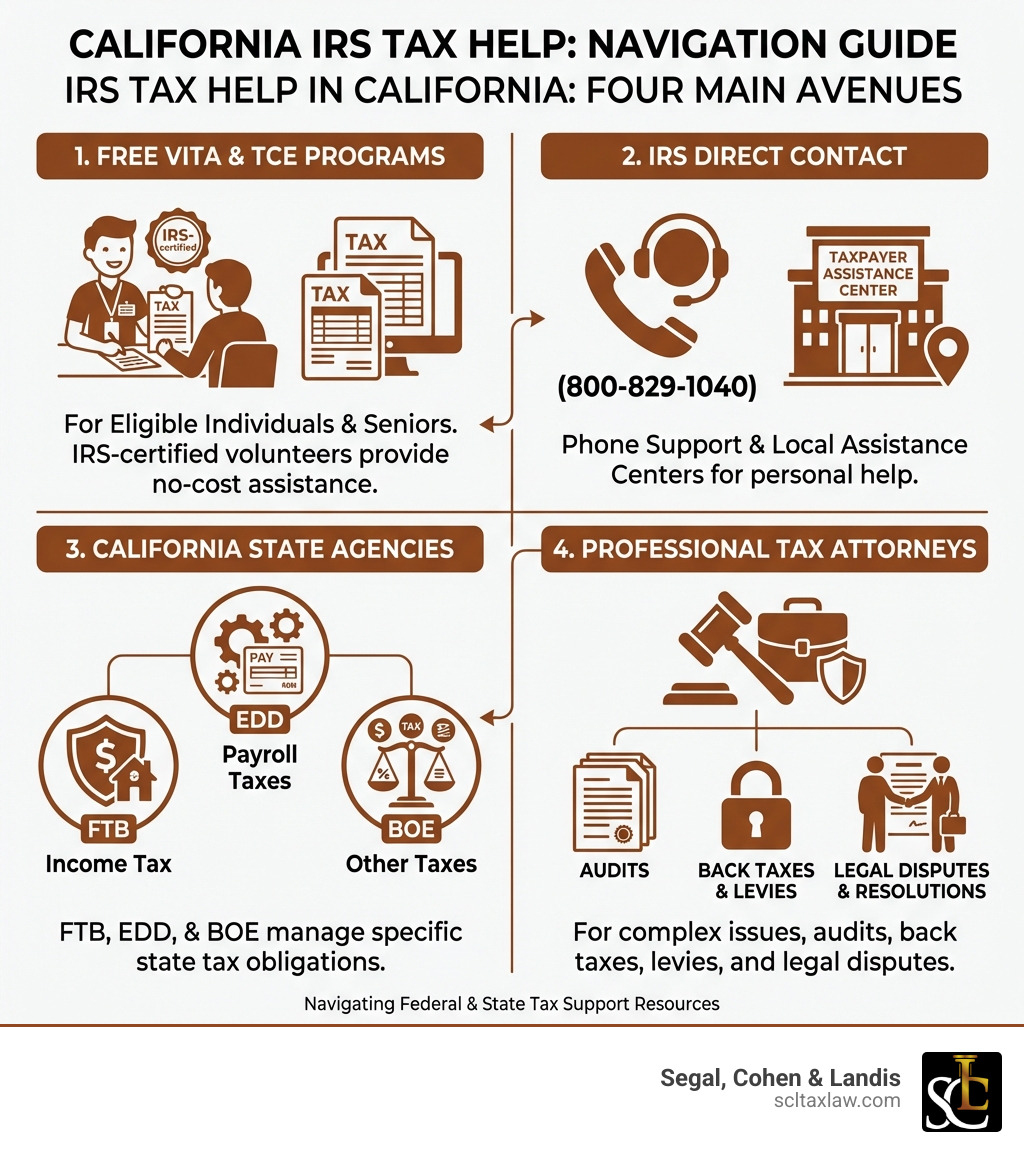
Quick look at IRS tax help California:
Free Tax Assistance Programs for Individuals in California
For many Californians, particularly those with low-to-moderate incomes, navigating tax season can feel like a labyrinth without a map. Thankfully, a wealth of free resources exists to provide much-needed IRS tax help California residents can access. These programs leverage the power of community and certified volunteers to ensure accurate filing and help taxpayers claim every eligible refund.
The most prominent of these programs are the Volunteer Income Tax Assistance (VITA) and Tax Counseling for the Elderly (TCE) initiatives. Administered by the IRS, these programs offer free basic tax return preparation services. The VITA program specifically targets low- and moderate-income taxpayers, while TCE is custom for individuals aged 60 and older, offering specialized assistance with pensions and retirement-related income.
These programs are not just about filling out forms; they’re about empowering communities. For instance, in 2024, the Free Tax Help program in the Bay Area alone assisted with over 35,000 tax returns, successfully returning an astounding $53.3 million in federal and state refunds to families. This remarkable statistic highlights the real-world impact of these services, helping families keep more of their hard-earned money.
The California State Controller’s office plays a crucial role in collaborating with the IRS and other agencies to make VITA and TCE programs widely available across California communities. This partnership ensures that these vital services reach those who need them most. Volunteers working within these programs are IRS-certified, meaning they undergo rigorous training and testing to ensure they are equipped to handle various tax situations accurately and securely. They can help eligible households maximize their refunds by claiming federal and state tax credits, such as the Earned Income Tax Credit (EITC) and the Child Tax Credit (CTC).
Assistance is generally available from February 1 through April 15 each year, though specific dates and times can vary by location. Some sites may also require appointments, so it’s always a good idea to check beforehand. Beyond just preparing returns, these programs offer peace of mind, knowing that trained professionals are handling your taxes.
If you’re a low-to-moderate income taxpayer in California, we strongly encourage you to explore these free resources. They are a fantastic starting point for basic tax preparation and a great example of accessible IRS tax help California offers. You can find more information about these invaluable services through the Get free tax help from the VITA and TCE programs page. For more comprehensive support or if you face complex tax issues, professional Tax Resolution Services California are also available to guide you.

How to Contact the IRS and State Agencies for Tax Help
When it comes to getting direct assistance with your taxes, knowing how to reach the right federal or state agency is paramount. Whether you have a quick question or a complex issue, there are several avenues for direct contact.
For federal tax matters, the Internal Revenue Service (IRS) offers various ways to connect. The most common method is by phone. For individuals, the main IRS phone number is 800-829-1040. For businesses, the number is 800-829-4933. These lines are generally open from 7 a.m. to 7 p.m. local time, Monday through Friday.
It’s helpful to be aware of potential wait times. During the peak filing season (January-April), wait times vary by line and workload. However, outside of filing season (May-December), wait times can vary substantially. Mondays and Tuesdays tend to be the busiest days, so if your schedule allows, try calling mid-week. The IRS even offers a return call option during high volume periods, so you don’t have to stay on hold.
For in-person IRS tax help California residents can visit a local Taxpayer Assistance Center (TAC). These centers provide face-to-face assistance. However, it’s crucial to know that TACs generally require an appointment for priority service. You’ll need to call ahead to schedule your visit. You can find your nearest center and contact information by visiting the Contact your local IRS office in California page.
Beyond federal taxes, California residents also interact with several key state agencies for their tax obligations. We’ll dive into these shortly.

What to Prepare for Your Call
Before you pick up the phone to call the IRS or head to a TAC, preparation is key to a smooth and efficient interaction. The IRS will need to verify your identity before discussing any personal tax information. Having the right documents and information at hand can save you significant time and frustration.
For individuals, be ready with:
- Your Social Security Number (SSN) or Individual Taxpayer Identification Number (ITIN).
- Your birth date.
- Your current filing status (e.g., Single, Married Filing Jointly).
- A copy of your prior-year tax return.
- The specific tax return you are calling about (if different from the prior year).
- Any correspondence you’ve received from the IRS regarding your issue.
If a third party is calling on your behalf, they will need your SSN/ITIN, the tax return in question, and proper authorization, such as a verbal consent or written authorization like Form 8821 (Tax Information Authorization) or Form 2848 (Power of Attorney).
Being prepared means we can get to the heart of your issue faster, whether it’s a simple query or a complex problem requiring detailed discussion. For issues related to obtaining past tax information, you might find our guide on More info about IRS transcript retrieval helpful.
Navigating California’s Key State Tax Agencies
While the IRS handles federal taxes, California has its own set of agencies responsible for state-level taxation. Understanding their roles is crucial for comprehensive IRS tax help California taxpayers might need.
Review the relevant notices, filing history, records, and deadlines before choosing a response. Evaluate professional assistance according to the facts, applicable law, and agreed scope of representation. Related resources: California FTB Audit.
Employment Development Department (EDD): The EDD handles payroll taxes, including State Disability Insurance (SDI), Unemployment Insurance (UI), Employment Training Tax (ETT), and Personal Income Tax (PIT) withholding. If you’re an employer in California, or have questions about unemployment benefits or disability, the EDD is the relevant agency. Like the FTB, the EDD also conducts audits, and our guide on California EDD Audit Complete Guide can provide valuable information.
California Department of Tax and Fee Administration (CDTFA) (formerly part of the Board of Equalization or BOE): This agency administers sales and use taxes, as well as various special taxes and fees. If your business collects sales tax, or you have questions about fuel taxes, cannabis taxes, or other specific fees, the CDTFA is the authority. The Board of Equalization (BOE) still exists but primarily focuses on property tax assessment and other specific functions.
Review the relevant notices, filing history, records, and deadlines before choosing a response. Evaluate professional assistance according to the facts, applicable law, and agreed scope of representation. Related resources: California State Tax Resolution Services.
Specialized Tax Help for California Small Businesses
California is a hub for innovation and entrepreneurship, but running a small business here means navigating a complex web of federal and state tax requirements. Fortunately, there are many resources designed to provide specialized IRS tax help California small business owners need.
The Small Business Assistance Center is an excellent starting point, offering a centralized resource for information on starting, running, and closing a business in California. This center is a collaborative effort by various state agencies to simplify tax and regulatory compliance.
The Small Business Administration (SBA) also provides valuable resources, including local district offices in California and online tools. For instance, the SBA.gov’s business licenses and permits search tool allows you to get a comprehensive listing of federal, state, and local permits, licenses, and registrations required for your specific business.
IRS tax workshops and educational materials are frequently available, helping small business owners understand federal tax obligations, such as estimated taxes, payroll taxes, and self-employment taxes. For specific concerns regarding employee-related taxes, our resources on California Payroll Tax can be very informative. Understanding these nuances is crucial for staying compliant and avoiding costly penalties.
Key Resources for Entrepreneurs
Beyond general tax help, California offers specific resources custom to support the entrepreneurial spirit:
Governor’s Office of Business and Economic Development (GO-Biz): This office serves as the state’s leader for job growth and economic development. GO-Biz offers a range of services, including assistance with permits and licenses, site selection, and business incentives. Their goal is to make it easier to do business in California.
Secretary of State: This office is responsible for various business filings, including incorporating a business, registering limited liability companies (LLCs), and filing trademarks. Proper registration is the first step to legal operation and tax compliance.
Small Business Administration (SBA) – California: With offices throughout the state, the SBA provides counseling, capital, and contracting expertise. They also offer a handy SBA.gov’s business licenses and permits search tool to help you identify all the necessary federal, state, and local requirements for your specific business.
Navigating the tax landscape as a business owner can be complex, especially with unique state and federal regulations. For more in-depth guidance on legal and tax strategies for your enterprise, our insights on Business Tax Attorneys in Los Angeles: Key Insights can prove invaluable.
Navigating Tax Deadlines, Extensions, and Disaster Relief
Staying on top of tax deadlines is crucial for both individuals and businesses. Missing a deadline can lead to penalties and interest, adding unnecessary stress and cost. However, life happens, and sometimes extensions are needed, or unexpected events like natural disasters can disrupt everything. Fortunately, both the IRS and California’s tax agencies offer provisions for these situations.
Understanding the interplay between federal and state deadlines is particularly important in California. While many dates align, some state-specific rules apply.
| Tax Type | Standard Deadline (Federal & State) | Extension Available (Federal) | Extension Available (California FTB) |
|---|---|---|---|
| Individual Income Tax | April 15 | Request a 6-month federal filing extension, generally to Oct 15; payment remains due by the original deadline. | Automatic 6-month (Oct 15) |
| Corporation Income Tax | Depends on entity type and tax-year end; calendar-year C corporations generally April 15 and S corporations March 15 | Request the applicable federal extension; form and period rules vary | Nonsuspended Form 100 filers generally 7 months; Form 100S generally 6 months. Filing extensions do not extend payment. |
| Estimated Tax Payments | Calendar-year individual federal installments generally fall in April, June, September and the following January; weekends, holidays and relief may change dates. California generally uses 30%, 40%, 0%, 30% installments, subject to applicable requirements. Entity schedules differ. | Check the applicable federal rules and current relief. | Check FTB requirements and current relief. |
Understanding Tax Filing Deadlines and Extensions
The standard deadline for filing federal and California state income tax returns is typically April 15th. However, if you find yourself needing more time, both the IRS and the California Franchise Tax Board (FTB) offer automatic extensions.
For federal taxes, individuals can file Form 4868 to receive an automatic 6-month extension, pushing the deadline to October 15th. An extension to file is not an extension to pay. If you owe taxes, you must still estimate and pay them by the original April 15th deadline to avoid penalties and interest.
Similarly, California provides its own automatic six-month individual filing extension; a federal extension request does not itself establish every state extension requirement. Penalties for late filing can be significant, so utilizing these extensions when necessary is a smart move. If you have unfiled tax returns from previous years, it’s crucial to address them promptly to minimize penalties and interest. Our resources on More info about unfiled tax returns can guide you through the process.
Claiming Disaster-Related IRS Tax Help California
California, unfortunately, is no stranger to natural disasters, from wildfires to floods. When federally declared disaster areas impact residents, both the IRS and the FTB often provide significant tax relief. This relief typically includes extending tax deadlines, waiving penalties, and allowing taxpayers to claim disaster-related losses.
As a historical example (the deadline has passed), following the major disaster declaration for California’s 2025 wildfires (FEMA Disaster Declaration 4856-DR), the IRS announced broad tax relief. Eligible affected taxpayers in Los Angeles County received an automatic extension to file and pay various federal taxes until October 15, 2025. California’s Franchise Tax Board (FTB) mirrored this relief, extending state income tax deadlines for affected Los Angeles County taxpayers to the same date.
This relief is often automatic for those whose principal residence, principal place of business, or tax records are located within the federally declared disaster zone. However, if you live outside the declared area but were affected (e.g., your tax records were in the disaster zone, or you are a relief worker), you might still qualify. You may need to contact the IRS disaster hotline to clarify your eligibility.
A key aspect of disaster relief is the ability to claim uninsured or unreimbursed losses. To deduct a disaster loss, you’ll need to file IRS Form 4684, Casualties and Thefts, with your tax return. This form helps you calculate the deductible loss after accounting for any insurance proceeds or reimbursements. A unique provision allows you to claim these losses on either the tax year the disaster occurred (e.g., 2025) or the immediately preceding tax year (e.g., 2024). Claiming it on the prior year’s return can often lead to a quicker refund. When claiming a loss, it’s a best practice to write the FEMA disaster declaration number (e.g., 4856-DR for the 2025 wildfires) on top of your tax return or Form 4684.
Review the relevant notices, filing history, records, and deadlines before choosing a response. Evaluate professional assistance according to the facts, applicable law, and agreed scope of representation.
When to Hire a Professional for IRS Tax Help California
While free tax assistance programs and direct agency contact are invaluable for many, there are certainly situations where the complexities of tax law demand the expertise of a qualified professional. When facing significant challenges, engaging a tax attorney can be the most effective way to protect your interests and achieve a favorable outcome.
Complex tax issues such as an IRS audit, substantial Back taxes owed, or the threat of an IRS tax levy or wage garnishment are not matters to be taken lightly. These situations can have severe financial implications and often involve intricate legal arguments and negotiation with tax authorities.
For instance, if you’re undergoing an IRS audit, the process can be intimidating. An experienced tax attorney can represent you, communicate directly with the auditor, and ensure your rights are protected throughout the examination. Similarly, if you owe a significant amount in back taxes, an attorney can explore various resolution options such as an Offer in Compromise, Installment Agreement, or Currently Not Collectible status, negotiating directly with the IRS or FTB on your behalf.
The Taxpayer Advocate Service is an independent organization within the IRS that may help eligible taxpayers facing financial difficulties or unresolved problems. Check current eligibility and contact instructions. Private counsel can provide legal advice and representation, but cannot guarantee faster agency action.
IRS tax help California: Review the relevant notices, filing history, records, and deadlines before choosing a response. Evaluate professional assistance according to the facts, applicable law, and agreed scope of representation.
Frequently Asked Questions about IRS Tax Help in California
What’s the fastest way to get IRS help in California?
For simple questions and straightforward information, the IRS website (IRS.gov) and its automated phone lines are generally the fastest. You can find forms, publications, and answers to common questions online. However, for complex problems like audits, significant tax debt, or legal disputes, contacting a professional like a San Francisco Tax Attorney is often the most efficient and effective path to a resolution. While direct calls to the IRS or visits to Taxpayer Assistance Centers can help, these avenues might involve significant wait times and may not provide the specialized advocacy needed for intricate issues.
Can I get free help with both my federal and California state taxes?
Eligible individuals may obtain basic federal and California return preparation at participating VITA or TCE sites. Available services and volunteer certification vary by location, and complex returns may be outside scope. Check eligibility, services and appointment requirements with the site.
What’s the difference between the IRS and the California FTB?
The IRS (Internal Revenue Service) is the federal government agency responsible for administering and collecting federal taxes throughout the United States. This includes federal income tax, payroll taxes, excise taxes, and more. The FTB (Franchise Tax Board), on the other hand, is the California state agency specifically responsible for administering and collecting California’s state income tax and corporation income and franchise taxes. Essentially, the IRS handles your federal tax obligations, while the FTB handles your state tax obligations. You’ll typically file separate returns for each.
Conclusion
Navigating the complexities of federal and state taxes in California can be a challenging journey for anyone. From understanding your filing obligations to responding to an audit or managing tax debt, the landscape is vast and often intimidating. The good news is that California provides a robust network of support for taxpayers. We’ve explored various avenues for IRS tax help California residents can access, ranging from free volunteer services for simple returns through VITA and TCE, to direct assistance from federal and state agencies like the IRS, FTB, and EDD. These resources are designed to help you stay compliant and understand your tax responsibilities.
However, when facing serious issues like an IRS audit, substantial tax debt, or disputes with the FTB, the guidance of a legal expert is not just helpful—it’s invaluable. These situations often involve complex legal precedents, negotiation strategies, and a deep understanding of tax law that goes beyond what general assistance programs can offer. That’s where we come in.
Review the relevant notices, filing history, records, and deadlines before choosing a response. Evaluate professional assistance according to the facts, applicable law, and agreed scope of representation.
If you’re overwhelmed by a tax problem, don’t face it alone. Contact us for a consultation
Checked October 1, 2026: the October 15, 2025 Los Angeles fire postponement was a specific historical measure, not a current statewide deadline. Consult the IRS disaster notice and FTB disaster page for the covered taxpayer, tax, period and deadline before relying on relief.
Have questions about this topic? Talk to an IRS attorney today.
Segal, Cohen & Landis, P.C. — Beverly Hills. Serving clients nationwide.

Samuel Landis, Esq.
LL.M. (Tax) · Selected to Super Lawyers®
Sam Landis is a Beverly Hills IRS tax attorney specializing in IRS collection defense, audit representation, and international tax compliance for foreign nationals and US expats.