


Understanding the Path to Tax Debt Settlement
An Offer in Compromise application allows you to settle your IRS tax debt for less than the full amount you owe. It’s a legitimate option when paying your full tax liability would create financial hardship or when there’s doubt about your ability to pay.
Quick Overview: How to Apply for an Offer in Compromise
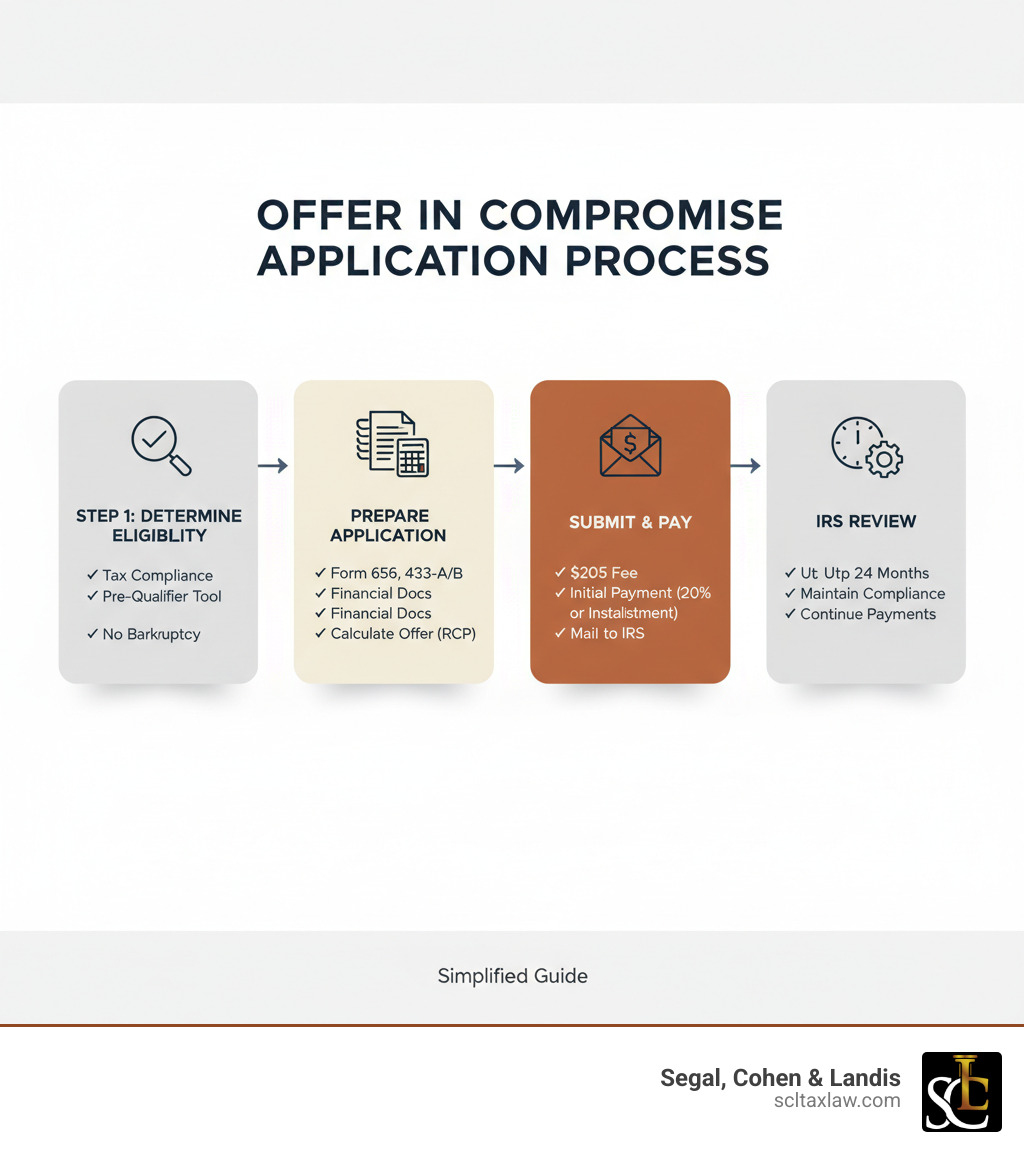
- Check Your Eligibility – Use the IRS Pre-Qualifier Tool and ensure you’ve filed all required tax returns
- Gather Required Forms – Complete Form 656, Form 433-A (individuals) or Form 433-B (businesses), and collect financial documentation
- Calculate Your Offer Amount – Determine your Reasonable Collection Potential based on assets, income, and allowable expenses
- Submit Your Application – Include the $205 application fee and initial payment (20% for lump sum or first installment for periodic payment)
- Wait for IRS Review: Processing time varies. Monitor correspondence and deadlines; the statutory 24-month deemed-acceptance rule has exclusions and depends on the offer’s procedural status.
Despite persistent advertising, an Offer in Compromise isn’t a simple fix for every tax problem. The IRS has strict eligibility requirements and rejects many applications. A successful application requires accurate financial disclosure, substantial documentation, and continued tax compliance during the 6-month to 2-year review period.
Review the relevant notices, filing history, records, and deadlines before choosing a response. Evaluate professional assistance according to the facts, applicable law, and agreed scope of representation.
First, Determine if You’re Eligible for an OIC
Before starting an Offer in Compromise application, you must confirm your eligibility. The IRS has strict requirements and will not consider forgiving past debts unless you are serious about staying current on your taxes.
Tax compliance is non-negotiable. You must have filed all required federal tax returns. For business owners, this also means making all required federal tax deposits for the current and two preceding quarters. If you are self-employed, you must have made all required estimated tax payments for the current year.
You also cannot be in an open bankruptcy proceeding, as tax debt is handled differently in bankruptcy. An OIC is not available during that process.
The IRS provides a helpful tool to save you time: the Offer in Compromise Pre-Qualifier Tool. We recommend starting here. It’s an anonymous, free tool that gives a preliminary answer on whether you qualify and what a potential offer amount might be.
If the pre-qualifier tool suggests you don’t qualify, it has saved you the time and expense of a full application. However, the accuracy of your financial data is critical. If you have exceptional circumstances, such as a serious illness, you might still qualify even if the tool suggests otherwise. In these cases, consult the full Offer in Compromise Booklet (Form 656-B) for guidance.
If an OIC isn’t right for you, other Tax Debt Relief options exist, such as an installment agreement to pay your debt over time.
The Three Grounds for an Offer in Compromise
The IRS evaluates your Offer in Compromise application based on one of three grounds:
- Doubt as to Collectibility: This is the most common ground. It asserts that you cannot pay the full tax debt. The IRS will analyze your income, expenses, and assets to determine the maximum amount they could reasonably collect. Your offer must represent this amount.
- Doubt as to Liability: This is used when you believe the tax debt itself is incorrect. You must provide a detailed written explanation and supporting documents to challenge the assessment. The IRS will investigate the accuracy of the debt before making a decision.
- Effective Tax Administration: This applies in rare cases where you could technically pay the debt, but doing so would cause significant economic hardship or be fundamentally unfair. This might include being unable to meet basic living expenses or other exceptional circumstances where full payment would be against public policy.
Understanding Low-Income Certification
The IRS Low-Income Certification provides significant relief for those struggling financially, removing major barriers to submitting an Offer in Compromise application.
If you qualify, the IRS waives the $205 application fee and the initial payment requirement. Normally, you would have to pay 20% of a lump sum offer or the first installment of a periodic offer. With this certification, no payments are due while the IRS reviews your offer.
Qualification is based on income thresholds that vary by family size and location. Your adjusted gross income (AGI) must fall below specific amounts listed in the Offer in Compromise Booklet (Form 656-B). If you qualify, check the Low-Income Certification box on Form 656. This makes the OIC process accessible for those who need it most.
The Complete Guide to Your Offer in Compromise Application
Once you confirm your eligibility, you can begin preparing your Offer in Compromise application. This process requires careful attention to detail and complete honesty about your finances to convince the IRS that accepting your offer is their best option.

Many people dealing with serious IRS Tax Problems find this process overwhelming. With the right preparation, however, you can steer it successfully.
Step 1: Gather All Required Documentation for Your Application
The IRS needs a complete picture of your financial life. Missing or inconsistent information can cause your application to be returned. You will need:
- Form 656: The official offer proposal, where you state your offer amount and the grounds for it.
- Form 433-A (OIC) for individuals or Form 433-B (OIC) for businesses: A detailed financial statement of your income, expenses, assets, and debts.
- Proof of Income: Pay stubs, profit and loss statements, and documentation for any other income sources.
- Proof of Expenses: Mortgage statements, rent receipts, utility bills, insurance premiums, medical bills, and other necessary living expenses.
- Asset Documentation: Vehicle titles, property deeds, and statements for bank, investment, and retirement accounts.
- Tax Returns: Copies of your federal income tax returns for the last two years.
- Written Statement: A letter explaining any special circumstances, such as a medical crisis or job loss, that contributed to your tax debt.
For a complete list of requirements, refer to the official guide:
Download the Offer in Compromise Booklet (Form 656-B): https://www.irs.gov/pub/irs-pdf/f656b.pdf
Step 2: How to Calculate Your Minimum Offer Amount
Your offer amount isn’t arbitrary; it must be based on your Reasonable Collection Potential (RCP). This is the IRS’s calculation of what they could realistically collect from you.
RCP is calculated based on two components:
- Equity in Your Assets: The net realizable value of what you own (home, car, investments, etc.). The IRS calculates this by taking the fair market value and subtracting any loans against the asset.
- Future Income Potential: The IRS starts with your gross monthly income and subtracts allowable living expenses based on IRS national and local standards. Any income left over is considered your monthly disposable income. This amount is then multiplied by either 12 (for a lump sum offer) or 24 (for a periodic payment offer) to determine your future income potential.
Your offer must generally meet or exceed your RCP, which is the sum of your asset equity and future income potential. This calculation is complex, and an error can jeopardize your application. For more details on this critical step, see The IRS Offer in Compromise: A Taxpayer’s Guide to Settlement with the IRS.
Step 3: Complete and Submit Your Offer in Compromise Application
With your documents and offer amount ready, you can complete and submit your Offer in Compromise application.
Use Form 656 and applicable OIC financial forms for collectibility or effective-tax-administration offers. A genuine liability dispute uses Form 656-L with its distinct requirements and no application fee. Returned offers and rejected offers have different consequences and appeal rights.
You must also include an initial payment. For a lump sum cash offer, this is 20% of your total offer. For a periodic payment option, it’s your first monthly installment. These payments are non-refundable and applied to your tax debt.
Mail your complete application package to the correct address listed in the Form 656-B booklet. Use certified mail for proof of delivery. Check the latest instructions for any electronic submission options. Before sending, make a complete copy of your application for your records.
For more guidance on the OIC process, visit our comprehensive resource on Offer in Compromise.
Choosing Your OIC Payment Option
When submitting your Offer in Compromise application, you must decide how you will pay the proposed amount if the IRS accepts it. Your choice of payment structure can influence the IRS’s decision and what happens during the review process.
The IRS offers two payment paths: the Lump Sum Cash Offer and the Periodic Payment Offer. Understanding their differences is key to structuring a successful offer.
For a deeper look at these strategies, see our guidance on our Offer in Compromise page.
Here’s a comparison of the two options:
| Feature | Lump Sum Cash Offer | Periodic Payment Offer |
|---|---|---|
| Initial Payment | 20% of the total offer amount, submitted with the application. | First proposed monthly installment, submitted with the application. |
| Payment Timeframe | Balance paid in 5 or fewer payments within 5 months of IRS acceptance. | Monthly installments continue while the IRS considers the offer and until paid in full (6 to 24 months). |
| Payments During Review | No further payments required while the IRS reviews (beyond the initial 20%). | Monthly installments continue throughout the IRS review period. |
| Total Payments | 5 or fewer payments. | 6 to 24 monthly installments. |
Lump Sum Cash Offer
The lump sum option is ideal if you can access funds quickly. You must submit a non-refundable payment of 20% of your total offer amount with your application, in addition to the $205 application fee.
If the IRS accepts your offer, you must pay the remaining balance in five or fewer payments within five months of the acceptance date. The IRS often looks more favorably on lump sum offers because they receive payment faster, which can sometimes result in a lower accepted offer amount.
Periodic Payment Offer
The periodic payment option provides flexibility if you cannot afford the 20% upfront payment. You will submit your first proposed monthly installment with your application.
A key difference is that you must continue making these monthly payments while the IRS reviews your offer, with review time depending on the facts and processing. Qualifying low-income individuals are exempt from these ongoing offer payments. If your offer is accepted, you continue these payments until the full amount is paid, typically over a period of 6 to 24 months.
Be aware that missing any of these monthly payments during the review period will cause the IRS to return your offer without appeal rights. This option may result in a slightly higher total offer amount, but it is often the only realistic choice for those with limited immediate funds.
What to Expect After You Apply
After submitting your Offer in Compromise application, monitor IRS correspondence and respond to information requests. The review time depends on the facts and processing; no particular decision date is guaranteed.
IRS Review Process and Timeline:
The IRS reviews the financial statement and supporting documents and may request additional information. The statutory 24-month deemed-acceptance rule excludes periods when liability is disputed in court; pending, returned and withdrawn offers have different procedural consequences. Do not assume an offer is accepted simply because you have not received a decision.
Collection Activity Suspension:
Once your application is pending, the IRS typically halts most collection actions, such as wage garnishments and bank levies. However, interest and penalties will continue to accrue during the review period.
Notice of Federal Tax Lien:
The IRS may file a Notice of Federal Tax Lien during the investigation. This is a standard procedure to protect the government’s interest in your property and does not mean your offer will be rejected.

This waiting period is a challenging phase of resolving your Category: Offer in Compromise issues, but understanding the process can make it more manageable.
If Your Offer is Accepted
An accepted Offer in Compromise application is a significant victory, but it comes with strict conditions.
Terms of Acceptance:
- Payment: You must pay the offer amount exactly as agreed upon in your chosen payment plan.
- 5-Year Compliance Period: For five years after acceptance, you must file all required tax returns on time and pay all new taxes as they become due. Failure to comply puts your entire settlement at risk.
Release of Tax Liens: Current Form 656-B provides for lien release within 45 days after the final offer payment is received and verified. Verification may depend on the payment method. Five-year future filing and payment compliance remains a separate offer condition; immediate release is not guaranteed.
Consequences of Default: If you fail to meet any terms of the agreement, the IRS can revoke the OIC. Your original tax debt, including all accrued interest and penalties, will be reinstated in full, and collection activities will resume.
If Your Offer is Rejected
A rejection is disappointing, but it is not the end of the road. You have options.
Common Rejection Reasons:
The IRS may reject your Offer in Compromise application if they determine you can pay the full debt, your offer is too low compared to your Reasonable Collection Potential, or your application was incomplete or non-compliant.
Right to Appeal:
You have the right to appeal a rejection, but you must act quickly. You have only 30 days from the date on the rejection letter to file Form 13711, Request for Appeal of Offer in Compromise. An independent IRS Appeals Officer will review your case, giving you a chance to explain why you disagree with the decision. An appeal is most effective if you have new information or believe the IRS misunderstood your financial situation.
Learn about the IRS Appeals process: https://www.irs.gov/appeals
Frequently Asked Questions about the OIC Application
When considering an Offer in Compromise application, several questions commonly arise. Here are answers to the most frequent inquiries.
What’s the difference between an OIC and the IRS Fresh Start Program?
This is a common point of confusion. The IRS Fresh Start Initiative is not a single program but a collection of relief options designed to help struggling taxpayers. An Offer in Compromise is one of the most powerful tools available under the Fresh Start umbrella.
Other Fresh Start provisions include more accessible installment agreements and changes to how federal tax liens are handled. The key is to determine which specific option fits your financial situation. An OIC allows you to settle your debt for less than you owe, while other options might involve paying the full amount over time.
For more on this topic, read our guide: What is the Difference Between the IRS Fresh Start Program and an Offer in Compromise?
Are there special OIC rules for businesses?
Yes, the rules for a business Offer in Compromise application are significantly more complex. Businesses must use Form 433-B (OIC), a detailed financial statement for the company.
A critical requirement for businesses with employees is that all required federal tax deposits must be current for the quarter of the application and the two preceding quarters. Failure to meet this rule results in an automatic return of the application.
Compromising trust fund taxes—money withheld from employee paychecks for income tax, Social Security, and Medicare—is extremely difficult. The government views this as money held in trust. Furthermore, business owners or other responsible parties can be held personally liable for these unpaid taxes through the Trust Fund Recovery Penalty (TFRP). This may require a separate, personal OIC application even if the business OIC is accepted. Due to this complexity, professional guidance is highly recommended for business Back Taxes.
Can state tax agencies offer a compromise?
Yes, most states have their own version of an Offer in Compromise program, but the rules and procedures vary significantly from the IRS and from each other.
For example, California’s Employment Development Department (EDD) accepts offers, but its decisions are final with no administrative appeal. On the other hand, it may allow a payment plan of up to five years.
Tennessee’s Department of Revenue will generally only accept an offer if it represents the maximum amount collectible over 3-5 years and often requires approval from the Attorney General and State Comptroller for larger offers.
Each state uses its own forms, has different application fees, and employs unique financial analysis methods. If you owe both federal and state taxes, you must submit separate applications to each agency. Success with one does not guarantee success with the other.
Conclusion
An Offer in Compromise application is a complex but legitimate path to resolving overwhelming tax debt and achieving a financial fresh start. As this guide has shown, the process is demanding and requires meticulous attention to detail.
From verifying eligibility and gathering extensive documentation to accurately calculating your Reasonable Collection Potential and maintaining perfect tax compliance for five years post-acceptance, the stakes are high. The IRS rejects many applications for avoidable errors, leaving taxpayers to face continued collection actions and mounting interest.
Review the relevant notices, filing history, records, and deadlines before choosing a response. Evaluate professional assistance according to the facts, applicable law, and agreed scope of representation.
Review the relevant notices, filing history, records, and deadlines before choosing a response. Evaluate professional assistance according to the facts, applicable law, and agreed scope of representation.
Ready to explore whether an OIC is the right solution for you? We would be honored to help you find the relief you deserve.
Contact our experienced tax attorneys for help with your IRS Offer in Compromise: https://scltaxlaw.com/irs-offer-in-compromise/
Have questions about this topic? Talk to an IRS attorney today.
Segal, Cohen & Landis, P.C. — Beverly Hills. Serving clients nationwide.

Samuel Landis, Esq.
LL.M. (Tax) · Selected to Super Lawyers®
Sam Landis is a Beverly Hills IRS tax attorney specializing in IRS collection defense, audit representation, and international tax compliance for foreign nationals and US expats.