

Understanding the True Cost of Tax Legal Representation
IRS lawyer fees depend on the matter and engagement terms. Request a written explanation of the billing method, scope, retainer and additional costs before retaining counsel.
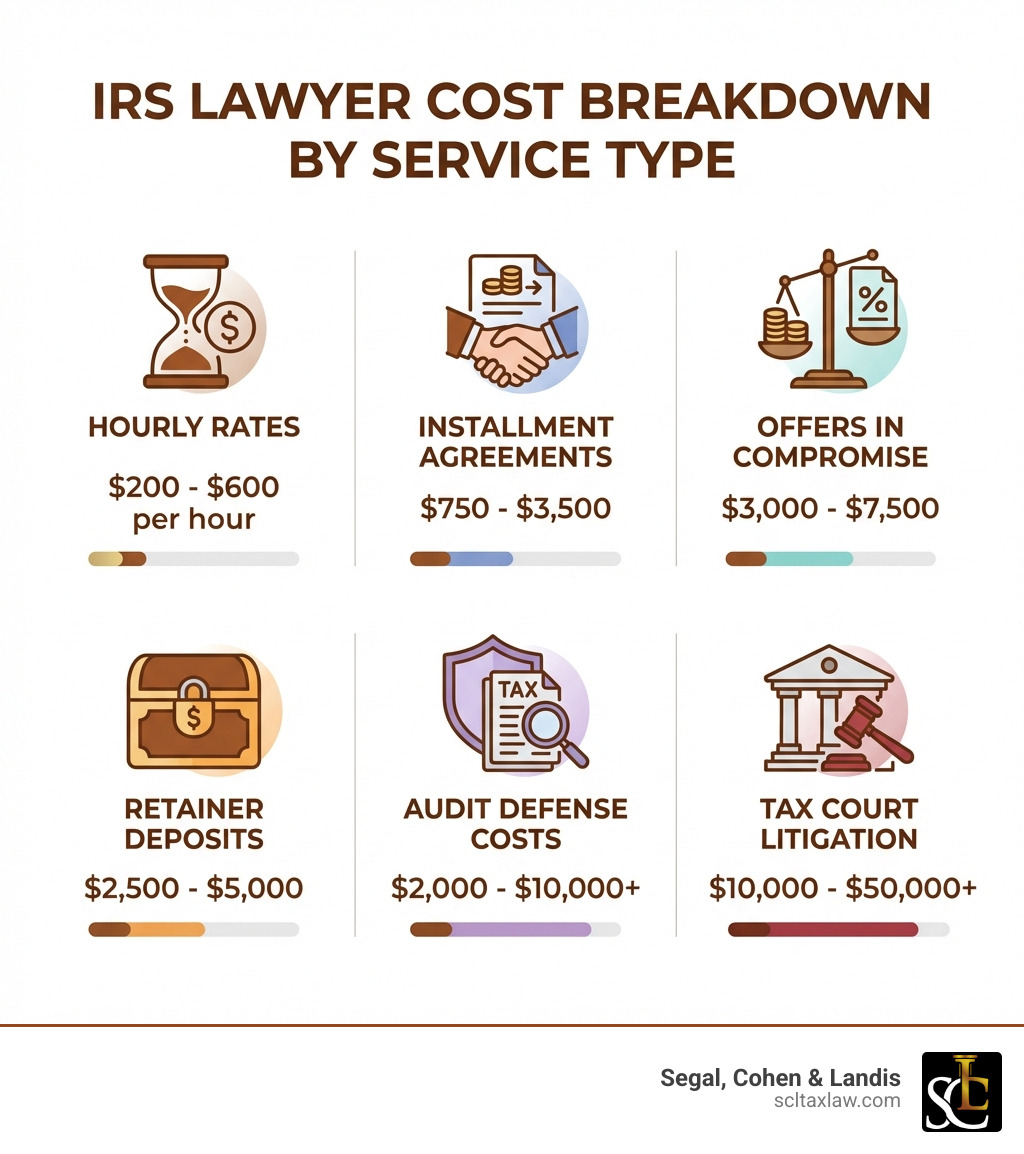
Here’s a quick breakdown of typical costs:
| Service Type | Typical Cost Range |
|---|---|
| Hourly Rates | Varies by engagement; request written fee terms. |
| Flat Fees | Varies by engagement; request written fee terms. |
| Retainers | Varies by engagement; request written fee terms. |
| Installment Agreements | Varies by engagement; request written fee terms. |
| Offer in Compromise | Varies by engagement; request written fee terms. |
| IRS Audit Defense | Varies by engagement; request written fee terms. |
| Tax Court Litigation | Varies by engagement; request written fee terms. |
When you’re facing IRS collection actions, audits, or mounting tax debt, understanding what you’ll pay for expert legal help is crucial. Unlike other tax professionals, IRS lawyers offer attorney-client privilege and can represent you in Tax Court, making them uniquely qualified for serious tax controversies.
The cost of hiring a tax attorney varies significantly based on your case complexity, the attorney’s experience, your location, and the type of service you need. A simple penalty abatement might cost a few hundred dollars, while defending a criminal tax investigation can run tens of thousands.
This guide discusses irs lawyer fees a comprehensive guide to understanding the investment. Review the applicable rules and facts, and verify the qualifications and scope of any proposed representation.
How much does an irs lawyer cost vocab to learn:
Common Fee Structures: Hourly, Flat, and Retainers
When you seek legal assistance for tax matters, one of the first things you’ll encounter is how attorneys structure their fees. Understanding these different approaches is key to budgeting and making an informed decision. The primary fee structures you’ll see are hourly rates, flat fees, and retainers. According to the 2025 Legal Trends Report, these models continue to be the most prevalent across the legal industry.
Hourly Rate Averages
Request written engagement terms describing the scope of work, billing method, rates, retainer and additional costs. Fees vary by matter; confirm the terms before retaining counsel.
- Fees depend on the scope and terms of the engagement. Request current written terms stating the billing method, rates, retainer and additional costs.
- Case Complexity: The more intricate your tax issue, the more time and specialized knowledge it will require, leading to a higher total hourly bill.
- Geographic Location: Attorneys in areas with a higher cost of living and greater demand for specialized tax expertise, like Los Angeles, San Francisco, or Manhattan, tend to have higher hourly rates than those in smaller cities. For more detailed insights into local costs, you can explore resources like our guide on Average Costs of Hiring a Tax Attorney in Los Angeles.
Attorneys typically record their time in small increments, often 6 to 15 minutes, for every task performed, from phone calls and emails to research and drafting documents. This ensures you’re billed accurately for the work done.
Flat Fee Arrangements
Flat fees offer predictability, which many clients appreciate. With a flat fee, you pay a single, agreed-upon price for a specific service, regardless of the hours the attorney ultimately spends on the case. This structure is generally reserved for more routine or standardized services where the scope of work is clearly defined and predictable.
Examples of services often offered on a flat-fee basis include:
- Preparing and filing unfiled tax returns: If the situation is relatively straightforward.
- Penalty abatement requests: For common penalties where the arguments are well-established.
- Setting up basic installment agreements: For taxpayers with manageable debt and clear financial situations.
- Simple IRS audits: Where the issues are limited and the documentation is readily available.
Costs depend on the services, provider and circumstances. Obtain current written terms and confirm the scope, charges and additional expenses before committing.
How Retainers Work
Retainer agreements are common for cases that are expected to be ongoing, complex, or involve a significant amount of work over an extended period, such as multi-year unfiled returns, tax court litigation, or business audits. A retainer is an upfront deposit paid by the client into a trust account. As the attorney works on your case and bills for their time (usually at an hourly rate), the fees are drawn down from this retainer.
Fees depend on the scope and terms of the engagement. Request current written terms stating the billing method, rates, retainer and additional costs.
Here’s how it generally works:
- Initial Deposit: You pay an initial sum to the law firm.
- Trust Account: This money is held in a special client trust account and is not yet considered earned by the attorney.
- Billing Drawdowns: As the attorney performs work, their hourly fees are deducted from the retainer.
- Replenishment: If the retainer falls below a certain level, you may be asked to replenish it (this is sometimes called an “evergreen retainer”).
- Refund: Any unused portion of the retainer is refunded to you at the conclusion of the case.
Retainers are particularly common in high-risk situations involving IRS criminal investigations, tax court experience, or intricate business tax audits, where the scope and duration of work can be difficult to predict.
How Much Does an IRS Lawyer Cost?
The question of how much does an IRS lawyer cost is best answered by looking at the specific service required, as costs can vary dramatically depending on the nature and complexity of your tax issue. From audit defense to complex litigation, each service has its own cost considerations.
Here’s a general comparison of costs for some common tax services:
| Service Type | Typical Cost Range | Key Factors Influencing Cost |
|---|---|---|
| IRS Audit Defense | Varies by engagement; request written fee terms. | Complexity of audit, number of years, documentation, business vs. individual |
| Offer in Compromise (OIC) | Varies by engagement; request written fee terms. | Financial analysis required, debt amount, negotiation complexity |
| Installment Agreements | Varies by engagement; request written fee terms. | Debt amount, unfiled returns, financial disclosure needs |
| Penalty Abatement | Varies by engagement; request written fee terms. | Type of penalty, reason for abatement, documentation |
| Tax Court Litigation | Varies by engagement; request written fee terms. | Case complexity, findy, trial preparation, duration |
| Wage Garnishment/Levy Release | Varies by engagement; request written fee terms. | Urgency, negotiation with IRS, complexity of financial situation |
| Business Tax Resolution | Varies by engagement; request written fee terms. | Payroll tax issues, entity type, multi-year problems |
Review the relevant notices, filing history, records, and deadlines before choosing a response. Evaluate professional assistance according to the facts, applicable law, and agreed scope of representation. Related resources: IRS Audit Representation.
Understanding how much does an irs lawyer cost for audit defense
Fees depend on the scope and terms of the engagement. Request current written terms stating the billing method, rates, retainer and additional costs.
- Simple Audits: Request written engagement terms describing the scope of work, billing method, rates, retainer and additional costs. Fees vary by matter; confirm the terms before retaining counsel.
- Fees depend on the scope and terms of the engagement. Request current written terms stating the billing method, rates, retainer and additional costs.
Our role in audit defense is to communicate directly with the IRS on your behalf, gather and present necessary documentation, and negotiate the best possible outcome. This involves understanding tax law, anticipating IRS arguments, and protecting your rights throughout the process.
Calculating how much does an irs lawyer cost for debt resolution
For taxpayers burdened by significant tax debt, resolution options like an Offer in Compromise (OIC) or Installment Agreements can provide much-needed relief. The costs associated with these services reflect the detailed financial analysis and negotiation expertise required.
- Offer in Compromise (OIC): Request written engagement terms describing the scope of work, billing method, rates, retainer and additional costs. Fees vary by matter; confirm the terms before retaining counsel. Related resources: IRS Offer in Compromise.
- Installment Agreements: Costs depend on the services, provider and circumstances. Obtain current written terms and confirm the scope, charges and additional expenses before committing.
- Fees depend on the scope and terms of the engagement. Request current written terms stating the billing method, rates, retainer and additional costs.
Navigating these debt resolution pathways requires a deep understanding of IRS procedures and financial analysis to present your case effectively and secure the most favorable terms.
Costs for Specialized Tax Issues
Beyond general audits and debt resolution, tax attorneys handle a variety of specialized issues, each with its own cost implications.
- Penalty Abatement: Costs depend on the services, provider and circumstances. Obtain current written terms and confirm the scope, charges and additional expenses before committing. Related resources: IRS Penalty Abatement.
- Tax Liens: Request written engagement terms describing the scope of work, billing method, rates, retainer and additional costs. Fees vary by matter; confirm the terms before retaining counsel.
- Wage Garnishment / Levy Release: Contact Segal, Cohen & Landis (SCL) to discuss the tax matter, relevant notices and deadlines, and available response options. Confirm the qualifications of the proposed representative and the scope of the engagement.
- Tax Court Litigation: Contact Segal, Cohen & Landis to discuss the tax matter, relevant notices and deadlines, and available response options. Confirm the qualifications of the proposed representative and the scope of the engagement.
These specialized services highlight the value of an experienced tax attorney who can steer the intricacies of the tax code and IRS procedures to protect your financial interests.
Factors, Alternatives, and Strategic Value
Understanding how much does an IRS lawyer cost involves more than just looking at average price lists; it requires considering the factors that influence those costs, the alternatives available, and the long-term strategic value an attorney provides.
When to Hire an Attorney vs. CPA or EA
Many professionals can assist with tax matters, including Certified Public Accountants (CPAs) and Enrolled Agents (EAs). However, there are critical distinctions, especially when it comes to serious tax issues.
- Attorney-Client Privilege: This is a cornerstone of legal representation and a significant advantage of hiring a tax attorney. Communications between you and your attorney are confidential and legally protected, even during initial consultations. This means sensitive information discussed cannot be compelled in court. CPAs and EAs do not offer the same level of privilege, which can be crucial in cases involving potential criminal investigations or fraud allegations.
- Representation requires admission to the U.S. Tax Court. Attorneys must apply, and qualified nonattorneys may be admitted under Rule 200. CPA or enrolled-agent credentials alone do not confer court admission.
- Criminal Investigations: If your tax issue involves allegations of fraud or potential criminal charges, a tax attorney is essential. Their legal training and understanding of criminal law are vital for protecting your rights.
- Legal Interpretation: Tax attorneys are trained in legal analysis and interpretation, which is invaluable for complex tax planning, understanding nuances of tax law, or challenging IRS legal positions.
For routine tax preparation or less complex audits, a CPA or EA might be a more cost-effective first step. However, for serious disputes, litigation, or when attorney-client privilege is paramount, an IRS lawyer is the clear choice. You can verify credentials of tax professionals, including lawyers, through the IRS’ online database.
Saving Money and Low-Cost Options
While the cost of a tax attorney can seem substantial, there are ways to manage expenses and find assistance.
- Review the relevant notices, filing history, records, and deadlines before choosing a response. Evaluate professional assistance according to the facts, applicable law, and agreed scope of representation.
- Flat-Fee Requests: For defined, routine services, always inquire if a flat-fee arrangement is possible. This provides cost predictability and can sometimes be more economical than hourly billing for specific tasks.
- Self-Representation: For very simple tax issues (e.g., owing less than $10,000, easy documentation, no legal threats), you might consider resolving the matter yourself. Resources like IRS publications and online guides are available. However, the U.S. tax code is notoriously complex, and self-representation can be risky, potentially leading to costly mistakes or missed opportunities. We generally advise against self-representation for anything beyond the most basic issues.
- Low-Income Tax Clinics (LITCs): For individuals with income below certain thresholds, Low-Income Taxpayer Clinics (LITCs) offer free or low-cost legal help. These clinics, often affiliated with law schools or non-profit organizations, can represent you in audits, appeals, and tax court. You can locate a local clinic on the Taxpayer Advocate Service website. Eligibility is based on income and the amount of tax in dispute.
Sometimes paying for expert legal help upfront can save you significantly more in reduced penalties, interest, or tax liability in the long run.
Strategic Questions for Your Consultation
The initial consultation is your opportunity to assess an attorney’s fit for your case and clarify all cost-related questions. Here are strategic questions we recommend asking:
- Experience:
- What is your experience with cases similar to mine?
- Have you represented clients before the IRS or in Tax Court for this type of issue?
- What is your success rate or typical outcomes for these cases?
- Fee Transparency:
- What is your fee structure (hourly, flat fee, retainer, or a combination)?
- What is your hourly rate, and how do you bill for time (e.g., 6-minute increments)?
- What is the estimated total cost for my case, or a range?
- What is included in your fee, and what are potential additional costs (e.g., filing fees, expert witness fees, travel)?
- Do you offer payment plans?
- Will I receive a written fee agreement or engagement letter?
- Communication & Process:
- Who will be primarily working on my case, and what are their credentials?
- How often can I expect updates, and what is your preferred communication method?
- What is the estimated timeline or duration for resolving my case?
- What documents or information do you need from me?
- What are the potential outcomes, both positive and negative, for my situation?
Asking these questions upfront ensures clarity, helps you compare attorneys effectively, and sets clear expectations for your legal journey.
Long-Term Financial Benefits
While the immediate question of how much does an IRS lawyer cost can be a concern, it’s crucial to view these fees as a strategic investment rather than just an expense. The long-term financial benefits of hiring a skilled tax attorney often far outweigh the upfront costs.
- Return on Investment (ROI): A seasoned tax attorney can often negotiate a significant reduction in your tax debt, penalties, or interest, saving you thousands more than their fees. For example, a successful Offer in Compromise or penalty abatement can dramatically reduce your overall liability.
- Penalty Reduction: Attorneys are adept at arguing for penalty abatements, which can save clients a substantial amount. Even a $1,000 penalty abatement can be a significant win.
- Asset Protection: In cases involving liens, levies, or wage garnishments, an attorney can act swiftly to protect your assets, preventing the IRS from seizing your property or income.
- Avoiding Litigation: Expert negotiation and representation can often resolve issues at lower administrative levels, helping you avoid the much higher costs and stress associated with Tax Court litigation.
- Peace of Mind: Navigating complex tax issues alone can be incredibly stressful. Having an experienced advocate by your side provides peace of mind, knowing your case is handled professionally and your rights are protected.
- Tax-Deductible Fees: In certain situations, tax attorney fees may be tax-deductible. If the attorney’s work is directly related to earning taxable income or managing income-producing property (such as business tax issues), their fees may qualify as deductions. This can further reduce the net cost of legal services.
Hiring the right tax attorney is an investment in your financial future, protecting you from potentially greater losses and ensuring a more favorable resolution with the IRS.
Frequently Asked Questions
Are tax attorney fees tax-deductible?
Deductibility depends on the origin and nature of the matter and applicable restrictions. Distinguish qualifying trade/business expenses from personal and investment expenses; do not imply that investment-related tax advice is automatically deductible. Related guidance: IRS publications.
How do business tax attorney fees differ from individual fees?
Fees depend on the scope and terms of the engagement. Request current written terms stating the billing method, rates, retainer and additional costs.
What is the average retainer for a tax lawyer?
Request written engagement terms describing the scope of work, billing method, rates, retainer and additional costs. Fees vary by matter; confirm the terms before retaining counsel.
Conclusion
Understanding how much does an IRS lawyer cost is a vital first step when facing tax challenges. While the figures might seem daunting, it’s clear that the expertise, strategic guidance, and legal protections offered by a qualified tax attorney often represent an invaluable investment. From navigating complex audits and negotiating debt resolution to representing you in Tax Court, the right legal professional can save you significant time, stress, and financial burden in the long run.
Contact Segal, Cohen & Landis to discuss the tax matter, relevant notices and deadlines, and available response options. Confirm the qualifications of the proposed representative and the scope of the engagement.
Resolve your back taxes today with a team you can trust.
Have questions about this topic? Talk to an IRS attorney today.
Segal, Cohen & Landis, P.C. — Beverly Hills. Serving clients nationwide.

Samuel Landis, Esq.
LL.M. (Tax) · Selected to Super Lawyers®
Sam Landis is a Beverly Hills IRS tax attorney specializing in IRS collection defense, audit representation, and international tax compliance for foreign nationals and US expats.