
Your Property Tax Bill Is Not Final — Here’s What You Can Do About It
California property tax protest is the formal process of challenging your county assessor’s valuation of your property — and it can save you thousands of dollars every year.
Here’s the quick version of how it works:
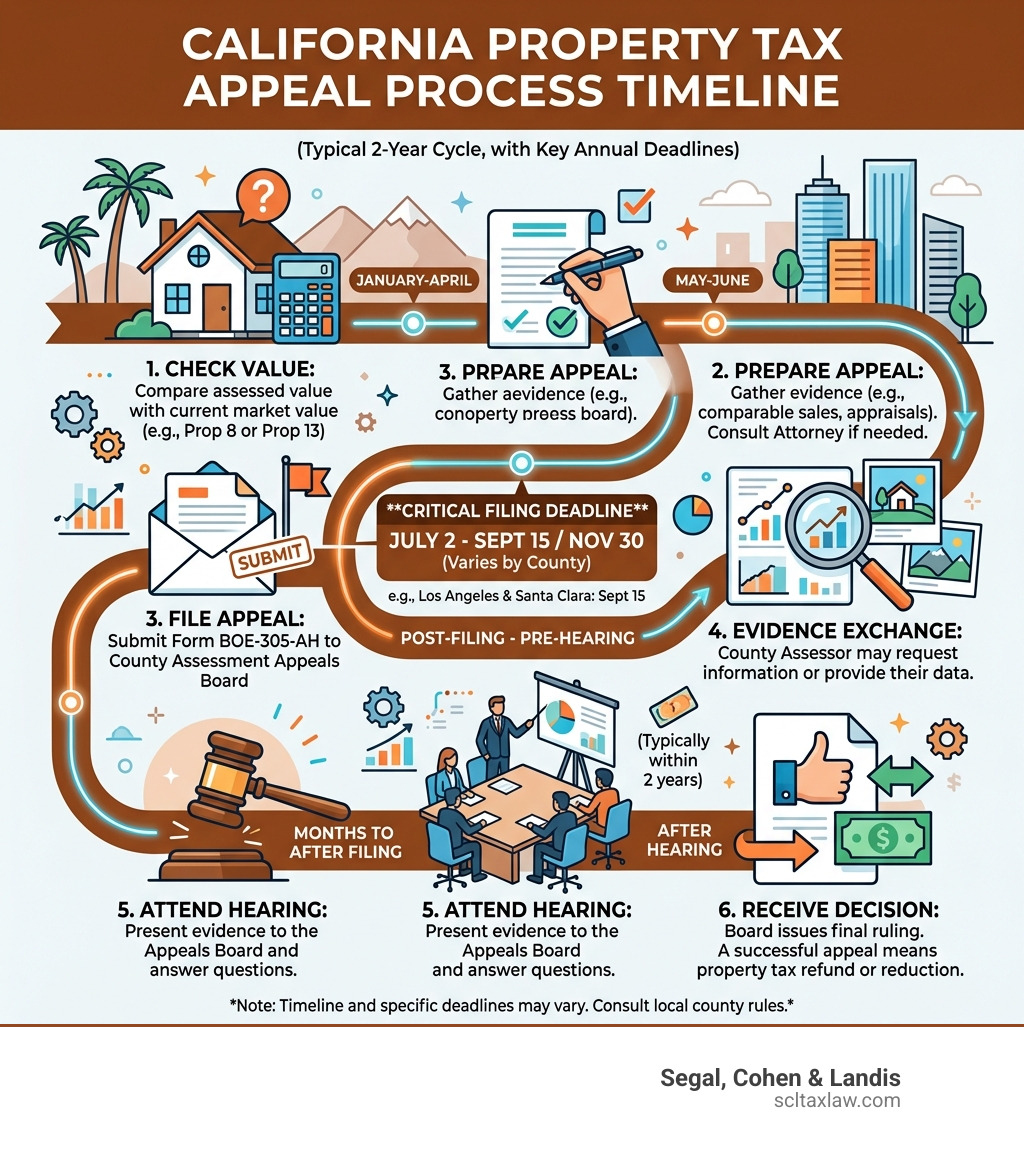
- Check your assessed value against current market value (look up recent sales of similar homes nearby)
- Determine your appeal type — either a Prop 8 decline-in-value claim or a Prop 13 base year dispute
- File Form BOE-305-AH with your county’s Assessment Appeals Board before the deadline
- Gather evidence — comparable sales, appraisals, photos of property issues
- Attend your hearing and present your case to the board
- Receive a decision — if you win, you get a refund with interest
Key deadlines: Most counties accept appeals from July 2 through November 30. Some counties (including Los Angeles and Santa Clara) cut off at September 15. Missing the deadline means waiting another full year.
Most California homeowners don’t realize their assessed value can be wrong — and that the county won’t fix it automatically. During market downturns, the gap between what your property is worth and what you’re being taxed on can grow quietly, year after year, without any correction unless you take action.
The stakes are real. Reducing your assessed value by $100,000 saves roughly $1,000 per year in property taxes. Over a decade, that’s $10,000 or more from a single successful appeal.
This guide discusses protesting your california property tax assessment like a pro. Review the applicable rules and facts, and verify the qualifications and scope of any proposed representation.
Understanding the Legal Framework: Proposition 13 vs. Proposition 8

In California, your property taxes are governed by a unique interplay between two landmark laws. Understanding the difference between them is the first step toward a successful California property tax protest.
Proposition 13 is the foundation of our system. Passed in 1978, it established that a property’s base year value is determined when it changes ownership or is newly constructed. From there, the assessed value can only increase by a maximum of 2% per year (or the rate of inflation, whichever is lower). This “factored base year value” provides long-term stability but can become disconnected from reality if the market takes a dive.
Proposition 8 is the “safety valve.” It allows for a temporary reduction in assessed value when the current fair market value of your property falls below its Prop 13 factored base year value. This is known as a decline-in-value appeal. Unlike Prop 13 protections, Prop 8 reductions are not permanent. The assessor reviews these values annually; as the market recovers, they can raise your assessment back up to the Prop 13 limit—sometimes by much more than 2% in a single year—until it reaches the original “protected” trajectory.
To win an appeal, you must prove that on the lien date (January 1), the market value was lower than the value on your tax bill. For more details on the formal rules, you can review the Assessment Appeals .
The Role of the County Assessor
The County Assessor is responsible for discovering all taxable property and establishing its fair market value. However, they aren’t mind readers. They generally only reassess property when a “triggering event” occurs, such as:
- A change in ownership (buying a new home).
- Completion of new construction (adding a bedroom or a pool).
- Major renovations or entity transfers.
Because the assessor’s office handles thousands of parcels, they often rely on mass appraisal techniques that miss the specific nuances of your home. If you believe they’ve missed the mark, you may need a Property Tax Appeal Lawyer Near Me to help bridge the gap between their estimate and your home’s true worth.
Why Market Fluctuations Matter in 2026
As we move through April 2026, we are seeing significant shifts in the real estate landscape. While residential markets in some areas remain stable, the commercial real estate and multifamily sectors have faced dramatic value declines in recent years. High interest rates and changing occupancy patterns have left many office buildings and apartment complexes overassessed.
If you own a property that has seen its value plateau or drop since 2024, your January 1, 2025, valuation (which dictates your 2025-2026 taxes) might be significantly inflated. Protesting now isn’t just a right; it’s a necessary move for tax optimization.
Deadlines and Eligibility for the 2025-2026 Tax Year
Timing is everything in a California property tax protest. If you miss the window, the board loses jurisdiction, and you are stuck with your bill.
| County Group | Filing Deadline |
|---|---|
| Regular California property assessment appeal periods depend on the county-certified filing period and assessment type. Confirm the current county deadline and roll year before filing; a prior-year appeal is not universally timely in 2026. | September 15 |
| Standard Deadline Counties (Most other CA counties) | November 30 |
The filing window officially opens on July 2. We always recommend filing as early as possible to avoid the last-minute rush. If November 30 falls on a weekend, the deadline typically moves to the next business day (in 2025, this meant December 1).
Beyond the regular roll, you might also encounter supplemental assessments. These occur when you buy a property or finish construction mid-year. You have a strict 60-day rule from the date of the notice to file an appeal. Similarly, if your property was damaged by a fire or flood, you may qualify for a calamity reassessment, but you must file within six months of the reassessment notice. More info on decoding your LA tax bill can help you identify these specific line items.
Who Can File an Appeal?
You are eligible to file a California property tax protest if you are:
- The property owner.
- An authorized agent (such as an attorney or consultant) with a signed authorization.
- A person with a direct economic interest (like a tenant who is contractually obligated to pay the taxes).
If a spouse, parent, or child is filing on your behalf, they generally do not need to be designated as an agent, but they must state their relationship on the BOE-305-AH form. If you are appealing on behalf of a corporation, the form must be signed by an officer of the company, not just an outside agent.
Step-by-Step Guide to a California Property Tax Protest
Filing a protest can feel like a bureaucratic maze, but following a structured process increases your success rate significantly.
- Informal Review: Before filing a formal appeal, call the county assessor’s office. Many counties offer a “Prop 8 Request for Review” between January and June. This is a faster, free way to resolve clear-cut cases of market decline without a hearing.
- Obtain Form BOE-305-AH: This is the “Application for Changed Assessment.” You can get this from your county’s Clerk of the Board.
- Submit the Application: Fill out the form meticulously. Ensure your “Opinion of Value” is based on data, not a guess. Some counties charge small filing fees (usually $30–$60).
- Wait for Your Hearing: Once filed, the board has up to two years to hear your case. You will receive a notice at least 45 days before your scheduled date.
For a deeper dive into the mechanics, see this How to Appeal Property Taxes in California guide.
Evidence Needed for a Successful California Property Tax Protest
The board makes decisions based on facts, not feelings. To win, you need a “preponderance of evidence.”
- Comparable Sales: This is the gold standard for residential property. Find 3–5 similar homes that sold near the January 1 lien date. Under the 90-day rule, the board generally won’t consider sales that occurred more than 90 days after the valuation date.
- Professional Appraisal: While not required, a formal appraisal from a certified professional can be highly persuasive.
- Property Condition: If your home has foundation issues, termite damage, or an ancient roof, document it. Photographs and repair estimates from licensed contractors are essential.
- Factual Errors: Review the property record for factual inaccuracies, such as incorrect square footage, and gather evidence supporting any proposed correction.
Navigating the Assessment Appeals Board Hearing
The hearing is a quasi-judicial proceeding. This means it’s less formal than a courtroom but still follows specific rules of evidence.
- Burden of Proof: For owner-occupied single-family homes, the burden of proof usually rests on the assessor to prove their value is correct. For commercial or non-owner-occupied properties, the burden is typically on you.
- Oral Testimony: You will present your case first. Be concise. Focus on your comparables and property condition.
- Cross-Examination: The assessor’s representative may ask you questions, and you have the right to question their data as well.
- Stipulation: Often, the assessor will contact you before the hearing to offer a compromise. If you agree, you sign a stipulation, and the hearing is canceled.
- Written Findings of Fact: If you plan to challenge the board’s decision in Superior Court, you must request “written findings of fact” before the hearing ends. There is usually an extra fee for this.
Risks and Financial Considerations of Appealing
While the rewards of a California property tax protest are high, you should be aware of the risks.
The most significant risk is an assessment increase. While rare for residential properties, the board does have the power to raise your value if the evidence suggests the assessor actually undervalued your home. This is why we advise against “speculative” filing. Only appeal if the data clearly supports a lower value.
A contingency arrangement may tie legal fees to savings, but the engagement may involve costs and an appeal can increase assessed value where permitted. Review the governing rules and written fee agreement. Related guidance: Los Angeles Tax Attorney Guide.
Paying Taxes During a Pending Appeal
One of the biggest mistakes taxpayers make is withholding payment while waiting for a hearing. Do not do this. You must pay your property taxes in full and on time to avoid delinquency penalties (10%) and interest.
If you win your appeal, the county will initiate a refund process. You will receive the overpaid amount plus interest. Because the 2-year resolution rule allows counties a long time to schedule hearings, you could be waiting a while for that check, so plan your cash flow accordingly.
Common Mistakes in a California Property Tax Protest
- Missing Deadlines: There are no extensions. A postmark one day late will disqualify you.
- Insufficient Comparables: Using active listings instead of closed sales. The board only cares about what homes actually sold for.
- Agent Authorization Errors: Failing to have the property owner sign the authorization section of the BOE-305-AH.
- Emotional Arguments: Complaining that “taxes are too high” or “I can’t afford this.” The board only cares about fair market value.
- Ignoring the Lien Date: Presenting sales from 2026 for a 2025 valuation. Your evidence must center around January 1 of the tax year in question.
Frequently Asked Questions about California Property Tax Appeals
Can the board increase my property taxes if I lose the appeal?
Yes, legally they can. If the board determines that the fair market value is actually higher than the assessor’s current value, they can raise your assessment. However, this is extremely uncommon for residential homes unless a major error is discovered during the process.
Do I need to hire a professional for a residential appeal?
Not necessarily. Many homeowners successfully represent themselves in straightforward Prop 8 cases. However, if you are dealing with a complex Prop 13 base year dispute, high-value commercial property, or a legal entity transfer, the expertise of a tax attorney can be invaluable in navigating the technicalities.
How long does it take to receive a refund after winning?
Once the board issues a decision, it typically takes the Auditor-Controller 2 to 6 months to process the refund. In total, the journey from filing the appeal to receiving a check can take anywhere from 6 to 18 months.
Conclusion
A California property tax protest is one of the most effective ways to protect your financial interests as a property owner. Whether you are dealing with a simple decline in residential value or a complex commercial overassessment, the key is preparation, timing, and evidence.
Contact Segal, Cohen & Landis (SCL) to discuss the tax matter, relevant notices and deadlines, and available response options. Confirm the qualifications of the proposed representative and the scope of the engagement. Related resources: Contact a San Francisco Tax Attorney.
Have questions about this topic? Talk to an IRS attorney today.
Segal, Cohen & Landis, P.C. — Beverly Hills. Serving clients nationwide.

Samuel Landis, Esq.
LL.M. (Tax) · Selected to Super Lawyers®
Sam Landis is a Beverly Hills IRS tax attorney specializing in IRS collection defense, audit representation, and international tax compliance for foreign nationals and US expats.