

When You Can’t Pay Your Tax Bill in Full, an IRS Installment Agreement Can Help
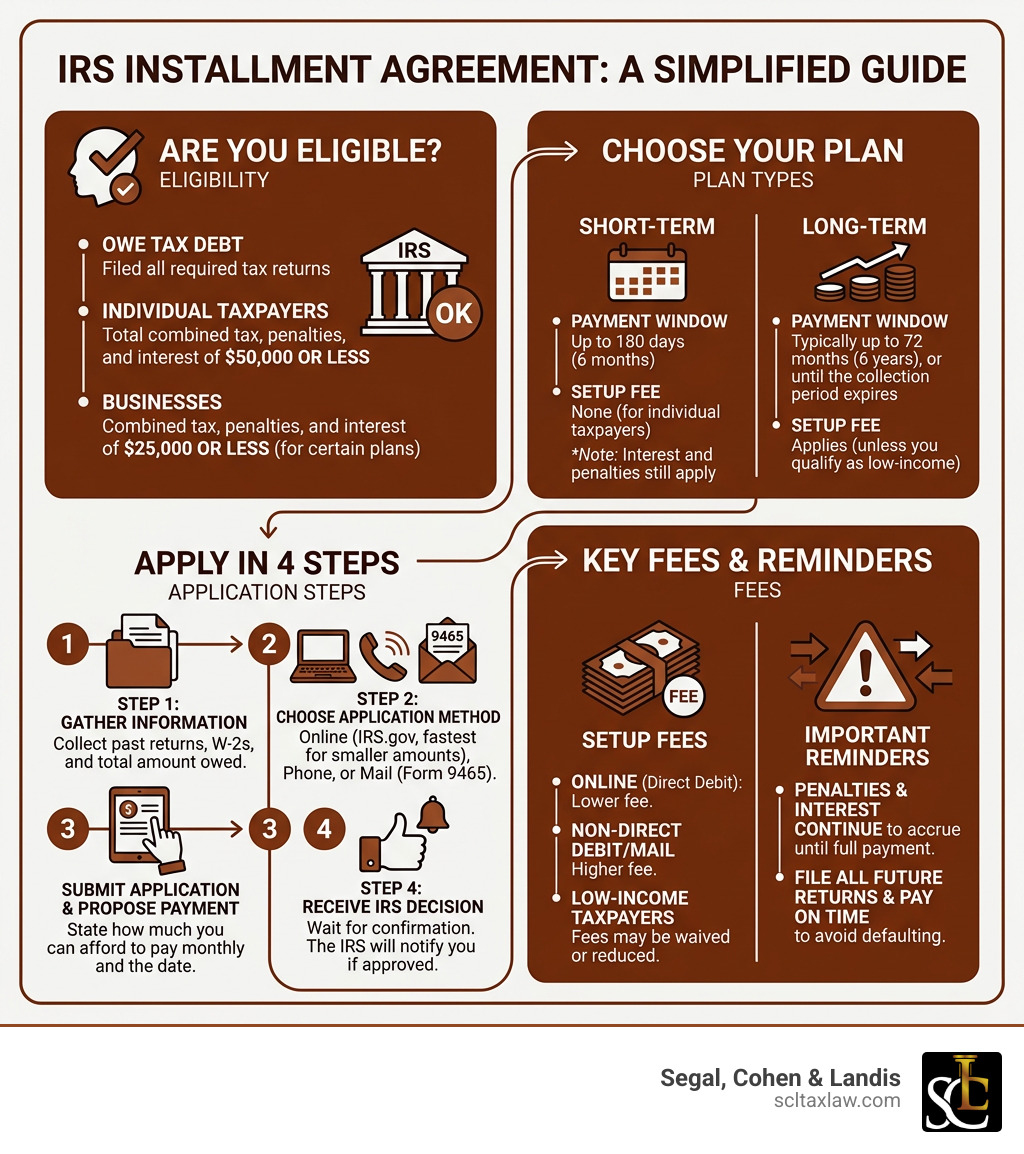
An IRS installment agreement is an official payment plan that lets you pay your tax debt over time instead of all at once. Here’s a quick overview of how it works:
- What it is: A formal agreement with the IRS to make monthly payments toward your tax balance
- Who qualifies: Most individual taxpayers owing $50,000 or less, and businesses owing $25,000 or less
- How to apply: Online at IRS.gov, by phone at 800-829-1040, or by mail using Form 9465
- How long you have: Up to 180 days (short-term) or up to 10 years (long-term)
- Key catch: Penalties and interest keep accruing until your balance is paid in full
A surprise tax bill is stressful. And when you can’t pay it all at once, it’s easy to feel like the IRS is closing in on you.
The good news? More than 90% of individual taxpayers qualify for some form of payment plan. The IRS would rather work with you than chase you — and a properly set-up installment agreement can stop collection actions in their tracks while you pay down what you owe.
But getting the right plan matters. The wrong setup can mean higher fees, continued enforcement actions, or a default that makes things worse.
IRS installment agreements: Review the relevant notices, filing history, records, and deadlines before choosing a response. Evaluate professional assistance according to the facts, applicable law, and agreed scope of representation.
Understanding the IRS installment agreement and Eligibility

At its core, an IRS installment agreement is a contract. You promise to pay a specific amount every month, and in exchange, the IRS agrees to stop aggressive collection tactics like bank levies or wage garnishments. However, it’s important to understand that this isn’t a “get out of jail free” card—interest and late-payment penalties will continue to grow until the balance is zero.
To qualify for a plan, you must first be in “filing compliance.” This means you have filed all required tax returns for past years. If you have unfiled tax returns, the IRS will generally reject your request for a payment plan until those records are up to date.
Individual and Business Limits
The IRS has specific thresholds for “self-service” or streamlined approval:
- Individuals: You generally qualify for a long-term plan if your combined tax, penalties, and interest total $50,000 or less. If you owe more, the IRS typically requires a more detailed look at your finances.
- Businesses: For a business to set up a plan online, the debt must be $25,000 or less from the current and preceding tax year.
Review the relevant notices, filing history, records, and deadlines before choosing a response. Evaluate professional assistance according to the facts, applicable law, and agreed scope of representation. Related resources: Online payment agreement application; complete guide to tax debt resolution.
Types of IRS Payment Plans Available
Not all tax debts are created equal, and the IRS offers several “flavors” of payment plans depending on how much you owe and how quickly you can pay it back. Understanding these options is the first step in managing back taxes effectively.
Short-Term vs. Long-Term IRS installment agreement Options
- Short-Term Payment Plan: If you can pay your full balance within 180 days, this is often your best bet. There is no setup fee for this plan, though interest and penalties still apply. This is available for individual balances under $100,000.
- up to 10 years for most qualifying Simple Payment Plan taxpayers, subject to the applicable collection period
Streamlined, Guaranteed, and Partial Payment Plans
- Guaranteed Installment Agreements: A guaranteed installment agreement under IRC 6159(c) applies to qualifying individual income-tax liabilities of $10,000 or less, excluding penalties and interest for that threshold. Payment must be completed within three years, and the statutory filing, payment, prior-agreement, ability-to-pay and future-compliance conditions must be met.
- Streamlined Agreements: These are for debts up to $50,000. They don’t require the IRS to dig into your monthly grocery bills or equity in your home, making the approval process much faster.
- Partial Payment Installment Agreement (PPIA): This is a powerful but often overlooked resolution alternative. A PPIA allows you to make monthly payments based on what you can actually afford after necessary living expenses. If you still owe money when the 10-year collection statute expires, the remaining debt may be forgiven. Because this requires a deep dive into your finances (using Form 433-F), professional representation is highly recommended.
Step-by-Step: Applying for an IRS installment agreement
Applying for a plan has become significantly easier thanks to IRS self-service payment plan options. Here is how you can get started.
Using the Online Payment Agreement Tool
For most taxpayers, the Online Payment Agreement (OPA) tool is the fastest route.
- Verify Identity: You will need to log in or create an account through ID.me.
- Check Eligibility: The system will automatically pull your balance and tell you which plans you qualify for.
- Propose a Payment: You’ll select a monthly payment amount and a due date (any day from the 1st to the 28th).
- Immediate Notification: In many cases, you’ll receive an approval message instantly.
Applying by Mail with Form 9465
If you aren’t tech-savvy or don’t qualify for the online tool, you can go the paper route.
- Download Form 9465: This is the standard “Installment Agreement Request.”
- Include Form 433-F: If you owe more than $50,000, you must attach this Collection Information Statement to show the IRS your assets, income, and expenses.
- Mail it in: Send the forms to the address listed in the instructions (this varies by where you live). Mail processing can take 30 days or longer.
Costs, Fees, and the Benefits of Direct Debit
The IRS charges a “user fee” to set up a long-term IRS installment agreement. These fees vary wildly based on how you apply and how you pay.
- The “Expensive” Way: Applying by phone, mail, or in person and paying by check or money order can cost up to $178.
- $29 for online direct debit setup; other setup or revision fees depend on the application method, agreement and low-income eligibility
- Low-Income Taxpayers: If your income is at or below 250% of the federal poverty level, you may qualify for a fee waiver or a reimbursement of the fee once the plan is completed.
We always recommend the Direct Debit Installment Agreement (DDIA). Not only is it cheaper, but it also virtually eliminates the risk of forgetting a payment and defaulting on your plan.
Managing Your Plan: Modifications and Avoiding Default
Life happens. Maybe you changed banks, or perhaps a medical emergency means you can’t afford your $500 monthly payment this month.
You can modify your existing plan online for a small fee (usually $10). This allows you to change your payment amount, your monthly due date, or your bank account information. If you find yourself facing new IRS tax problems, don’t just stop paying.
The Danger of Default
If you miss a payment, the IRS will send a CP523 Notice (Notice of Intent to Terminate Your Installment Agreement). You typically have 30 days to fix the issue before the agreement is officially canceled. Once you default:
- Review the actual CP523 notice deadline promptly. Levy restrictions ordinarily continue during the protected termination and appeal periods, subject to applicable exceptions. See Notice of Intent to Levy.
- You will owe a reinstatement fee (around $89) to get back on a plan.
- The IRS may file a tax lien, which can complicate selling your home or getting a loan.
Alternatives to a Standard Payment Plan
If an IRS installment agreement feels like a mountain you can’t climb, there are other paths to relief.
- Offer in Compromise (OIC): This is the “settle for less” option. If you can prove you’ll never be able to pay the full debt, the IRS may accept a lump sum or short-term payment plan for a fraction of what you owe. This is the cornerstone of the IRS Fresh Start Program.
- Currently Not Collectible (CNC): If paying federal tax would prevent you from meeting basic, reasonable living expenses, request an IRS review of your financial circumstances. Currently Not Collectible status delays most collection; the debt remains due, interest and applicable penalties continue, refunds may be offset, and the IRS may still file a Notice of Federal Tax Lien. Eligibility and later review depend on the facts. Related guidance: Currently Not Collectible status.
- Penalty Abatement: Sometimes, we can get the IRS to remove the penalties (but not the interest) associated with your debt if you have a “reasonable cause,” such as a natural disaster or serious illness.
Frequently Asked Questions about IRS Payment Plans
What happens if I can’t make my monthly payment?
Contact the IRS—or your tax attorney—immediately. You may be able to lower your payment or skip one month by showing financial hardship. Ignoring the problem will lead to a default and aggressive collection actions.
Can I have more than one IRS installment agreement?
No. The IRS only allows one active payment plan at a time. If you owe more taxes for a new year, you must “consolidate” the new debt into your existing agreement, which will likely increase your monthly payment.
How does a payment plan affect my credit score and tax liens?
The IRS does not report your debt to credit bureaus. However, if they file a Notice of Federal Tax Lien (which they often do for debts over $10,000), that lien is a public record that can show up on background checks and affect your ability to get credit. Setting up a Direct Debit plan can sometimes help you get a lien withdrawn earlier.
Conclusion
Los Angeles: Review the relevant notices, filing history, records, and deadlines before choosing a response. Evaluate professional assistance according to the facts, applicable law, and agreed scope of representation.
Review the relevant notices, filing history, records, and deadlines before choosing a response. Evaluate professional assistance according to the facts, applicable law, and agreed scope of representation.
Stop your tax stress today—contact us for a consultation and let us handle the IRS for you.
Have questions about this topic? Talk to an IRS attorney today.
Segal, Cohen & Landis, P.C. — Beverly Hills. Serving clients nationwide.

Samuel Landis, Esq.
LL.M. (Tax) · Selected to Super Lawyers®
Sam Landis is a Beverly Hills IRS tax attorney specializing in IRS collection defense, audit representation, and international tax compliance for foreign nationals and US expats.