


Why Finding the Right Tax Audit Representation Matters
Receiving an IRS audit notice strikes fear in the hearts of taxpayers, and for good reason. While the IRS audits less than one percent of returns, being in that group means facing a complex process where the stakes are high. A search for tax audit representation near me is often the first, most urgent step.
If you need tax audit representation, here’s what to do now:
- Don’t panic – Check the response deadline printed on your actual notice.
- Find a qualified professional – Look for an Enrolled Agent (EA), CPA, or Tax Attorney.
- Check local directories – Search professional associations and the IRS database.
- Schedule consultations – Many firms offer free initial meetings.
- Verify their experience – Ensure they specialize in audit defense, not just tax preparation.
An audit may raise complex factual or legal issues. A qualified representative can help evaluate the information requested, organize a response and explain your rights. Representation does not guarantee a lower assessment or savings greater than its cost.
This guide will walk you through finding and working with local tax audit representation.
Review the relevant notices, filing history, records, and deadlines before choosing a response. Evaluate professional assistance according to the facts, applicable law, and agreed scope of representation.
Step 1: Understand Your Audit Notice and Your Rights
When you see an official IRS envelope, it’s easy to panic, but take a deep breath. Read the response deadline on the notice promptly; the available time depends on the notice and proceeding. Being audited doesn’t automatically mean you did anything wrong; sometimes, the IRS just needs to verify information.
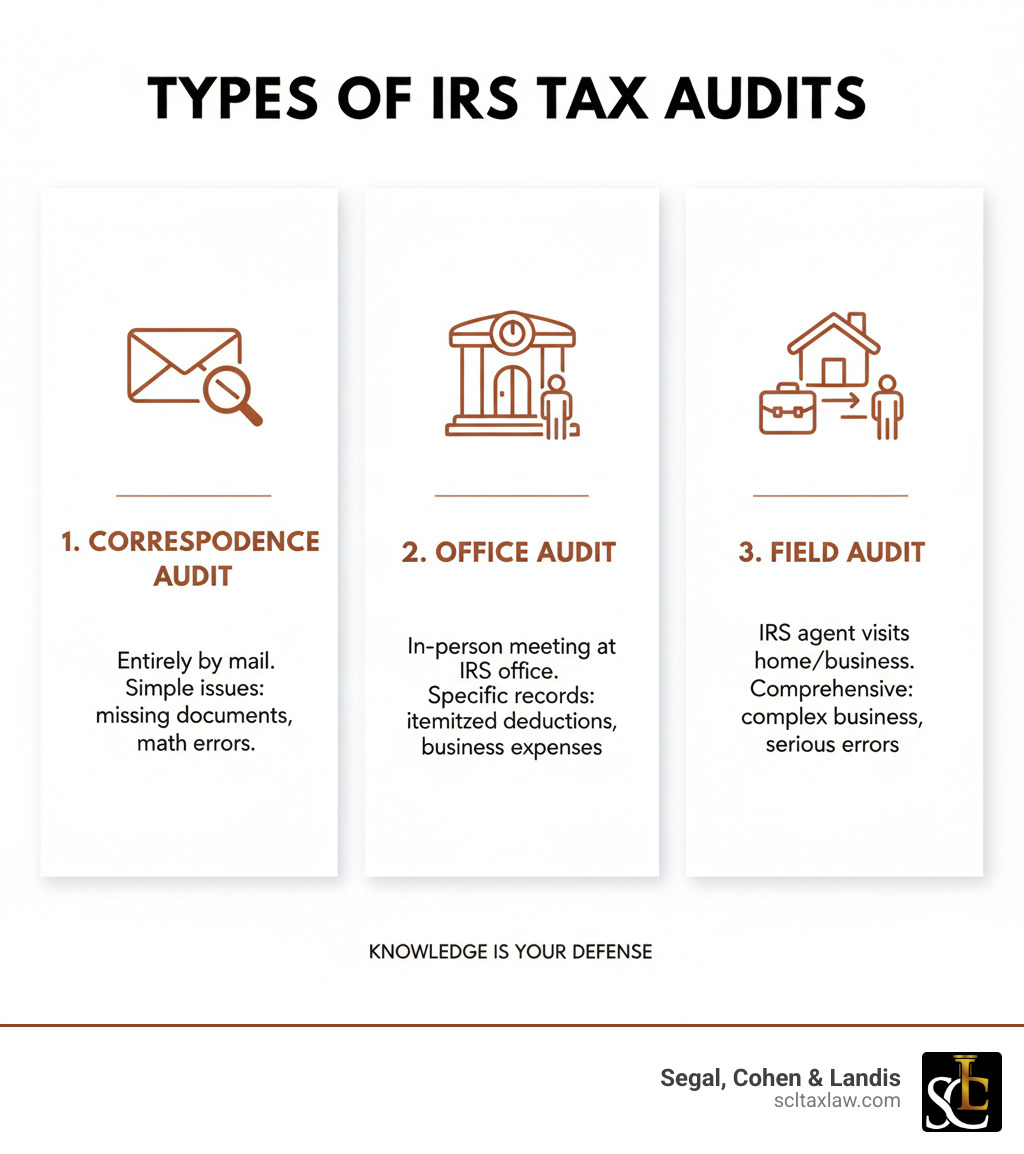
Knowing the three types of audits helps you prepare:
- A correspondence audit generally addresses requested information through mail or other channels identified in the notice. Follow the actual instructions for submitting records and responding.
- An office audit requires you to visit a local IRS office with specific records. These usually focus on itemized deductions, rental income, or business expenses.
- A field audit is the most comprehensive. An IRS agent visits your home or business, typically for complex returns or suspected significant errors. If you’re facing a field audit, you definitely want representation.
Your rights as a taxpayer are real and enforceable. The Taxpayer Bill of Rights protects you throughout the audit. You have the right to representation, meaning you can hire an authorized professional to act on your behalf and never have to face the IRS alone. You also have the right to privacy, and the IRS must treat you professionally. For a complete breakdown, see your rights as a taxpayer on the IRS website.
Why the IRS Audits Tax Returns
The IRS selects returns through computer screening, random statistical research and related examinations. Information matching and mathematical-error notices are separate processes and do not necessarily mean a formal audit.
- Missing information: Your return doesn’t match data from employers or banks (Forms W-2, 1099, etc.).
- Large deductions or credits: Claiming unusually high deductions compared to your income can raise a red flag.
- Math errors or typos: Simple mistakes can trigger a review.
- Related examinations: An audit of a business partner or investment can lead to an audit of your return.
Not every audit is an accusation. Often, the IRS just has questions that can be cleared up with the right representation.
Federal vs. State Tax Audits
State tax agencies can also audit you, and their rules can be just as complex as federal ones. In California, the Franchise Tax Board (FTB) administers personal and business income taxes. The California Department of Tax and Fee Administration (CDTFA) administers sales and use and special taxes; the Employment Development Department (EDD) administers California payroll taxes. California’s residency audits are particularly aggressive, as the FTB wants to determine if you owe California income tax.
Review the relevant notices, filing history, records, and deadlines before choosing a response. Evaluate professional assistance according to the facts, applicable law, and agreed scope of representation.
Step 2: Decide if You Need Professional Representation
A qualified tax professional can explain the audit process, review the legal and factual issues, and help prepare responsive records. Whether representation is useful depends on the complexity and circumstances of the case.
This is the classic “penny wise, pound foolish” scenario. The money saved on a representative’s fee can be dwarfed by additional taxes, penalties, and interest if the audit goes poorly.
A representative can manage authorized communications and help with requested records, but you may still need to participate or supply information. Consider professional representation when the case involves:
- Significant tax issues involving large sums or complex law.
- Accusations of fraud or tax evasion.
- Business audits, which are almost always complex.
- Significant stress or uncertainty about the process.
Tax Preparer vs. Tax Audit Representative
Attorneys, CPAs and enrolled agents generally have broad IRS representation rights; some other preparers have limited rights. An error in a prepared return may create a potential conflict requiring evaluation under the applicable professional rules, rather than an automatic disqualification.
A tax audit representative is specifically qualified to stand between you and the IRS. These professionals include:
- Enrolled Agents (EAs): Federally licensed tax specialists who can represent taxpayers nationwide.
- Certified Public Accountants (CPAs): State-licensed professionals with IRS practice authorization.
- Tax attorneys: Can advise on legal issues and applicable privilege protections. Privilege is not automatic for every conversation or document; discuss its limits before sharing records.
An independent representative can provide a fresh review. Discuss any actual or potential conflicts of interest before the engagement.
The Importance of Timely Action
Check the response deadline on the actual notice. If you do not respond, the IRS may propose adjustments based on available information. Assessment, penalties and collection depend on applicable legal requirements and notice procedures.
A representative can help prepare Form 2848 for specified matters and tax periods. Authorization does not itself eliminate your responsibilities, halt collection or guarantee that every communication goes only to the representative.
Step 3: How to Find Qualified Tax Audit Representation Near Me
When you get an IRS letter, searching for “tax audit representation near me” is the right move. Finding a qualified professional is essential, and you have several options for how you work with them.

While remote representation is effective and common, local expertise offers real value, especially in states with complex tax laws like California. A local representative understands state-specific challenges like residency audits. However, don’t let geography be your only guide. Many top professionals work remotely, handling audits effectively through secure portals and video calls. The key is finding the right balance of accessibility and expertise.
What Qualifications to Look For
The IRS has strict IRS rules for representatives, limiting practice to qualified professionals. This ensures you’re dealing with experts held to high ethical standards. Focus on these three types of professionals:
- Enrolled Agents (EAs): Federally licensed tax specialists authorized by the U.S. Department of the Treasury.
- Certified Public Accountants (CPAs): State-licensed accounting professionals who can also represent taxpayers before the IRS.
- Tax attorneys: Can represent taxpayers administratively before the IRS within their authorization. Representation in U.S. Tax Court requires separate admission. Privilege may protect qualifying confidential legal advice; it does not automatically protect every communication or underlying record.
Beyond credentials, look for someone with specific experience in your type of audit. Ask about their track record with cases similar to yours.
Where to Search for Tax Audit Representation Near Me
Use reliable sources to find the right professional:
- Online Research: Use local search terms like “tax audit attorney Los Angeles” or “IRS audit representation California.” Review websites for clear explanations of services and experience.
- Professional Associations: The National Association of Tax Professionals (NATP) and state CPA societies maintain searchable directories of qualified members.
- IRS Directory: The directory lists preparers with current PTINs who hold specified credentials or an Annual Filing Season Program record of completion. It does not include every qualified professional, and listed practitioners have different representation rights. Verify current credentials and the intended scope of practice.
- Referrals: A personal recommendation from a trusted friend, family member, or business associate who had a positive experience can be invaluable.
The goal is to find a professional with a proven track record in audit defense who understands both federal and state tax law.
Step 4: Steer the Audit Process with Your Representative
Once you hire a qualified tax audit representation near me professional, the weight lifts off your shoulders. Your representative becomes your advocate and shield in all dealings with the IRS.
The process begins with an initial consultation to review your audit notice and tax return. Your representative is on your side, working to understand your situation and build a defense.
One of the first steps is filing IRS Form 2848, the Power of Attorney document. Form 2848 authorizes eligible representatives for the matters and periods listed. You generally still receive notices; designated representatives can receive copies. The form does not eliminate every direct contact.
Your representative will then:
- Handle all IRS communication: They know what information the IRS is entitled to and how to respond in a way that protects your rights.
- Conduct a document review: They will help you gather and organize all necessary records, like receipts and bank statements, and identify any potential weaknesses in your case.
- Develop a strategy: Based on the review, they will craft a custom approach to present your case in the strongest possible light.
- Attend all meetings: If your audit requires an in-person meeting (office or field audit), your representative will be there. You can often request that a field audit take place at your representative’s office, not your home or business.
Throughout this process, you can focus on your life while your representative steers the audit and keeps you informed.

Potential Outcomes of a Tax Audit
An audit typically ends in one of three ways:
- No change: The IRS accepts the examined items without additional tax from that examination. Other outstanding tax debts may remain.
- Agreement with proposed changes: The auditor finds legitimate adjustments. Your representative will review these with you, and if they are fair, you can agree to pay the additional tax and interest.
- Disagreement: If you and your representative believe the auditor’s findings are incorrect, you have the right to challenge them.
A skilled representative actively negotiates on your behalf, presenting legal arguments to minimize any additional tax liability and often achieving a better outcome than you could on your own.
Your Options if You Disagree with the IRS
If you disagree with the audit’s result, you have powerful options. Your first step is the IRS Independent Office of Appeals, an impartial body within the IRS that resolves disputes. Your representative will prepare a formal protest and present your case to an appeals officer who has the authority to settle cases based on the “hazards of litigation.” Many disputes are resolved favorably at this stage. You can learn more at the IRS Independent Office of Appeals.
If the dispute remains unresolved, available judicial review depends on the notice and applicable deadlines. Taxpayers may represent themselves in U.S. Tax Court, or use an admitted attorney or qualified nonattorney; a CPA or enrolled-agent credential alone does not confer admission.
Understanding the Cost of Tax Audit Representation
Fees vary with the provider, scope and complexity of the engagement. Ask for the billing terms in writing and evaluate the legal assistance needed without assuming that representation will save more than it costs.
Review the relevant notices, filing history, records, and deadlines before choosing a response. Evaluate professional assistance according to the facts, applicable law, and agreed scope of representation.
The value of professional help goes beyond just the final tax bill. A representative can find missed deductions, catch IRS errors, and negotiate payment plans. They can assess the scope of information requests and explain your rights; representation does not prevent examination of other years.
Common Pricing Structures
When seeking representation, you’ll likely encounter a few common pricing models:
- Hourly rates: Ask the provider for the actual rate, billing increments and expected scope before agreeing to an engagement.
- Flat-fee arrangements: You pay a single, upfront price for the entire audit. This is common for more straightforward cases and provides cost certainty.
- Retainers: You pay an upfront deposit that the firm bills against as they work on your case. This is often used for potentially lengthy matters.
During an initial consultation, we can discuss which structure makes the most sense for your situation and provide a clear estimate. Ask your adviser whether any representation expense is deductible under the rules applicable to your situation.
Frequently Asked Questions about Tax Audit Representation
What happens if I ignore an IRS audit notice?
If you do not respond to an audit notice, the IRS may propose adjustments using available information. Additional tax, penalties, interest and collection are subject to applicable requirements and review opportunities. Seek advice promptly if a deadline has passed.
From there, the IRS can use its extraordinary powers to collect the debt through aggressive actions like:
- Bank levies to seize funds from your accounts.
- Wage garnishments to take money from your paychecks.
- Tax liens on your property, which can complicate financing or sale of assets.
Don’t let fear turn a manageable issue into a financial disaster. If you’ve missed a deadline, call a professional immediately to minimize the damage.
Can my tax preparer represent me in an audit?
Maybe, but it’s often not the best choice. If your preparer is an Enrolled Agent (EA), CPA, or Tax Attorney, they are legally authorized to represent you. However, if they don’t hold one of these credentials, their ability to help is extremely limited.
Even if they are qualified, a conflict of interest can arise if they prepared the return being audited. They may be more focused on defending their own work than on getting the best outcome for you.
Attorney-client privilege may protect qualifying confidential legal advice, subject to exceptions. IRC 7525 also provides limited protection for qualifying noncriminal federal tax advice from authorized tax practitioners. Neither protection automatically covers underlying records or every conversation.
Do I have to meet my representative in person?
Not at all. Modern tax representation can be handled effectively and entirely remotely. We use secure document portals, phone, email, and video conferencing to communicate and manage your case. This flexibility allows you to get expert help without taking time off work or traveling to an office.
That said, having a representative who understands California-specific tax laws and local IRS practices is invaluable, whether you meet in person or not. When you search for tax audit representation near me, you’re looking for that local expertise, which you can access from the convenience of your home.
We are always happy to meet in person at our Los Angeles office, but the choice is yours, and the quality of our representation remains the same.
Conclusion

Facing an IRS audit doesn’t have to be a nightmare. While the initial notice is stressful, the right tax audit representation near me can turn an overwhelming situation into a manageable one. Having an expert on your side changes everything.
An experienced representative—whether an Enrolled Agent, CPA, or tax attorney—puts you on equal footing with the IRS. The peace of mind that comes from professional representation is immense. You no longer have to worry about saying the wrong thing, missing a deadline, or taking time off work. Your representative handles it all while you get back to your life.
Review the relevant notices, filing history, records, and deadlines before choosing a response. Evaluate professional assistance according to the facts, applicable law, and agreed scope of representation.
Our approach is straightforward: upfront pricing, expert guidance, and a commitment to protecting your rights. We’re not just your representatives—we’re your advocates.
Don’t face the IRS alone. The stakes are too high. Whether you’re dealing with a federal issue or a California state matter, we’re here to help.
Get expert IRS audit representation today and take the first step toward resolving your tax audit with confidence.
Have questions about this topic? Talk to an IRS attorney today.
Segal, Cohen & Landis, P.C. — Beverly Hills. Serving clients nationwide.

Samuel Landis, Esq.
LL.M. (Tax) · Selected to Super Lawyers®
Sam Landis is a Beverly Hills IRS tax attorney specializing in IRS collection defense, audit representation, and international tax compliance for foreign nationals and US expats.