

Understanding Government and Tax Audits: IRS, Healthcare, and Corporate Scrutiny
An audit defense lawyer can help protect your rights during an examination by reviewing Information Document Requests (IDRs), evaluating applicable privileges, and using financial evidence to challenge disputed calculations. Counsel can manage communications and examine the agency’s authority and deadlines. Hiring a lawyer does not automatically stop an audit, asset restraint, tax lien, or criminal referral.
IRS examinations review tax reporting and substantiation. The procedures, purpose, and legal standards for healthcare reimbursement and financial-statement audits differ; do not assume that every audit is automated or designed solely to maximize recovery. Related reading: IRS tax audit help.
Comparing IRS, Medicaid/Medicare, and PBM Audits
While all audits demand strict compliance, the underlying statutory authorities, procedural rules, and financial exposures vary substantially depending on the governing entity:
| Audit Category | Primary Auditing Entities | Governing Framework & Authorities | Core Financial & Operational Risks |
|---|---|---|---|
| IRS & State Tax Audits | IRS Revenue Agents, Tax Compliance Officers, State Departments of Revenue | Internal Revenue Code (IRC), State Revenue & Taxation Codes | Back taxes, civil fraud penalties, statutory interest, tax liens, bank levies, criminal tax referrals |
| Medicare & Medicaid Audits | CMS, Recovery Audit Contractors (RACs), Unified Program Integrity Contractors (UPICs), Medicare Administrative Contractors (MACs) | Social Security Act, False Claims Act, Civil Monetary Penalties Law (CMPL) | Retroactive recoupments, pre-payment claims review, program exclusion (LEIE list), DOJ criminal referrals |
| Pharmacy Benefit Manager (PBM) Audits | Commercial PBM Auditors, Special Investigation Units (SIUs) | Commercial Provider Contracts, State Pharmacy Practice Acts, MAC Pricing Rules | Direct fee clawbacks, inventory shortfall assessments, spread pricing adjustments, network termination |
| Public Accounting & Corporate Inquiries | SEC Enforcement Division, PCAOB Inspectors, State Boards of Accountancy | Sarbanes-Oxley Act (SOX), Securities Exchange Act of 1934, GAAP/GAAS standards | Restatements, civil money penalties, loss of CPA license, SEC administrative bars, accountant and auditor liability claims |
Government contractors, such as Recovery Audit Contractors (RACs), are often financially incentivized through contingency fee models to maximize clawbacks. Similarly, commercial PBMs frequently rely on aggressive interpretations of Maximum Allowable Cost (MAC) pricing benchmarks and disputed inventory reconciliations. Understanding these distinctions is critical when framing a targeted defense.
Common Audit Triggers and Algorithmic Red Flags
Auditors rarely select targets at random. Today’s regulatory environment relies on automated data mining to identify anomalous patterns:
- Discriminant Function (DIF) Scores: The IRS scores tax returns against statistical norms. Unusually high deductions relative to gross revenue or significant unreimbursed business expenses immediately elevate audit risk.
- Form 1099 and Information Reporting Mismatches: Discrepancies between reported gross receipts and automated 1099-K, 1099-NEC, or W-2 filings submitted by third parties trigger automated IRS notices.
- Healthcare Coding and Prescribing Outliers: CMS and private payors flag providers whose billing for specific evaluation and management (E/M) codes, modifier usage, or high-cost pharmaceuticals deviates from regional peer averages.
- Employee Retention Credit (ERC) and Pandemic Relief Claims: Aggressive marketing around Employee Retention Credits has prompted intense federal scrutiny into eligibility determinations and gross receipts calculations.
- Inventory and Documentation Discrepancies: In pharmacies and medical practices, minor documentation lapses or mismatches between wholesaler purchase invoices and billed claims can be incorrectly categorized as intentional inventory shortfalls.
The True Cost of Non-Compliance: Civil, Financial, and Criminal Exposure
An examination may result in proposed adjustments and applicable penalties. Liability and any referral depend on the facts and governing law; an unfavorable finding does not automatically impose every penalty or cause a criminal referral.
To understand how individual tax examinations can expand across multiple tax years, consult our IRS audit defense complete guide.
Severe Financial and Professional Penalties
Civil penalties can add to the amount in dispute. Applicable law and facts determine which penalties may be imposed.
For licensed professionals—including CPAs, corporate officers, attorneys, and enrolled agents—an audit outcome carries severe occupational risks:
- IRS Office of Professional Responsibility (OPR) Actions: The IRS OPR investigates tax professionals accused of incompetence, disreputable conduct, aiding and abetting tax non-compliance, or violating Treasury Circular 230 regulations. A negative finding can lead to public censure, suspension, or permanent disbarment from practicing before the IRS.
- State Licensing Revocation: Medical boards, state boards of accountancy, and state bar associations routinely open parallel disciplinary inquiries following an adverse government audit finding.
- Corporate Restatements and Securities Sanctions: Public reporting entities may face financial restatements, enforcement proceedings, and civil or criminal exposure during financial reporting inquiries. These matters can require securities, accounting, and tax counsel working together.
When Civil Audits Turn into Criminal Investigations
The most dangerous audit is an “eggshell audit”—a civil examination where undisclosed income, unverified deductions, or aggressive billing practices create substantial exposure to criminal prosecution.
Auditors are trained to spot badges of fraud, such as two sets of accounting books, altered invoices, false statements, or unrecorded cash receipts. When an auditor suspects willful misconduct, they pause civil proceedings without warning and coordinate with internal criminal divisions or federal prosecutors.
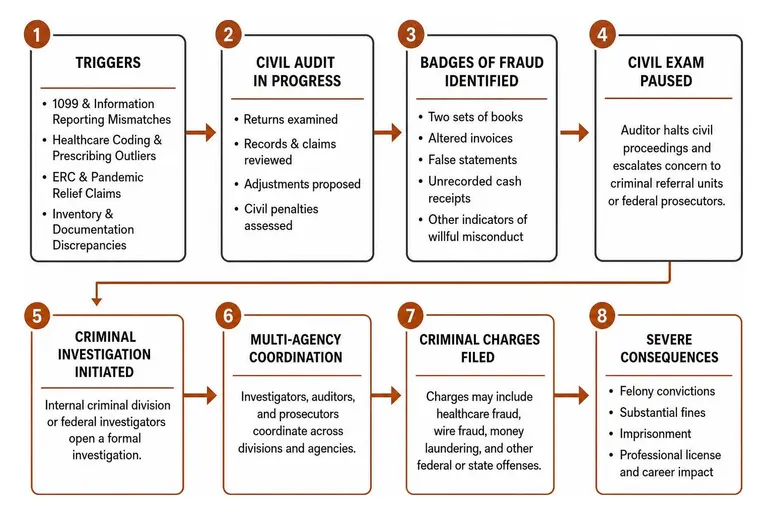
The criminal stakes are severe:
- State Medicaid-fraud offenses can carry fines and imprisonment. The charge, amount involved, applicable statute, and individual facts determine the potential punishment; there is no single sentencing maximum for every Medicaid-fraud case.
- Under federal law, healthcare fraud convictions carry statutory maximums of up to 20 years in prison if the violation resulted in serious bodily injury, and life imprisonment if the conduct led to a patient’s death.
- Major federal enforcement actions can involve vast multi-agency task forces; federal prosecutors have indicted complex healthcare fraud, wire fraud, and money laundering conspiracies totaling over $1,400,000,000.
Why Hiring an Audit Defense Lawyer Is Critical to Protecting Your Assets
When an audit commences, the government’s primary goal is clear: audit verification, adjustment, and collection. Retaining experienced legal counsel establishes an immediate protective barrier between you and government investigators.
If you are facing an active state or federal tax examination, securing tax audit representation near me allows our legal team to take over all direct communications, preventing inadvertent admissions and keeping the audit strictly confined to its lawful boundaries.
How an Audit Defense Lawyer Controls Audit Scope and Authority
Auditors are administrative investigators, but their authority is strictly circumscribed by statute, administrative rules, and constitutional protections. Without legal representation, taxpayers and business owners often make the mistake of over-producing records in an effort to appear cooperative, inadvertently handing the auditor evidence that expands the inquiry into prior tax years or related corporate entities.

An audit defense lawyer manages this dynamic through several key interventions:
- Restricting Information Document Requests (IDRs): We evaluate every government summons or IDR to ensure requests are relevant, non-burdensome, and within the statutory period of limitations.
- Implementing Immediate Legal Holds: We guide your staff in preserving relevant electronic and paper records while preventing the unauthorized creation of informal, unvetted explanatory notes that auditors could misinterpret.
- Controlling Physical and Digital Site Access: Government contractors—such as Zone Program Integrity Contractors (ZPICs) or IRS Revenue Officers—sometimes attempt unannounced site visits. Legal counsel establishes clear ground rules governing interviews, workplace access, and document copying.
- Asserting Evidentiary Privileges: Confidential communications made for legal advice may qualify for attorney-client privilege. The protection is subject to exceptions and waiver; pre-existing business records do not become privileged merely because they are given to a lawyer. The limited federal tax-practitioner privilege under 26 U.S. Code § 7525 does not apply in criminal tax matters.
The Strategic Value of Former Prosecutors and Regulatory Insiders
Effective audit defense demands an intimate understanding of how government investigators build cases from the inside out. Attorneys with regulatory backgrounds—including former federal prosecutors and government agency counsel—understand institutional enforcement thresholds.
This background provides critical advantages:
- Anticipating Prosecutorial Theories: Insider experience allows counsel to recognize when an auditor’s questions shift from factual inquiries to establishing willful intent.
- Pre-Indictment Negotiations: In complex white-collar, tax, or healthcare allegations, experienced trial attorneys can present comprehensive factual presentations to U.S. Attorney’s Offices or state Attorneys General, demonstrating administrative compliance and encouraging prosecutors to decline criminal charges.
- Negotiating Supported Resolutions: Counsel can present evidence and legal arguments supporting a reduction or resolution of a disputed claim. Outcomes depend on the facts and applicable law; another taxpayer’s settlement or charging decision does not predict the result in your matter.
Building a Strong Defense: Experts, Evidence, and Appeals
An audit cannot be won through passive compliance. A successful outcome requires a proactive, evidence-based legal posture that challenges flawed auditor assumptions, reconstructs ambiguous financial records, and establishes affirmative legal defenses under the law.
For a detailed review of procedural timelines and administrative defense frameworks, consult our IRS audit representation complete guide.
Reviewing Financial Evidence and Specialist Needs
The evidence relevant to an audit depends on the disputed issues. Review the records and any need for specialized assistance for the particular matter.
- Forensic Accountants: Reconstruct bank deposits, evaluate historical general ledgers, perform detailed fund-tracing analyses, and counter IRS indirect methods of income reconstruction (such as bank deposit analyses or net worth methods).
- Statistical Experts: Auditors routinely review a small sample of claims or transactions and mathematically extrapolate those errors across years of business revenue. Statistical experts analyze sample sizes, confidence intervals, and stratified sampling methods to invalidate mathematically flawed extrapolations.
Substantial-authority and reasonable-cause defenses depend on the particular penalty and statutory conditions. They can apply to specified accuracy-related issues but are not an automatic defense to the civil fraud penalty under section 6663.
Challenging Auditor Methodologies and Filing Unfavorable Determination Appeals
Auditors make mistakes. They misinterpret complex regulations, overlook documentation, and apply improper statistical models. If an examiner issues an adverse audit report or demand for recoupment, you maintain substantive administrative appeal rights.
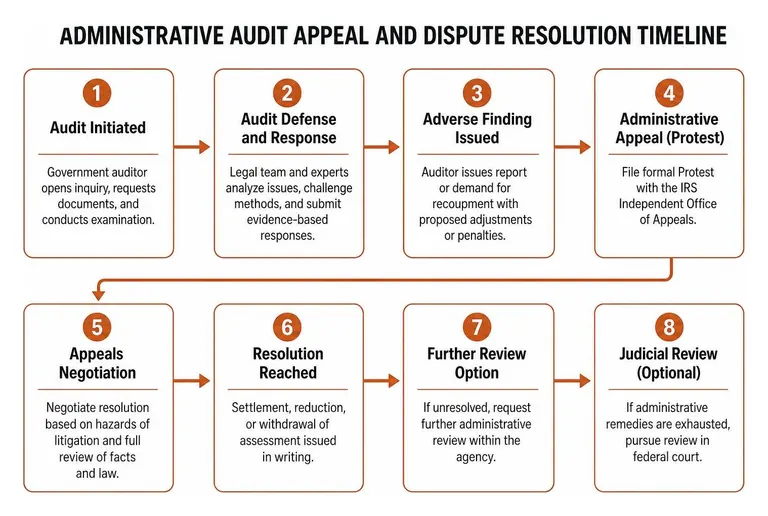
Key strategies for challenging an adverse finding include:
- Reviewing Sampling Methods: Review the sampling method and supporting records before responding to an estimated assessment.
- Administrative Appeals: Review the applicable notice and available appeal procedure. The availability and scope of Appeals review depend on the matter.
An IRS audit defense lawyer can help identify deadlines and response options. Available remedies depend on the notice, law and facts; representation does not guarantee that every deadline or remedy will be preserved.
Immediate Action Plan: What to Do When You Receive an Audit Notice
The first 72 hours following receipt of an audit notice set the tone for the entire examination. Taking deliberate, legally sound steps prevents common mistakes that compromise asset protection strategies.
If you operate in California or face state-specific franchise tax board or employment development department reviews, consult an experienced California audit defense lawyer to address unique state statutory requirements.
When to Engage an Audit Defense Lawyer: Immediate vs. Post-Determination Intervention
Many taxpayers and business owners hesitate to contact legal counsel, believing that hiring an attorney might signal guilt or that they can handle preliminary inquiries themselves and bring in a lawyer only if things go poorly.
This approach carries significant risks. In an audit, the administrative record is constructed from day one. Inadvertent statements made during initial auditor interviews cannot easily be retracted, and documents produced without context become permanent evidence.

Engaging counsel immediately upon receipt of an audit notice allows our legal team to:
- Analyze the Scope of the Examination Letter: Determine whether the review is a routine correspondence check, a comprehensive field audit, or a targeted program integrity inquiry.
- Enforce Statutory Response Windows: Prevent default assessments by securing necessary extensions and formalizing all document submissions.
- Review Lawful Asset Protections: Evaluate applicable exemptions, collection procedures, and available challenges to proposed restraints or liens. Do not hide assets, destroy records, or transfer property to obstruct collection or an investigation.
For immediate assistance in managing active examinations, explore our dedicated IRS audit defense help resources.
Frequently Asked Questions About Audit Defense
Can an audit defense attorney prevent a civil audit from turning criminal?
An audit defense attorney can help evaluate criminal exposure and protect procedural rights, but cannot guarantee that a civil audit will remain civil. In sensitive “eggshell audit” situations, counsel reviews interview requests, considers Fifth Amendment protections where applicable, and presents accurate factual and legal responses. The investigating agencies retain authority to make a criminal referral.
What is the difference between representation by a CPA and an audit defense lawyer?
While CPAs are skilled at accounting and tax preparation, their client communications do not enjoy confidentiality in criminal or grand jury proceedings. Under federal law (26 U.S. Code § 7525), the statutory tax practitioner privilege applies solely to non-criminal civil matters before the IRS and is void in criminal investigations.
Attorney-client privilege and work-product protection have specific requirements, exceptions, and limits. An accountant retained to assist counsel with legal advice may qualify for protection under the Kovel doctrine in appropriate circumstances. A Kovel agreement alone does not make all accounting work or work papers privileged.
How do defense lawyers challenge statistical extrapolation in government audits?
Auditing bodies frequently examine a small sample of transactions—such as 50 claims out of 10,000—and extrapolate the calculated error rate across all revenue generated during the audit period. Defense attorneys challenge this methodology by working with statisticians to scrutinize:
- The randomness and sample size of the audit selection
- Stratification errors (e.g., treating high-dollar, complex claims as representative of low-dollar routine claims)
- The statistical confidence intervals applied by the auditor
- Calculation errors in the base error rate
A successful challenge may require the auditing entity to revise its sample, methodology, or assessment. The available remedy depends on the governing rules and evidence; a sampling challenge does not necessarily eliminate extrapolation altogether.
Conclusion
A government or commercial audit represents a direct threat to your financial stability, professional standing, and personal assets. Whether you are navigating an aggressive IRS tax examination, a Medicaid program integrity audit, a PBM recoupment demand, or a corporate accounting investigation, proactive legal defense is your strongest safeguard.
Contact Segal, Cohen & Landis (SCL) to discuss the audit notice, deadlines and available response options.
Review the relevant notices, filing history, records, and deadlines before choosing a response. Evaluate professional assistance according to the facts, applicable law, and agreed scope of representation. Related resources: dedicated IRS audit representation.
Have questions about this topic? Talk to an IRS attorney today.
Segal, Cohen & Landis, P.C. — Beverly Hills. Serving clients nationwide.

Samuel Landis, Esq.
LL.M. (Tax) · Selected to Super Lawyers®
Sam Landis is a Beverly Hills IRS tax attorney specializing in IRS collection defense, audit representation, and international tax compliance for foreign nationals and US expats.