


Why Boston Homeowners Are Facing Record Property Tax Increases
Tax relief Boston includes residential exemptions and assessment abatements for eligible homeowners. The FY2026 figures below are historical; check the City’s current Assessing guidance for the applicable fiscal year.
Quick Overview: Boston Tax Relief Options
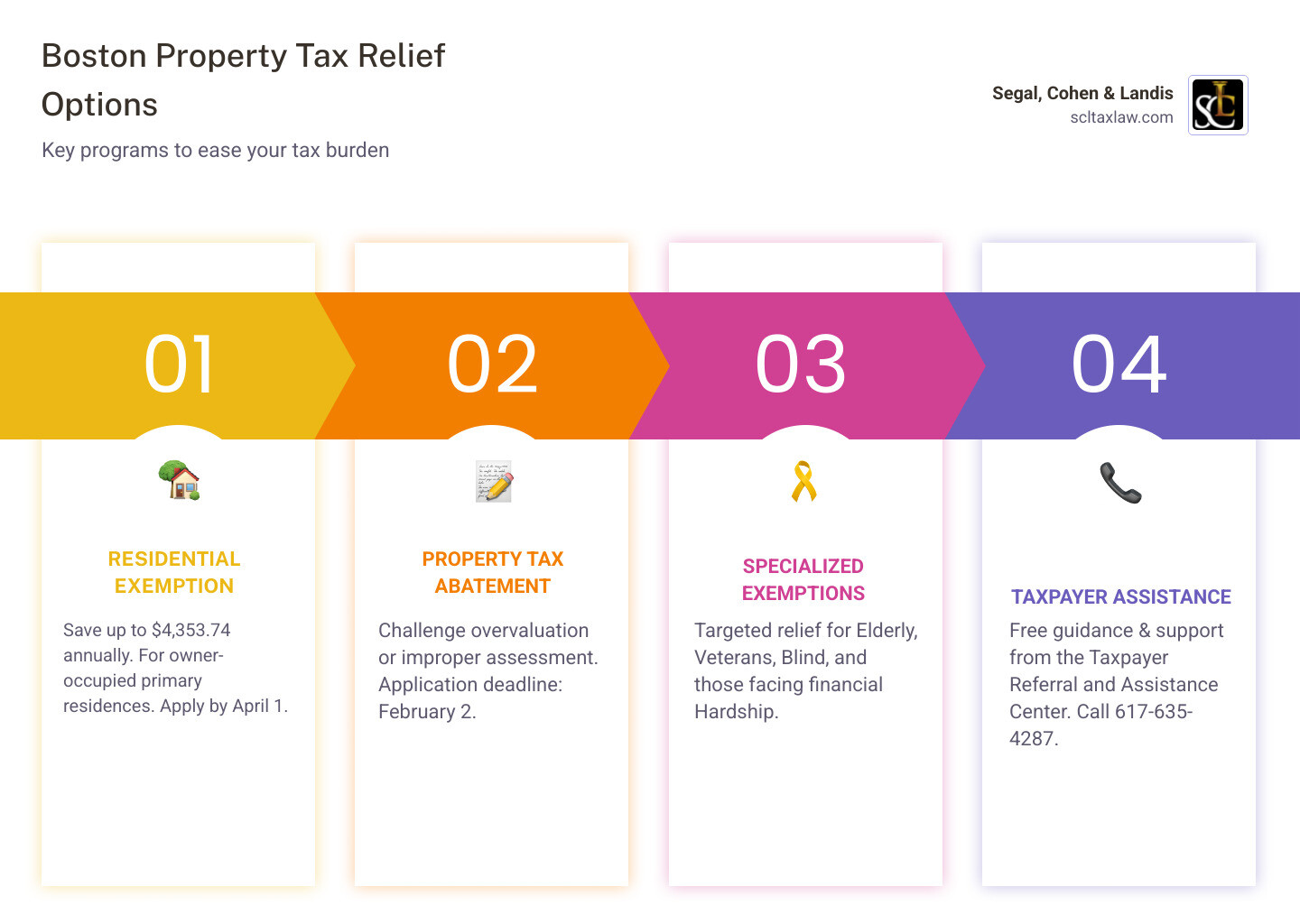
- Residential Exemption: Eligible Boston homeowners could save up to $4,353.74 for FY2026; the application deadline was April 1, 2026. Current-year amounts and deadlines may differ.
- Property Tax Abatement: Challenge an overvaluation or improper assessment by the applicable filing deadline. For FY2026, the deadline was February 2, 2026; check the current third-quarter bill and City instructions.
- Elderly/Veteran/Blind Exemptions: Targeted relief for qualifying residents
- Hardship Exemption: Available for those facing financial difficulties
- Taxpayer Referral and Assistance Center: Free guidance at Boston City Hall (617-635-4287)
Boston’s FY2026 guidance described a 13 percent annual tax-bill increase for the average single-family home receiving the residential exemption. Changes in commercial and residential property values can shift the tax burden between those classes. Individual bills depend on assessed value, exemptions and the applicable tax rate; these historical figures do not predict the current fiscal year’s bill.
Mayor Michelle Wu proposed changes to Boston’s residential and commercial tax classification to address shifts in property values. Legislative status and adopted tax rates are time-sensitive; consult the City and Commonwealth’s current official materials before relying on a proposed measure.
Boston relies heavily on property taxes to fund services. Its classification process separates residential property from commercial, industrial and personal property and can shift the levy between those groups under the applicable law. The effect depends on the City’s adopted classification and values for the fiscal year.
The good news? Several established relief programs exist right now that can significantly reduce your property tax burden, regardless of what happens at the state level. This guide walks you through every available option—from the Residential Exemption that saved qualified homeowners nearly $4,000 last year, to abatement applications and specialized exemptions for seniors, veterans, and those facing hardship.
Tax relief Boston: Review the relevant notices, filing history, records, and deadlines before choosing a response. Evaluate professional assistance according to the facts, applicable law, and agreed scope of representation.
Tax relief Boston further reading:
Understanding Boston’s Current Property Tax Climate
Boston homeowners are currently caught in a unique and challenging property tax situation. We’ve seen significant shifts in property values across the city, directly impacting how the tax burden is distributed. It’s a complex puzzle, but understanding its pieces is the first step toward finding effective tax relief Boston.
Recently, commercial property values in Boston have seen a notable decline, dropping by an estimated 6%. This isn’t a one-off event; the total value of commercial property in Boston fell by $2.3 billion in fiscal 2026, building on a $1.9 billion drop in fiscal 2025. Meanwhile, residential property values have moved in the opposite direction, increasing by approximately 2%. This divergence creates a significant imbalance, as the city’s budget relies heavily on property taxes.
Boston funds over 70% of its budget through property taxes, a reliance higher than many other major cities. This means that when one sector’s property values decline, the burden disproportionately shifts to the other to maintain city services and funding levels. The state law further complicates this, as it limits how much the tax burden can be shifted to commercial properties, setting a ceiling of 175% compared to residential properties.
Boston uses different residential and commercial property-tax rates. Rates are adopted for each fiscal year, so use the City’s official rate table and your assessment notice to calculate the applicable bill.
According to analysis from the Boston Municipal Research Bureau, the city’s budget itself has increased by more than 4% within the last year, largely driven by increased spending on Boston Public Schools and pension payments. This growing budget, coupled with the shifting property values, puts immense pressure on residential taxpayers.
For more in-depth insights into managing your overall financial picture, consider exploring tax planning services.
Why Your Property Taxes Are Rising
The reasons behind Boston’s rising property taxes are multifaceted, stemming from a combination of economic shifts and the city’s financial structure. The post-pandemic era has significantly impacted urban real estate, particularly commercial properties. The widespread adoption of remote work has contributed to a decline in commercial property values, as demand for office space diminishes. Commercial values and their effect on tax classification vary by fiscal year.
Boston’s FY2026 guidance described a 13 percent annual tax-bill increase for the average single-family home receiving the residential exemption. Changes in commercial and residential property values can shift the tax burden between those classes. Individual bills depend on assessed value, exemptions and the applicable tax rate; these historical figures do not predict the current fiscal year’s bill.
Adding to this pressure is the city’s expanding budget. As we mentioned, the city’s budget increased by more than 4% in the last year, driven primarily by essential spending on Boston Public Schools and pension payments. These are crucial investments in our community, but they require a stable and growing tax base to support them. When commercial values falter, the burden inevitably shifts.
The Tale of Two Tax Rates: Commercial vs. Residential
Boston uses separate residential and commercial tax rates through classification under state law. Classification can lower the residential rate relative to a single-rate system. Review the City’s adopted rates and classification for the applicable fiscal year rather than assuming an earlier limit or proposal governs the current bill.
Boston’s residential and commercial property-tax rates differ. Use the official rates adopted for the fiscal year shown on your bill; an earlier year’s rate does not establish the current charge.
Historically, this formula has often resulted in Boston residents paying tax bills that are below the state mean. However, with residential values continuing to rise and commercial values declining in the wake of the COVID-19 pandemic and the shift to remote work, homeowners are now beginning to see significant spikes in their annual tax bills. The system, once a protective measure for residents, is now struggling to absorb the impact of these market changes, making proactive tax relief Boston strategies even more critical.
Official City Programs for Tax Relief Boston
While the broader political debate unfolds, the City of Boston offers several established programs designed to provide direct tax relief Boston homeowners. These programs are vital tools that can significantly reduce your property tax bill if you meet the eligibility criteria. It’s important to understand and use these official city resources.
The City of Boston’s Assessing Department and the Taxpayer Referral and Assistance Center (TRAC) are your primary points of contact for these programs. TRAC, located at 1 City Hall Square, Room M-5, Boston, provides a “one-stop” service to help explain tax bills, abatements, and exemption programs. They can assist with mailing address changes, provide information on excise taxes, and accept applications for exemptions and abatements. Their office hours are Monday through Friday, 9 a.m. to 5 p.m., and you can reach them at 617-635-4287.
The Residential Exemption: Your Primary Relief Tool
One of the most impactful forms of tax relief Boston offers to homeowners is the Residential Exemption. This program is specifically designed to reduce your tax bill by excluding a portion of your residential property’s value from taxation, provided it is your primary residence.
How much can it save you? For FY2026, the Residential Exemption saved eligible Boston homeowners up to $4,353.74. This is a historical figure; the City publishes the amount and eligibility rules for each fiscal year.
To be eligible, you must own and live in the property as your primary residence. A recent home rule petition expanded eligibility, allowing homeowners who obtained their homes before July 1st to potentially qualify for the current Fiscal Year. This means if you recorded a deed and occupied the property as your principal residence between January 1 and June 30 of the current year, you may be eligible.
The FY2026 Residential Exemption application deadline was April 1, 2026. For the current fiscal year, review the City’s deadline and application instructions. You can use Assessing Online to locate your property and available abatement and exemption forms.
We strongly encourage all eligible homeowners to apply for this exemption. It’s a straightforward process that can lead to significant savings. Filing for the exemption does not mean you can postpone paying your taxes; you will be credited later in the fiscal year if approved. If your application is denied, you have the right to file an appeal with the Massachusetts Appellate Tax Board within three months of the decision.
You can find more detailed information and the application process on the city’s official page: How to apply for the Residential Exemption. For those considering the long-term financial implications of property ownership and wealth transfer, exploring options for estate planning can also be beneficial.
Filing for a Property Tax Abatement
Beyond exemptions, another critical avenue for tax relief Boston homeowners can pursue is a property tax abatement. An abatement is essentially a reduction in your property taxes, which can be granted if you can demonstrate that your property has been overvalued, disproportionately assessed, improperly classified, or if you qualify for a statutory exemption that wasn’t applied.
An assessment abatement requires attention to the deadline on the third-quarter bill and the City’s instructions. The FY2026 filing deadline was February 2, 2026. An exemption application has a separate deadline and purpose.
To apply, you’ll need to obtain the Abatement application and an Information Requisition Form. These can often be found through the city’s Assessing Online tool or by contacting the Assessing Department directly. It’s crucial to complete both forms thoroughly and submit them either by mail or in person at Boston City Hall. Be aware that the Assessing Department has three months to review your application, and failing to provide all requested information on the Information Requisition Form within 30 days can result in the denial of your application. Furthermore, not completing this form might forfeit your right to appeal to the Appellate Tax Board.
For comprehensive instructions and to access the necessary forms, please refer to the city’s guide: How to file for a real estate tax abatement.
[LIST] of Other Key Property Tax Exemptions
In addition to the Residential Exemption, Boston offers a range of other statutory exemptions designed to provide tax relief Boston residents based on specific circumstances, such as age, veteran status, disability, or financial hardship. If you qualify for more than one exemption, the city will apply the one that provides you with the greatest savings.
Here are some of the key exemptions available:
- Elderly Exemption (Clause 41C): Provides relief for seniors who meet certain age, income, and asset requirements.
- Veterans Exemption (Clause 22): Offers tax reductions for eligible veterans and their surviving spouses.
- Blind Exemption (Clause 37A): Reduces taxes for legally blind residents.
- Hardship Exemption (Clause 18): Available for individuals facing extreme financial hardship due to physical ailments or other unforeseen circumstances.
- Surviving Spouse, Minor Child of Deceased Parent, Elderly Exemption (Clause 17D): Provides relief for surviving spouses, minor children of deceased parents, or elderly individuals who meet specific criteria.
- National Guard Exemption: For eligible members of the National Guard.
- Co-op Housing Exemption: Specific relief for residents in cooperative housing.
Each of these exemptions has specific eligibility criteria and application deadlines, which can vary. We recommend visiting the city’s official website for the most up-to-date information and to determine if you qualify. You can find a full list of exemption programs on the City of Boston’s Assessing Department page.
The Political Battle Over Broader Tax Solutions

While individual relief programs are crucial, the larger conversation around tax relief Boston is playing out in a significant political battle between Mayor Michelle Wu and the State House. This struggle centers on systemic changes to how Boston’s property tax burden is distributed, and it has profound implications for homeowners and businesses alike.
Proposals to change Boston’s residential and commercial tax classification have sought to address shifts in the tax base. A proposed change does not itself alter your bill; verify the final enacted law and the City’s adopted classification for the fiscal year in question.
The legislative stalemate has created a sense of urgency and frustration among city officials and homeowner advocates. The Massachusetts Senior Action Council, for instance, has blamed state lawmakers for not being more proactive, highlighting the struggles of residents. Councilor Sharon Durkan expressed anger at the Senate’s inaction, stating that Mayor Wu’s proposal is the “only available lever” for relief to prevent a “destabilizing effect on affordable housing for young families and low-income seniors.”
Mayor Wu’s Proposed Tax Shift Legislation
Mayor Wu’s proposed classification change sought to shift part of the residential tax burden to commercial property. The proposal’s intended effect should be distinguished from enacted law and the tax rates actually adopted for a particular fiscal year.
The city believes this measure is necessary to address the revenue gap created by the decline in commercial real estate, which has been exacerbated by the shift to remote work. By adjusting the tax burden, Wu’s administration hopes to protect homeowners from absorbing an even larger share of the city’s budget, which relies on property taxes for over 70% of its funding.
Local approval of a home rule petition does not itself enact a change requiring Commonwealth approval. Check the state’s legislative record and the City’s adopted tax materials for the final disposition and effective date. Related guidance: details on the legislation.
Opposition and Alternative Proposals
Mayor Wu’s proposed tax shift has encountered significant resistance, primarily from the State Senate and various business groups. Arguments against shifting more of the tax burden to commercial properties are varied and often vocal:
- Burden on Struggling Businesses: Opponents argue that placing an additional tax burden on commercial properties, particularly when many are already struggling with declining values and reduced occupancy due to remote work, could be detrimental. NAIOP CEO Tamara Small stated that increasing the tax burden on the business sector is not the solution.
- Impact on Small Businesses: The Small Property Owners Association of Massachusetts (SPOA) has called Wu’s plan “anti-competitive” and warned it could “devastate small businesses” and cause them to flee Boston. They contend that the commercial sector, including small businesses, would bear the brunt of the increase.
- Timing and Strategy: Some state senators, like Karen Spilka and Nick Collins, have criticized the timing of Wu’s public push and suggested alternative approaches. Senator William Brownsberger noted that engaging with the business community and persuading the Senate should have happened much earlier. There’s also been a more personal feud between Wu and Collins, with accusations of political maneuvering.
Other proposed measures have focused on targeted assistance for particular groups of taxpayers. Eligibility and relief depend on the measure actually enacted; confirm the current program’s requirements rather than relying on a proposal. Related guidance: alternative legislation.
While labor unions and senior advocacy groups largely support Mayor Wu’s proposal, viewing it as essential for residents, the legislative path forward remains uncertain. The State Senate’s role is crucial; without their approval of the home rule petition, Mayor Wu’s plan cannot proceed. The lack of action, with the proposal not even making it to a committee, highlights the significant problems.
Review the relevant notices, filing history, records, and deadlines before choosing a response. Evaluate professional assistance according to the facts, applicable law, and agreed scope of representation. Related resources: IRS appeals.
Frequently Asked Questions about Boston Tax Relief
Review the relevant notices, filing history, records, and deadlines before choosing a response. Evaluate professional assistance according to the facts, applicable law, and agreed scope of representation.
How much is the projected property tax increase for Boston homeowners?
Boston’s FY2026 guidance described a 13 percent annual tax-bill increase for the average single-family home receiving the residential exemption. Changes in commercial and residential property values can shift the tax burden between those classes. Individual bills depend on assessed value, exemptions and the applicable tax rate; these historical figures do not predict the current fiscal year’s bill.
What is the residential exemption and how much can it save me?
The Residential Exemption is a crucial program designed to provide tax relief Boston homeowners. It reduces your tax bill by excluding a portion of your residential property’s value from taxation, provided you own and live in the property as your primary residence.
How much can it save you? For FY2026, the Residential Exemption saved eligible Boston homeowners up to $4,353.74. Consult the City’s current exemption materials for the applicable fiscal year’s amount and requirements.
Can I still get tax relief if Mayor Wu’s proposal is stalled?
Absolutely, yes! Even if Mayor Wu’s proposal to shift the tax burden to commercial properties remains stalled in the State House, you can still access significant tax relief Boston through existing city programs. Homeowners can and should apply for these established measures.
These include:
- The Residential Exemption: As discussed, this can save qualified homeowners thousands of dollars annually.
- Other Personal Exemptions: The city offers various exemptions for specific groups, such as the elderly, veterans, blind individuals, and those facing hardship.
- Property Tax Abatements: If you believe your property has been overvalued or improperly assessed, you have the right to file for an abatement to reduce your tax bill.
Residential exemptions and assessment abatements have their own eligibility requirements and filing deadlines. Review the current program instructions and apply for any relief for which you qualify.
When to Seek Professional Help for Your Tax Issues
Dealing with property taxes in Boston can be complex, and sometimes, navigating the various relief programs, understanding eligibility, or resolving disputes requires more than just general guidance. If you find yourself facing complex tax situations, such as an IRS audit, state tax disputes, significant back taxes, tax liens, or wage garnishments, knowing when to seek professional help is crucial.
Review the relevant notices, filing history, records, and deadlines before choosing a response. Evaluate professional assistance according to the facts, applicable law, and agreed scope of representation.
Navigating the intricacies of tax law, whether it’s understanding property assessments or responding to a tax authority, can be overwhelming. We can help you understand your rights, prepare necessary documentation, and represent your interests effectively. Our goal is to alleviate your burden and work towards the best possible resolution for your unique circumstances.
If you are facing a significant tax debt or a dispute with the IRS or Massachusetts Department of Revenue, navigating the system can be overwhelming. A qualified Boston tax attorney can provide expert guidance and representation to help you find the best possible resolution. For those struggling with past obligations, you can find more info about resolving back taxes on our website. Don’t face your tax challenges alone; we are here to help.
Have questions about this topic? Talk to an IRS attorney today.
Segal, Cohen & Landis, P.C. — Beverly Hills. Serving clients nationwide.

Samuel Landis, Esq.
LL.M. (Tax) · Selected to Super Lawyers®
Sam Landis is a Beverly Hills IRS tax attorney specializing in IRS collection defense, audit representation, and international tax compliance for foreign nationals and US expats.