

Why Tax Relief Los Angeles Matters Right Now
This article describes relief announced for the January 2025 Los Angeles wildfires. The listed deadline postponements are historical and have expired; check current agency guidance and your individual eligibility for any other relief.
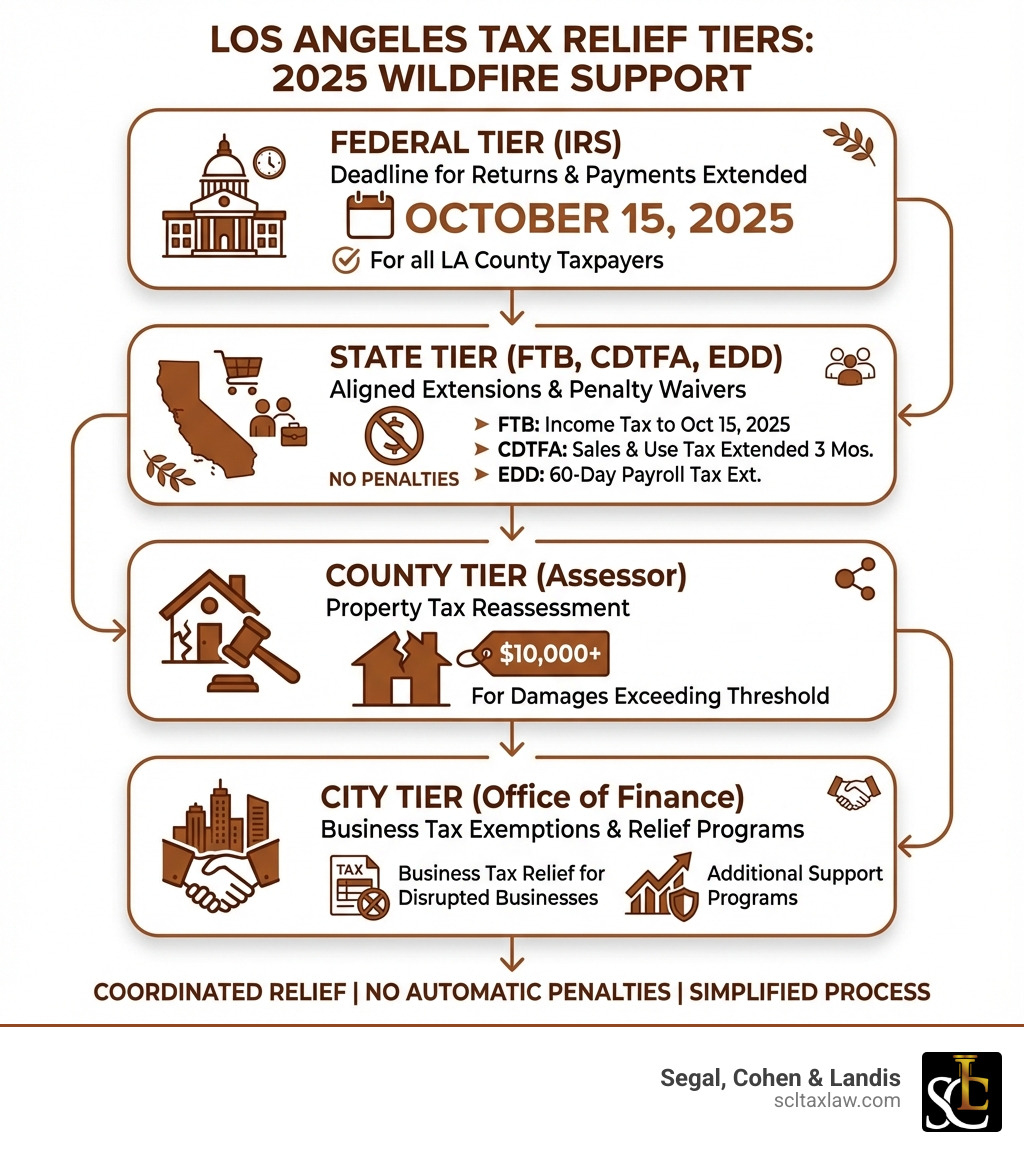
Available Tax Relief Programs:
- The January 2025 Los Angeles wildfire deadline postponements described here are historical. The October 15, 2025 income-tax deadline and April 10, 2026 property-tax postponement have passed; eligibility for other relief or later postponements requires separate verification.
- The January 2025 Los Angeles wildfire deadline postponements described here are historical. The October 15, 2025 income-tax deadline and April 10, 2026 property-tax postponement have passed; eligibility for other relief or later postponements requires separate verification.
- State (CDTFA): Sales and use tax returns extended by three months
- State (EDD): 60-day extension available for payroll tax reports
- County (Assessor): Property tax reassessment for damages exceeding $10,000
- City (Office of Finance): Business tax relief for destroyed or economically disrupted businesses
Key Benefit: No penalties or interest will accrue during the relief period, and most extensions are automatic—you don’t need to apply.
The recent wildfires have created unprecedented financial hardship for countless Angelenos. Between lost homes, damaged businesses, and displaced families, the last thing anyone should worry about is meeting tax deadlines or facing IRS penalties. Fortunately, federal, state, and local agencies have coordinated a comprehensive response that extends deadlines, waives penalties, and provides pathways to reduce tax burdens for those affected.
This guide breaks down every available tax relief option in simple terms—from the IRS extensions that apply to everyone in Los Angeles County, to specialized property tax programs for damaged homes, to business tax relief for companies forced to close. Whether your property was directly impacted or you’re simply trying to steer the financial aftermath, understanding these programs can save you thousands of dollars and months of stress.
tax relief Los Angeles: Review the relevant notices, filing history, records, and deadlines before choosing a response. Evaluate professional assistance according to the facts, applicable law, and agreed scope of representation.
Quick Tax relief Los Angeles terms:
Federal & State Disaster Tax Relief: Extended Deadlines for LA County
When disaster strikes, the last thing on your mind should be tax deadlines. Thankfully, both federal and state tax authorities have stepped up to provide significant extensions and relief for individuals and businesses in Los Angeles County affected by the recent wildfires. This means we have more time to focus on recovery without the added pressure of impending tax obligations.

The core of this relief is an automatic extension of various filing and payment deadlines. This applies not just to those directly impacted, but to all taxpayers whose IRS or FTB address of record is located within Los Angeles County. This broad approach ensures that the entire community has breathing room to steer the aftermath of the disaster.
IRS Postponements for Wildfire Victims
The January 2025 Los Angeles wildfire deadline postponements described here are historical. The October 15, 2025 income-tax deadline and April 10, 2026 property-tax postponement have passed; eligibility for other relief or later postponements requires separate verification. See Federal Emergency Management Agency (FEMA).
This extended deadline covers a wide range of tax obligations that were originally due from January 7, 2025, through October 15, 2025. This includes individual income tax returns, estimated tax payments, and various business tax returns such as partnership, S corporation, and corporate returns. It also extends to quarterly payroll and excise tax returns.
A significant benefit of this relief is that it’s largely automatic. If your IRS address of record is in the disaster area, you don’t need to contact the IRS to receive this extension. Furthermore, the IRS is automatically providing filing and penalty relief. If you receive a late filing or payment penalty notice, but you moved into the disaster area, you should call the number on the notice to have the penalty abated. We often help clients with these kinds of penalty abatements, ensuring they receive the relief they’re entitled to.
California Franchise Tax Board (FTB) Alignment
The January 2025 Los Angeles wildfire deadline postponements described here are historical. The October 15, 2025 income-tax deadline and April 10, 2026 property-tax postponement have passed; eligibility for other relief or later postponements requires separate verification.
This state-level extension covers individual income tax returns, estimated tax payments, partnership returns, corporate returns, and tax-exempt organization returns. Similar to the IRS, this relief is automatic for taxpayers whose principal residences or principal places of business are in Los Angeles County. You generally won’t need to apply for this extension, even if you weren’t directly affected by the fires. When filing, we advise clients to write “Los Angeles County Fire” in blue or black ink at the top of their tax returns to alert the FTB of their eligibility for disaster relief.
For more details on the Governor’s announcement, you can refer to the official statement here: California Gov. Gavin Newsom announced the extension.
Other State Agency Extensions (CDTFA & EDD)
Beyond the IRS and FTB, other California state agencies are also offering crucial tax relief Los Angeles residents and businesses need.
The CDTFA sales and use tax deadline postponement described here concerned 2025 returns and payments and has expired. Check the current CDTFA disaster-relief guidance and the notice applicable to your account for any separate relief.
For employers, the California Employment Development Department (EDD) is offering assistance. Employers in Los Angeles County directly affected by the wildfires can request a 60-day extension to file state payroll reports or deposit payroll taxes without incurring penalties or interest. A request for extension must be received within two months from the original delinquent date. This can provide much-needed flexibility for businesses trying to get back on their feet.
Claiming Losses and Specific Relief Measures
Beyond extended deadlines, there are specific mechanisms to help ease the financial burden of disaster-related losses. Understanding how to properly claim these losses and what constitutes qualified relief payments can significantly impact your financial recovery. This section will guide you through the process of accounting for damages and ensuring you receive all eligible tax relief Los Angeles has to offer.

Deducting Disaster-Related Casualty Losses
A qualifying disaster casualty loss may be claimed for the disaster year or, with a timely election, the preceding year. Check eligibility, reimbursements, documentation, and the election deadline. IRS Publication 547 describes the six-month election period measured from the regular disaster-year return due date, without extensions; applicable postponements require separate review.
Electing to claim losses on the prior year’s return can sometimes result in a quicker refund, providing immediate financial relief. To claim these losses, you’ll generally use Form 4684, Casualties and Thefts. It’s crucial to include the FEMA disaster declaration number (4856-DR) on any return claiming a loss. This helps the IRS process your claim correctly.
Calculating the value of your loss can be complex, involving factors like the property’s adjusted basis and the decrease in fair market value. We often guide our clients through this process, helping them accurately assess their losses to maximize their deductions. For more comprehensive information on navigating audits related to deductions, you can review our IRS Audit Defense Complete Guide.
Understanding Qualified Wildfire Relief Payments
Relief-payment exclusions depend on the applicable provision, payment dates, covered expenses, and reimbursements. The special qualified-wildfire-payment exclusion and section 139 qualified-disaster-payment rules are distinct; a payment related to a wildfire is not automatically excluded.
IRS Publication 547 describes the special qualified-wildfire-payment exclusion for payments received from January 1, 2020 through December 31, 2025, subject to its conditions. Check current law before treating a later payment as excluded. The covered categories below do not replace the statutory requirements.
- Personal property losses
- Medical expenses
- Temporary housing or living expenses
- Repairs to your home
This exclusion is a critical piece of tax relief Los Angeles victims can benefit from, as it helps ensure that assistance received for recovery efforts doesn’t inadvertently create a new tax burden. It’s important to keep clear records of any payments received and how they were used, as well as any insurance payouts, to accurately determine the non-taxable portion.
Required Documentation for Tax Relief Claims
While some disaster relief, like deadline extensions, is automatic, claiming certain benefits, especially casualty losses or business disruption relief, often requires documentation. Having the right paperwork in order can make the difference between a successful claim and a denied one. Here’s a list of essential documents and information we recommend gathering:
- Photographs of Damage: Before and after photos of damaged property can serve as crucial visual evidence.
- Insurance Claim Documents: Copies of all communications, claims filed, and settlement statements from your insurance company. This helps establish what losses were and were not covered.
- Repair Receipts and Estimates: Documentation of costs incurred for repairs, rebuilding, or replacing damaged property.
- Debris Removal Confirmation: If you had professional debris removal, keep records of this service.
- Proof of Business Closure/Disruption: For businesses seeking relief, documentation such as utility bills, payroll records, or communication with employees showing cessation or reduction of operations.
- Verified Clientele List & Client Testimonials: If your business experienced severe economic disruption without physical destruction, evidence like a verified clientele list and client testimonials can help demonstrate the impact.
Maintaining meticulous records is a best practice for any tax situation, but it becomes even more critical in the aftermath of a disaster. This documentation supports your claims and can be vital if your relief application or tax return is ever questioned.
Comprehensive Tax Relief Los Angeles: County and City Programs
Beyond federal and state initiatives, local governments in Los Angeles County and the City of Los Angeles have also implemented specific tax relief Los Angeles residents and businesses can leverage. These programs often address property tax concerns and business-specific exemptions, providing targeted support where it’s most needed.
Property Tax Relief for Damaged Homes and Businesses
Property owners in Los Angeles County whose property was damaged by the wildfires may be eligible for significant property tax relief through the misfortune and calamity program. To qualify, the loss must exceed $10,000 in current market value. If your property meets this criterion, you can apply for a temporary reduction in your property’s assessed value. This program requires filing Form ADS-820, “Application for Reassessment: Property Damaged or Destroyed by Misfortune or Calamity,” with the Los Angeles County Assessor’s Office within 12 months of the damage. For more information, you can also consult the County of Los Angeles and this resource from the Property Tax Disaster Relief Available to Victims of the Los Angeles County Wildfires. Further details on the misfortune and calamity program are also available: Misfortune and Calamity Property Tax Reassessment.
Additionally, if your property was substantially damaged or destroyed by a governor-declared disaster, California Proposition 19, which took effect in 2021, provides for the property’s tax base to be transferred to a comparable property in California. This can be a substantial benefit for homeowners looking to rebuild or relocate.
The January 2025 Los Angeles wildfire deadline postponements described here are historical. The October 15, 2025 income-tax deadline and April 10, 2026 property-tax postponement have passed; eligibility for other relief or later postponements requires separate verification. See Executive Order N-10-25.
City of Los Angeles Business Tax Exemptions
The City of Los Angeles offers a variety of tax exemptions that can help reduce or even eliminate business tax liability, independent of disaster relief. These are important for local businesses to be aware of under normal circumstances, and even more so when recovering from hardship. We encourage our business clients to explore these options as part of their overall tax planning.
Two notable exemptions include:
- Small Business Exemption: Registered businesses with gross receipts not exceeding $100,000 from within and outside the City of Los Angeles (worldwide) qualify for this exemption. Timely renewal statements are required to maintain this benefit.
- Entertainment Creative Talent Exemption: This exemption applies to “creative artists” who generate up to $300,000 in total taxable and non-taxable gross receipts attributable to their qualifying “creative activities.” This is specifically for registered businesses and individual creative artists performing for entertainment or aesthetic purposes and also requires timely renewal filings.
These exemptions, along with others, are detailed on the City of Los Angeles’s official page: Tax Incentives and Exemptions.
Applying for Business Disruption Relief in Los Angeles
For businesses that were destroyed or economically disrupted by the wildfires, the City of Los Angeles also provided specific relief. While the submission period for the 2025 Business Tax Relief Program has officially concluded, understand the process for historical context and future disaster preparedness.
Under such programs, businesses whose locations were destroyed or experienced severe economic disruption for at least 45 days could qualify. If granted relief, the business account was deemed closed as of December 31, 2024, meaning business tax renewal was not required for the 2025 tax year. This relief, however, only affected City of Los Angeles Business Tax Registration Certificate status and did not impact other permits, licenses, or state/federal tax status.
If a business that received this relief plans to reopen or continue services, they generally need to re-register as if they were a newly established business. This involves submitting a Business Tax Application Form and including a copy of the tax relief approval notification. This process ensures that businesses can resume operations while properly navigating their tax obligations.
Navigating General Tax Problems and Finding Assistance
Even without a disaster, tax issues can be daunting. From audits to disputes and unmanageable tax debt, many individuals and businesses find themselves in need of guidance. Fortunately, a range of resources exists to help steer these complexities, including free assistance programs and established relief options. Understanding these can be a lifeline, offering pathways to manage or reduce your tax liabilities. For broader solutions, we also offer specific Tax Debt Relief Los Angeles services.
Free Tax Preparation and Dispute Assistance
For those seeking help with tax preparation or disputes, several valuable resources are available:
- Volunteer Income Tax Assistance (VITA) and Tax Counseling for the Elderly (TCE): These programs offer free tax preparation services to eligible individuals or families. You can find your closest site using the VITA Locator Tool or by calling 800-906-9887. While VITA sites typically cannot help claim disaster losses, they are excellent for general tax preparation.
- AARP Tax-Aide: Similar to VITA/TCE, AARP Tax-Aide also provides free tax preparation assistance. Their site locator tool is available here: AARP Site Locator Tool.
- Low Income Taxpayer Clinic (LITC): The LITC program provides free to low-cost services to individuals who have tax disputes with the IRS. This includes representation in audits, appeals, collections, and litigation, as well as help responding to IRS notices and correcting account problems. They also educate taxpayers on their rights and advocate for low-income and English-as-a-Second-Language (ESL) taxpayers.
- City of Los Angeles Taxpayer Advocate Program: For businesses in Los Angeles facing complex city business tax problems, the City’s Office of Finance has a dedicated City of Los Angeles Taxpayer Advocate Program. This program works with businesses to research and resolve intricate tax issues.
These resources are designed to ensure that everyone, regardless of income or language barrier, has access to the tax assistance they need.
Eligibility for General Tax Relief Los Angeles Programs
Beyond disaster-specific relief, the IRS offers several programs that can provide significant relief from tax debt or penalties. We often help clients determine their eligibility for these options:
- Offer in Compromise (OIC): An OIC allows certain taxpayers to resolve their tax liability with the IRS for a lower amount than what they originally owe. Eligibility is based on your ability to pay, taking into account your income, expenses, asset equity, and overall financial condition. To qualify, you must be current on all tax filings and not be in an active bankruptcy. Our Offer in Compromise Complete Guide provides an in-depth look at this powerful tool.
- Penalty Abatement: If you’ve been assessed penalties, you might qualify for penalty abatement. This can occur under various circumstances, such as:
- First-Time Abate (FTA): If you have a clean compliance history for the past three years, you may qualify for abatement of certain penalties.
- Reasonable Cause: If you can demonstrate a legitimate reason for failing to file or pay on time (e.g., serious illness, death in the family, unavoidable absence), the IRS may abate penalties. Our Tax Penalty Abatement Complete Guide explains the criteria and process in detail.
- Currently Not Collectible (CNC) Status: If the IRS determines that you cannot pay your tax debt without experiencing financial hardship, they may place your account in CNC status. While this doesn’t forgive the debt, it pauses collection efforts until your financial situation improves.
Review the relevant notices, filing history, records, and deadlines before choosing a response. Evaluate professional assistance according to the facts, applicable law, and agreed scope of representation.
Key Agency Contacts for More Information
When you need more detailed or specific information about tax relief Los Angeles programs, knowing who to contact is key. Here are the primary agencies and their resources:
- Federal Emergency Management Agency (FEMA) / DisasterAssistance.gov: For comprehensive information on disaster recovery, including eligibility for various federal assistance programs, visit DisasterAssistance.gov. This site is often the first stop for understanding the broader scope of disaster aid.
- Internal Revenue Service (IRS):
- For questions about federal tax relief due to disasters or if your records are located outside the disaster area but were impacted, call the IRS disaster hotline at 866-562-5227.
- For general tax questions or assistance with specific issues like penalty notices, refer to the contact information on your IRS correspondence or visit IRS.gov.
- California Franchise Tax Board (FTB):
- For state income and franchise tax relief, remember to write “Los Angeles County Fire” on the top of your tax returns.
- For specific inquiries, refer to the FTB’s official website or their phone lines dedicated to taxpayer assistance.
- California Department of Tax and Fee Administration (CDTFA):
- For sales and use tax relief and other CDTFA-administered programs, visit their website or contact their customer service lines.
- California Employment Development Department (EDD):
- For payroll tax extensions, visit the EDD website and follow the instructions for requesting an extension due to disaster.
- Los Angeles County Assessor’s Office:
- For property tax relief through the misfortune and calamity program or questions about Proposition 19, contact the Assessor’s Office directly or visit their website for Form ADS-820.
- City of Los Angeles Office of Finance:
- For city business tax exemptions or past business disruption relief programs, contact the Office of Finance or use their online resources.
Don’t hesitate to reach out to these agencies directly. They are there to help you steer the process and ensure you receive the relief you are entitled to.
Frequently Asked Questions about Los Angeles Tax Relief
Review the relevant notices, filing history, records, and deadlines before choosing a response. Evaluate professional assistance according to the facts, applicable law, and agreed scope of representation.
What is the main tax deadline extension for LA wildfire victims?
The January 2025 Los Angeles wildfire deadline postponements described here are historical. The October 15, 2025 income-tax deadline and April 10, 2026 property-tax postponement have passed; eligibility for other relief or later postponements requires separate verification.
Do I need to apply for the IRS and FTB deadline extensions?
No, the relief is automatic for any taxpayer with an IRS or FTB address of record located in Los Angeles County. You do not need to contact the agencies to get this extension. However, if you receive a penalty notice despite being eligible, you should contact the relevant agency to have the penalty abated.
Can I get property tax relief if my home was damaged but not destroyed?
Yes, if your property suffered damage exceeding $10,000 in value due to the wildfires, you may be eligible for a temporary reduction in your property’s assessed value through the county’s Misfortune and Calamity program. You will need to file Form ADS-820 with the Los Angeles County Assessor’s Office within 12 months of the damage.
Expert Guidance Through Complex Tax Challenges
Navigating the complexities of disaster relief, federal tax law, and California tax regulations can be overwhelming, especially when you’re already dealing with the aftermath of wildfires. Whether you’re an individual trying to deduct casualty losses, a business seeking to understand local exemptions, or simply need help with general tax problems like an IRS audit or unfiled tax returns, understanding your options is paramount.
Review the relevant notices, filing history, records, and deadlines before choosing a response. Evaluate professional assistance according to the facts, applicable law, and agreed scope of representation. Related resources: Los Angeles Tax Attorney.
Have questions about this topic? Talk to an IRS attorney today.
Segal, Cohen & Landis, P.C. — Beverly Hills. Serving clients nationwide.

Samuel Landis, Esq.
LL.M. (Tax) · Selected to Super Lawyers®
Sam Landis is a Beverly Hills IRS tax attorney specializing in IRS collection defense, audit representation, and international tax compliance for foreign nationals and US expats.