

When the IRS Comes Knocking: What You Need to Know About Audit Transcript Retrieval
IRS audit transcript retrieval is the process of requesting official tax records directly from the IRS to support your audit defense, verify your filed return, or reconstruct missing documentation.
Here’s how to do it quickly:
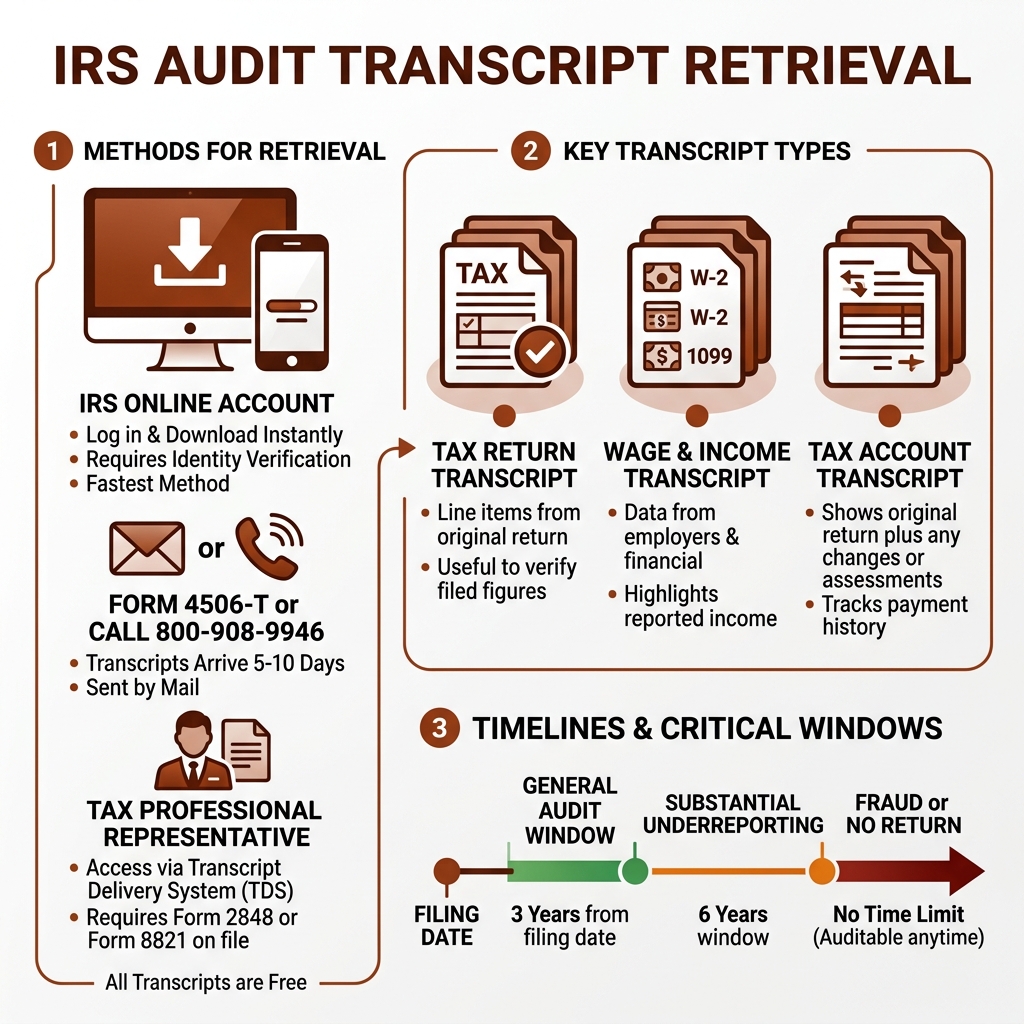
- Online (fastest): Sign in to your IRS Individual Online Account and download transcripts instantly
- By mail: Use Form 4506-T or call 800-908-9946 — transcripts arrive in 5 to 10 calendar days
- Through a tax professional: Your representative can access records via the IRS Transcript Delivery System (TDS) with a signed Form 2848 or Form 8821 on file
- All transcripts are free — no fee to retrieve any transcript type
Receiving an IRS audit notice is stressful. For many taxpayers, the first challenge isn’t understanding the audit itself — it’s finding the records to respond to it.
Your own files may be incomplete. Years may have passed. Documents get lost.
That’s exactly where IRS tax transcripts become critical. They give you an official, IRS-verified snapshot of your tax history — including what you reported, what the IRS received from employers and payers, and any changes made after you filed. Whether you’re facing a correspondence audit by mail or a full field audit with an agent at your door, transcripts are often the foundation of a strong response.
The IRS generally has three years from your filing date to audit a return. In cases of substantial underreporting, that window extends to six years — and there’s no time limit if fraud or an unfiled return is involved. Knowing exactly what the IRS has on file, and acting quickly, can make a significant difference in the outcome.
Review the relevant notices, filing history, records, and deadlines before choosing a response. Evaluate professional assistance according to the facts, applicable law, and agreed scope of representation.
Understanding the Role of IRS Audit Transcript Retrieval in Tax Defense
Review the relevant notices, filing history, records, and deadlines before choosing a response. Evaluate professional assistance according to the facts, applicable law, and agreed scope of representation. Related resources: Federal Income Tax Audit.
A tax transcript is essentially a computer-generated summary of your tax return information. It isn’t a photocopy of the original paper you mailed in, but it contains all the line items, schedules, and forms that matter. One of the most important features of modern transcripts is the masking of Personally Identifiable Information (PII). To protect you from identity theft, the IRS partially hides Social Security numbers and bank account details, but the financial data remains fully visible for audit purposes.

Why is this so important for your defense? Transcripts contain “Transaction Codes.” These are three-digit numbers that tell a story: when the return was filed, when payments were made, if a penalty was assessed, or if the IRS previously adjusted your account. By Navigating IRS Audits with these codes, we can spot errors in the IRS’s logic before the auditor even opens their mouth.
Furthermore, the IRS provides Routine access to IRS records through these transcripts to help taxpayers resolve issues without having to file complex Freedom of Information Act (FOIA) requests. In our Complete Guide to IRS Audit Defense, we emphasize that being prepared with your transcripts is the best way to prevent an auditor from making assumptions about “unreported income” that might just be a simple clerical error.
Types of IRS Tax Transcripts and Their Audit Relevance
Not all transcripts are created equal. Depending on the Types of IRS Audits you are facing, we may need to pull several different versions to get the full picture.
| Transcript Type | What it Shows | Audit Relevance |
|---|---|---|
| Tax Return Transcript | Most line items from the original return (1040 series). | Best for verifying what you originally claimed for income and deductions. |
| Tax Account Transcript | Basic data like filing status, AGI, and taxable income. | Shows post-filing changes, payments, and assessment dates. |
| Record of Account | A combination of the Return and Account transcripts. | The “gold standard” for a comprehensive audit defense. |
| Wage and Income | Data from W-2s, 1099s, 1098s, and 5498s. | Vital for IRS Audit for Unreported Income cases. |
| Verification of Non-Filing | Record of whether the IRS has processed a return for the requested year. | Confirms that the IRS has no record of a processed return for the requested year; it does not determine whether you were required to file. |
When we ask, “Are You at Risk of an IRS Audit?“, we often look at the Wage and Income transcript first. This document shows exactly what your employers and banks reported to the IRS. A mismatch may lead to a request for information or proposed adjustments, such as a CP2000 notice. A CP2000 notice is not a formal audit, and a mismatch does not guarantee that an examination will occur.
For more details on these categories, you can review Transcript types for individuals and ways to order them.
Step-by-Step Guide to IRS Audit Transcript Retrieval
If you’ve received an IRS Tax Audit Letter, don’t panic. You can handle the IRS audit transcript retrieval process using several methods. We always recommend the digital route for speed, but the IRS offers traditional options for those who prefer them.
Using the “Get Transcript” Tool for IRS Audit Transcript Retrieval
The fastest way to get your records is the Get Transcript Online tool.
- Register: You will need to create an account through ID.me, the IRS’s identity verification partner. You’ll need a photo ID (like a driver’s license or passport) and a smartphone to take a “selfie” for verification.
- Select Reason: Once logged in, the system will ask why you need the transcript. Select “Audit” or “Federal Tax” to ensure you get the right format.
- Download: You can view, print, or download your transcripts as PDFs immediately. This is a lifesaver when you need IRS Tax Audit Help on a tight deadline.
If you can’t use the online tool, you can request a transcript by mail. You can do this through the “Get Transcript by Mail” portal or by calling 800-908-9946. These typically arrive at your address of record within 5 to 10 calendar days. If you’ve moved recently, you’ll need to update your address with the IRS first, or the transcript will be sent to your old home!
For those who prefer paper forms, you can mail or fax Form 4506-T. Use the form instructions to request the available transcript product. The IRS ended direct third-party delivery of individual transcripts in July 2019; authorized representatives have separate access procedures.
Professional Requirements for IRS Audit Transcript Retrieval
If you decide to seek IRS Audit Representation, your IRS Audit Defense Lawyer or CPA can handle the heavy lifting for you. However, the IRS has strict security requirements for professionals.
To pull your transcripts, a representative must:
- Be a “Circular 230” practitioner (an attorney, CPA, or Enrolled Agent).
- Have a valid Form 2848 (Power of Attorney) or Form 8821 (Tax Information Authorization) signed by you.
- Use the Transcript Delivery System (TDS). This is a professional-grade portal that allows us to pull years of records in minutes.
As an IRS Audit Attorney in LA, we use these tools to perform a “pre-audit” of your files. By seeing what the IRS sees, we can anticipate their questions and prepare your defense strategy before the first meeting with the auditor.
Comparing Tax Transcripts vs. Formal Return Copies
Many people ask us, “Why can’t I just get a copy of my actual return?” You can, but it’s usually the “long way around.”
A Tax Transcript is free and fast. It contains all the financial data needed for an audit. In fact, most auditors actually prefer transcripts because the data is already in the IRS’s standardized format.
A Formal Return Copy (requested via Form 4506) is an actual photocopy of the original return you filed, including any handwritten notes or attachments. However, there is a $30 fee for each tax year you request, and the process can take up to 75 days.
Whether a transcript is sufficient depends on the issue and the records requested. For What Happens If the IRS Audits You?, review the actual notice and supporting documents needed. A full return copy may be useful when signatures, attachments or other details absent from a transcript matter. A transcript does not replace substantiation for an Audit Tax Return examination.
Strategies for Missing Records and Unreported Income
The biggest nightmare in an audit is missing records. Maybe a pipe burst in your basement, or you simply didn’t keep the receipts for that business trip three years ago. When What to Do When You Disagree with an IRS Audit involves missing data, IRS audit transcript retrieval is your first line of defense.
If your own records are gone, we use the Wage and Income Transcript to reconstruct your income. This shows W-2s and 1099s that were reported by third parties. While it doesn’t show your expenses, it ensures you aren’t hit with a “failure to report income” penalty for something you simply forgot.
When the IRS sends an Information Document Request (IDR), they are asking for specific proof. If you don’t have the receipt, we can often use bank statement analysis or third-party verification to satisfy the auditor. According to the official Audits Records Request guidelines, the IRS will accept “circumstantial evidence” if it is credible and organized.
For businesses, this might mean pulling a Business Tax Audit transcript to see if payroll taxes were correctly credited. For individuals, it might involve an Individual Tax Audit review to ensure that deductions for mortgage interest match the 1098 forms the bank sent to the IRS.
Frequently Asked Questions about IRS Audit Transcripts
Is there a cost associated with obtaining IRS tax transcripts?
No. All five types of IRS tax transcripts are provided free of charge. Whether you download them through your online account, order them by phone, or have your representative pull them through the TDS system, you should never have to pay the IRS for a transcript. The only time you pay is if you request a full photocopy of the original return ($30 per year).
How many years of tax transcripts can be requested?
It depends on the type:
- Tax Return Transcripts: Available for the current year and the three prior years.
- Tax Account Transcripts: Available for the current year and up to ten prior years online (three years by mail).
- Wage and Income Transcripts: Available for the current year and ten prior years.
- Record of Account: Available for the current and three prior years.
If you are dealing with an older debt, we often use the ten-year account history to determine the Collection Statute Expiration Date (CSED).
What is the difference between a Tax Account Transcript and a Tax Return Transcript?
The Tax Return Transcript is a “static” document—it shows exactly what you filed on your original return. It does not reflect any changes you (or the IRS) made later.
The Tax Account Transcript is “dynamic.” It shows the original filing, but it also lists every action taken on the account since then. This includes payments you made, penalties the IRS added, interest accrued, and any adjustments from a previous Audit After Tax Return Accepted. This is the transcript we use to track your balance and payment history.
Conclusion: Don’t Face the Auditor Alone
IRS audit transcript retrieval is a powerful tool, but it’s only the first step. Knowing how to read those transcripts—and how to use them to challenge an auditor’s findings—requires a deep understanding of tax law.
Los Angeles: Review the relevant notices, filing history, records, and deadlines before choosing a response. Evaluate professional assistance according to the facts, applicable law, and agreed scope of representation. Related resources: IRS Audit Defense Strategies.
From From Audit to Appeal, we stand by our clients to ensure they are treated fairly by the government. If you’ve received an audit notice for your 2025 Tax Audits or have concerns about Inflation Reduction Act IRS Audits, we can help you pull the right records and build a winning case.
Review the relevant notices, filing history, records, and deadlines before choosing a response. Evaluate professional assistance according to the facts, applicable law, and agreed scope of representation. Related resources: Contact Segal, Cohen & Landis today.
Have questions about this topic? Talk to an IRS attorney today.
Segal, Cohen & Landis, P.C. — Beverly Hills. Serving clients nationwide.

Samuel Landis, Esq.
LL.M. (Tax) · Selected to Super Lawyers®
Sam Landis is a Beverly Hills IRS tax attorney specializing in IRS collection defense, audit representation, and international tax compliance for foreign nationals and US expats.