

What “Getting Audited” Actually Means — and What to Do About It
Getting audited meaning in plain terms: the IRS is reviewing your tax return to verify that what you reported is accurate and that you paid the right amount of tax.
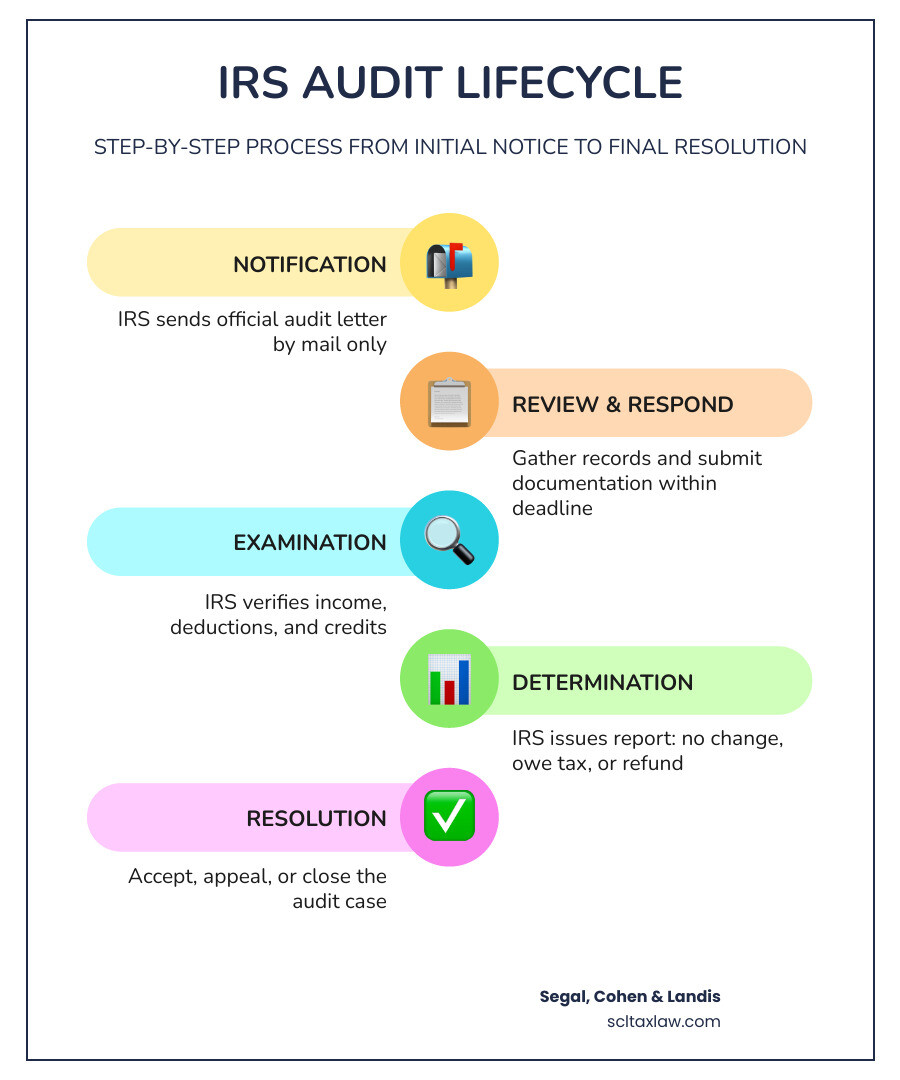
Here’s a quick breakdown:
| Term | What It Means |
|---|---|
| IRS Audit | A formal review of your tax records by the IRS |
| Who gets audited? | Individuals and businesses — selected by algorithm, random draw, or red flags |
| How you’re notified | Always by mail — never by phone or email |
| What the IRS checks | Income, deductions, credits, and supporting documents |
| Possible outcomes | No change, you owe more tax, or you receive a refund |
Most people dread the word “audit.” But the reality is often less dramatic than the fear. Many audits are resolved entirely by mail, with no face-to-face meetings — and a significant number result in no change at all to what you originally filed.
That said, an audit is still a serious matter. Ignoring it — or responding without preparation — can turn a manageable situation into a costly one.
Review the relevant notices, filing history, records, and deadlines before choosing a response. Evaluate professional assistance according to the facts, applicable law, and agreed scope of representation.
Understanding the Getting Audited Meaning and General Scope
When we talk about what is a audit, we are describing an independent examination of financial information. In the context of the government, an income tax audit is the process where a tax authority—like the IRS or the California Franchise Tax Board—verifies that income, expenses, and credits are reported accurately according to the law.
The word “audit” actually comes from the Latin audire, which means “to hear.” Historically, auditors would literally listen to accounts read aloud to verify their accuracy. Today, the process is much more data-driven, but the goal remains the same: to ensure fairness in the tax system.
Financial-statement audits seek reasonable assurance about material misstatement. An IRS examination reviews whether a return reports the correct tax; it does not give a financial-audit opinion.
There are different levels of scrutiny depending on the taxpayer. An individual tax audit might focus on specific deductions like charitable giving or child credits, whereas a corporate audit might look at complex international transactions. Regardless of the scope, the objective is to determine if the financial report presents a “true and fair” view of your tax liability.
Why the IRS Selects Taxpayers for Examination
Many of our clients ask, “Why me?” It’s a fair question. The IRS doesn’t just throw a dart at a phone book. Most selections are driven by sophisticated technology. The IRS uses the Discriminant Function (DIF) score, a secret mathematical formula that rates every tax return. If your return deviates significantly from the “norm” for taxpayers in your income bracket, your DIF score goes up, and so does your chance of being flagged.
Another tool is the Unreported Income Discriminant Function (UIDIF), which specifically looks for signs that a taxpayer might have hidden cash. We cover this in detail in our guide on IRS audit unreported income.
Other common reasons for selection include:
- Data Matching: The IRS receives copies of your W-2s and 1099s. If the numbers you report don’t match the numbers the IRS has on file, a notice is automatically generated.
- Related Examinations: If you do business with someone who is being audited—like a business partner or an investor—their audit might lead the IRS to your door.
- Random Selection: Sometimes, you’re just the “lucky” winner of a purely random statistical sample used by the IRS to study taxpayer behavior.
To learn more about your specific risks, see are you at risk of an IRS audit and how far back can the IRS go.
Common Red Flags and the Getting Audited Meaning for High Earners
For high-income earners and business owners, the getting audited meaning often involves a deep dive into lifestyle and business deductions. The IRS looks for “lifestyle discrepancies”—for instance, if you report $30,000 in income but own a $2 million home in Los Angeles, the IRS will want to know where the money came from.
Other red flags include:
- Unusually high deductions: Claiming $50,000 in business expenses on $60,000 of income.
- Round numbers: Reporting exactly $5,000 for “supplies” and $10,000 for “travel” looks like you’re guessing rather than using real receipts.
- Scrutiny on credits: An audit for claiming dependents or the Earned Income Tax Credit (EITC) is common because these areas have high error rates.
- Consistent losses: If your business tax audit shows you’ve lost money five years in a row, the IRS may reclassify your business as a “hobby,” which means you can’t deduct those losses.
Modern Triggers: Digital Assets and the Getting Audited Meaning in 2026

As we move through May 2026, the IRS has significantly increased its focus on digital assets. If you trade Bitcoin, Ethereum, or NFTs, you must understand your cryptocurrency tax liability. The IRS now receives much more data from exchanges, and failing to check the “Yes” box on your return regarding digital assets is a major red flag.
Furthermore, payment apps like Venmo, PayPal, and CashApp now report business transactions to the IRS. If you have a side gig and receive payments digitally, that income is now visible to the “Taxman.” We are also seeing a massive wave of ERC credit audits targeting businesses that may have been misled by “ERC mills” into claiming pandemic-era credits they didn’t qualify for.
The Three Main Types of IRS Audits
Not all audits are created equal. Depending on the complexity of your return, you will face one of three types:
| Audit Type | Method | Scope |
|---|---|---|
| Correspondence | Simple errors or missing documents | |
| Office | IRS Office | Specific items like itemized deductions |
| Field | Your Home/Office | Comprehensive review of business/lifestyle |
Understanding the types of IRS audits is crucial because the strategy for defense changes with each. A federal income tax audit can escalate quickly if the auditor (known as a Revenue Agent) finds evidence of broader issues.
Correspondence Audits: The Most Common Getting Audited Meaning
A CP 2000 notice proposes an information-matching adjustment through the Automated Underreporter process; it is not a formal IRS examination. Follow the actual notice’s instructions and response deadline. Related reading: IRS tax audit letter.
For example, if you forgot to report a $1,000 interest payment from your bank, the IRS will send a letter proposing a change to your tax bill. If you agree, you pay the bill and the audit is over. If you have proof the IRS is wrong, you mail in your documentation. It’s relatively simple, but don’t let the “mail-only” nature fool you—the penalties for ignoring these letters are just as real.
Office and Field Audits: In-Person Scrutiny
Office and field audits are more intense. In an office audit, you are asked to bring your records to a local IRS branch. In a field audit, the IRS agent actually comes to your home, place of business, or your representative’s office.
Field audits are generally reserved for complex cases, such as an IRS payroll audit or a large business review. The agent will often want to interview employees and tour your facility. This is where professional representation is most critical, as agents are trained to look for “scope expansion”—finding new things to tax while they are already on-site.
Navigating the IRS Audit Process and Your Rights
If you find yourself being audited in LA, or anywhere else in the country, the first step is to stay calm. The IRS must notify you by mail; they will never call you out of the blue or email you to start an audit.
Once notified, you have a set of legal protections known as the Taxpayer Bill of Rights. These include:
- The Right to Be Informed: You have the right to know why the IRS is questioning your return.
- The Right to Quality Service: You deserve professional and courteous treatment.
- The Right to Representation: You have the right to hire a tax attorney to speak to the IRS on your behalf.
- The Right to Appeal: If you disagree with the findings, you can take your case to the IRS Appeals office or even Tax Court.
If you disagree with an IRS audit, you should not sign the examination report. Instead, you can request a conference with a manager or file a formal protest. If the IRS issues a Statutory Notice of Deficiency, you generally have 90 days to petition the Tax Court to prevent the IRS from collecting the tax until a judge hears your case.
Professional IRS audit representation is often the difference between a “No Change” result and a massive tax bill. We act as your shield, ensuring the IRS only gets the information they are legally entitled to and nothing more.
Frequently Asked Questions about IRS Audits
How far back can the IRS audit a tax return?
The general statute of limitations is three years from the date you filed your return or the due date, whichever is later. However, there are big exceptions. If you omit more than 25% of your gross income, the IRS can go back six years. If the IRS suspects fraud or if you never filed a return at all, there is no time limit—they can go back as far as they want. Even an audit after a tax return is accepted is possible within these timeframes.
How long does an IRS audit typically take?
There is no “standard” time. A simple mail audit might be resolved in a few months. A complex field audit of a large business could take a year or more. Factors that influence the timeline include the complexity of the issues, the availability of your records, and how quickly you respond to IRS requests. To see the potential outcomes, read about what happens if the IRS audits you.
What documents should I prepare for an audit?
The IRS will provide a list of specific items they want to see. Generally, you should gather:
- Receipts and Invoices: Organized by category and year.
- Bank Statements and Canceled Checks: To prove the money actually left your account.
- Electronic Records: The IRS now accepts many digital logs and spreadsheets.
- Legal Documents: Such as closing statements from a home sale or divorce decrees.
If you’ve lost your records due to a fire or flood, don’t panic. There are ways to reconstruct your data. For more help, check out The Essential Guide To Federal Audit Transcript Retrieval And Defense or our guide on how to audit a tax return.
Conclusion
The getting audited meaning doesn’t have to mean financial ruin. While it is a stressful experience, it is ultimately a methodical, evidence-based process. By maintaining good records, staying informed of your rights, and seeking proactive compliance, you can navigate an audit with confidence.
Review the relevant notices, filing history, records, and deadlines before choosing a response. Evaluate professional assistance according to the facts, applicable law, and agreed scope of representation.
If you’ve received a letter from the IRS, don’t wait. Contact us today for a confidential consultation. For a deeper dive into protecting your assets, read our IRS audit representation complete guide. We have locations across the United States, from Los Angeles and San Francisco to New York, Chicago, and Miami, ensuring you have expert help wherever you are.
Have questions about this topic? Talk to an IRS attorney today.
Segal, Cohen & Landis, P.C. — Beverly Hills. Serving clients nationwide.

Samuel Landis, Esq.
LL.M. (Tax) · Selected to Super Lawyers®
Sam Landis is a Beverly Hills IRS tax attorney specializing in IRS collection defense, audit representation, and international tax compliance for foreign nationals and US expats.