


What Business Owners Must Know About Personal Liability for Unpaid Payroll Taxes
The Trust fund recovery penalty is one of the IRS’s most powerful collection tools. It makes you personally liable for your business’s unpaid payroll taxes, even if your company is a corporation or LLC. This penalty equals 100% of the taxes your business withheld from employees but failed to pay to the government, creating statutory liability for a responsible person who willfully fails to collect, account for, or pay over trust fund taxes. Collection against personal assets remains subject to applicable procedures.
Quick Answer: Trust Fund Recovery Penalty Overview
- What it is: A penalty equal to 100% of unpaid employee withholding taxes (income tax, Social Security, Medicare)
- Who it affects: Any “responsible person” who willfully failed to pay—including owners, officers, bookkeepers, or anyone with control over finances
- What’s at risk: Your personal bank accounts, wages, home, and other assets
- Key fact: The penalty is not dischargeable in bankruptcy
- Assessment and collection periods are separate and can be affected by statutory exceptions, extensions, and suspensions. Review the return, assessment, and Letter 1153 dates; do not rely on a single three-year/ten-year summary.
During a cash flow crunch, it’s tempting to use withheld payroll taxes to pay other creditors like rent or suppliers. This decision, often made out of desperation, can trigger devastating consequences. The IRS can file liens against your home, levy your bank accounts, and garnish your wages. Closing the business won’t stop them, and this debt cannot be discharged in bankruptcy.
As an experienced tax attorney, I’ve seen how destructive these cases can be. This guide explains everything you need to know about the TFRP—how it works, how to avoid it, and what to do if the IRS is targeting you.
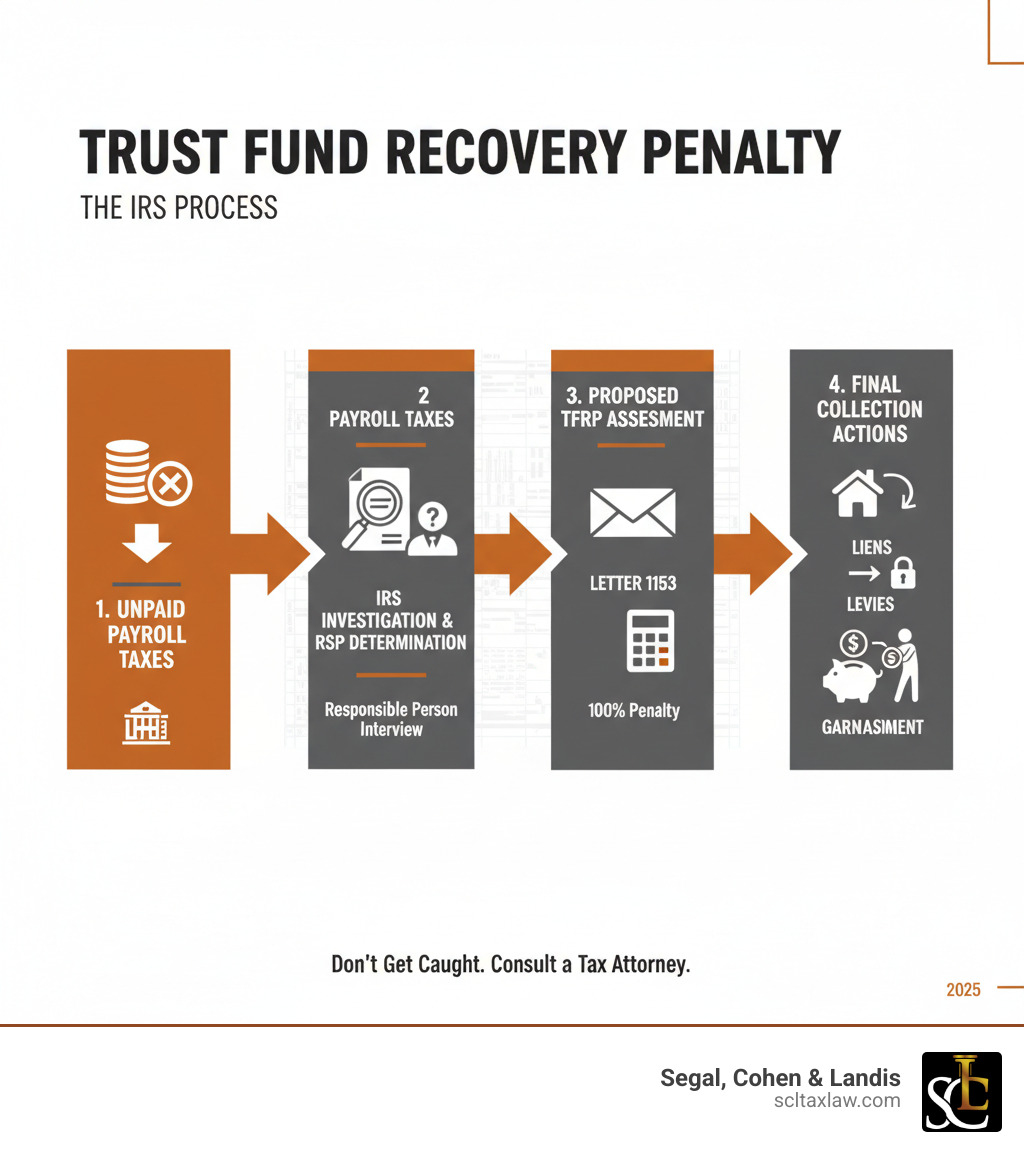
Explore more about Trust fund recovery penalty:
Deconstructing the Trust Fund Recovery Penalty (TFRP)
Understanding the Trust fund recovery penalty is essential for any business owner or financial manager. It’s the IRS’s direct path to holding you personally accountable when a business fails to remit certain taxes.
What Are Trust Fund Taxes?
When you withhold taxes from an employee’s paycheck, that money isn’t yours. You are simply a trustee, holding funds on behalf of the federal government. These trust fund taxes include federal income tax and the employee’s share of FICA taxes (Social Security and Medicare).
Using this money for other business expenses is viewed by the IRS as spending government funds. The TFRP applies only to these trust fund taxes, not all employment taxes.
| Category | Description | TFRP Applicable? |
|---|---|---|
| Trust Fund Taxes | Federal income tax withheld from employee wages; Employee’s portion of Social Security and Medicare taxes | Yes |
| Non-Trust Fund Taxes | Employer’s matching portion of Social Security and Medicare taxes; Federal unemployment taxes (FUTA) | No |
For the IRS’s official explanation, see their guidance on Employment taxes and the Trust Fund Recovery Penalty (TFRP).
The Two Pillars of Liability: Responsibility and Willfulness
To assess the TFRP, the IRS must prove two elements: you were a “responsible person” and your failure to pay was “willful.”
Understanding “Responsible Person”
A responsible person is anyone with significant control over company finances and the authority to decide which bills get paid. This broad definition isn’t limited by job title. It can include owners, officers, board members, and even bookkeepers. The key question is: did you have the authority and ability to ensure the taxes were paid? If yes, you may be considered responsible. For more details, review our guide on Personal Responsibility for Payroll Tax Liability.
Defining “Willfulness”
In this context, willfulness doesn’t require malicious intent. It simply means you voluntarily, consciously, and intentionally failed to pay the taxes. The most common example is paying other creditors (like suppliers or landlords) when you knew payroll taxes were due. Acting with reckless disregard—suspecting a problem but failing to investigate or correct it—also qualifies as willful.
How the TFRP is Calculated
The penalty is brutally simple: 100% of the unpaid trust fund taxes. It covers only the employee’s portion of withheld taxes—federal income tax and their share of Social Security and Medicare. It does not include the employer’s matching FICA contributions or other penalties and interest accrued by the business.

For example, if a business failed to remit $10,000 in withheld income tax and $6,500 in employee FICA taxes, the TFRP assessed against a responsible person would be exactly $16,500.
The IRS Investigation and Assessment Process
The IRS has efficient systems for detecting unpaid payroll taxes. Once a problem is flagged, the investigation that can lead to a Trust fund recovery penalty begins.
From Delinquency to Investigation
Common triggers for an IRS investigation include:
- Failing to file Form 941 (Quarterly Federal Tax Return).
- A pattern of late payroll tax deposits.
- Accumulating failure-to-deposit penalties.
- Using withheld taxes to pay other creditors.
Once an investigation starts, a Revenue Officer is typically assigned to the case. Their job is to investigate the delinquency and identify who was responsible for paying the taxes. This is a serious development that requires immediate attention. For more context, see our Business Tax Problems: Ultimate Guide.
The Trust Fund Recovery Interview and Form 4180
The Revenue Officer will conduct interviews to determine responsibility and willfulness. The centerpiece of this process is Form 4180, Report of Interview with Individual. This detailed questionnaire asks about your duties, financial authority, and knowledge of the unpaid taxes.
Your answers on Form 4180 can be used to build a case against you. Answering these questions without legal counsel is extremely risky, as you may inadvertently admit to facts that establish your liability. We strongly advise never attending a Trust Fund Recovery Interview without an experienced tax attorney.

The Proposed Assessment: Letter 1153 and Form 2751
If the IRS concludes you are a responsible and willful person, you will receive Letter 1153, Proposed Assessment of Trust Fund Recovery Penalty. This is not the final assessment; it is your opportunity to fight back.
Crucially, this letter gives you a 60-day window to appeal the decision (75 days if outside the U.S.). If you miss this deadline, your options become severely limited.
The mailing will also include Form 2751, Agreement to Assessment. Do not sign this form without consulting a tax attorney. Signing it means you waive your appeal rights and consent to immediate collection actions against your personal assets. Letter 1153 is your call to action—use the 60-day window to build a defense.
For more information, the IRS provides details on their page about the Trust Fund Recovery Penalty.
Your Rights and Options After a TFRP Assessment
Receiving a Trust fund recovery penalty assessment is a serious blow, but you are not without options. Understanding the consequences and your rights is the first step toward a resolution.
Consequences of a TFRP Assessment
Once the TFRP is assessed, it becomes your personal debt, and the corporate shield will not protect you. The IRS can use powerful collection tools, including:
- Federal Tax Liens: Placed on all your personal property, including your home and car, damaging your credit and ability to sell assets.
- Bank Levies: Freezing and seizing funds from bank accounts under applicable levy procedures. The IRS generally must provide notice and an opportunity for a hearing before levy; statutory exceptions apply.
- Wage Garnishments: Taking a significant portion of your paycheck from your employer.
- Asset Seizure: In some cases, seizing and selling personal assets like real estate or vehicles.
Most importantly, the TFRP is not dischargeable in bankruptcy. This debt can follow you for the entire 10-year collection period. For more on this, see our guide on the Consequences of Unpaid Payroll Taxes and Solutions with a Payroll Tax Attorney.
How to Challenge a Trust Fund Recovery Penalty Assessment
If you believe the IRS is wrong, you can fight the assessment. Your chance begins with Letter 1153, which gives you 60 days to file an appeal. Missing this deadline is a critical mistake.
The appeals process involves formally protesting the proposed assessment. Your defense will focus on proving you were not a “responsible person” or that your failure to pay was not “willful.”
- Arguing Against Responsibility: You can present evidence that you lacked the actual authority to control financial decisions or direct payments, regardless of your job title.
- Arguing Against Willfulness: You can show that you did not know the taxes were unpaid or that you did not recklessly disregard the obligation. For example, perhaps you were misled by a partner or a payroll service.
Successfully appealing a TFRP requires a well-documented, strategic argument. These cases can be won with proper representation. Learn more about IRS Audit Defense Strategies: Navigating the Audit Process with a Payroll Tax Attorney.
Resolving the Debt: Payment Plans and Settlements
If the penalty is assessed, you still have options to manage the debt.
- Installment Agreement: A monthly payment plan with the IRS. While interest continues to accrue, an agreement halts aggressive collection actions like levies and garnishments. It’s vital to negotiate a payment you can realistically afford.
- Offer in Compromise (OIC): An agreement to settle the debt for less than the full amount owed. OICs for TFRP are difficult to obtain because the IRS views the underlying failure as a serious breach of trust. However, they are possible if you can prove a genuine inability to pay the full amount.
- Penalty Abatement: A TFRP assessment may be abated when the IRS determines that all or part of the liability is not owed, or following an applicable Appeals determination or court judgment. Payments on related liabilities may require an adjustment. Review the assessment, payment records, and available claim procedures; relief is not guaranteed.
Choosing the right strategy depends on a detailed analysis of your financial situation. For a deeper look at these options, read our guide on Understanding Tax Debt Relief Options: How an IRS Tax Law Firm Can Guide You.
Proactive Measures and Key Considerations
The best way to deal with the Trust fund recovery penalty is to avoid it altogether. Proactive measures can protect you and your business from this devastating financial outcome.
Best Practices to Avoid a Trust Fund Recovery Penalty
Treat withheld payroll taxes as sacred funds that do not belong to the business. Here are key practices to ensure compliance:
- Maintain a Separate Payroll Tax Account: Immediately transfer all withheld taxes into a dedicated bank account. This prevents you from accidentally using the funds for operating expenses.
- Use a Reputable Payroll Service: A professional provider can manage tax remittance, but remember, you are still ultimately responsible. Vet your provider carefully and verify that payments are being made.
- Conduct Regular Internal Audits: On a quarterly basis, review your Form 941 filings and tax deposit records to catch discrepancies early.
- Know and Document Your Role: Understand your financial responsibilities. If you delegate payroll, verify that the duties are being performed correctly.
- Address Financial Problems Immediately: If you foresee trouble making tax deposits, don’t hide. Contact the IRS or a tax professional to explore options before you become delinquent.
For more on managing these obligations, see our guide on Handling Payroll Taxes: What to Know and How a Payroll Tax Attorney Can Help.
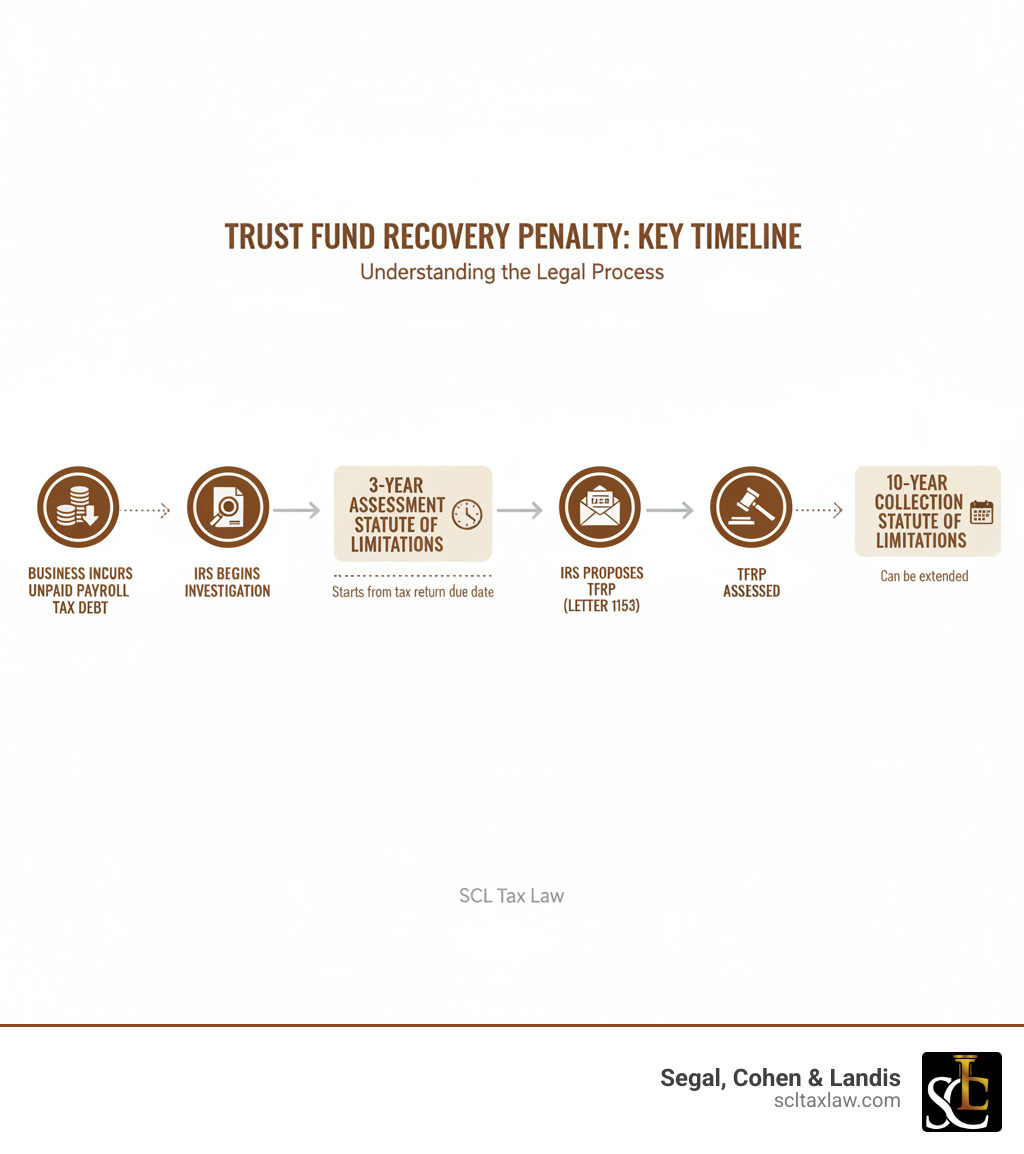
Important Legal Timelines and Considerations
Timing is critical when dealing with the TFRP.
- Statute of Limitations to Assess: The IRS generally has three years to assess the TFRP, generally measured from April 15 following the calendar year of the withholding/FICA tax period, or the actual filing date if later. Fraud, missing returns, extensions, and timely Letter 1153 procedures can change the period.
- Statute of Limitations to Collect: Once assessed, the IRS has ten years to collect the debt through liens, levies, and other actions. This period can be extended by certain events, including a pending installment-agreement request and certain bankruptcy periods. An approved installment agreement alone does not suspend the collection period.
Hiring a third-party payroll provider does not absolve you of liability. If they fail to remit the taxes, the IRS can still pursue you.
Review the relevant notices, filing history, records, and deadlines before choosing a response. Evaluate professional assistance according to the facts, applicable law, and agreed scope of representation.
Frequently Asked Questions about the TFRP
Here are answers to some of the most common questions we hear from clients in Los Angeles and across California about the Trust fund recovery penalty.
Can an employee or bookkeeper be held liable for the TFRP?
Yes. Liability is not limited to owners or officers. The IRS can assess the TFRP against any “responsible person.” This includes any employee—such as a bookkeeper, controller, or office manager—who had significant control over company finances and the authority to decide which bills were paid. If you had the power to ensure tax compliance but failed to do so, you are at risk, even if you were following an owner’s instructions. Federal TFRP liability requires responsible-person status and willful failure to collect, account for, or pay over trust fund taxes; ownership alone is insufficient.
What is the difference between the TFRP and a failure-to-deposit penalty?
They are two different penalties related to unpaid payroll taxes:
- The failure-to-deposit (FTD) penalty is assessed against the business for making late or incorrect tax deposits. It’s a percentage-based fine for non-compliance.
- The Trust fund recovery penalty (TFRP) is assessed against a responsible individual personally. It is not a fine; it is a 100% recovery of the actual trust fund taxes (employee withholdings) that the business failed to pay.
Accumulating FTD penalties is often a red flag that triggers a TFRP investigation.
Can the IRS collect the full amount from more than one responsible person?
Yes. The liability is “joint and several.” This means the IRS can assess the full penalty against multiple responsible individuals. For example, if the debt is $100,000, the IRS can try to collect the full $100,000 from any single responsible person. However, the IRS can only collect the total amount of the debt once. Once the $100,000 is paid (whether by one person or a combination of people), collection stops. This allows the IRS to pursue the individual with the most accessible assets.
Conclusion
The Trust fund recovery penalty can impose statutory personal liability equal to the unpaid trust fund taxes on responsible persons who act willfully. Ownership alone is insufficient. Collection generally runs for ten years from assessment, subject to extensions and suspensions, and the liability is generally not dischargeable in bankruptcy.
Proactive compliance is your best defense. Treat payroll taxes as funds held in trust for the government, make timely deposits, and conduct regular audits. If your business faces financial hardship, address the problem head-on before it spirals out of control.
If you have received an IRS notice about unpaid payroll taxes, been contacted by a Revenue Officer, or received Letter 1153, do not wait. The stakes are too high to steer this process alone. What you say and do next can have a lasting impact on your financial future.
Review the relevant notices, filing history, records, and deadlines before choosing a response. Evaluate professional assistance according to the facts, applicable law, and agreed scope of representation.
Don’t let the Trust fund recovery penalty jeopardize your future. The sooner you take action, the more options you have.
Contact us for expert guidance on your payroll tax issues.
Have questions about this topic? Talk to an IRS attorney today.
Segal, Cohen & Landis, P.C. — Beverly Hills. Serving clients nationwide.

Samuel Landis, Esq.
LL.M. (Tax) · Selected to Super Lawyers®
Sam Landis is a Beverly Hills IRS tax attorney specializing in IRS collection defense, audit representation, and international tax compliance for foreign nationals and US expats.