

What the IRS Trust Fund Penalty Means for You — and Why It’s Urgent
The IRS trust fund penalty — formally called the Trust Fund Recovery Penalty (TFRP) — is one of the most aggressive collection tools in the IRS’s arsenal. Here is what you need to know right away:
Quick Answer: IRS Trust Fund Penalty at a Glance
| Question | Answer |
|---|---|
| What is it? | A personal liability equal to 100% of unpaid withheld payroll taxes |
| Who does it target? | Any “responsible person” who willfully failed to pay over employee tax withholdings |
| What taxes does it cover? | Withheld federal income tax + employee share of Social Security and Medicare (FICA) |
| Can it follow you personally? | Yes — your LLC or corporation does NOT protect you |
| Can it be discharged in bankruptcy? | No — it survives bankruptcy |
| How long does the IRS have? | 3 years to assess; 10 years to collect |
| How do you appeal? | You have 60 days after IRS Letter 1153 to respond |
Most business owners assume their corporate structure shields them from personal tax liability. It does not — not here. When a business fails to hand over the taxes it withheld from employee paychecks, the IRS does not just pursue the company. It comes after you personally. It can file liens against your home, levy your bank accounts, and garnish your wages — even if the business has been closed for years.
The law behind this is IRC Section 6672, and courts have applied it broadly. Officers, bookkeepers, partners, board members, and even employees with check-signing authority have all been held personally liable.
The stakes are high, and the IRS moves fast once it opens an investigation.
Review the relevant notices, filing history, records, and deadlines before choosing a response. Evaluate professional assistance according to the facts, applicable law, and agreed scope of representation.
Explore more about IRS trust fund penalty:
What Is the IRS Trust Fund Penalty?
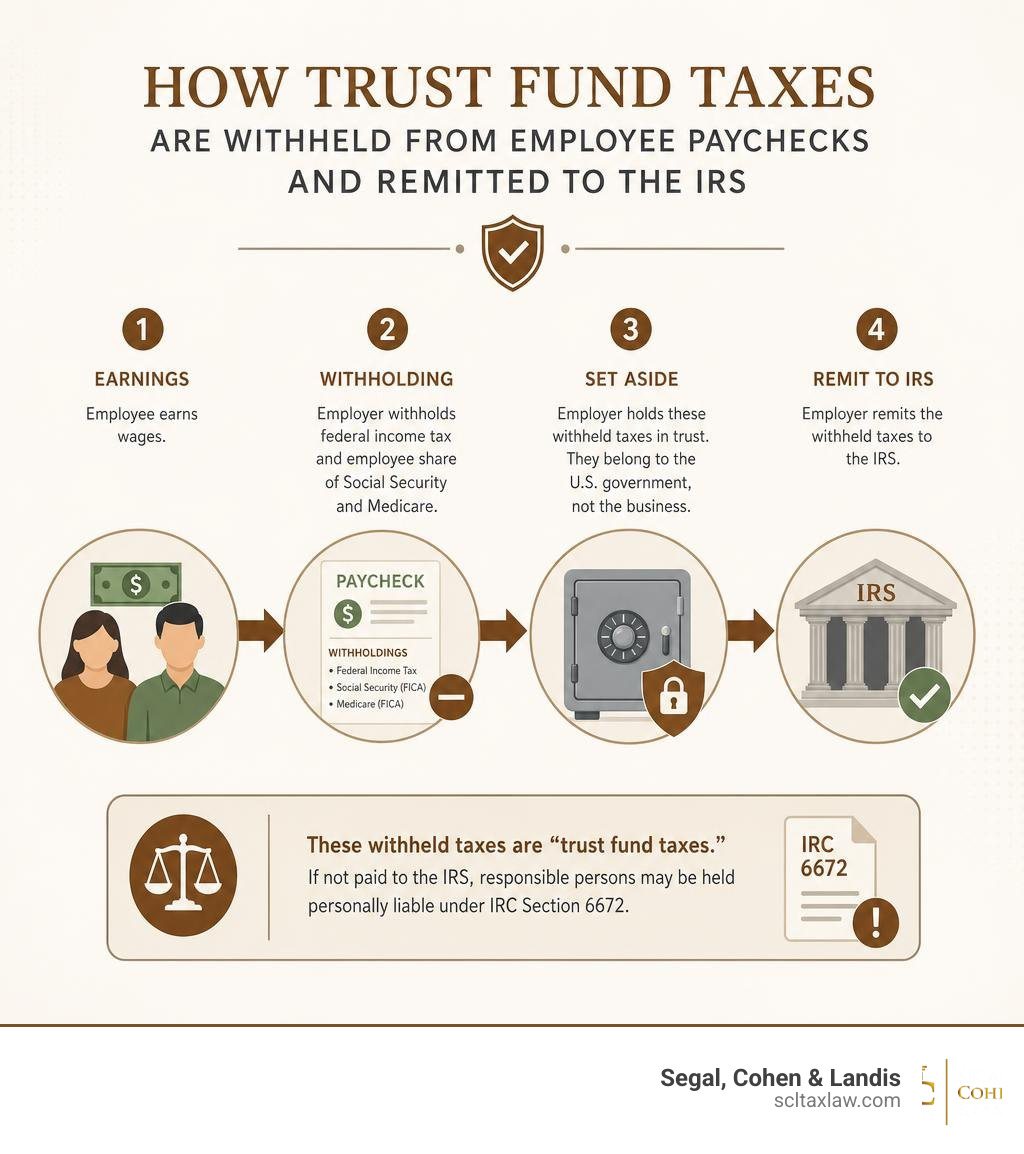
To understand the IRS trust fund penalty, we first have to understand what a Trust Fund Tax actually is. When you run a business with employees, you don’t just pay them their net wages. You are legally required to withhold federal income taxes, as well as the employees’ share of FICA (Social Security and Medicare) taxes, directly from their paychecks.
Under the law, these withheld amounts do not belong to your business. You are simply holding them “in trust” for the United States government until you make your federal tax deposits.
If your business runs into a cash flow crunch, it can be incredibly tempting to use those trust fund taxes to pay critical vendors, rent, or utilities just to keep the lights on. But the IRS views this as taking government money to fund your business operations.
IRC Section 6672 authorizes the Trust Fund Recovery Penalty against responsible persons who willfully fail to collect, account for, or pay over trust fund taxes. Liability equals the unpaid trust fund portion; ownership alone is insufficient. See Employment taxes and the Trust Fund Recovery Penalty (TFRP) | Internal Revenue Service.
The Two Triggers: Responsibility and Willfulness
The IRS cannot just assess the IRS trust fund penalty against anyone. To hold you personally liable, they must prove two specific legal triggers: that you were a responsible person and that you willfully failed to pay the taxes.
Under the guidelines in 5.7.3 Establishing Responsibility and Willfulness for the Trust Fund Recovery Penalty (TFRP) | Internal Revenue Service, these triggers are defined as:
- Responsibility: A “responsible person” is anyone who has the status, duty, and authority to ensure trust fund taxes are collected, accounted for, and paid over to the IRS. The IRS looks past formal corporate titles. You might be the President, but if you have no control over financial decisions, you might not be responsible. Conversely, you might be an unpaid board member or a non-owner manager, but if you have check-signing authority and decide which bills get paid, these facts may support a responsibility finding, but the IRS must evaluate the full scope of your financial authority; check-signing authority alone is insufficient.
- Willfulness: To act “willfully” in the eyes of the IRS does not require bad intent or a desire to defraud the government. It simply means you were aware (or should have been aware) that the taxes were unpaid, and you voluntarily, consciously, and intentionally chose to pay other expenses or creditors instead of the IRS. Paying net wages to your employees while ignoring the tax withholding is, by definition, a willful act.
To understand how these factors apply to your business structure, you can read our detailed guide on Personal Responsibility for Payroll Tax Liability.
Calculating the IRS Trust Fund Penalty Amount
The term “100% penalty” is often misunderstood. It does not mean the IRS doubles the business’s total tax bill. Instead, the penalty is equal to exactly 100% of the unpaid trust fund portion of the taxes.
The business’s overall payroll tax liability (reported on Form 941) consists of two main parts: the trust fund taxes (withheld from employees) and the employer’s matching contributions (matching FICA and FUTA). The personal penalty only applies to the trust fund portion.
| Tax Type | Is it part of the personal TFRP? | Description |
|---|---|---|
| Employee Federal Income Tax Withholding | Yes | Withheld directly from employee paychecks |
| Employee Share of FICA (Social Security & Medicare) | Yes | Withheld directly from employee paychecks |
| Employer Matching FICA | No | Paid directly by the business; cannot be assessed personally under TFRP |
| Federal Unemployment Tax (FUTA) | No | Paid directly by the business; cannot be assessed personally under TFRP |
While the employer’s matching taxes and associated late-filing or late-payment penalties remain liabilities of the business entity, the trust fund portion is what crosses the corporate shield to become your personal debt.
Who Can Be Held Personally Liable for the TFRP?
Because the IRS is highly aggressive when it comes to unpaid payroll taxes, revenue officers will cast a wide net during their investigation. They want to identify every single person who could potentially be held personally liable.

This personal liability can extend to:
- Corporate Officers and Directors: Presidents, Vice Presidents, Treasurers, and CFOs are primary targets.
- LLC Members and Managers: Because LLCs are flexible structures, the IRS looks at who actually holds the financial reins.
- Shareholders and Partners: Anyone with a significant financial stake who exercises control over corporate disbursements.
- Non-Owner Employees: Controllers, accountants, and bookkeepers who have independent authority to sign checks and decide which creditors to pay.
- Voluntary Board Members: Even board members of non-profit organizations can be held liable if they had active knowledge and oversight of the organization’s financial failures.
Third-Party Payroll Providers and PEOs
Many modern businesses outsource their payroll operations to third-party payroll service providers or Professional Employer Organizations (PEOs). If you hire a third party to handle your payroll, you might assume you are completely safe from the IRS trust fund penalty.
Unfortunately, that is a dangerous misconception.
Under IRC Section 3505 and the IRS internal policies outlined in 5.17.7 Liability of Third Parties for Unpaid Employment Taxes | Internal Revenue Service, the IRS can hold third-party payers liable under specific conditions, particularly if they directly pay wages or supply funds specifically for wages knowing that the employer cannot or will not pay the withholding taxes.
However, outsourcing your payroll does not relieve you of your primary responsibility. If your payroll provider steals your tax funds or fails to make the deposits, the IRS still considers the business owners and officers to be the primary responsible parties. Unless you are using a Certified Professional Employer Organization (CPEO) that meets strict statutory requirements to assume sole tax liability, you remain on the hook.
IRS Assessment, Appeals, and Statute of Limitations
The IRS does not simply assess the TFRP out of nowhere. The process begins when a Revenue Officer conducts an investigation, which usually includes interviewing potential responsible parties using Form 4180 (Report of Interview with Individual Relative to Trust Fund Recovery Penalty).
If the IRS decides you are liable, they will send you two critical documents:
- Letter 1153: The formal proposal of the TFRP assessment.
- Form 2751: A form listing the exact tax quarters and penalty amounts proposed against you.
Once Letter 1153 is mailed, you have a strict 60-day window (75 days if you are outside the United States) to file a written appeal. If you ignore this letter or fail to respond in time, the IRS will officially assess the penalty against you, and active collections will begin. For a comprehensive look at how the IRS handles penalties generally, review our IRS Tax Penalties Complete Guide.
How to Appeal an IRS Trust Fund Penalty Assessment
If you disagree with the proposed assessment — either because you were not a responsible person or because your actions were not willful — you must submit a formal protest to the Revenue Officer who issued the letter.
According to 5.7.6 Trust Fund Penalty Assessment Action | Internal Revenue Service, the type of appeal you file depends on the dollar amount in dispute:
- Small Case Request: If the proposed penalty is $25,000 or less for any single tax period, you can submit a simplified appeal requesting an Appeals conference.
- Formal Written Protest: If the amount is more than $25,000, you must file a detailed, formal written protest. This protest must include a statement of facts, a discussion of the relevant laws and case rulings, and a declaration under penalty of perjury.
Review the relevant notices, filing history, records, and deadlines before choosing a response. Evaluate professional assistance according to the facts, applicable law, and agreed scope of representation. Related resources: IRS Appeals.
Statute of Limitations for Assessment and Collection
The IRS operates under strict timelines when it comes to both assessing and collecting the IRS trust fund penalty.
- Assessment Statute Expiration Date (ASED): For withholding and FICA taxes, the ordinary TFRP assessment period is three years from the April 15 following the calendar year of the taxable period, or from the actual return filing date, whichever is later. No filed return, fraud, and other exceptions can change this period. A timely Letter 1153 can extend the assessment deadline to the later of 90 days after the notice or 30 days after a final administrative determination on a timely protest. A proposal is not itself the assessment; Form 2750 may also extend the period for the person signing it.
- Collection Statute Expiration Date (CSED): Once the TFRP is formally assessed against you personally, the IRS has ten years to collect the debt. This ten-year collection period can be suspended or extended by qualifying events, including bankruptcy, a pending installment-agreement request, and a pending Offer in Compromise. An approved installment agreement by itself does not automatically suspend the collection period; rejection, termination, and related appeals can affect it.
Defending Against and Resolving TFRP Liability
If you are facing a potential TFRP assessment, you are not powerless. There are several powerful legal defenses that can prevent the IRS from holding you personally liable.
Some of the most common defenses we raise on behalf of our clients include:
- The Non-Owner/Ministerial Duties Defense: If your job title was “Manager” or “Controller” but you only signed checks at the direct, supervised instruction of the business owner with no independent decision-making authority, you are not a responsible person under the law.
- Lack of Willfulness: If you did not know the taxes were unpaid, or if you were actively lied to or kept in the dark by a business partner or accountant, we can argue that your failure to pay was not willful.
- No Available Funds: If you took control of a business after the tax liability already accrued, you are generally not responsible for the prior tax debt unless there were unencumbered funds available in the business accounts at the moment you took over.
To explore these defense options in greater detail, you can read our page on the Trust Fund Recovery Penalty.
IRS Tax Debt Resolution Options for Individuals
If the IRS has already assessed the TFRP against you and the defense window has passed, you must look toward resolving the debt. Because this is a personal liability, you have access to standard individual tax resolution pathways:
- Offer in Compromise (OIC): You can settle your personal TFRP liability for less than the full amount owed if you can demonstrate that you do not have the income or assets to pay it off before the 10-year statute expires. However, keep in mind that the IRS will not compromise the trust fund portion for less than your true “reasonable collection potential.”
- Installment Agreement: You can set up a monthly payment plan with the IRS based on your financial capacity.
- Currently Not Collectible (CNC): If paying federal tax would prevent you from meeting basic, reasonable living expenses, request an IRS review of your financial circumstances. Currently Not Collectible status delays most collection; the debt remains due, interest and applicable penalties continue, refunds may be offset, and the IRS may still file a Notice of Federal Tax Lien. Eligibility and later review depend on the facts. A business entity’s eligibility and any responsible-person liability require separate review.
To find the best path forward for your specific financial situation, we recommend reviewing our IRS Tax Debt Resolution Complete Guide and our guide on IRS Penalty Abatement Complete Guide.
Frequently Asked Questions About the TFRP
Can the IRS trust fund penalty be discharged in bankruptcy?
No. Under the U.S. Bankruptcy Code, trust fund taxes are classified as priority debts. Because they are funds held in trust for the federal government, they are completely non-dischargeable in both personal Chapter 7 and Chapter 11 bankruptcies. Even if your business files for bankruptcy and dissolves, the personal TFRP assessed against you will survive the bankruptcy process intact.
How do business payments affect personal TFRP liability?
Because the IRS trust fund penalty is a collection tool rather than a punitive fine, the IRS is only allowed to collect the unpaid trust fund tax amount once. If the business makes a payment, or if another responsible person pays a portion of the debt, your personal liability is reduced by that exact amount.
However, to protect yourself, any voluntary payments made by the business to the IRS must be clearly designated in writing. You must instruct the IRS to apply the payment specifically to the trust fund portion of the tax liability for the specific quarters in question. If you do not designate the payment, the IRS will automatically apply it to the non-trust fund portion (the employer match, interest, and business penalties) first, leaving your personal liability completely untouched.
What collection actions can the IRS take for unpaid TFRP?
Once the TFRP is personally assessed, the IRS treats it like any other personal tax debt. They can and will employ their most aggressive collection tactics, including:
- Filing a Federal Tax Lien against your personal real estate and assets.
- Issuing a Bank Levy to seize funds directly from your personal checking and savings accounts.
- Enacting a Wage Garnishment to take a portion of your weekly paycheck or retirement distributions.
- Seizing and selling personal property.
If you are facing or currently experiencing these aggressive actions, learn how we can help you stop them by reading our guide to tax levy services.
Protect Your Personal Assets with Expert Representation
The IRS trust fund penalty is one of the most high-stakes challenges a business owner or financial professional can face. Because the IRS can bypass your LLC or corporate protection, your home, your savings, and your retirement are directly on the line.
You should never attend an IRS Form 4180 interview or respond to a Letter 1153 without experienced legal counsel by your side.
Review the relevant notices, filing history, records, and deadlines before choosing a response. Evaluate professional assistance according to the facts, applicable law, and agreed scope of representation.
If you are facing a payroll tax dispute, do not wait for the IRS to take action. Contact Segal, Cohen & Landis for Payroll Tax Help today to schedule a professional consultation with our tax attorneys.
Have questions about this topic? Talk to an IRS attorney today.
Segal, Cohen & Landis, P.C. — Beverly Hills. Serving clients nationwide.

Samuel Landis, Esq.
LL.M. (Tax) · Selected to Super Lawyers®
Sam Landis is a Beverly Hills IRS tax attorney specializing in IRS collection defense, audit representation, and international tax compliance for foreign nationals and US expats.