

Why a 3520 Late Filing Penalty Can Be So Serious
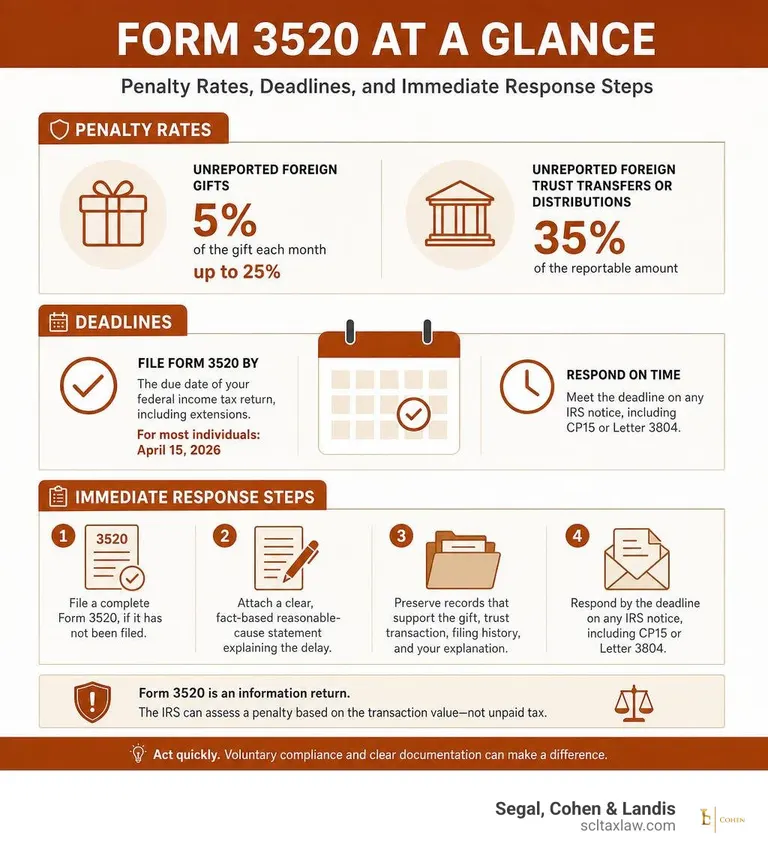
A 3520 late filing penalty can apply even when you owe no U.S. income tax. For an unreported foreign gift, the penalty may be 5% of the gift each month, up to 25%. For certain unreported foreign trust transfers or distributions, it can be 35% of the reportable amount.
If you filed late or received an IRS notice, act quickly:
- File a complete Form 3520, if it has not been filed.
- Attach a clear, fact-based reasonable-cause statement explaining the delay.
- Preserve records that support the gift, trust transaction, filing history, and your explanation.
- Respond by the deadline on any IRS notice, including CP15 or Letter 3804.
Foreign gifts, inheritances, and trust transactions can create complex reporting duties. The stakes are high because Form 3520 is an information return: the IRS can assess a penalty based on the transaction value rather than unpaid tax.
This guide explains selected Form 3520 obligations, potential penalties and response options. Outcomes depend on the applicable requirements and facts.
Basic 3520 late filing penalty glossary:
Understanding Form 3520 Filing Requirements and Deadlines

Form 3520 reports certain foreign-trust transactions, ownership and foreign gifts. Reporting duties and penalty rules differ by transaction. Late or incomplete reporting can create penalty exposure, subject to applicable requirements and reasonable-cause provisions; a missed deadline does not establish an automatic penalty in every case.
For comprehensive procedural rules, taxpayers should review the Official IRS Form 3520 Instructions, and individuals managing ongoing cross-border wealth structures must stay current on foreign trust reporting.
Form 3520 generally is due on the 15th day of the fourth month after the taxpayer’s tax year ends. Qualifying taxpayers living and working abroad have a sixth-month filing date. Review the current instructions for extensions and applicable exceptions. File Form 3520 separately using the instructions’ filing address and include required attachments.
Who Must File Form 3520 and Form 3520-A?
Filing obligations fall upon any “United States person”—which includes U.S. citizens, lawful permanent residents (green card holders), and resident aliens meeting the substantial presence test—who engages in specific foreign financial activities. You are required to submit Form 3520 if you:
- Create a foreign trust or transfer money or property to a foreign trust.
- Hold ownership of foreign trust assets under the grantor trust rules (IRC §§ 671–679).
- Receive direct or indirect distributions from a foreign trust.
- Receive substantial gifts or bequests from non-resident aliens or foreign entities.
It is crucial to understand the distinct Form 3520 and Form 3520-A differences. While Form 3520 is an annual informational return filed by the U.S. individual taxpayer, Form 3520-A (Annual Information Return of Foreign Trust With a U.S. Owner) is filed by the foreign trust itself. Form 3520-A is due earlier—on the 15th day of the third month following the close of the trust’s tax year (March 15 for calendar-year trusts). If the foreign trustee fails to file Form 3520-A, the U.S. owner must file a substitute Form 3520-A attached to their own Form 3520 to avoid severe ownership penalties.
Reporting Thresholds for Foreign Gifts and Trust Transfers
The threshold that triggers a Form 3520 filing depends heavily on the source and character of the funds:
- Gifts or Bequests from Non-Resident Alien Individuals: You must report gifts or bequests exceeding $100,000 in aggregate during the tax year. This includes cumulative transfers from related foreign individuals. For example, helping children buy property through gifts from foreign parents routinely crosses this threshold.
- Gifts from Foreign Entities: Purported gifts from foreign corporations or partnerships have a separate, lower reporting threshold that is adjusted annually. Check the Form 3520 instructions for the relevant year and consider whether the receipt should be recharacterized as income.
- Foreign Inheritances: Inheriting property or cash from an estate abroad requires disclosure under the same $100,000 threshold. Many recipients are surprised to learn that proper foreign inheritance tax reporting is mandatory even when the inheritance is completely exempt from U.S. income tax.
- Foreign Trust Distributions: There is no minimum dollar threshold for foreign trust distributions. Receiving even a modest distribution from a foreign trust creates an immediate Form 3520 reporting duty.
How the IRS Calculates the 3520 Late Filing Penalty
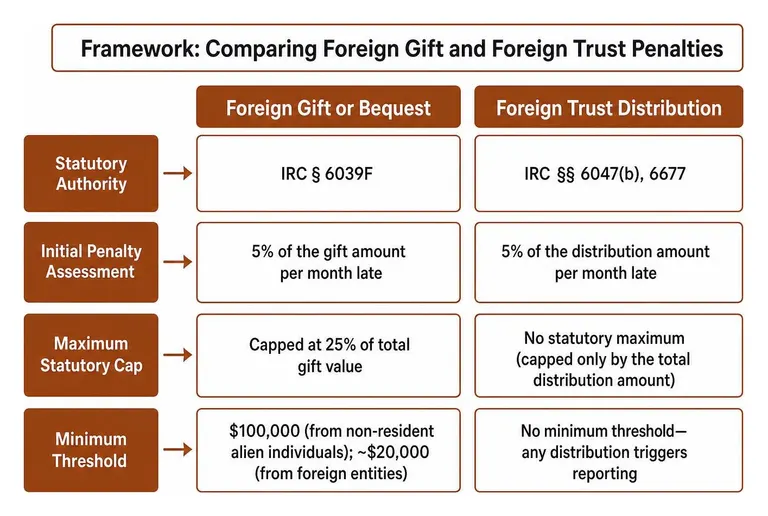
Unlike standard domestic penalties that scale based on unpaid taxes, Form 3520 penalties are calculated as a percentage of the gross reportable amount. This creates catastrophic liability for taxpayers who owe no underlying taxes. The IRS outlines examiner standards in its Failure to File the Form 3520/3520-A Penalties documentation.
| Violation Category | Statutory Authority | Initial Penalty Assessment | Maximum Statutory Cap |
|---|---|---|---|
| Foreign Gift or Bequest | IRC § 6039F | 5% of the gift amount per month late | Capped at 25% of total gift value |
| Foreign Trust Transfer | IRC § 6677(a) | Greater of $10,000 or 35% of gross transfer | Generally limited to the gross reportable amount, including continuation penalties |
| Foreign Trust Distribution | IRC § 6677(a) | Greater of $10,000 or 35% of gross distribution | Generally limited to the gross reportable amount, including continuation penalties |
| Foreign Trust Ownership (3520-A) | IRC § 6677(b) | Greater of $10,000 or 5% of trust assets annually | 100% of gross reportable asset value |
| Continuation Penalties | IRC § 6677(a) | $10,000 per 30-day period (after 90-day notice) | Limited to gross reportable amount |
Foreign Gift Penalties Under IRC Section 6039F
IRC § 6039F authorizes a penalty of 5% per month on the reportable gift, up to 25%, subject to reasonable cause. Current processing policy does not mean automatic assessment at filing.
Consider a practical example: A U.S. taxpayer receives a lawful, non-taxable cash gift of $500,000 from their parents overseas to purchase a home. The taxpayer fails to file Form 3520 by the annual deadline. The statutory foreign-gift reporting penalty can accrue at 5% per month, up to 25%, subject to reasonable cause. For a $500,000 reportable gift, maximum statutory exposure could be $125,000; this is not an automatic assessment at filing under current IRS processing policy.
Foreign Trust Penalties for Unreported Transactions and Ownership
Penalties surrounding foreign trusts under IRC § 6677 are even more aggressive:
- Transfers to Foreign Trusts (Part I): The initial penalty is the greater of $10,000 or 35% of the gross value of property transferred.
- Foreign Trust Distributions (Part III): Beneficiaries who fail to report distributions face an initial penalty equal to the greater of $10,000 or 35% of the gross distribution received. A $1,000,000 trust distribution can generate an immediate $350,000 fine.
- Unreported Trust Ownership (Part II / Form 3520-A): U.S. owners of foreign grantor trusts face an annual penalty of the greater of $10,000 or 5% of the total trust assets for each year Form 3520-A is omitted.
For foreign-trust reporting subject to section 6677, additional penalties can apply if noncompliance continues more than 90 days after the IRS mails a notice. Aggregate penalties are limited by the gross reportable amount under the applicable rules. Review the reporting obligation, notice and reasonable-cause provisions; foreign-gift penalties follow separate section 6039F rules. Related resources: Form 3520 penalties guide.
IRS Relief Procedures and Avoiding Automatic Assessments

Historically, IRS service centers processed delinquent international information returns through systemic automation. The computer systems automatically generated multi-thousand-dollar CP15 assessment notices without human review of attached reasonable-cause explanations.
The IRS Policy Shift on Automatic Penalty Assessments
Following intense criticism from practitioners, legal challenges, and National Taxpayer Advocate reports, the IRS shifted its enforcement strategy. Under current IRS processing guidance, Part IV foreign-gift and bequest penalties are no longer systemically assessed at filing. Foreign-trust reporting has separate penalty rules and reasonable-cause review procedures; do not assume all late Forms 3520 and 3520-A are penalty-free.
Proactive Compliance: Streamlined Filing vs. Delinquent Submissions
If you discover past-due Form 3520 filing obligations before the IRS initiates an examination, several administrative pathways exist:
- Delinquent International Information Return Submission Procedures (DIIRSP): For taxpayers who do not need to file delinquent federal income tax returns and have reasonable cause for the late Form 3520, submissions can be made with a detailed reasonable cause statement attached.
- Streamlined Filing Compliance Procedures: Eligible taxpayers whose conduct was non-willful may use the Streamlined Filing Compliance Procedures, subject to the applicable domestic or foreign eligibility rules. Domestic procedures generally include a 5% miscellaneous offshore penalty; qualifying foreign submissions generally do not. Tax and interest can still be due. A taxpayer already under IRS examination is generally ineligible.
- IRS Voluntary Disclosure Practice: If omissions may have been willful, obtain legal advice about the IRS Voluntary Disclosure Practice before making a submission. A timely, truthful, and complete disclosure may affect a prosecution recommendation, but it does not automatically guarantee immunity.
The Hazards of Filing a Quiet Amended Return
Some taxpayers attempt a “quiet disclosure” by mailing delinquent Forms 3520 or filing amended returns without entering an established IRS disclosure program, hoping the forms slip past automated detection.
A prior delinquent or amended filing does not by itself eliminate eligibility for streamlined procedures. IRS guidance expressly allows some taxpayers who previously made a quiet disclosure to participate, but prior penalty assessments generally will not be abated through those procedures. Eligibility, examination status, willfulness, and the correct disclosure path require individual review.
How to Fight IRS Assessment Notices
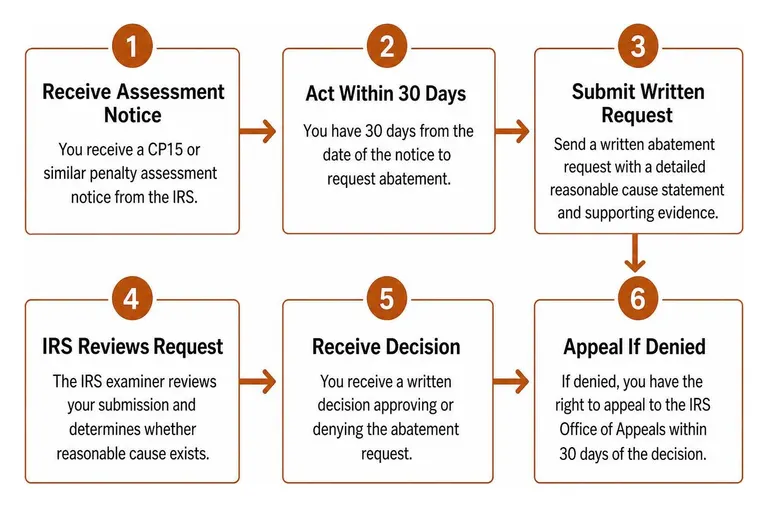
If you receive a penalty assessment notice, you must act decisively. Preserving your appeal rights requires meeting strict statutory deadlines.
Establishing Reasonable Cause to Abate a 3520 Late Filing Penalty
Under both IRC § 6039F(c)(1)(B) and IRC § 6677(d), penalties are waived if the failure to file is due to reasonable cause and not willful neglect. To prevail, you must show that you exercised ordinary business care and prudence but were nonetheless unable to comply.
Successful reasonable cause arguments generally involve:
- Reliance on a Qualified Tax Advisor: You fully disclosed the international transactions to a competent CPA or tax attorney, and the professional erroneously advised that no Form 3520 was required.
- Inadvertent Error and Unfamiliarity: Newly arrived immigrants or accidental foreign trust beneficiaries who had no reason to know of arcane U.S. reporting rules, provided they corrected the filing immediately upon discovery.
- Severe Illness or Natural Disasters: Unavoidable disruptions that incapacitated the taxpayer or destroyed vital international financial records.
A bare assertion that you did not know about the form usually does not establish reasonable cause. The full facts, efforts to comply, advice received, and corrective action matter. Foreign secrecy laws do not excuse required disclosure. For defense strategies, explore our penalty abatement guide.
Responding to IRS Notice CP15 and Letter 3804
International reporting matters may involve different IRS notices and letters with different purposes. Review the actual document, penalty provision and procedural stage promptly with counsel instead of assuming that one notice type applies to every penalty.
To successfully challenge these notices:
- Calendar the Applicable Deadline: Review the actual notice and governing procedure promptly, identify any available response or appeal rights, and confirm the applicable deadline. Do not assume a universal 30-day protest period.
- Submit a Formal Written Protest: Draft a comprehensive legal memorandum detailing your factual timeline, signed under penalties of perjury, establishing statutory reasonable cause.
- Review Refund-Claim Procedures: If a penalty has been paid, determine whether IRS Form 843 is the appropriate refund-claim procedure and confirm the filing deadline and required supporting records.
- Review Available Remedies: If a request is denied, review the decision and applicable administrative or judicial remedies with counsel. Availability, prerequisites and deadlines depend on the penalty and procedural posture; do not assume that every case follows one Appeals-to-refund-litigation sequence.
Frequently Asked Questions about Form 3520 Penalties
Can the IRS impose a 3520 late filing penalty if no tax is owed?
Yes. Form 3520 is strictly an information-reporting return. The penalties authorized under IRC § 6039F and IRC § 6677 punish the failure to disclose cross-border transactions, completely independent of income tax liability. A taxpayer who receives a $2,000,000 non-taxable foreign inheritance and fails to report it can face a statutory maximum penalty of $500,000 (25%), even with zero underlying tax due.
What is the statute of limitations for Form 3520 penalties?
IRC § 6501(c)(8) can extend the assessment period when required foreign-trust information is missing. Its scope depends on the reporting obligation and the taxpayer’s circumstances; reasonable cause can limit the extension to related items. It is not a blanket rule that every Form 3520 failure leaves every tax issue open forever. Complete reporting can start the applicable three-year period, subject to other limitations rules.
Can I get a refund if I already paid a Form 3520 penalty?
A taxpayer who paid a Form 3520 penalty may have a refund claim, including a reasonable-cause argument where applicable. The proper form, payment requirements, claim deadline, and court jurisdiction depend on the penalty and facts. Obtain advice promptly rather than assuming that a general income-tax refund deadline applies. If a timely administrative claim is denied or remains unresolved, counsel can evaluate whether refund litigation is available.
Conclusion
A Form 3520 penalty notice can create substantial exposure even when the underlying transaction is not taxable. An assessment is not necessarily the final word. The IRS announced changes to its initial processing of late foreign-gift returns and review of reasonable-cause statements for trust returns; these changes do not abolish the penalties. A documented response may support relief, but an individual result is not guaranteed.
Contact Segal, Cohen & Landis (SCL) to discuss international reporting questions or a penalty notice. Learn about Segal, Cohen & Landis penalty relief services.
Have questions about this topic? Talk to an IRS attorney today.
Segal, Cohen & Landis, P.C. — Beverly Hills. Serving clients nationwide.

Samuel Landis, Esq.
LL.M. (Tax) · Selected to Super Lawyers®
Sam Landis is a Beverly Hills IRS tax attorney specializing in IRS collection defense, audit representation, and international tax compliance for foreign nationals and US expats.