

Checked October 1, 2026: The IRS states that Automatic Exemption from Penalty (AEP) begins in summer 2026 for eligible 2025 annual returns and 2026 quarterly returns, and subsequent periods. It applies automatically when eligible original returns finish processing and the required compliance history is met. FTA remains a requested remedy for eligible assessed penalties. Other penalties, tax and applicable interest remain due.
What Are IRS Tax Penalties — and Why They Matter
The Internal Revenue Code provides many civil penalties; this guide describes common examples.
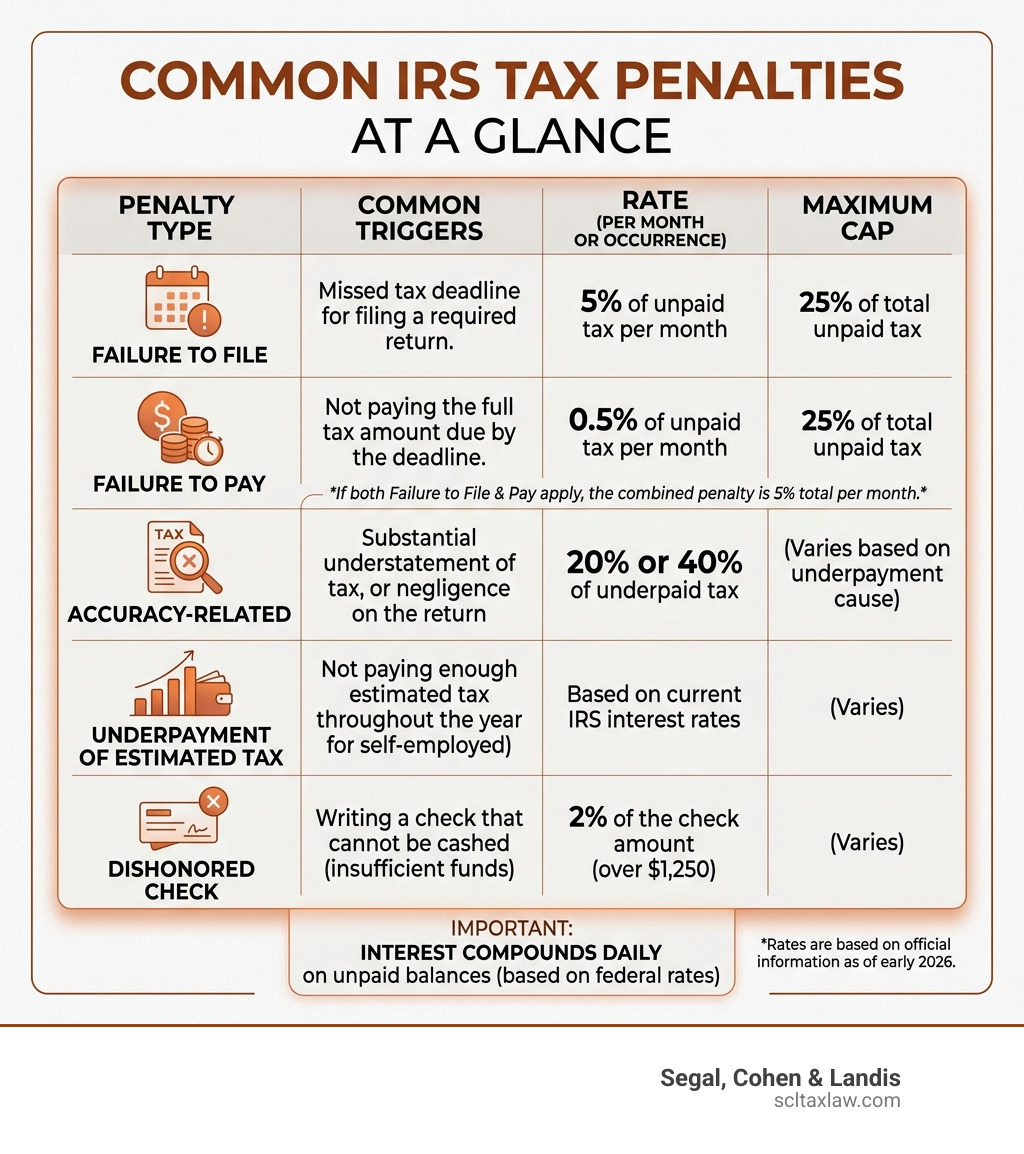
Here are the most common IRS tax penalties at a glance:
| Penalty Type | Rate | Maximum |
|---|---|---|
| Failure to File | 5% of unpaid tax per month | 25% |
| Failure to Pay | 0.5% of unpaid tax per month | 25% |
| Accuracy-Related | 20% or 40% of underpaid tax | Varies |
| Underpayment of Estimated Tax | Based on IRS interest rate | Varies |
| Dishonored Check | 2% of check amount | Varies |
Interest rates are set quarterly and interest generally compounds daily. For individuals, the underpayment rate is generally the federal short-term rate plus three percentage points; corporate rates and penalty-interest start dates can differ.
The IRS notifies you of a penalty by mailing a notice or letter that explains what you owe, why, and what to do next. That notice is your first warning sign — and your first opportunity to act.
IRS penalty notices identify the assessed penalty, tax period and response instructions. Review those details before choosing a relief procedure.
IRS Tax Penalties: Review the relevant notices, filing history, records, and deadlines before choosing a response. Evaluate professional assistance according to the facts, applicable law, and agreed scope of representation.
Understanding Common IRS Tax Penalties
Navigating tax compliance can feel like walking through a minefield. One wrong step—a missed deadline or a mathematical error—and suddenly you are staring at a mounting balance of IRS Tax Penalties. The Internal Revenue Service uses these penalties as a “stick” to encourage voluntary compliance with the Internal Revenue Code.
The most common triggers for these charges are failing to send in your paperwork on time and failing to send in your money on time. While they sound similar, the IRS treats them very differently. You can find an official IRS penalty overview on their website, but the key to staying out of trouble is to Avoid IRS Penalties before they even start.
The Failure-to-File Penalty Explained
If you don’t file your tax return by the due date (usually April 15, unless it’s a weekend or holiday), the IRS will apply the failure-to-file penalty. This is often the most expensive penalty because it accrues at a whopping 5% of the unpaid taxes for each month or part of a month that your return is late.
A late refund claim can be barred by statutory filing and lookback limits. Extensions and specific exceptions can affect the calculation. Check the applicable deadline promptly. Related guidance: Penalty For Filing Taxes Late.
The Failure-to-Pay Penalty and Collection Notices
The failure-to-pay penalty kicks in if you file your return but don’t pay the tax you owe by the deadline. This penalty is much smaller than the filing penalty—0.5% of the unpaid taxes for each month or part of a month the tax remains unpaid. Like the filing penalty, this is also capped at 25%.
The IRS generally bills an assessed balance before further collection steps. The failure-to-pay rate generally increases to 1% per month if tax remains unpaid 10 days after a notice of intent to levy. For an individual who filed the return on time, it generally decreases to 0.25% per month while an approved installment agreement is in effect. Related guidance: IRS notices and interest charges.
Calculation and Interaction of Filing and Payment Penalties
A common question we hear at Segal, Cohen & Landis is: “What happens if I fail to file and fail to pay at the same time?” The IRS has a specific rule for this “double whammy” scenario to ensure the total monthly penalty doesn’t exceed 5%.
If both penalties apply in the same month, the 5% failure-to-file penalty is reduced by the 0.5% failure-to-pay penalty. This means the IRS charges a combined 5% per month (4.5% for filing late and 0.5% for paying late).
For returns more than 60 days late, a minimum failure-to-file penalty can apply. Its dollar amount depends on the return due date and inflation adjustments; check the current IRS table and applicable statutory limit.
| Feature | Failure-to-File | Failure-to-Pay |
|---|---|---|
| Monthly Rate | 5% | 0.5% |
| Maximum Cap | 25% | 25% |
| Combined Max | 5% total per month | 5% total per month |
| Minimum (>60 days) | Due-date-specific inflation-adjusted amount | N/A |
That while penalties may cap out, interest does not. Our IRS interest and accrual guide explains how interest continues to grow on both the tax and the penalties until the entire balance is zeroed out.
Accuracy-Related and Underpayment of Estimated IRS Tax Penalties
Not all IRS Tax Penalties stem from being late. Sometimes, you file on time but the information on the return is incorrect. This triggers an accuracy-related penalty.
The IRS typically imposes a 20% penalty on the portion of your underpayment that happened because of negligence, disregard of rules, or a “substantial understatement” of income tax. If the error is even more severe—such as a “gross valuation misstatement” (claiming something is worth significantly more or less than it is)—the penalty can soar to 40%. You can find more information on accuracy penalties in various tax law resources, but generally, the IRS is looking for whether you made a “reasonable attempt” to follow the law.
Safe Harbor Rules for Estimated Taxes
Because the U.S. uses a “pay-as-you-go” system, you are required to pay taxes as you earn income throughout the year, either through withholding or quarterly estimated payments. If you don’t pay enough, you might face an underpayment penalty.
However, the IRS provides “Safe Harbor” rules that allow you to avoid this penalty if you meet any of the following:
- You owe less than $1,000 in tax after subtracting your withholding and credits.
- You paid at least 90% of the tax for the current year.
- Apply the individual safe-harbor percentages to timely installments, using a prior-year return covering 12 months; the 110% threshold generally applies above $150,000 prior-year AGI, or $75,000 for married filing separately.
Meeting these benchmarks is the best way to stay in the IRS’s good graces. If you’ve already missed these marks, our Tax Penalty Abatement Complete Guide offers strategies for mitigation.
Other Notable IRS Tax Penalties
Beyond the “big three” (filing, paying, and accuracy), there are several other penalties that can catch taxpayers off guard:
- For a dishonored payment below $1,250, the penalty is $25 or the payment amount, whichever is less. For a payment of $1,250 or more, it is 2% of the payment amount.
- Information Returns: Failing to file correct W-2s or 1099s on time can result in year- and lateness-dependent penalties. For returns due in 2026, the IRS lists $60, $130 or $340 per return or payee statement, and $680 for intentional disregard; statutory limits and rules apply.
- The trust fund recovery penalty may apply to a responsible person who willfully fails to collect, account for or pay over trust fund taxes. It equals the unpaid trust fund portion, rather than every employment-tax component.
- Nonwillful FBAR penalties are subject to an inflation-adjusted statutory maximum per report, rather than per account, under Bittner. Reasonable-cause relief and the facts of the violation must be considered; willful violations have different rules. Related guidance: international reporting penalties.
How to Qualify for IRS Tax Penalty Relief
The good news is that the IRS isn’t entirely heartless. They recognize that life happens. Penalty abatement is the process of having these charges removed or reduced.
The most common way to get a penalty removed is by showing Reasonable Cause. To qualify, you must demonstrate that you acted in good faith and had a legitimate reason for not meeting your obligations. Common reasons include:
- Death or serious illness of the taxpayer or an immediate family member.
- Unavoidable absence (e.g., being in a coma or incarcerated).
- Destruction of records due to fire, flood, or other natural disasters.
- Incorrect written advice from the IRS (though this is notoriously hard to prove).
If you believe you qualify, you can use our IRS Penalty Abatement resources or follow our IRS Form 843 Abatement Guide to submit a formal request.
First Time Abate (FTA) Policy
The First Time Abate (FTA) policy is a hidden gem in the tax code. It is an administrative waiver that allows taxpayers with a clean history to remove penalties for failure-to-file, failure-to-pay, or failure-to-deposit.
The IRS requires timely filing of the same return type for the prior three years, or 12 consecutive quarters, and no assessed penalty other than estimated-tax penalties, unless later abated for reasonable cause or IRS error. Prior FTA relief is not equivalent to reasonable-cause relief. Business deposit-history and EFTPS-avoidance restrictions also apply. Review the actual return type, period and account history; a generic clean-record summary is not enough.
Strategies to Reduce IRS Tax Penalties
If you don’t qualify for a full abatement, there are still ways to Reduce IRS Tax Penalties.
For an individual who filed the return on time, the failure-to-pay rate generally drops to 0.25% per month while an approved installment agreement is in effect.
Follow the notice and current claim instructions. Eligible administrative relief may be requested by phone; a written request or Form 843 may be appropriate for specified claims. The explanation should address the actual legal basis for relief. Related guidance: IRS Form 843.
Frequently Asked Questions about IRS Tax Penalties
How does interest accrue on IRS penalties?
Interest rates are set quarterly and interest generally compounds daily. For individuals, the underpayment rate is generally the federal short-term rate plus three percentage points; corporate rates and penalty-interest start dates can differ.
Removing a penalty also removes interest attributable to that penalty. Interest on tax is separate and generally cannot be removed for reasonable cause, although specific statutory abatement provisions may apply. Related guidance: interest and penalty facts.
What are the special rules for farmers and fishers?
The IRS gives a bit of a break to those in the agricultural and fishing industries due to the seasonal nature of their income. If at least two-thirds of your gross income is from farming or fishing, you only have one estimated tax payment due date: January 15.
Even better, if you file your total return and pay everything you owe by March 1, you can avoid the underpayment of estimated tax penalty entirely. If you miss that March deadline, you should use Form 2210-F to calculate if you owe a penalty.
What happens if I ignore IRS penalty notices?
Ignoring the IRS is never a good strategy. If you fail to respond to notices, the IRS will move from “asking” to “taking.” This includes:
- Federal Tax Liens: A legal claim against your property (including your home and car).
- Wage Garnishment: The IRS can take a significant portion of your paycheck before it even hits your bank account.
- Bank Levies: They can freeze and seize the funds in your bank accounts.
- Passport Revocation: If you have “seriously delinquent tax debt”—which is more than $66,000 in 2026, subject to certification conditions and exclusions—the IRS can notify the State Department to revoke or deny your passport.
Conclusion
IRS Tax Penalties are designed to be intimidating, but they don’t have to be the end of your financial story. Whether you are dealing with a simple late filing or a complex accuracy-related audit, there are legal pathways to relief.
Review the relevant notices, filing history, records, and deadlines before choosing a response. Evaluate professional assistance according to the facts, applicable law, and agreed scope of representation.
Review the relevant notices, filing history, records, and deadlines before choosing a response. Evaluate professional assistance according to the facts, applicable law, and agreed scope of representation. Related resources: Reduce IRS Tax Penalties.
Related Resources
FTA replacement milestone: IRS fact sheet FS-2026-12 separately states that FTA is unavailable for original returns with due dates on or after January 1, 2027, and is replaced by AEP. This is distinct from the summer-2026 rollout for eligible 2025 annual and 2026 quarterly returns. During the transition, check processing status and contact the IRS if an assessed penalty appears despite potential eligibility.
Have questions about this topic? Talk to an IRS attorney today.
Segal, Cohen & Landis, P.C. — Beverly Hills. Serving clients nationwide.

Samuel Landis, Esq.
LL.M. (Tax) · Selected to Super Lawyers®
Sam Landis is a Beverly Hills IRS tax attorney specializing in IRS collection defense, audit representation, and international tax compliance for foreign nationals and US expats.