


Understanding Your Path To Tax Debt Relief
Offer in Compromise eligibility determines if you can settle your tax debt with the IRS for less than you owe. While ads promise settlements “for pennies on the dollar,” the reality is stringent. In 2023, the IRS rejected nearly 58% of applications, accepting only 12,711 out of 30,163.
Before the IRS considers your offer, you must meet several basic requirements, including being current on all tax filings. But even then, acceptance isn’t guaranteed. The IRS evaluates your offer based on your ability to pay, which considers your income, expenses, and asset equity. This calculation is known as your “Reasonable Collection Potential” (RCP).
The IRS will generally only accept an offer for one of three reasons:
- Doubt as to Collectibility: You cannot pay the full amount.
- Doubt as to Liability: The tax debt is incorrect.
- Effective Tax Administration: Paying would create an exceptional economic hardship.
Review the relevant notices, filing history, records, and deadlines before choosing a response. Evaluate professional assistance according to the facts, applicable law, and agreed scope of representation.
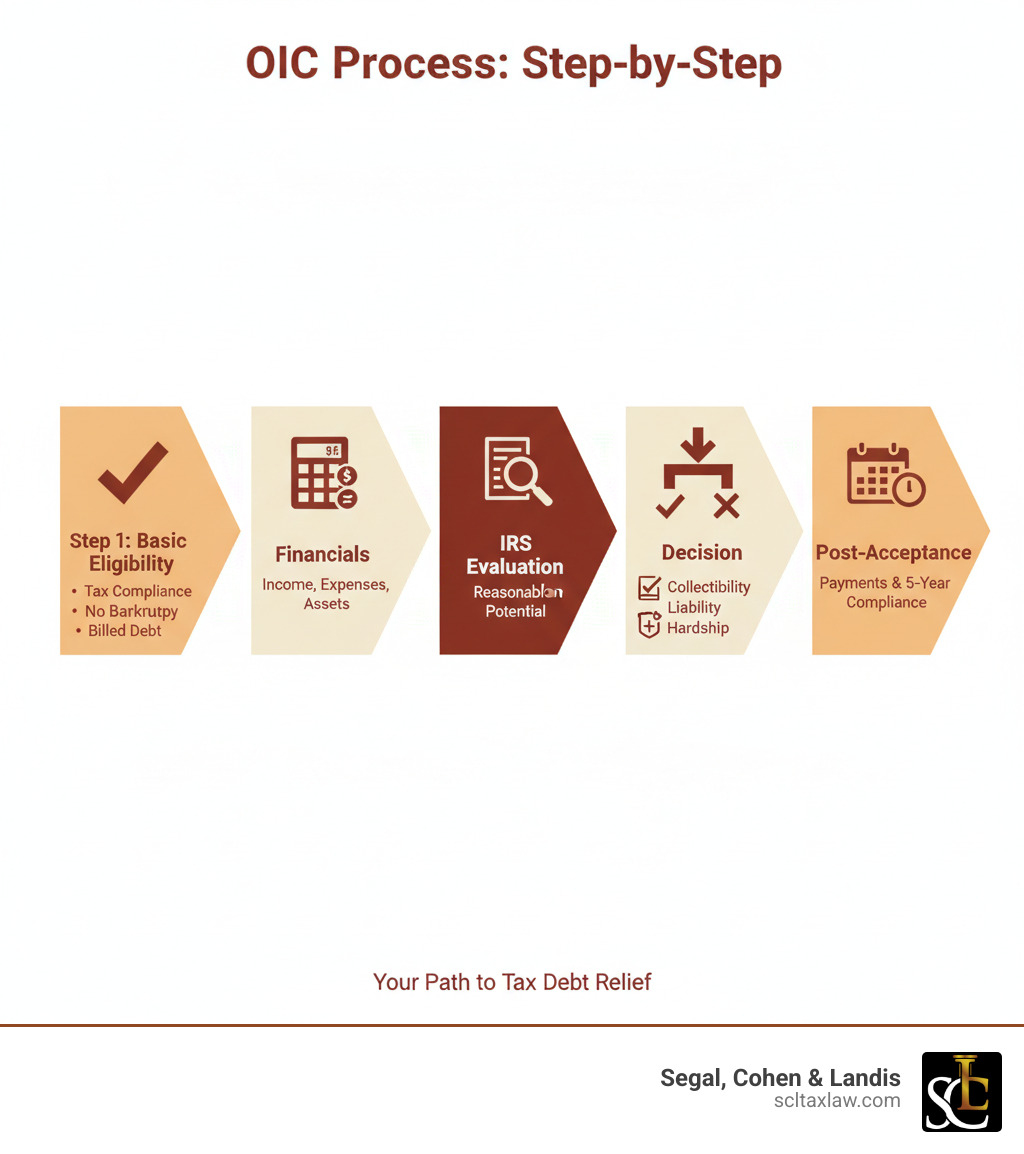
The Four Pillars Of Basic Offer In Compromise Eligibility
Before the IRS reviews your settlement proposal, you must meet four foundational requirements. Your application will not be considered unless you satisfy all of them.

1. You Must Be in Tax Compliance
The IRS will not negotiate past debt if you aren’t meeting current obligations. Tax compliance is the most critical pillar of Offer in Compromise eligibility. This means you must have:
- Filed all legally required federal tax returns. Missing even one return will cause your application to be sent back without review.
- Made all required estimated tax payments for the current year. This is crucial for self-employed individuals or those with income not subject to withholding.
- Made all required federal tax deposits for the current and two preceding quarters (for business owners with employees). The IRS is extremely strict about the handling of payroll taxes.
Compliance shows the IRS you are serious about meeting your ongoing tax responsibilities.
2. You Cannot Be in an Open Bankruptcy Proceeding
If you are in an open bankruptcy case, you must address your tax debt through that process, not an Offer in Compromise. The IRS automatically rejects OIC applications from anyone in active bankruptcy, as the two processes cannot run concurrently. Once your bankruptcy case is closed, you may then explore an OIC for any remaining tax debt.
3. You Must Have a Billed Tax Debt
An OIC is not a proactive tool. You must have received an official bill from the IRS for at least one tax debt before you can apply. This ensures the liability has been formally assessed. If you’ve filed a return but haven’t received a notice, you must wait for the assessment to be completed.
4. Use the IRS Pre-Qualifier Tool for a Preliminary Check
Before starting the full application, use the Offer in Compromise Pre-Qualifier Tool on the IRS website. This online assessment provides a preliminary check of your eligibility and a potential offer amount.
This is not a guarantee of acceptance, but it offers a realistic starting point and can save you time if you clearly do not qualify. This tool does not work for partnerships, corporations, or those living outside the U.S. (with some military exceptions). In those cases, refer directly to the Offer in Compromise Booklet, Form 656-B (PDF).
Beyond Eligibility: How the IRS Decides to Accept Your Offer
Meeting basic Offer in Compromise eligibility is just the first hurdle. To succeed, you must give the IRS a specific, documented reason to accept less than you owe.
Understanding Your “Reasonable Collection Potential” (RCP)
The IRS decision hinges on your Reasonable Collection Potential (RCP)—the amount it believes it could collect from you. The RCP is calculated by analyzing your income vs. expenses (using IRS standards), your asset equity (the value of what you own minus debts), and your future earning potential. Your offer must typically equal or exceed your RCP.
Reason 1: Doubt as to Collectibility
This is the most common basis for an OIC. It applies when your assets and income are less than your total tax debt, meaning you simply cannot pay the full amount. You must prove that paying would cause significant financial hardship, making it more practical for the IRS to accept a smaller, guaranteed sum now.
| Financial Metric | Taxpayer’s Situation | IRS Tax Debt |
|---|---|---|
| Monthly Disposable Income (after allowed expenses) | $200 | |
| Liquid Assets (cash, investments) | $5,000 | |
| Equity in Non-Liquid Assets (home, car) | $10,000 | |
| Available asset equity before future-income calculation | $15,000 | $50,000 |
Assuming $15,000 of available equity and $200 monthly remaining income, the standard calculation adds $2,400 for a lump-sum offer or $4,800 for a periodic offer, producing $17,400 or $19,800 before applicable adjustments. Acceptance is not guaranteed.
Reason 2: Doubt as to Liability
If there’s a genuine dispute about whether you owe the tax, you can file an offer based on “doubt as to liability.” This is for cases where you believe the IRS made a calculation error or based its assessment on faulty information. You’ll use Form 656-L and must provide a written statement with supporting evidence, as explained in the Offer in compromise FAQs. No application fee is required for this type of offer.
Reason 3: Effective Tax Administration (ETA)
This rare option applies when the tax is correct and you could technically pay, but doing so would create exceptional circumstances leading to economic hardship or would be otherwise unfair. This is not for mere inconvenience but for situations like a long-term illness that prevents you from working or being forced to sell your primary home at a severe loss. You must provide compelling documentation of your unique hardship.
Preparing Your OIC Application: A Document And Cost Checklist
After confirming your Offer in Compromise eligibility, you must assemble your application. This is a detail-oriented process where an incomplete or inaccurate submission can lead to rejection, forcing you to start over.

What Financial Information and Forms Are Needed?
The IRS requires a complete financial picture to verify your claims. You will need to submit:
- Form 656, Offer in Compromise: The main application where you state your offer amount and terms.
- Form 433-A (OIC) for individuals or Form 433-B (OIC) for businesses: A detailed financial statement of your income, expenses, and assets.
You must provide supporting documentation for all figures, including:
- Pay stubs and proof of all income sources.
- Bank and investment account statements.
- Retirement account records.
- Vehicle information (make, model, year, mileage) and loan statements.
- Real estate deeds, mortgage statements, and appraisal documents.
- Proof of monthly expenses (rent, utilities, medical bills, etc.).
- Statements for all other debts (credit cards, student loans).
This comprehensive disclosure is non-negotiable, as it’s how the IRS calculates your RCP. For a complete list, review the Offer in Compromise Booklet, Form 656-B (PDF).
Understanding the Costs of Applying for an OIC
Submitting an OIC involves upfront, non-refundable costs that are applied to your tax debt if your offer is rejected.
- Application Fee: A $205 fee is required with your submission.
- Initial Payment: You must also include a payment that depends on your offer type:
- Lump-Sum Offer (paid in 5 or fewer installments): Submit 20% of your total offer amount with the application.
- Periodic Payment Offer (paid over 6-24 months): Submit your first proposed monthly payment. You must continue making these monthly payments while the IRS reviews your offer.
If you meet the low-income certification guidelines (based on federal poverty levels), you may qualify for a waiver of both the application fee and the initial payment. The worksheet to determine this is in Form 656-B.
What Happens After You Apply? (And What If You Don’t Qualify?)
Submitting your OIC application is the start of a long process. It’s important to understand the risks and have a backup plan if an OIC isn’t the right fit.
The OIC Process: Risks and Downsides
An OIC comes with significant trade-offs:
- Time: Offer review varies with the facts and IRS processing. The statutory 24-month deemed-acceptance rule has exclusions, including periods when liability is disputed in court; pending, returned and withdrawn offers have different procedural consequences.
- Accruing Debt: Interest and penalties continue to accumulate on your tax balance while you wait. A rejection could leave you owing more than when you started.
- Tax Liens: The IRS may file a Notice of Federal Tax Lien while your offer is pending, which can damage your credit.
- 5-Year Compliance: If your offer is accepted, you must file and pay all taxes on time for the next five years. Failing to do so can void the agreement, reinstating your original debt.
- Public Record: Accepted OICs are public information for one year, including your name, city, debt amount, and settlement terms.
What Happens if Your OIC is Rejected?
A rejection isn’t necessarily the end. The IRS will send a letter explaining its decision, and you have 30 days from the date of that letter to appeal. You can file Form 13711, Request for Appeal of Offer in Compromise, to challenge the findings. The IRS provides an online resource to guide you through the appeals process. An appeal can sometimes succeed, especially with professional assistance.
Alternatives to an OIC if You Don’t Meet the Eligibility
If an OIC isn’t right for you, other relief options exist:
- Installment Agreement: Allows you to make monthly payments over time, typically up to 72 months. A Partial Payment Installment Agreement may be an option if you cannot pay the full debt within the collection statute.
- Currently Not Collectible (CNC) Status: For severe financial hardship, the IRS may temporarily pause collection efforts. Interest and penalties still accrue, but it provides immediate breathing room.
- Penalty Abatement: You may be able to have penalties removed if you can show reasonable cause (e.g., serious illness, natural disaster) for failing to file or pay on time.
- Innocent Spouse Relief: This may relieve you of tax debt resulting from errors or fraud committed by your spouse on a joint return.
Review the relevant notices, filing history, records, and deadlines before choosing a response. Evaluate professional assistance according to the facts, applicable law, and agreed scope of representation.
Navigating The Process: Professional Help And Avoiding Scams

The complexity of Offer in Compromise eligibility and the high rejection rate make professional guidance a valuable asset. However, this vulnerability also attracts predatory companies.
Can a Tax Professional Help with Offer in Compromise Eligibility?
While you can apply on your own, the strict requirements and complex calculations make it difficult. A qualified Tax Attorney, Enrolled Agent (EA), or CPA specializing in tax controversy can significantly improve your chances. A professional can:
- Accurately assess if you meet the Offer in Compromise eligibility requirements.
- Strategically frame your case under the correct acceptance reason (collectibility, liability, or ETA).
- Ensure all paperwork is completed accurately and all documentation is included.
- Negotiate directly with the IRS on your behalf, handling all communications.
- Manage the appeals process if your initial offer is rejected.
When seeking help, verify credentials using the IRS Directory of Federal Tax Return Preparers and look for professionals with specific OIC experience.
Beware of “Offer in Compromise Mills”
Be cautious of companies making unrealistic promises. These “OIC mills” often use aggressive marketing to lure in desperate taxpayers, charge excessive upfront fees, and deliver poor results. Watch for these red flags:
- Guaranteed results or promises to settle for “pennies on the dollar” before a full financial review.
- Large upfront fees demanded before any significant work is done.
- High-pressure sales tactics pushing you to sign immediately.
A reputable professional will provide an honest assessment of your chances, explain their fee structure transparently, and give you a clear-eyed view of your options. At Segal, Cohen & Landis, our approach is straightforward: we assess your eligibility honestly, explain your options, and fight for the best possible outcome. We never make promises we can’t keep.
Frequently Asked Questions About OIC Eligibility
Here are answers to some of the most common questions we hear from clients about the Offer in Compromise eligibility and application process.
How long does the OIC process typically take?
Review time varies with the financial facts, requested documentation and IRS processing. The statutory 24-month deemed-acceptance rule has exclusions, including periods when liability is disputed in court. Do not assume an offer is accepted merely because no decision has arrived; its pending, returned or withdrawn status matters.
What happens to my future tax refunds if my OIC is accepted?
Under the current offer terms, the IRS may retain refunds for tax assessed before acceptance. Retained refunds do not reduce the agreed offer amount. Review the accepted offer and current Form 656 terms before changing withholding or assuming a particular refund will be retained.
Will the IRS release a tax lien if my offer is accepted?
The IRS generally retains its lien until the offer payment terms are fulfilled. Five-year future filing and payment compliance remains a separate condition of the accepted offer.
Is An OIC Right For You? Get An Expert Opinion
You’ve seen how intricate the Offer in Compromise eligibility requirements are. It demands full tax compliance and a complete financial disclosure, and the IRS still rejects more offers than it accepts.
However, for taxpayers who genuinely cannot pay their full tax debt, an OIC can be a life-changing fresh start. The challenge is knowing if you qualify and presenting your case in the most compelling way.
Review the relevant notices, filing history, records, and deadlines before choosing a response. Evaluate professional assistance according to the facts, applicable law, and agreed scope of representation.
Review the relevant notices, filing history, records, and deadlines before choosing a response. Evaluate professional assistance according to the facts, applicable law, and agreed scope of representation. Related resources: IRS Offer in Compromise.
Have questions about this topic? Talk to an IRS attorney today.
Segal, Cohen & Landis, P.C. — Beverly Hills. Serving clients nationwide.

Samuel Landis, Esq.
LL.M. (Tax) · Selected to Super Lawyers®
Sam Landis is a Beverly Hills IRS tax attorney specializing in IRS collection defense, audit representation, and international tax compliance for foreign nationals and US expats.