

Administrative relief checked October 1, 2026: IRS Automatic Exemption from Penalty (AEP) began rolling out in summer 2026 for eligible 2025 annual returns and 2026 quarterly returns. IRS guidance separately replaces First-Time Abatement (FTA) for original returns due January 1, 2027 or later; this is distinct from the summer-2026 rollout. Eligible failure-to-file, failure-to-pay and failure-to-deposit penalties have return-specific compliance tests. The lookback generally covers the same return type for three prior annual periods or twelve prior quarterly periods; prior penalties removed for reasonable cause or IRS error do not necessarily disqualify the taxpayer. Estimated-tax, event-based and information-return penalties have different rules. Check current IRS criteria and the actual notice; relief is not guaranteed.
Understanding Penalties for Late Tax Filing
The penalty for filing taxes late can be a source of significant stress. Whether you missed the deadline, couldn’t afford to pay, or faced unexpected challenges, the IRS has clear rules about the consequences. Understanding these penalties is the first step toward resolving the issue.
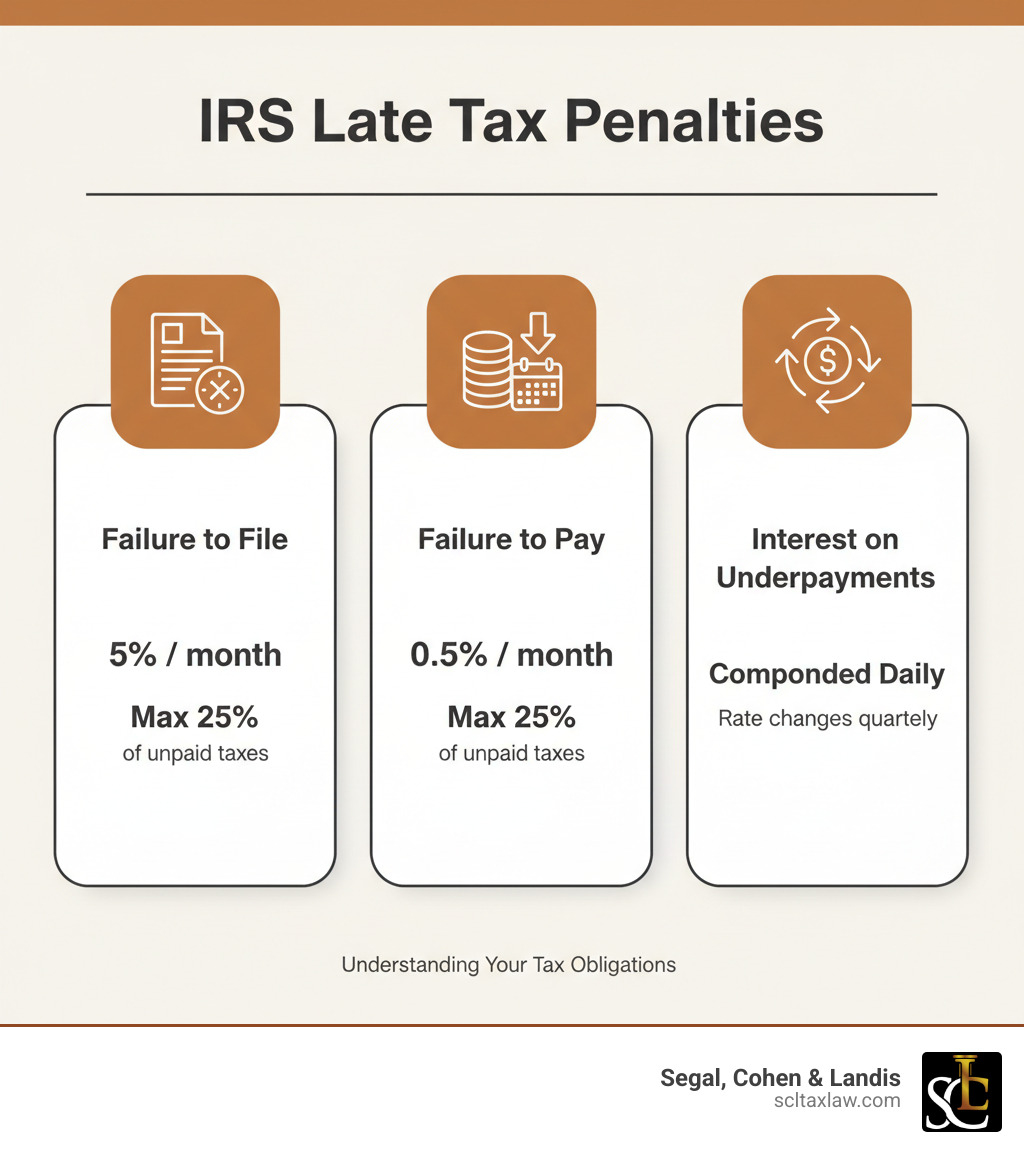
Here’s a quick look at the main penalties you might face:
- Failure to File Penalty: 5% of the unpaid taxes for each month your return is late, capped at 25%.
- Failure to Pay Penalty: 0.5% of the unpaid taxes for each month the tax remains unpaid, also capped at 25%.
- Interest on Underpayments: Compounded daily on any unpaid taxes and penalties, with a rate that changes quarterly.
penalty for filing taxes late: Review the relevant notices, filing history, records, and deadlines before choosing a response. Evaluate professional assistance according to the facts, applicable law, and agreed scope of representation.
The Two Main Penalties: Failure to File vs. Failure to Pay
When you miss the tax deadline, the IRS can impose two distinct penalties: one for filing late and one for paying late. Understanding the difference is crucial, as the penalty for filing taxes late is significantly higher. The IRS prioritizes receiving your return to assess what you owe, even if you can’t pay the full amount immediately.
Let’s break down how these two penalties compare:
| Penalty Type | Rate | Maximum | When It Applies |
|---|---|---|---|
| Failure to File | 5% of unpaid taxes per month | 25% of unpaid taxes | Your return is late AND you owe taxes |
| Failure to Pay | 0.5% of unpaid taxes per month | 25% of unpaid taxes | You filed on time but didn’t pay what you owe by the deadline |
The IRS provides more details in their guide on late filing and late payment penalties.
Failure to File Penalty
The Failure to File penalty is 5% of your unpaid taxes for each month or part of a month your return is late, maxing out at 25%. For example, owing $2,000 and filing three months late results in a $300 penalty. If you file more than 60 days late, a minimum penalty applies: for Forms 1040 and 1120 with an original due date after December 31, 2025, the smaller of $525 or 100% of the underpayment; other due-date years have different minimums. This penalty only applies if you owe taxes; there is no penalty for filing late if you are due a refund. The key is to file on time, even if you can’t pay, to avoid this steep penalty. For more guidance, see our resource on Unfiled Tax Returns or the IRS page on failure-to-file penalties.
Failure to Pay Penalty
The Failure to Pay penalty is less severe at 0.5% of your unpaid taxes each month, also capped at 25%. For instance, if you filed on time but paid a $1,500 tax bill three months late, the penalty would be about $22.50. If both penalties apply in the same month, the combined total is capped at 5%. Always pay as much as you can by the deadline to minimize penalties and interest. The IRS offers payment options like installment agreements if you can’t pay in full. Our guide on what to do when you owe the IRS but can’t pay explains these options in detail.
Understanding the Full Cost: The Penalty for Filing Taxes Late
The initial penalties are just the start. The true cost of a penalty for filing taxes late escalates due to compounding interest, so acting quickly is essential. Additionally, self-employed individuals may face separate penalties for underpaying estimated taxes throughout the year.
How the IRS Calculates Interest
The IRS charges interest on unpaid taxes and penalties, and it compounds daily. This means interest is calculated on your original debt plus the accumulated interest, causing the total to grow quickly. The interest rate is set by law and changes quarterly (federal short-term rate plus 3%). Crucially, interest start dates depend on the penalty type; failure-to-pay interest does not universally start on the original return due date, which can significantly increase your debt. For a deeper dive, see our article on IRS Interest Accrual and Abatement or the IRS guide on interest calculations.
The Hidden Penalty for Filing Taxes Late: Estimated Tax Payments
Self-employed individuals and small business owners must pay estimated taxes quarterly on income not subject to withholding. The IRS requires you to pay taxes as you earn, with due dates on April 15, June 15, September 15, and January 15. Even if you file and pay your annual return on time, you can still be penalized for underpaying throughout the year. The IRS calculates this penalty based on the underpayment for each quarter. This often surprises new business owners or those with fluctuating income. Use Form 1040-ES to calculate and pay these estimates. For those with employees, similar quarterly obligations exist, as detailed in our Payroll Tax guide. Proactive planning is key to avoiding these penalties.
How to Handle a Late Tax Filing Penalty
Receiving an IRS notice for a penalty for filing taxes late is stressful, but ignoring it will only make it worse. The good news is that you have options. Taking prompt action can save you significant money and stress.

Step 1: File Your Return Immediately
File your tax return immediately, even if you can’t pay what you owe. This is the most critical step. The Failure to File penalty (5% per month) is ten times higher than the Failure to Pay penalty (0.5% per month). Filing stops the larger penalty from accumulating and shows the IRS you are taking responsibility, which can help later. Learn more about the risks of not filing in our article on Unfiled Tax Returns Consequences and Compliance.
Step 2: Explore Payment Options
After filing, determine how to pay the balance. If you can’t pay in full, the IRS offers several options:
- IRS Installment Agreement: This lets you make monthly payments for up to 72 months. While interest and penalties continue to accrue, it prevents aggressive collection actions like levies.
- Offer in Compromise (OIC): For those with significant financial hardship, an OIC allows you to settle your tax debt for less than the full amount owed. Qualification depends on your ability to pay, income, expenses, and assets.
- Currently Not Collectible (CNC) Status: If you cannot afford basic living expenses, the IRS may temporarily halt collection efforts. Your debt will still grow with interest, and a tax lien may be filed.
Each option has unique requirements. Our guide on Understanding Tax Debt Relief Options: How an IRS Tax Law Firm Can Guide You provides more detail.
Step 3: Request Penalty Abatement
You can ask the IRS to remove or reduce penalties through a process called penalty abatement. There are two main qualifications:
- First-Time Penalty Abatement (FTA): If you have a clean compliance history for the past three years, have filed all required returns, and have paid or arranged to pay your tax debt, you may qualify for this one-time relief.
- Reasonable Cause: You may qualify if you can prove you were unable to file or pay on time due to circumstances beyond your control, such as a serious illness or natural disaster. You must show you exercised ordinary business care and prudence.
Proving reasonable cause requires strong documentation and a compelling explanation, often submitted with Form 843. Professional assistance can be invaluable here. Our article on IRS Penalty Abatement offers more insight. If you’ve just missed the deadline, see our guide on your next step.
Severe Consequences of Not Filing or Paying Taxes
Ignoring tax obligations leads to consequences far more severe than standard penalties. The IRS has powerful enforcement tools that can be financially devastating and can take swift action to collect unpaid taxes.
IRS Collection Actions: Liens and Levies
After sending multiple notices, the IRS can escalate collection actions with liens and levies.
- A federal tax lien is a legal claim against all your current and future property. A filed notice is public and can affect property transactions and credit availability; do not assume a guaranteed credit-score effect.
- A tax levy is the actual seizure of your property. Common examples include:
- Wage Garnishment: The IRS can order your employer to send a large portion of your paycheck directly to them.
- Bank Account Levy: The IRS can freeze your bank account and seize the funds to pay your tax debt.
- Asset Seizure: In extreme cases, the IRS can seize and sell physical assets like your car or home.
These actions are severe and limit your options. It’s critical to address tax problems before they reach this stage. Learn more about owing back taxes and how to tackle them effectively and other IRS Tax Problems.
Can You Go to Jail for Not Filing Taxes?
The fear of jail time is common, but it’s important to understand the distinction between civil and criminal tax issues. Most cases of non-payment result in civil penalties like the penalty for filing taxes late, interest, liens, and levies. Jail time is not a consequence of simple negligence or inability to pay.
Criminal charges, such as for tax evasion, are reserved for cases of willful intent to defraud the government. This includes actions like hiding income or deliberately not filing for years. While negligence (careless mistakes) leads to civil penalties, willful evasion can lead to a criminal investigation.
Conviction for tax evasion can result in fines up to $100,000 for individuals and prison sentences of up to five years. While criminal prosecution is rare, it is a real possibility for intentional fraud. The best defense is to be honest and proactive in resolving tax issues. Learn more about the line between civil and criminal issues in our article, IRS Tax Fraud: Are You at Risk?
Frequently Asked Questions about Late Filing Penalties
We often hear similar questions from clients navigating tax penalties. Here are answers to some of the most common concerns.
What happens if you file late but are owed a refund?
If you file late but are owed a refund, you will not face a penalty for filing taxes late. The penalty is based on unpaid taxes, so if you don’t owe, there’s no penalty. However, you should still file promptly because:
- Your refund will be delayed until the IRS receives your return.
- Filing is often required to receive government benefits and credits.
- You only have three years from the original due date to claim a refund. If you wait longer, you forfeit the money.
Are tax penalties tax-deductible?
No, IRS penalties, including the penalty for filing taxes late, are not tax-deductible. They are considered punitive and not an ordinary business expense. However, the interest paid on tax debt may be deductible for businesses, though it is generally not deductible for individual income tax underpayments. This is a complex area, so consult a tax professional for guidance specific to your situation.
How do US penalties compare to other countries like Canada?
While most countries penalize late filing, the specifics vary. Here’s a brief comparison between the US (IRS) and Canada (CRA) penalties:
- US Failure-to-File Penalty: 5% of unpaid tax per month (max 25%). A minimum penalty applies if over 60 days late.
- Canada (CRA) Late-Filing Penalty: 5% of the balance owing, plus 1% for each full month late (up to 12 months). Penalties are higher for repeat offenders.
- US Failure-to-Pay Penalty: 0.5% of unpaid tax per month (max 25%).
- Interest: Both countries charge daily compounding interest on unpaid taxes and penalties.
- Key Differences: The US has a significant minimum penalty for being over 60 days late. Canada has a clear, escalating penalty structure for repeat offenders. In Canada, late filing can also directly delay government benefits, even if no tax is owed.
Take Control of Your Tax Situation
Facing a penalty for filing taxes late is stressful, but ignoring it only makes it worse. You have more control than you think. The most important step is to take action now.
Start by filing your return immediately to stop the costly failure-to-file penalty. Then, explore your options for payment and penalty relief, such as an installment agreement or First-Time Abatement. These are established IRS programs designed to help taxpayers.
Review the relevant notices, filing history, records, and deadlines before choosing a response. Evaluate professional assistance according to the facts, applicable law, and agreed scope of representation.
You don’t have to face the IRS alone. We can handle communications, negotiate a resolution, and shoulder the burden for you. The sooner you act, the more options you have.
Contact us for IRS penalty abatement assistance and let us help you regain control of your financial future. Your peace of mind is worth it.
Have questions about this topic? Talk to an IRS attorney today.
Segal, Cohen & Landis, P.C. — Beverly Hills. Serving clients nationwide.

Samuel Landis, Esq.
LL.M. (Tax) · Selected to Super Lawyers®
Sam Landis is a Beverly Hills IRS tax attorney specializing in IRS collection defense, audit representation, and international tax compliance for foreign nationals and US expats.