
What Is a Federal Tax Late Penalty — and How Much Can It Cost You?
A federal tax late penalty can add up fast. Here’s a quick breakdown of what you’re dealing with:
| Penalty Type | Rate | Maximum |
|---|---|---|
| Failure to File | 5% of unpaid tax per month | 25% of unpaid tax |
| Failure to Pay | 0.5% of unpaid tax per month | 25% of unpaid tax |
| Both Together (same month) | 5% combined (filing reduced by pay rate) | 47.5% total |
| Minimum Penalty (60+ days late) | $485 (2024) or 100% of tax owed | Whichever is smaller |
| Interest | ~7% annually, compounded daily | Continues until paid |
Miss the tax deadline and the IRS doesn’t wait. Penalties start accruing immediately — and interest piles on top of those penalties, every single day.
Life gets complicated. A missed deadline might feel like a small slip, but the IRS treats it as a financial obligation that grows the longer it sits unresolved. Whether you forgot to file, couldn’t afford to pay, or simply ran out of time, the consequences are real and they escalate quickly.
The good news? You have options. Understanding exactly how these penalties work is the first step toward stopping the damage.
federal tax late penalty: Review the relevant notices, filing history, records, and deadlines before choosing a response. Evaluate professional assistance according to the facts, applicable law, and agreed scope of representation.
Understanding the Failure to File and Failure to Pay Penalties
When we talk about a federal tax late penalty, we are actually talking about two distinct monsters: the “Failure to File” penalty and the “Failure to Pay” penalty. While they sound similar, the IRS treats them very differently. One punishes you for being late with your paperwork, while the other punishes you for being late with your money.

The legal backbone for these charges is found in 26 USC 6651: Failure to file tax return or to pay tax. At Segal, Cohen & Landis, we often see clients who are paralyzed by the fear of these mounting costs. However, the most important thing to remember is that the “Failure to File” penalty is generally ten times more expensive than the “Failure to Pay” penalty. If you can’t afford to pay your taxes, you should still file your return to avoid the most aggressive charges. For those who have already missed the boat, you can find more info about unfiled tax returns on our dedicated resource page.
The Cost of Procrastination: Failure to File
The Failure to File penalty is the “heavy hitter.” If you owe taxes and don’t file your return (or an extension) by the deadline, the IRS charges you 5% of the unpaid balance for every month or part of a month that the return is late.
This penalty starts the day after the tax filing due date and caps out at 25% of your total unpaid tax. To put that in perspective, if you owe $10,000, you could be hit with a $500 penalty after just one day of being late. By month five, you’ve added $2,500 to your bill just for the paperwork delay.
The Cost of Underpayment: Failure to Pay
The Failure to Pay penalty is a bit “softer” but more persistent. It is calculated at 0.5% of the unpaid taxes for each month or part of a month the tax remains unpaid. Like the filing penalty, this also caps at 25% of the unpaid tax.
According to eCFR :: 26 CFR 301.6651-1 — Failure to file tax return or to pay tax, the clock starts ticking on the original due date of the return, regardless of whether you filed an extension. While 0.5% sounds small, it is a “part of a month” penalty. If you pay on the second day of the month, you are charged for the full month.
How the IRS Calculates Your federal tax late penalty
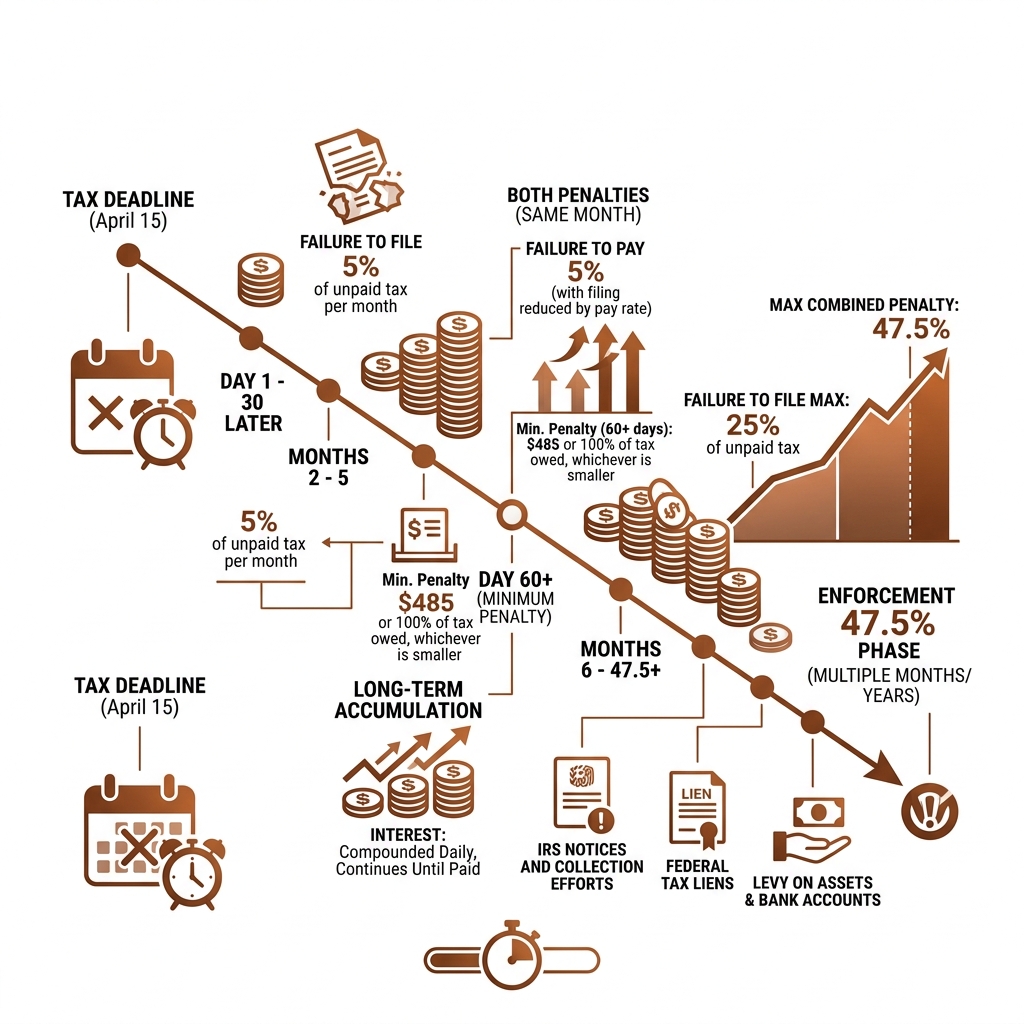
Calculating a federal tax late penalty isn’t always a simple addition problem. When both penalties apply in the same month, the IRS offers a small “discount.” Instead of charging you 5.5% (5% for filing + 0.5% for paying), they reduce the Failure to File penalty by the amount of the Failure to Pay penalty. This results in a combined monthly charge of 5%.
However, this “grace” only lasts for the first five months until the Failure to File penalty hits its 25% cap. After that, the Failure to Pay penalty continues to accrue at 0.5% per month until it also hits its own 25% cap or the balance is paid. This means the total combined penalty for being both late to file and late to pay can eventually reach 47.5% of the original tax amount.
IRS interest rates change quarterly. Use the current IRS rate table for the applicable period. Related guidance: more info about interest accrual.
Minimum Penalties for Long-Term Delinquency
If you are more than 60 days late filing your return, the IRS stops playing around with small percentages and moves to a “minimum penalty.” For returns due in 2024, the minimum federal tax late penalty for filing more than 60 days late is $485 or 100% of the tax required to be shown on the return, whichever is smaller.
This means if you owe a very small amount—say $100—and you file three months late, your penalty won’t just be $15 (5% for 3 months). It will be $100 (100% of the tax due). If you owe $10,000, the penalty will be at least $485, even if the 5% monthly calculation would have been less.
How Interest Compounds the Damage
Interest is the silent killer of tax relief. Under Internal Revenue Code Section 6621, the interest rate is the federal short-term rate plus 3%. Because it compounds daily, the balance grows every 24 hours.
Review the relevant notices, filing history, records, and deadlines before choosing a response. Evaluate professional assistance according to the facts, applicable law, and agreed scope of representation.
Strategies to Avoid or Reduce a Federal Tax Late Penalty
The best way to handle a federal tax late penalty is to never let it happen in the first place. But we know that life in places like Houston, Miami, or Seattle can be hectic. If you find yourself staring down a deadline you can’t meet, there are specific steps you can take to shield yourself.
File an accurate, complete return as promptly as possible even if you cannot pay. Seek advice about missing records and any timely extension that remains available. Related guidance: more info about avoiding penalties.
Avoiding a federal tax late penalty with Form 4868
If you realize by April 15 that you aren’t ready to file, you must submit Form 4868: Application for Automatic Extension of Time To File. This gives you an extra six months—until October 15—to get your paperwork in order.
However, there is a major catch: An extension to file is NOT an extension to pay. To avoid the Failure to Pay penalty during those six months, you generally must pay at least 90% of your actual tax liability by the April deadline. If you file the extension but pay nothing, you will still owe the 0.5% monthly penalty on the balance, though you will successfully avoid the much harsher 5% Failure to File penalty.
Qualifying for Relief from a federal tax late penalty
Review the relevant notices, filing history, records, and deadlines before choosing a response. Evaluate professional assistance according to the facts, applicable law, and agreed scope of representation.
- FTA is an administrative waiver for specified penalties when the relevant compliance criteria are met. AEP began rolling out in summer 2026 for eligible 2025 annual and 2026 quarterly returns. IRS guidance separately replaces FTA for original returns due January 1, 2027 or later. Covered penalties, return-specific compliance history and exclusions determine eligibility; relief is not guaranteed.
- Reasonable Cause: If you missed a deadline due to circumstances beyond your control—such as a natural disaster, a house fire, a serious illness, or the death of an immediate family member—the IRS may waive the penalties. You must prove that you exercised “ordinary business care and prudence” but were still unable to meet your obligations.
For a deep dive into these programs, see our more info about penalty abatement article.
Navigating IRS Notices and the Consequences of Non-Filing
The IRS communicates through a very specific sequence of letters. Ignoring these is the fastest way to lose your rights. It usually starts with a CP14 notice, which is essentially a bill for the tax, interest, and initial federal tax late penalty.
CP504 warns of intended levy action, including a state tax refund levy. A levy on other property generally requires notice of Collection Due Process rights if those rights were not previously provided, subject to statutory exceptions. Follow the actual notice and its deadlines. Related guidance: more info about tax levies.
Responding to IRS Penalty Notices
When you receive a notice, you typically have a 21-day window (or 10 days if the amount is over $100,000) to pay in full before further action is taken. If you can’t pay in full, do not hide.
Setting up an approved payment plan (Installment Agreement) can actually save you money. For taxpayers on an approved plan, the Failure to Pay penalty is reduced from 0.5% to 0.25% per month. Conversely, if you wait until the IRS issues a Final Notice of Intent to Levy (Letter 1058), the penalty can jump to 1% per month. If you believe the penalty was assessed in error, we often use more info about IRS form 843 to formally request a refund or abatement of the charges.
The Danger of the Substitute for Return (SFR)
Some people think that if they never file, the IRS will never know. This is a dangerous myth. If you don’t file, the IRS may eventually file a Substitute for Return (SFR) for you.
When the IRS files an SFR, they use information from your W-2s and 1099s, but they give you zero deductions or credits. They file you as “Single” or “Married Filing Separately” with the standard deduction. This almost always results in a much higher tax bill than if you had filed yourself. Once the SFR is processed, the IRS begins aggressive collection actions based on that inflated number.
Frequently Asked Questions about Federal Tax Late Penalties
What if I am owed a refund but file late?
If you are due a refund, there is generally no penalty for filing late. The Failure to File and Failure to Pay penalties are percentages of the unpaid tax. If your “unpaid tax” is zero (or negative), the penalty is zero. However, you must file within three years of the return due date, or you forfeit your refund to the U.S. Treasury forever.
Can I get a penalty removed if I had a family emergency?
Yes. This falls under the “Reasonable Cause” category. You will need to provide documentation, such as hospital records or a death certificate, and explain how the emergency directly prevented you from filing or paying on time. The IRS looks for a direct link between the event and the delay.
Does a tax extension give me more time to pay?
No. This is the most common misconception in tax law. An extension only gives you more time to file your paperwork. Your payment is still due by the original April deadline. If you don’t pay by then, the Failure to Pay penalty and interest will begin to accrue on the unpaid balance.
Conclusion
A federal tax late penalty can feel like a death sentence for your finances, but it doesn’t have to be. Whether you are dealing with a simple oversight or years of unfiled returns, the key is to take action before the IRS moves from sending letters to seizing assets.
Review the relevant notices, filing history, records, and deadlines before choosing a response. Evaluate professional assistance according to the facts, applicable law, and agreed scope of representation.
If you are ready to stop the bleeding and regain your peace of mind, we are here to help. Stop the bleeding and reduce IRS tax penalties by contacting us for a consultation today. We’ll look at your specific situation, determine if you qualify for abatement, and build a strategy to protect your future.
Have questions about this topic? Talk to an IRS attorney today.
Segal, Cohen & Landis, P.C. — Beverly Hills. Serving clients nationwide.

Samuel Landis, Esq.
LL.M. (Tax) · Selected to Super Lawyers®
Sam Landis is a Beverly Hills IRS tax attorney specializing in IRS collection defense, audit representation, and international tax compliance for foreign nationals and US expats.