

Why an IRS Payment Plan Attorney Can Save You Thousands
An IRS payment plan attorney helps taxpayers secure installment agreements that stop IRS collection actions and make tax debt manageable through monthly payments.
Quick Answer for Taxpayers Seeking IRS Payment Plans:
- What they do: Negotiate installment agreements, prevent application rejection, and minimize monthly payments
- When to hire: When you owe more than you can pay, face levy or lien threats, or need to reduce payment terms
- Key benefits: Stop wage garnishments, avoid tax liens, lower setup fees, and protect assets during collection
- Best for: Anyone owing $10,000+ who wants expert negotiation with IRS revenue officers
If you owe the IRS more than you can afford to pay, collection letters, threats of levies, and wage garnishment can feel overwhelming. The good news? Most taxpayers who can’t pay in full qualify for a payment plan—but the application process is complex, and mistakes can lead to rejection or unfavorable terms.
According to IRS data, taxpayers owing $50,000 or less can apply online for long-term payment plans lasting up to 72 months. Those owing $10,000 or less may qualify for guaranteed installment agreements with no financial disclosure required. But here’s the catch: penalties and interest continue to accrue on unpaid balances at the federal short-term rate plus 3%, compounding daily.
The wrong payment plan can cost you thousands in unnecessary fees and interest. Setup fees range from $22 for online direct debit to $178 for phone or mail applications. Low-income taxpayers may qualify for waivers, but only if they know to request them.
An experienced IRS payment plan attorney evaluates your financial situation, calculates your reasonable collection potential, and negotiates terms that protect your assets while minimizing what you pay. They can also explore alternatives like Offers in Compromise or Currently Not Collectible status—options that may reduce your debt more effectively than installment plans.
Without professional help, many applications get rejected due to incomplete financial disclosures or failure to meet IRS compliance requirements. Missing a single payment can terminate your entire agreement, making the full balance immediately due and triggering enforced collection.
IRS payment plan attorney: Review the relevant notices, filing history, records, and deadlines before choosing a response. Evaluate professional assistance according to the facts, applicable law, and agreed scope of representation.
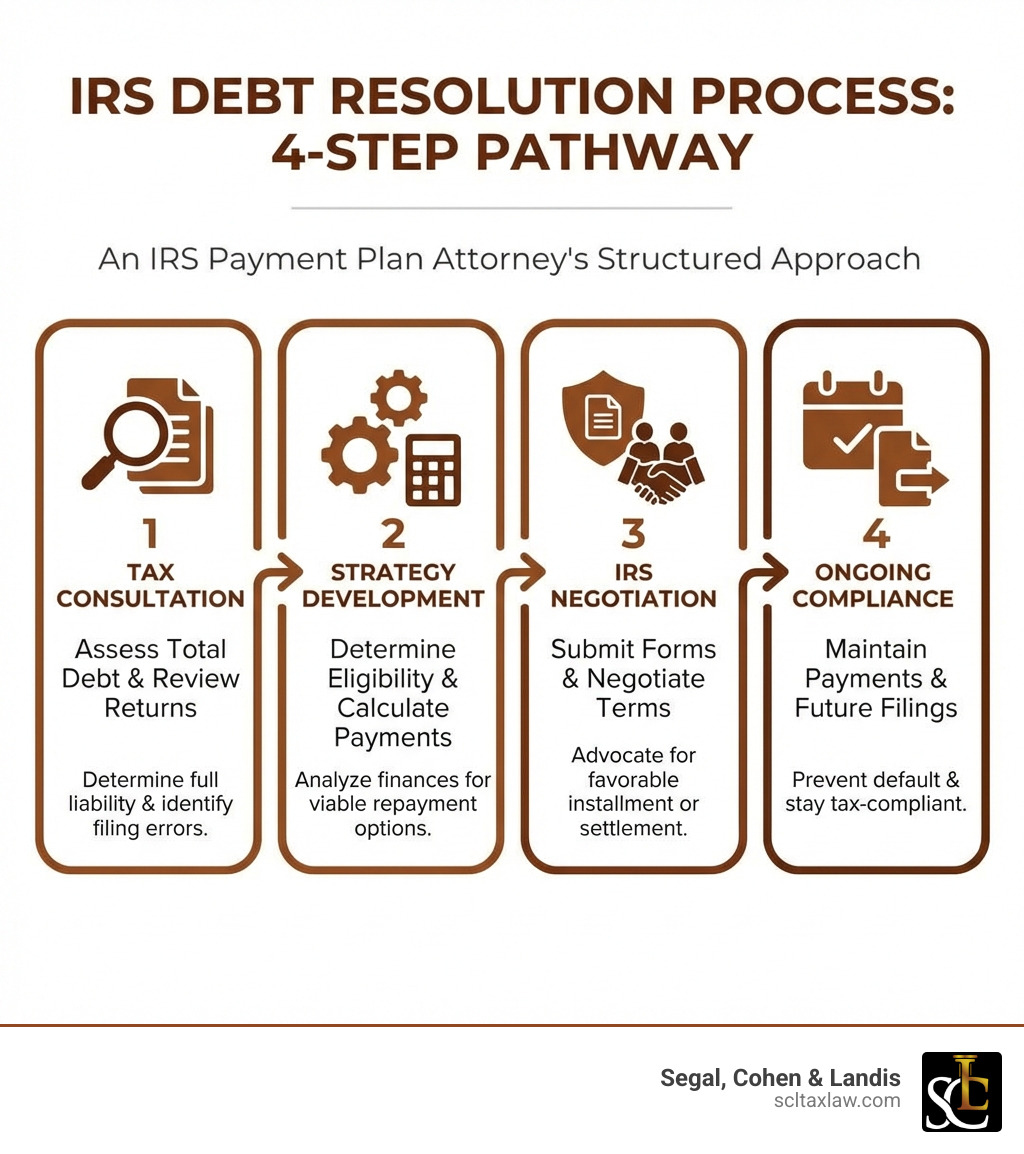
IRS payment plan attorney terms explained:
Navigating the Different Types of IRS Payment Plans
When you first realize you can’t pay your tax bill, the IRS website might make it look like there is only one “Apply Now” button. In reality, the IRS offers several different types of installment agreements, each with its own set of rules and benefits. Choosing the wrong one is like wearing flip-flops to a mountain hike—you might get started, but you’re going to regret it quickly.
Review the relevant notices, filing history, records, and deadlines before choosing a response. Evaluate professional assistance according to the facts, applicable law, and agreed scope of representation.
| Plan Type | Debt Limit | Max Term | Financial Disclosure Required? |
|---|---|---|---|
| Guaranteed | $10,000 or less | 36 Months | No |
| Individual Simple Payment Plan | $50,000 or less | Most qualifying taxpayers: up to 10 years, subject to the collection period | No (usually) |
| Partial Payment (PPIA) | No Limit | Until Statute Expires | Yes (Extensive) |
| Business Simple Payment Plan with trust fund taxes | $25,000 or less | Term depends on the applicable collection period and approved agreement | No |
A guaranteed installment agreement under IRC 6159(c) applies to qualifying individual income-tax liabilities of $10,000 or less, excluding penalties and interest for that threshold. Payment must be completed within three years, and the statutory filing, payment, prior-agreement, ability-to-pay and future-compliance conditions must be met. Other payment-plan options have separate requirements. Eligible Simple Payment Plans generally use the remaining collection period, usually up to ten years for most taxpayers. An agreement does not automatically withdraw an existing lien notice or prevent every future lien filing.
For those in deeper trouble, the Partial Payment Installment Agreement (PPIA) is the “hidden gem.” This plan allows you to pay what you can afford, even if it doesn’t cover the full debt before the 10-year collection statute expires. However, the IRS won’t just take your word for it—they require a deep dive into your finances. This is where IRS back tax help becomes essential to ensure your expenses are presented in a way the IRS accepts.
Eligibility Requirements for Individuals and Businesses
The IRS doesn’t just hand out payment plans like candy; you have to prove you’re “compliant.” This means every single tax return that was supposed to be filed must be in their system. If you have unfiled tax returns, that is your first hurdle.
For individuals, the magic number is often $50,000. If you owe less than this in combined tax, penalties, and interest, you can typically apply for a long-term plan online. If you owe more, the IRS demands a Collection Information Statement (Form 433-A or 433-F), which is a line-by-line accounting of your life’s value.
Businesses face a tighter squeeze. To qualify for a streamlined plan online, a business must owe $25,000 or less. If your business owes payroll taxes, the IRS is significantly more aggressive. We often help clients with navigating payroll tax debt to prevent the IRS from shutting down their operations.
Long-Term vs. Short-Term Agreements
Sometimes, you just need a little breathing room.
- Short-Term Payment Plan: This is actually a payment extension. You get up to 180 days to pay the full balance. There is no setup fee, but interest and penalties still grow every day.
- Long-Term Payment Plan (Installment Agreement): This is for those who need months or years. These plans generally last up to 72 months.
According to official IRS payment plan guidelines, while the plan is pending or in effect, the IRS is prohibited from levying your property. This “stay” on collection is one of the biggest reasons to get an agreement in place immediately.
The Application Process: Fees, Interest, and Penalties
Applying for a payment plan isn’t free—the IRS charges you for the “privilege” of paying them over time. These setup fees can vary wildly based on how you apply and how you choose to pay.
- Direct Debit (Online): $29 for an online direct debit application; eligibility and other fees depend on the plan and application method
- Direct Debit (Phone/Mail): $107
- Non-Direct Debit (Online): $69
- Non-Direct Debit (Phone/Mail): $178
- Low-Income Taxpayers: The fee may be reduced to $43 or waived entirely. If you meet the 250% federal poverty level threshold, you can even get that $43 reimbursed after completing your plan.
To apply, most people use IRS Form 9465. If you owe more than $50,000, you’ll also need to include Form 433-F to prove your financial status.
Understanding Accruing Interest and Penalties
This is the part that catches most people off guard: The IRS is not a 0% APR lender. Even if you negotiate a payment plan, you will still continue to accrue interest and penalties. The IRS makes this clear, stating, “[i]nterest and some penalty charges continue to be added to the amount you owe until the balance is paid in full.”
The interest rate is the federal short-term rate plus 3% (for individuals) or 8% (in some business cases), and it compounds daily. Additionally, there is a failure-to-pay penalty. Normally, this is 0.5% per month, but once your installment agreement is approved, that penalty drops to 0.25% per month—provided you filed your return on time. This 50% reduction in the penalty rate is a massive reason to get an IRS payment plan attorney to secure your approval quickly.
How to Revise or Change an Existing Plan
Life happens. Maybe you lost your job, or maybe you had an unexpected medical bill. You can change your plan, but you have to be proactive. You can use the IRS online tool to:
- Change your monthly payment amount.
- Change your monthly due date.
- Convert an existing plan to a Direct Debit agreement.
- Reinstate a plan after a default (though a reinstatement fee usually applies).
If you can’t meet the minimum payment during a revision, you might be required to submit Form 433-B (for businesses) or 433-A (for individuals). Don’t wait until you miss a payment to make these changes; the IRS is much easier to work with before you break the contract.
Why Hire an IRS Payment Plan Attorney?
You might be thinking, “Can’t I just click the button on the IRS website?” For simple, small debts, sure. But if you owe a significant amount, the IRS isn’t your friend—they are a creditor with the power to seize your bank account.
An IRS payment plan attorney acts as your shield. Once we file Form 2848 (Power of Attorney), the Form 2848 authorizes us to represent you for the listed matters. You may still receive IRS notices or permitted direct contact. We handle the revenue officers and the appeals process on your behalf.
How an IRS payment plan attorney prevents application rejection
The IRS rejects thousands of applications every year. Why?
- Incomplete Financials: Missing one bank statement or failing to list an asset.
- Unreasonable Expenses: You think your $800 car payment is necessary; the IRS thinks you should be driving a used sedan.
- Lack of Compliance: You haven’t filed a return from three years ago.
Review the relevant notices, filing history, records, and deadlines before choosing a response. Evaluate professional assistance according to the facts, applicable law, and agreed scope of representation. Related resources: expert tax debt lawyer services.
Negotiating lower monthly payments with an IRS payment plan attorney
If you owe $100,000, the IRS might want $1,500 a month. But what if you can only afford $300?
An IRS payment plan attorney can negotiate a Partial Payment Installment Agreement (PPIA). We argue your case based on financial hardship, proving that a higher payment would prevent you from paying for basic necessities like food and rent. This doesn’t just lower your monthly stress; it can lead to massive savings. If the 10-year statute of limitations expires while you are on a PPIA, the remaining debt is often wiped out.
We also assist with tax levy releases. If the IRS has already started taking your wages, we can negotiate an installment agreement as a condition for them to stop the garnishment immediately.
Alternatives: Offer in Compromise and CNC Status
Sometimes, a payment plan is just a Band-Aid on a broken leg. If your debt is so large that you’ll never pay it off, we look at more aggressive options.
Offer in Compromise vs. Installment Agreements
An Offer in Compromise (OIC) is the “settlement” option. You offer the IRS a lump sum (or a short series of payments) that is less than the total you owe. If they accept, the rest of the debt is forgiven.
| Feature | Installment Agreement | Offer in Compromise |
|---|---|---|
| Total Paid | Full amount + Interest | Fraction of the debt |
| Difficulty | Relatively easy to get | Very difficult / High rejection |
| Credit Impact | Minimal | Can be significant |
| Financial Review | Low to Moderate | Extremely strict |
Review the relevant notices, filing history, records, and deadlines before choosing a response. Evaluate professional assistance according to the facts, applicable law, and agreed scope of representation. Related resources: IRS Offer in Compromise guide.
When to Seek Currently Not Collectible (CNC) Status
If you are experiencing severe economic hardship, we can request Currently Not Collectible (CNC) status. This doesn’t make the debt go away, but it tells the IRS, “This person literally cannot afford to pay us anything right now.”
While in CNC status:
- An installment agreement generally restricts levies while in effect, subject to exceptions and compliance; the IRS may still file a Notice of Federal Tax Lien.
- You aren’t required to make monthly payments.
- The 10-year clock on the debt keeps ticking.
This is a temporary status, and the IRS will review your income every year or two to see if your situation has improved.
Frequently Asked Questions about IRS Installment Agreements
What happens if I miss a payment or default on my plan?
If you miss a payment, the IRS will send a Notice of Intent to Terminate your installment agreement. You usually have 30 days to fix the issue before the plan is officially cancelled. Once you default:
- The full balance becomes due immediately.
- The IRS can resume levies and wage garnishments.
- You will have to pay a reinstatement fee to get back on a plan.
If you’re struggling, contact an IRS payment plan attorney immediately. We can often negotiate a modification to prevent the default from happening.
Can I qualify for a payment plan if I haven’t filed all my returns?
Approval ordinarily requires filing the returns the IRS requires. Confirm which returns remain due and complete the necessary filing compliance. See unfiled tax returns.
Does an IRS payment plan stop tax liens and levies?
Yes and no.
- Levies: Once a payment plan is approved, the IRS will generally stop or “stay” all levy actions (like taking money from your bank account).
- Liens: A payment plan does not automatically prevent a Notice of Federal Tax Lien. However, under the Fresh Start Program, Certain taxpayers with a balance of $25,000 or less may request lien-notice withdrawal under a Direct Debit Installment Agreement that fully pays the balance within 60 months or before the collection period expires, whichever comes first. Filing and payment compliance, three consecutive direct debit payments, and the IRS default requirements also apply; withdrawal is not automatic.
Conclusion: Take Control of Your Financial Future
Dealing with the IRS is a game of chess. If you move without a strategy, you’ll find yourself in checkmate with an empty bank account. Whether you are an individual in Los Angeles or a business owner in Houston, the rules remain the same: compliance, documentation, and negotiation.
Review the relevant notices, filing history, records, and deadlines before choosing a response. Evaluate professional assistance according to the facts, applicable law, and agreed scope of representation. Related resources: Partial Payment Installment Agreements.
Don’t let the interest compound for another day. Take the first step toward financial freedom and contact Segal, Cohen & Landis for a consultation today. We’ll show the IRS that your debt has finally met its worst nightmare.
Our Locations Include: Los Angeles, Chicago, Houston, Miami, Washington DC, Atlanta, Dallas, Phoenix, Seattle, and many more cities across the United States.
Related Resources
Have questions about this topic? Talk to an IRS attorney today.
Segal, Cohen & Landis, P.C. — Beverly Hills. Serving clients nationwide.

Samuel Landis, Esq.
LL.M. (Tax) · Selected to Super Lawyers®
Sam Landis is a Beverly Hills IRS tax attorney specializing in IRS collection defense, audit representation, and international tax compliance for foreign nationals and US expats.