

What is a Direct Debit Installment Agreement (DDIA)?
A direct debit installment agreement (DDIA) is an IRS payment plan where your monthly tax payments are automatically withdrawn from your checking account — no checks to mail, no deadlines to remember.
Here’s what you need to know at a glance:
| Question | Quick Answer |
|---|---|
| What is a DDIA? | An automatic monthly bank withdrawal to pay your IRS tax debt over time |
| Who qualifies? | Individuals owing $50,000 or less; businesses owing $25,000 or less |
| Is direct debit required? | Yes, if you owe more than $25,000 (individual) or $10,000 (business) and apply online |
| What forms are involved? | Form 9465 (application) and Form 433-D (direct debit authorization) |
| What are the key benefits? | Lower setup fees, automatic payments, reduced risk of default |
| Can I change or cancel it? | Yes, through the IRS Online Payment Agreement tool |
If you owe back taxes and can’t pay in full right now, you’re not alone — and you’re not out of options. The IRS offers structured payment plans to help taxpayers resolve their debt without facing immediate collection actions like levies or wage garnishments. A DDIA is one of the most practical and cost-effective of these options.
The biggest advantage? Once it’s set up, the payments happen automatically. No postage. No missed deadlines. No risk of forgetting.
That said, setting up a DDIA correctly — and staying in good standing — requires understanding the rules. The wrong move can lead to default, reinstatement fees, or worse, a federal tax lien.
direct debit installment agreements: Review the relevant notices, filing history, records, and deadlines before choosing a response. Evaluate professional assistance according to the facts, applicable law, and agreed scope of representation.
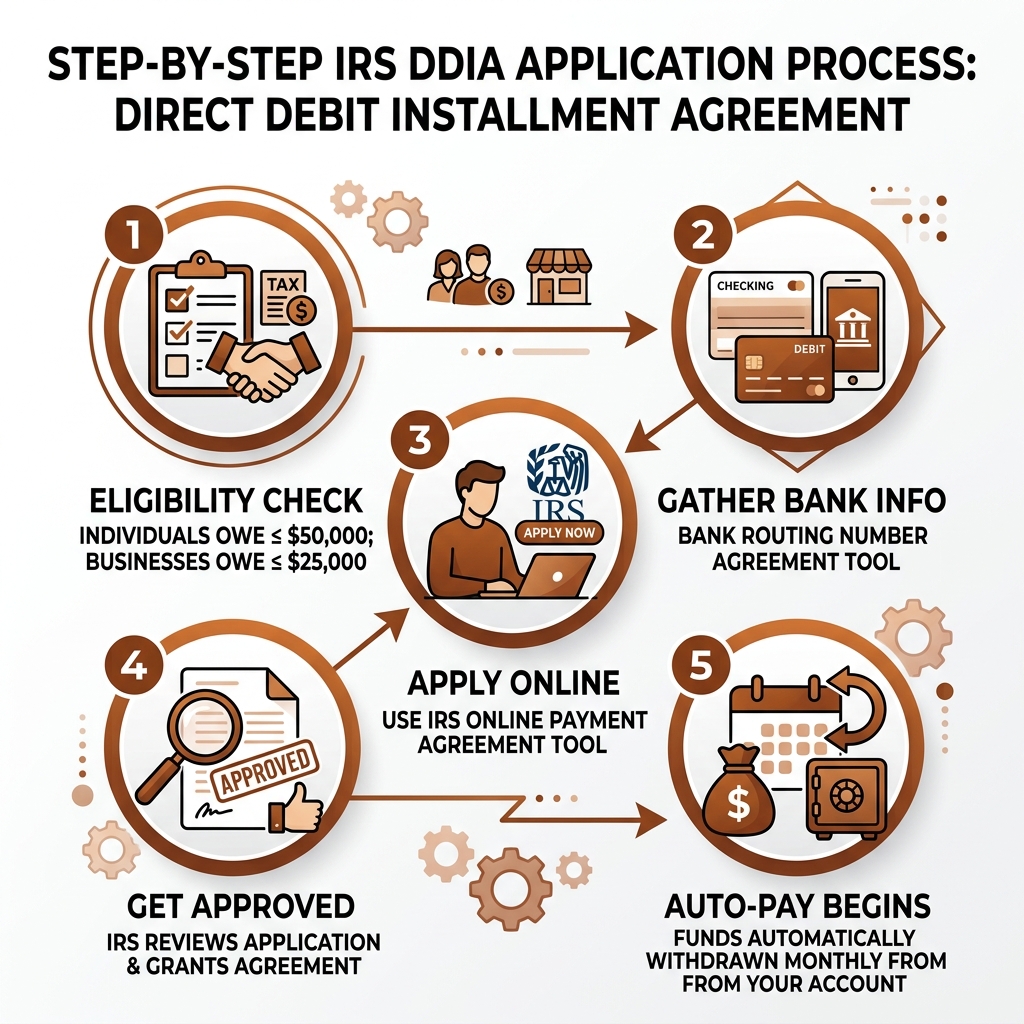
At its simplest, a direct debit installment agreement is a contract between you and the IRS. You agree to pay your tax debt in monthly increments, and the IRS agrees to automatically pull those funds directly from your checking account. Think of it like your Netflix subscription or your gym membership, but instead of streaming movies, you’re buying back your financial freedom.
The beauty of this arrangement is the consistency. Because the IRS knows exactly when and how they are getting their money, they are generally much more amenable to working with you. This automation helps you manage back taxes without the anxiety of manually writing a check every month and wondering if it will arrive at the IRS processing center on time.
Eligibility Requirements for a Direct Debit Installment Agreement
Not every taxpayer can simply click a button and get a DDIA. The IRS has specific guardrails in place to ensure you are a good candidate for a long-term payment plan.
- Individual Qualifications: For a “simple” or streamlined online agreement, individuals generally must owe $50,000 or less in combined tax, penalties, and interest. If you owe more, the IRS typically requires a more detailed dive into your finances via a Collection Information Statement.
- Business Limits: Businesses can apply for a long-term plan online if they owe $25,000 or less from the current or prior year.
- Mandatory Thresholds: If you are an individual owing more than $25,000 or a business owing more than $10,000, the IRS actually requires you to set up a direct debit installment agreement if you are applying through their online tool.
- Tax Compliance: This is the big one. You cannot set up an agreement if you have unfiled tax returns. The IRS won’t negotiate with you until you’ve “come clean” by filing all required paperwork.
For those who meet these criteria, the Online payment agreement application | Internal Revenue Service is the fastest path to approval.
Advantages Over Other Payment Methods
Why choose direct debit over mailing a check or paying by credit card? Besides the “set it and forget it” convenience, there are cold, hard financial reasons:
- Lower Setup Fees: The IRS charges a “user fee” to set up these plans. Because direct debit is cheaper for them to process, they pass those savings on to you.
- Reduced Default Risk: Human error is the #1 reason payment plans fail. You forget to mail the check, or the mail gets lost. With a DDIA, as long as the money is in your account, the payment is made.
- No Convenience Fees: Paying by credit card often incurs a processing fee of 1.5% to 3.5%. Over a 72-month plan, that adds up to a small fortune.
- Fresh Start Benefits: Using a DDIA is a key component of the IRS Fresh Start Initiative, which was designed to make it easier for taxpayers to pay back what they owe while avoiding the harshest collection tactics.
How to Apply for an IRS Direct Debit Plan
There are four main ways to get your direct debit installment agreement off the ground. While we almost always recommend the online route for its speed and lower costs, your specific situation might require a different approach.
- Online Payment Agreement (OPA) Tool: This is the “Express Lane.” If you owe under $50,000, you can usually get immediate approval.
- Phone Applications: You can call the IRS (800-829-1040 for individuals) to set up a plan, but be prepared for long hold times.
- Mail-In Requests: Using Form 9465, you can request an agreement by mail. This is often necessary if you owe more than the online limits.
- In-Person: You can visit a Taxpayer Assistance Center, though this is the least common method today.
To help you visualize the cost difference, look at how the IRS structures its setup fees:
| Application Method | Direct Debit (DDIA) Fee | Non-Direct Debit Fee |
|---|---|---|
| Online | $22 | $69 |
| Phone/Mail/In-Person | $107 | $178 |
As you can see, applying online for a DDIA is significantly more affordable. For more details on the full range of resolution options, check out our tax debt resolution complete guide.
Essential Information for Your Direct Debit Installment Agreement
Before you start the application, gather your “financial toolkit.” You will need:
- Your bank’s 9-digit routing number.
- Your checking account number.
- Written authorization (if applying via paper).
- IRS Form 433-D: This is the specific form used to authorize the IRS to begin the automated withdrawals. You can view the PDF Installment Agreement – IRS Form 433-D to see exactly what information is required.
DDIA vs. Payroll Deduction Agreements (PDIA)
Sometimes, a direct debit from your bank account isn’t the best fit. In those cases, the IRS might suggest a Payroll Deduction Agreement (PDIA).
- PDIA: Your employer deducts the tax payment directly from your paycheck and sends it to the IRS. This requires your employer to agree to the extra paperwork using Form 2159.
- DDIA: You maintain control. The money stays in your account until the scheduled withdrawal date.
The IRS Internal Manual notes that DDIAs generally have the lowest default rates of all payment plans because they don’t rely on an employer’s payroll department to stay compliant. You can read more about the technical differences in IRS Manual 5.14.10.
Setup Fees, Waivers, and Low-Income Reductions
We know that if you’re struggling to pay your taxes, even a setup fee can feel like a burden. The IRS does offer relief for low-income taxpayers (defined as those at or below 250% of the federal poverty level).
- Fee Waivers: If you qualify as low-income and agree to a direct debit installment agreement, the IRS will waive the setup fee entirely.
- Fee Reimbursements: If you are low-income but cannot use direct debit, you may have to pay a reduced fee ($43) upfront, which the IRS will reimburse once you successfully complete the payment plan.
These provisions are part of the IRS Fresh Start Program, aimed at ensuring tax debt resolution is accessible to everyone, regardless of their current financial status.
Managing and Revising Your Agreement
Life happens. You might get a raise and want to pay off your debt faster, or you might hit a rough patch and need to lower your payment.

The IRS Online Payment Agreement tool allows you to:
- Change your monthly payment amount.
- Change your monthly due date (choose any day from the 1st to the 28th).
- Update your bank routing or account numbers.
- Convert a “check-by-mail” plan into a DDIA.
The best part? If you make these changes online, the general revision fee is $6 online or $89 by phone or mail, subject to exceptions. Some online changes to an existing direct debit agreement have no fee, and low-income rules may apply. If you call the IRS to make the change, you might be charged a fee. If you’re unsure how to handle a change in your ability to pay, our guide on what to do if you owe the IRS but can’t pay offers some strategic advice.
Potential Risks and How to Avoid Default
While we love the “set it and forget it” nature of a direct debit installment agreement, it isn’t without risks.
- Overdraft Fees: If the IRS attempts a withdrawal and the funds aren’t there, your bank will likely hit you with an NSF (non-sufficient funds) fee.
- IRS Fees: The IRS may also charge you a penalty for a “dishonored” payment.
- Default: Generally, you miss a payment or fail another agreement requirement, the IRS will consider the agreement in default.
To avoid this, we recommend choosing a withdrawal date that falls a few days after your primary payday. This ensures the funds are “fresh” in the account before the IRS comes knocking.
What Happens if You Miss a Payment?
If you miss a payment, don’t panic, but do act quickly. The IRS will send you a Notice of Intent to Terminate Your Installment Agreement (often Letter CP523). This notice gives you a 30-day window to fix the problem before they officially cancel the plan.
If the plan is terminated:
- You will have to pay a reinstatement fee (usually around $89).
- The IRS can resume collection actions, including filing a federal tax lien or issuing a levy.
- You lose the “protection” the agreement provided.
If your financial situation has changed drastically, you might need to look into IRS back tax help or even a partial pay installment arrangement, which allows you to pay less than the full amount owed over the life of the collection statute.
Frequently Asked Questions about Direct Debit Plans
How do I stop a scheduled direct debit payment?
If you need to stop a single payment due to a financial emergency, you have two options:
- Arrange Payment-Method Changes With the IRS: You must notify them at least 3 business days before the transfer.
- Contact the IRS: You must notify them at least 14 business days before the transfer to ensure their system has time to halt the pull.
Are businesses required to use direct debit?
Yes, in specific cases. If a business applies for a long-term payment plan online and owes more than $10,000, the IRS mandates a direct debit installment agreement. This ensures the IRS has a reliable “pipeline” to the business’s funds.
How long does it take for the first payment to be withdrawn?
The first withdrawal date depends on how the agreement is established and the IRS confirmation. For field-collection DDIAs processed under IRM 5.14.10.4, the manual directs IRS staff to set the first payment approximately 60 days after establishment and issue Letter 2849. This is not a universal start date for every online or other agreement. Follow your acceptance notice and confirm when automatic withdrawals will begin; arrange any required interim payments with the IRS.
Conclusion
A direct debit installment agreement is one of the most effective tools in the taxpayer’s arsenal for resolving debt with the least amount of stress. It lowers your costs, automates your compliance, and keeps the IRS collection officers at bay.
However, the “IRS machine” can be unforgiving if you don’t set the agreement up correctly or if your financial situation requires a more nuanced approach, like an Offer in Compromise or a Partial Payment plan.
Review the relevant notices, filing history, records, and deadlines before choosing a response. Evaluate professional assistance according to the facts, applicable law, and agreed scope of representation.
Don’t let tax debt keep you up at night. Contact Segal, Cohen & Landis for tax services today, and let us help you set up a plan that actually works for your life.
Have questions about this topic? Talk to an IRS attorney today.
Segal, Cohen & Landis, P.C. — Beverly Hills. Serving clients nationwide.

Samuel Landis, Esq.
LL.M. (Tax) · Selected to Super Lawyers®
Sam Landis is a Beverly Hills IRS tax attorney specializing in IRS collection defense, audit representation, and international tax compliance for foreign nationals and US expats.