

What You Need to Know About Reducing Crypto Tax Liability
Reducing crypto tax liability is possible through several legal strategies available to U.S. taxpayers right now.
Here are the most effective ways to lower what you owe on crypto:
| Strategy | How It Helps |
|---|---|
| Hold crypto over 1 year | Qualifies for lower long-term capital gains rates (0%-20%) |
| Tax-loss harvesting | Offset gains with losses; deduct up to $3,000 against ordinary income |
| Donate appreciated crypto | Avoid capital gains and claim a fair market value deduction |
| Gift crypto | Transfer up to the annual exclusion amount per person without triggering gift or capital gains tax, subject to IRS rules |
| Use a self-directed IRA | Grow crypto tax-deferred or tax-free |
| Borrow against crypto | Access liquidity without a taxable sale |
| Choose the right cost basis method | Valid specific identification requires applicable records and timing; otherwise FIFO rules may apply |
The stakes are real. One Reddit user famously reported owing $500,000 to the IRS after a series of Ethereum trades – while his account had dropped from $1 million to under $200,000. Stories like this are a stark reminder that every crypto trade, swap, or spend is a taxable event under IRS rules.
The IRS classifies cryptocurrency as property, not currency. That means selling, trading, spending, or earning crypto can trigger either capital gains tax or ordinary income tax – depending on how and when it happened.
The good news? With the right planning, you can legally reduce what you owe.
reducing crypto tax liability: Review the relevant notices, filing history, records, and deadlines before choosing a response. Evaluate professional assistance according to the facts, applicable law, and agreed scope of representation.
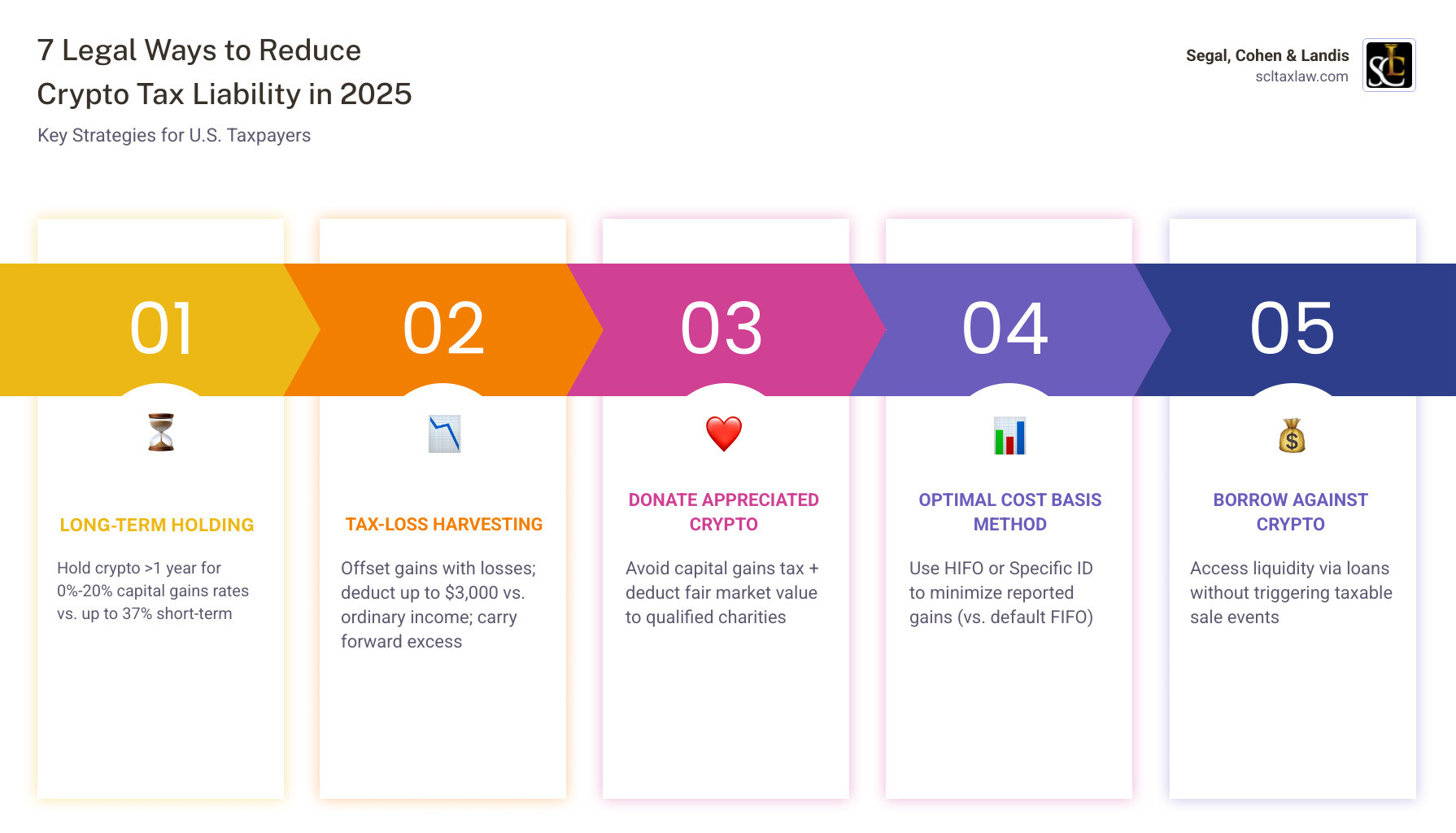
7 Legal Ways for Reducing Crypto Tax Liability
Navigating the tax code can feel like trying to solve a puzzle where the pieces keep changing shape. However, the IRS has provided a framework that, when used correctly, allows for significant tax optimization. By understanding that digital assets are treated as property, we can apply traditional tax-saving maneuvers to your crypto portfolio.

At Segal, Cohen & Landis, we emphasize that these methods are not about “evading” taxes—which is illegal—but about “avoiding” unnecessary tax through strategic planning. Here are the seven primary levers you can pull to lower your bill.
Holding Assets for Long-Term Gains
The simplest way to cut your tax bill nearly in half is to practice patience. The IRS distinguishes between short-term and long-term capital gains based on a 12-month holding period.
- Short-Term Capital Gains: If you hold an asset for one year or less, your profit is taxed at your ordinary income rate, which can be as high as 37% in 2025.
- Long-Term Capital Gains: If you hold for more than 365 days, you qualify for preferential rates of 0%, 15%, or 20%.
For 2025, the 0% long-term rate applies to single filers with taxable income up to $48,350. This means if your total income is below that threshold, you could potentially sell your appreciated Bitcoin or Ethereum and pay $0 in federal capital gains tax. Even for higher earners, the jump from a 37% short-term rate to a 20% long-term rate represents a massive 17-percentage-point saving.
To ensure you are calculating these periods correctly and staying within IRS guidelines on virtual currencies, you must track the exact minute you acquired the asset. For more personalized help, check out more info about cryptocurrency tax liability on our site.
Strategic Crypto Donations
If you have a charitable heart and a highly appreciated crypto portfolio, donating appreciated crypto is arguably the most powerful double-benefit strategy available.
When you donate crypto that you have held for more than a year directly to a 501(c)(3) nonprofit, two things happen:
- You avoid capital gains tax: You don’t have to sell the asset first, so the appreciation is never “realized” for tax purposes.
- You get a full deduction: You can typically deduct the full fair market value of the crypto at the time of the donation from your taxable income (up to certain AGI limits).
For example, if you bought $5,000 worth of Solana and it is now worth $20,000, selling it would normally trigger a tax on the $15,000 gain. By donating it, you bypass that tax entirely and get a $20,000 deduction to lower your other taxable income. Just remember: if your donation is valued at over $5,000, the IRS requires a “qualified appraisal” from a certified appraiser, even if the coin is listed on a public exchange.
Optimizing Inventory Methods: FIFO vs. LIFO
How you “account” for the coins you sell can change your tax bill by thousands of dollars. Since many investors buy the same asset (like Bitcoin) at different prices over several years, the IRS needs to know which specific “unit” you sold.
In 2025, new rules require more granular tracking. The IRS is moving toward a per-wallet requirement, meaning you generally cannot “mix” the cost basis of Bitcoin held in a hardware wallet with Bitcoin held on a centralized exchange.
| Method | Definition | Best Used When… |
|---|---|---|
| FIFO (First-In, First-Out) | The oldest coins you bought are the first ones sold. | Prices have been steadily rising (often the default). |
| Newest units first, only through valid specific identification | The most recent coins you bought are the first ones sold. | You bought recently at high prices and want to minimize gains. |
| Specific Identification | You choose exactly which “lot” or “unit” to sell. | You want maximum control over your tax outcome. |
Using Specific Identification to Reduce Crypto Tax Liability
Valid specific identification can affect crypto tax liability. Selecting higher-basis units requires the applicable identification, timing and recordkeeping rules within the relevant wallet or account; it is not an unrestricted choice after a sale. Otherwise the applicable FIFO rules may govern.
If you bought Bitcoin at $20,000, $40,000, and $60,000, and you sell a portion today at $65,000, using FIFO would mean you “sold” the $20,000 coin (creating a $45,000 gain). Using HIFO via Specific Identification allows you to “sell” the $60,000 coin, resulting in only a $5,000 gain.
Valid identification requires the applicable timing and adequate records for the units selected within the relevant wallet or account. Notice 2026-20 provides limited temporary identification relief for qualifying custodial transactions through 2026; it does not eliminate basis records or change every broker reporting rule. This level of detail usually requires professional software or professional tax services to ensure your records stand up to an audit.
Advanced Strategies: Tax Loss Harvesting
In the volatile world of crypto, not every investment is a winner. Tax-loss harvesting is the process of selling assets that are currently worth less than what you paid for them to “realize” a loss.
These realized losses can be used to:
- Offset Capital Gains: If you have $10,000 in gains from Bitcoin but $10,000 in losses from an altcoin, your net taxable gain is $0.
- Deduct Against Ordinary Income: If your total losses exceed your total gains, you can use up to $3,000 of the “excess” loss to reduce your regular taxable income (like your salary).
- Carry Forward: Any losses beyond that $3,000 can be carried forward into future years indefinitely.
If you are dealing with significant losses from previous years or need help with back taxes, harvesting current losses is a critical step in cleaning up your tax profile.
Navigating Wash Sale Rules for Reducing Crypto Tax Liability
One of the most unique opportunities in crypto right now involves the “Wash Sale Rule.” In the stock market, if you sell a stock at a loss and buy it back within 30 days, the IRS disallows the loss.
Section 1091 addresses wash sales of stock or securities. Applying the rule to a particular digital asset requires review of that asset and transaction; the IRS’s general property treatment does not establish one securities classification for all tokens. Do not assume that an immediate repurchase always preserves a deductible loss.
A word of caution: The IRS still follows the “Economic Substance Doctrine.” If a transaction has no purpose other than tax avoidance, they can disallow it. Furthermore, there have been several legislative proposals to close this loophole. We always recommend consulting with us to ensure your trades have legitimate economic substance.
Reporting and Current Regulatory Changes
The era of “crypto anonymity” is officially over. The IRS is introducing Form 1099-DA for digital asset reporting. This form is issued by digital asset brokers, including centralized exchanges and certain hosted wallets, to report gross proceeds from your sales directly to the IRS.
This means the IRS may already have a record of your trading volume before you even file. To stay compliant, you must accurately report your activity using:
- Form 8949: Where you list every individual sale or exchange.
- Schedule D: Where you summarize your total capital gains and losses.
- Form 1040: Where you must answer “Yes” to the question asking if you received, sold, or exchanged any digital assets.
Taxpayers remain responsible for accurate basis records. Covered brokers report 2025 gross proceeds, with basis reporting generally beginning for 2026 transactions involving covered assets. Broker reports do not establish every taxpayer’s complete basis or eliminate recordkeeping duties. If the IRS challenges your numbers, having a “Safe Harbor Plan” or meticulous per-wallet records is your best defense. If you receive a notice or are facing an inquiry, our IRS audit representation services can help protect your rights.
Frequently Asked Questions about Crypto Taxes
Do airdrops and staking rewards count as income?
Yes. The IRS treats airdrops and staking rewards as ordinary income at the moment you gain “dominion and control” over them. This means you owe tax on the fair market value of the coins on the day you receive them. If the value later goes up and you sell them, you will also owe capital gains tax on that increase.
Can I deduct lost or stolen cryptocurrency?
Unfortunately, for most individual taxpayers, the answer is no. Following the Tax Cuts and Jobs Act of 2017, personal casualty and theft loss deductions were largely eliminated (unless they occur in a federally declared disaster area). Losing access to a wallet does not itself establish a deductible loss. A qualifying theft in a profit-motivated transaction may have different rules from personal-use losses, even outside an operating business. Classification, discovery year and reasonable prospects of recovery require review.
How does borrowing against crypto avoid taxes?
When you take out a loan using your crypto as collateral, the loan proceeds are not considered taxable income. This allows you to access cash for a down payment or expenses without selling your assets and triggering a capital gains tax event. Additionally, if the loan is used for investment purposes, the interest might even be tax-deductible. The risk here is a “margin call”—if the price of your collateral drops significantly, the lender may sell your crypto to cover the loan, which would trigger a taxable event.
Conclusion
Reducing crypto tax liability isn’t about finding “loopholes” – it’s about using the established rules of the U.S. tax code to your advantage. Whether you are holding for the long term, harvesting losses, or utilizing specific identification, the key is proactive planning and impeccable record-keeping.
Review the relevant notices, filing history, records, and deadlines before choosing a response. Evaluate professional assistance according to the facts, applicable law, and agreed scope of representation.
Don’t let a “Reddit-style” tax shock happen to you. If you have significant gains, complex DeFi transactions, or need to catch up on unfiled returns, our expert legal counsel can provide the roadmap you need. Explore our strategies for reducing crypto tax liability or contact us today to schedule a consultation at one of our many locations across the United States. We are here to ensure your digital wealth stays where it belongs – with you.
Have questions about this topic? Talk to an IRS attorney today.
Segal, Cohen & Landis, P.C. — Beverly Hills. Serving clients nationwide.

Samuel Landis, Esq.
LL.M. (Tax) · Selected to Super Lawyers®
Sam Landis is a Beverly Hills IRS tax attorney specializing in IRS collection defense, audit representation, and international tax compliance for foreign nationals and US expats.