


Why Crypto Margin Trading Taxes Can Make or Break Your Financial Future
Crypto margin trading taxes are one of the most complex areas of U.S. tax law for digital asset investors. Here is what you need to know right away:
How crypto margin trading is taxed — at a glance:
| Event | Tax Treatment |
|---|---|
| Closing a profitable margin position | Capital gain (short-term or long-term) |
| Closing a losing margin position | Capital loss (deductible against gains) |
| Forced liquidation | Taxable disposal — capital gain or loss |
| Adding collateral during a margin call | Not a taxable event |
| Margin interest paid | Potentially deductible as investment interest expense |
| Trading and gas fees | Reduce taxable gain (adjust cost basis) |
- Short-term gains (positions held one year or less) are taxed at ordinary income rates — 10% to 37%
- Long-term treatment depends on the actual asset, transaction, and applicable holding-period rules; keeping a margin position open for a year alone does not establish eligibility.
- Net capital losses can offset up to $3,000 of ordinary income per year, with the rest carried forward
Margin trading lets you borrow funds from an exchange or broker to control a much larger position than your own capital allows. A $10,000 deposit with 5x leverage puts $50,000 to work in the market. That kind of power can amplify your gains — but it also amplifies your losses and your tax exposure.
The IRS has not issued rules specific to crypto margin trading. Instead, it applies the same property and securities principles it uses for traditional assets. That means every time you close a position, get liquidated, or repay a loan with crypto, you may be triggering a taxable event — whether you realize it or not.
For traders already under IRS scrutiny, or those sitting on significant gains and losses from leveraged positions, the stakes are very high. Getting this wrong can mean penalties, back taxes, or a full audit.
crypto margin trading taxes: Review the relevant notices, filing history, records, and deadlines before choosing a response. Evaluate professional assistance according to the facts, applicable law, and agreed scope of representation.
Understanding the Mechanics of Leveraged Trading
Before we dive into the tax forms, we need to understand the gears turning behind the scenes. Margin trading isn’t just “buying crypto”; it’s a financial arrangement involving debt. You start by depositing initial margin—your own skin in the game—which acts as collateral. The exchange then provides borrowed capital to increase your position size.
However, this “loan” comes with strings attached. You must maintain a maintenance margin, a minimum account value required by the exchange. If the market moves against you and your account value drops below this threshold, you’ll receive a margin call.
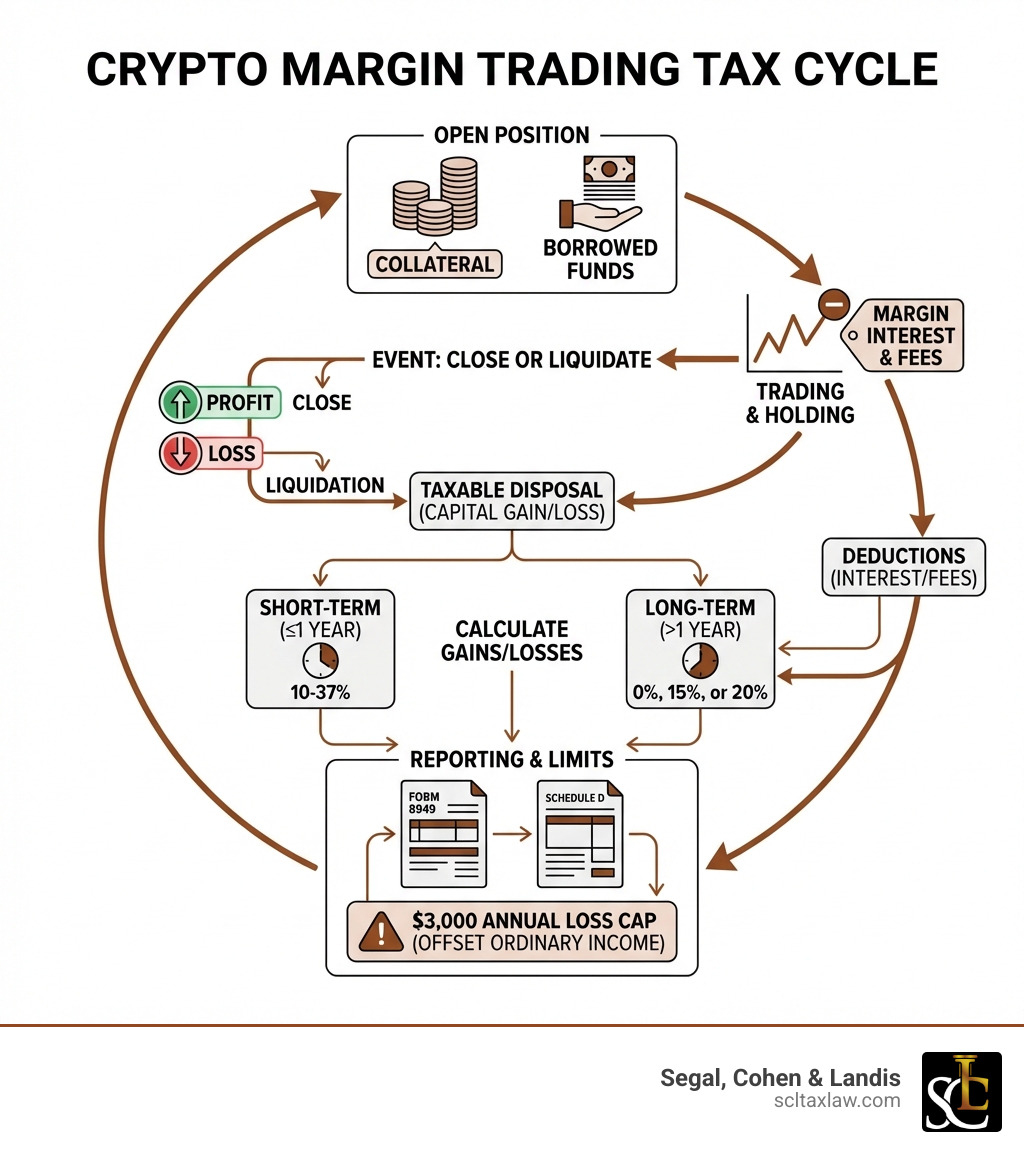
From a tax perspective, the most important concept to grasp is the realization event. In a standard spot trade, you realize a gain or loss when you sell an asset you own. In margin trading, a realization event occurs when you close your leveraged position, when you are liquidated, or even when you use one cryptocurrency to repay a margin loan. Understanding your cryptocurrency tax liability starts with recognizing that the IRS views these complex movements as a series of property disposals.
How the IRS Regulates Crypto Margin Trading Taxes
The IRS does not have a “Margin Trading Handbook” specifically for Bitcoin or Ethereum. Instead, they rely on IRS Notice 2014-21 principles, which establish that cryptocurrencies are treated as property for federal tax purposes. Because crypto is property, it is generally considered a capital asset in the hands of an investor.
When you trade on margin, you are essentially acquiring property with a mix of your own funds and borrowed funds. Your adjusted basis—the amount used to calculate your gain or loss—includes the total cost of the position, including the borrowed portion and acquisition fees.
Spot Trading vs. Margin Trading Tax Triggers
| Feature | Spot Trading | Margin Trading |
|---|---|---|
| Acquisition | Buying with your own cash/crypto. | Buying with cash/crypto + borrowed funds. |
| Basis | Purchase price + fees. | Acquisition cost, including borrowed funds and qualifying acquisition fees. Margin interest has separate deduction or capitalization rules. |
| Tax Trigger | Selling or exchanging the asset. | Closing position, liquidation, or loan repayment. |
| Holding Period | Starts day after purchase. | Starts day after position is opened. |
Every transaction must be valued at its fair market value (FMV) in U.S. dollars at the time of the event. If you open a position at 8:00 AM and close it at 4:00 PM, the USD value at those exact moments determines your tax bill.
Tax Treatment of Leveraged Profits and Losses
For sales of capital assets, holding period generally affects short-term or long-term treatment. Short sales and derivatives can have different rules. Review the property used to close a short sale and the particular contract; the duration of a leveraged position alone does not determine tax treatment.
Your specific capital gains tax rates are determined by your total taxable income and filing status. For many active traders, the goal is to accurately calculate the cost basis to ensure they aren’t paying more than necessary.
Reporting Profits from Crypto Margin Trading Taxes
When you close a profitable margin trade, you calculate your gain by taking the amount realized (the total value of the position when closed) and subtracting your adjusted basis (the total cost to open it, including fees).
- Short-Term Gains: These are taxed at rates ranging from 10% to 37%. Most margin trades fall into this category because leverage is typically used for quick, tactical moves.
- Long-Term Gains: Review the applicable asset and holding-period rules before applying preferential capital-gain rates. A leveraged position held for 366 days does not automatically qualify.
Deducting Losses from Crypto Margin Trading Taxes
One “silver lining” of the high risks involved in margin trading is the ability to use losses to lower your tax bill. Capital loss offsets allow you to use your margin losses to cancel out capital gains from other sources, like stocks or other crypto trades.
If your total capital losses exceed your total gains, you can use up to $3,000 of net capital losses to reduce your ordinary income for the year. Any remaining loss doesn’t disappear; it becomes a loss carryforward that you can use in future tax years. This is a core component of tax-loss harvesting, a strategy we often use to help our clients minimize their overall tax liability.
Liquidations, Margin Interest, and Deductible Fees
In margin, “liquidation” is the word no one wants to hear. A forced liquidation happens when the exchange automatically sells your collateral to cover your borrowed funds because the market moved against you.
To the IRS, a liquidation is a taxable disposal. Even though you didn’t choose to sell, the exchange sold the assets on your behalf. You must calculate a gain or loss based on the difference between the FMV at the time of liquidation and your original cost basis.
Beyond the trades themselves, you also have to account for:
- Trading Commissions: Fees paid to the exchange to open or close a position.
- Gas Fees: Network fees paid to move crypto (common in DeFi margin trading).
- Loan Repayments: If you repay a margin loan using a different cryptocurrency, that repayment is considered a “sale” of the crypto used to pay, potentially triggering a gain or loss.
Deductibility of Margin Interest and Expenses
The interest you pay on the funds you borrow is classified by the IRS as investment interest. According to IRS Publication 550 guidelines, you may be able to deduct these expenses, but there is a major catch: you can only deduct investment interest up to the amount of your net investment income for the year.
To claim this deduction, you typically need to use Form 4952 and itemize your deductions on Schedule A. If your interest expenses are higher than your investment income, you can carry the excess forward to future years. However, the IRS has not been 100% explicit on how these rules apply to decentralized finance (DeFi), so professional guidance is highly recommended.
IRS Reporting Requirements and Compliance
Staying on the right side of the IRS requires meticulous record-keeping and the use of specific forms.
- Form 1040 (The Digital Asset Question): Every taxpayer must answer “Yes” or “No” to the question asking if they received, sold, or disposed of any digital assets. If you traded on margin, the answer is almost certainly “Yes.”
- Form 8949: This is where you list every single margin disposal. You must include the description of the asset, the date acquired, the date sold, the proceeds, and the cost basis.
- Schedule D: This form summarizes your total capital gains and losses from Form 8949.
When reporting, the IRS now defaults to a FIFO (First-In, First-Out) accounting method unless you can provide specific identification of the units sold. This means you must be able to prove which specific “lot” of crypto you used as collateral or for repayment to use a different method like HIFO (Highest-In, First-Out), which can often result in lower taxes.
Frequently Asked Questions about Crypto Margin Trading Taxes
Are margin calls and collateral deposits taxable?
Generally, no. Moving your own funds into a margin account to meet a maintenance margin requirement or responding to a margin call is not a taxable event. You are simply moving property from one of your “pockets” to another. A tax trigger only occurs when there is an asset disposal—meaning the assets are sold, exchanged, or used to pay a debt.
How are short positions and crypto derivatives taxed?
Short selling—where you borrow an asset to sell it, hoping to buy it back cheaper—is almost always treated as a short-term capital gain or loss, regardless of how long the position stays open.
For crypto derivatives like regulated futures (e.g., those traded on the CME), the rules change. These may fall under Section 1256 contracts, which use a “60/40 rule.” This means 60% of the gain is taxed at the lower long-term rate and 40% at the short-term rate, no matter the holding period. However, this typically does not apply to unregulated offshore or DeFi perpetual swaps.
What records are required for margin trading audits?
If the IRS comes knocking, “I think I made a profit” won’t cut it. You need a comprehensive paper trail, including:
- Acquisition and disposal dates (to the second).
- Fair market values in USD at the time of every trade.
- Interest records showing exactly what you paid to the lender.
- Transaction logs from the exchange. We recommend a seven-year retention policy for these records, as crypto remains a high-priority area for IRS enforcement.
Conclusion
Navigating crypto margin trading taxes is like walking a tightrope over a digital canyon. The potential for profit is massive, but the complexity of U.S. tax compliance can easily pull you down if you aren’t prepared. Between calculating basis on borrowed funds and managing the deductibility of margin interest, there are dozens of places to make a costly mistake.
Review the relevant notices, filing history, records, and deadlines before choosing a response. Evaluate professional assistance according to the facts, applicable law, and agreed scope of representation.
Don’t wait for a notice from the IRS to address your leveraged trading activity. Consult with a tax professional today to secure your financial peace of mind.
Have questions about this topic? Talk to an IRS attorney today.
Segal, Cohen & Landis, P.C. — Beverly Hills. Serving clients nationwide.

Samuel Landis, Esq.
LL.M. (Tax) · Selected to Super Lawyers®
Sam Landis is a Beverly Hills IRS tax attorney specializing in IRS collection defense, audit representation, and international tax compliance for foreign nationals and US expats.