

What Is Crypto Tax Liability and What Do You Owe the IRS?
Crypto tax liability is a legal obligation that applies to millions of Americans — and the IRS is collecting.
Here is a quick breakdown of what you need to know:
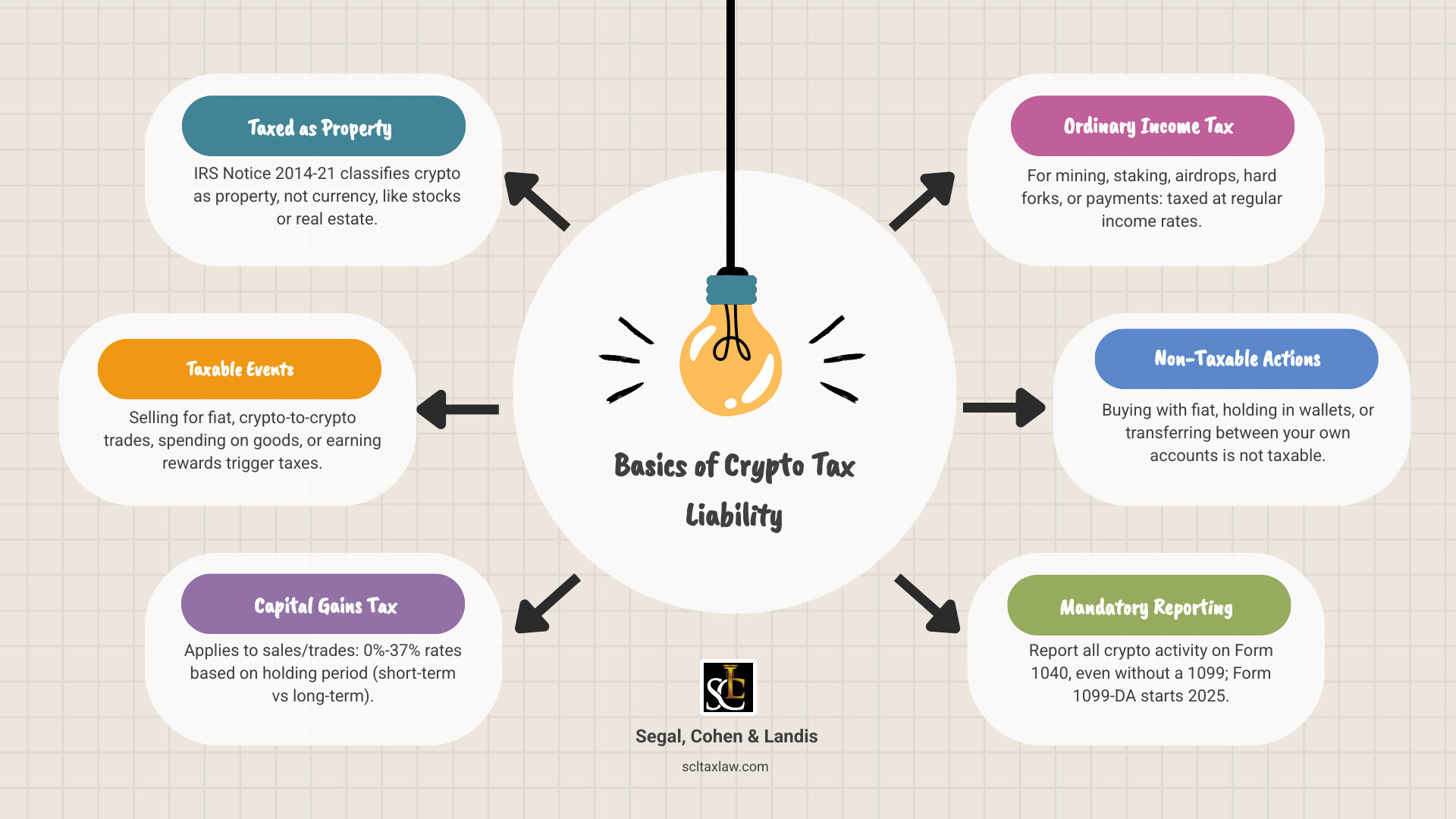
- Crypto is taxed as property, not currency (per IRS Notice 2014-21)
- Selling, trading, spending, or earning crypto are all taxable events
- Capital gains tax applies when you sell or trade crypto (0%–37% depending on holding period and income)
- Ordinary income tax applies when you earn crypto (mining, staking, airdrops, payment for services)
- Simply buying and holding crypto is not taxable — until you dispose of it
- Report required digital-asset income and dispositions, even without a 1099. Mere holding, buying with U.S. dollars or moving assets between wallets you own does not itself create taxable income; answer the digital-asset question under current instructions
The rules around crypto taxes have grown more complex every year. The IRS now treats digital assets — including Bitcoin, Ethereum, stablecoins, and NFTs — as property subject to federal tax law. That means every trade, sale, or earned reward can trigger a tax bill, whether you cashed out to dollars or not.
Many taxpayers are caught off guard by this. A common mistake? Assuming crypto is only taxable when you convert it back to cash. In reality, trading one cryptocurrency for another is also a taxable event — and the IRS has made it clear that it is paying close attention.
With new broker reporting rules, expanded IRS enforcement, and Form 1099-DA rolling out for the 2025 tax year, the window to fly under the radar has essentially closed.
If you already have unreported crypto activity, back taxes, or are facing an audit, the stakes are high — and getting expert legal help matters.
crypto tax liability: Review the relevant notices, filing history, records, and deadlines before choosing a response. Evaluate professional assistance according to the facts, applicable law, and agreed scope of representation.
Understanding Your Federal Crypto Tax Liability
To manage your taxes effectively, you first need to understand how the government views your digital wallet. The IRS does not see Bitcoin as “money” in the traditional sense. Instead, it classifies it as a capital asset, similar to stocks, bonds, or real estate.

According to the latest IRS guidance on digital asset reporting, a “digital asset” is any digital representation of value that is recorded on a cryptographically secured distributed ledger. This broad definition covers:
- Convertible Virtual Currency: Assets like Bitcoin or Ethereum that can be exchanged for fiat currency (USD).
- Stablecoins: Assets pegged to a stable value, such as the U.S. Dollar (e.g., USDC or USDT).
- Non-Fungible Tokens (NFTs): Unique digital identifiers that denote ownership of art, music, or other media.
Because these are treated as property, general tax principles apply. This means when you dispose of an asset, you must calculate the difference between what you paid for it (your “cost basis”) and what it was worth when you let it go. If the value went up, you have a taxable gain. If it went down, you have a loss that might help lower your tax bill.
Taxable Events: When Does Crypto Trigger a Tax Bill?
One of the most frequent questions we hear is: “What exactly triggers a tax bill?” In the eyes of the IRS, a taxable event occurs whenever you realize a gain or receive income.
Common taxable events include:
- Selling crypto for fiat: Cashing out your Bitcoin for U.S. Dollars.
- Crypto-to-crypto trades: Swapping Ethereum for Solana. This is a “disposal” of one asset to acquire another.
- Spending crypto on goods or services: Using your digital assets to buy a cup of coffee, a laptop, or a car.
- Receiving crypto as payment: Being paid in digital assets for work you performed.
When these events occur, you must determine the fair market value (FMV) of the asset in U.S. Dollars at the exact time of the transaction. For example, if you trade 1 BTC for ETH, your taxable gain is based on the USD value of that 1 BTC at the moment of the swap.
It is also important to remember that while the technology is new, the risks remain high. The SEC and other regulators often issue an investor bulletin on crypto risks highlighting volatility and fraud. From a tax perspective, volatility can lead to massive “phantom gains” where you owe taxes on a trade made at a peak, even if the market crashes shortly after.
Calculating Crypto Tax Liability for Earned Income
Not all crypto activity results in capital gains. Some activities are taxed as ordinary income at your standard federal income tax bracket (which currently ranges from 10% to 37%).
You generally owe income tax on:
- Mining Rewards: The value of the coins you earn for securing a blockchain network.
- Staking Yields: Rewards earned for holding and “staking” your coins to support network operations.
- Airdrops: New tokens sent to your wallet, often following a marketing campaign or a “hard fork.”
- Payment for Services: An employee paid in crypto generally has wage income. A contractor’s compensation is not automatically wages; the actual activity determines the appropriate income and employment-tax treatment.
Employee status and self-employment depend on the actual relationship and activity, not merely earning $400. Net earnings from a trade or business may require Schedule C and Schedule SE; the self-employment tax filing threshold generally is $400 of net earnings. Other reward income requires separate classification. Businesses or platforms paying you more than $600 in rewards or fees may issue a Form 1099-NEC or 1099-MISC.
Determining Crypto Tax Liability for Capital Gains
When you sell or trade crypto held for investment, you trigger capital gains or losses. The rate you pay depends heavily on your holding period—how long you owned the asset before selling it.
| Holding Period | Tax Type | Federal Tax Rate (2025) |
|---|---|---|
| 1 Year or Less | Short-Term Capital Gain | 10% – 37% (Ordinary Income Rates) |
| More than 1 Year | Long-Term Capital Gain | 0%, 15%, or 20% (Based on Income) |
Determining Cost Basis Your cost basis is generally what you paid for the crypto, plus any transaction fees. If you received the crypto through mining or staking, your basis is the fair market value on the day you received it (since you already paid income tax on that value).
Additional Taxes for High Earners If your income exceeds certain thresholds, you may be subject to an additional 3.8% Net Investment Income Tax (NIIT). Furthermore, if the IRS classifies your NFTs as “collectibles,” they could be taxed at a maximum long-term rate of 28%.
Offsetting Gains and IRS Reporting Requirements
The silver lining of a volatile market is the ability to use capital losses to reduce your crypto tax liability. If you sold an asset for less than its cost basis, you have a realized loss.
- Netting Gains: You first use your losses to offset your gains. For example, if you had $10,000 in gains and $12,000 in losses, you have a net loss of $2,000.
- The $3,000 Limit: If your total capital losses exceed your total capital gains, you can use up to $3,000 of the excess loss to offset other income (like your salary).
- Loss Carryover: Any remaining loss over $3,000 can be “carried forward” to future tax years indefinitely.
To report these transactions, you will primarily use Form 8949 to list every individual sale or trade, and Schedule D to summarize your total gains and losses. Additionally, every taxpayer must answer the “digital asset question” on the front of Form 1040, disclosing whether they received or disposed of any digital assets during the year. For more detailed strategies on managing these filings, you can explore our specific guide on cryptocurrency tax liability.
New Reporting Standards and Form 1099-DA
The “wild west” era of crypto reporting is ending. Following the American Infrastructure Bill of 2021, the Treasury has released final regulations and related IRS guidance for reporting by brokers.
The biggest change is the introduction of Form 1099-DA. Starting with the 2025 tax year, centralized exchanges (brokers) will be required to report gross proceeds from your sales to the IRS. Basis reporting generally begins for 2026 transactions involving covered assets under applicable broker rules; not every holding or transaction has reportable broker basis.
Wallet-by-Wallet Tracking Beginning January 1, 2025, the IRS is moving toward a “wallet-by-wallet” tracking method. This means you must track the basis of assets within each specific wallet rather than treating all your holdings across different platforms as one giant pool. Different rules must be distinguished. Public Law 119-5, approved April 10, 2025, disapproved the December 30, 2024 rule for brokers regularly providing services effectuating digital-asset sales; that rule has no force or effect. Separately, Notice 2024-57 provides reporting exceptions for specified transactions until further guidance, while the custodial broker rules apply under their own terms. Neither broker reporting relief nor disapproval eliminates a taxpayer’s obligation to report taxable income and dispositions.
Record-Keeping and Compliance Strategies
Because the IRS can now use blockchain analytics and “John Doe” summonses to track transactions, manual record-keeping is no longer optional. For instance, in 2016, a major exchange was forced to hand over records for over 8 million transactions to the IRS.
To stay compliant, we recommend the following:
- Maintain a Transaction Log: Record the date, unit amount, fair market value in USD, and purpose of every transaction.
- Choose an Accounting Method: The IRS generally defaults to FIFO (First-In, First-Out), which assumes the first coins you bought are the first ones you sold. However, you may be able to use HIFO (Highest-In, First-Out) or Specific Identification to lower your tax bill, provided you have the records to prove which specific “units” you sold.
- Download CSVs Regularly: Don’t rely on exchanges to keep your data forever. If a platform goes bankrupt or loses your history, the burden of proof is still on you to establish your cost basis.
Failure to keep accurate records can lead to an IRS audit. If the IRS identifies a discrepancy, they may assume your cost basis is zero, resulting in a much higher tax bill than you actually owe. In some cases, we can assist with penalty abatement if you can show a reasonable cause for reporting errors, but proactive compliance is always the safer route.
Frequently Asked Questions about Crypto Taxes
What crypto transactions are considered non-taxable events?
Not every movement of crypto triggers a tax bill. You generally do not owe taxes when you:
- Purchase crypto with USD: Buying Bitcoin with cash is a non-taxable event (though you must track the purchase price for your future basis).
- Hold in a wallet: Simply watching your portfolio grow in value is not taxable. These are “unrealized gains.”
- Transfer between your own wallets: Moving ETH from your exchange account to your hardware wallet is not a sale.
- Receive a “Soft Fork”: If a blockchain upgrades but you don’t receive new tokens, there is no income to report.
How does the IRS treat crypto gifts and charitable donations?
Gifting crypto can be a savvy tax move, but it has specific rules:
- Gifts: You can give up to $19,000 (for 2025) per recipient per year without filing a gift tax return (Form 709). The recipient “inherits” your cost basis and holding period.
- Donations: If you donate crypto held for more than a year to a 501(c)(3) charity, you can often deduct the full fair market value and avoid paying any capital gains tax on the appreciation.
What are the consequences of not reporting crypto activity?
The IRS is increasingly aggressive about crypto enforcement. Potential consequences include:
- Substantial Penalties: Failure-to-pay and failure-to-file penalties can add up to 25% or more to your original bill.
- Interest Charges: Interest on unpaid taxes compounds daily.
- Tax Liens and Levies: The IRS can seize assets or place a lien on your property to secure the debt.
- Criminal Prosecution: In extreme cases of intentional tax evasion, you could face prison time.
If you have realized you missed reporting crypto from previous years, you may need to look into options for resolving back taxes before the IRS contacts you.
Conclusion
Navigating crypto tax liability is no longer a niche concern for tech enthusiasts—it is a mainstream financial requirement. With the IRS implementing wallet-by-wallet reporting and the new Form 1099-DA, the complexity of staying compliant is only going to increase.
Review the relevant notices, filing history, records, and deadlines before choosing a response. Evaluate professional assistance according to the facts, applicable law, and agreed scope of representation.
Don’t wait for a notice from the IRS to arrive in your mailbox. Work with a tax expert today to ensure your crypto activity is reported correctly and your financial future is secure.
Have questions about this topic? Talk to an IRS attorney today.
Segal, Cohen & Landis, P.C. — Beverly Hills. Serving clients nationwide.

Samuel Landis, Esq.
LL.M. (Tax) · Selected to Super Lawyers®
Sam Landis is a Beverly Hills IRS tax attorney specializing in IRS collection defense, audit representation, and international tax compliance for foreign nationals and US expats.