

What Is a Back Taxes Forgiveness Program — and Can It Help You?
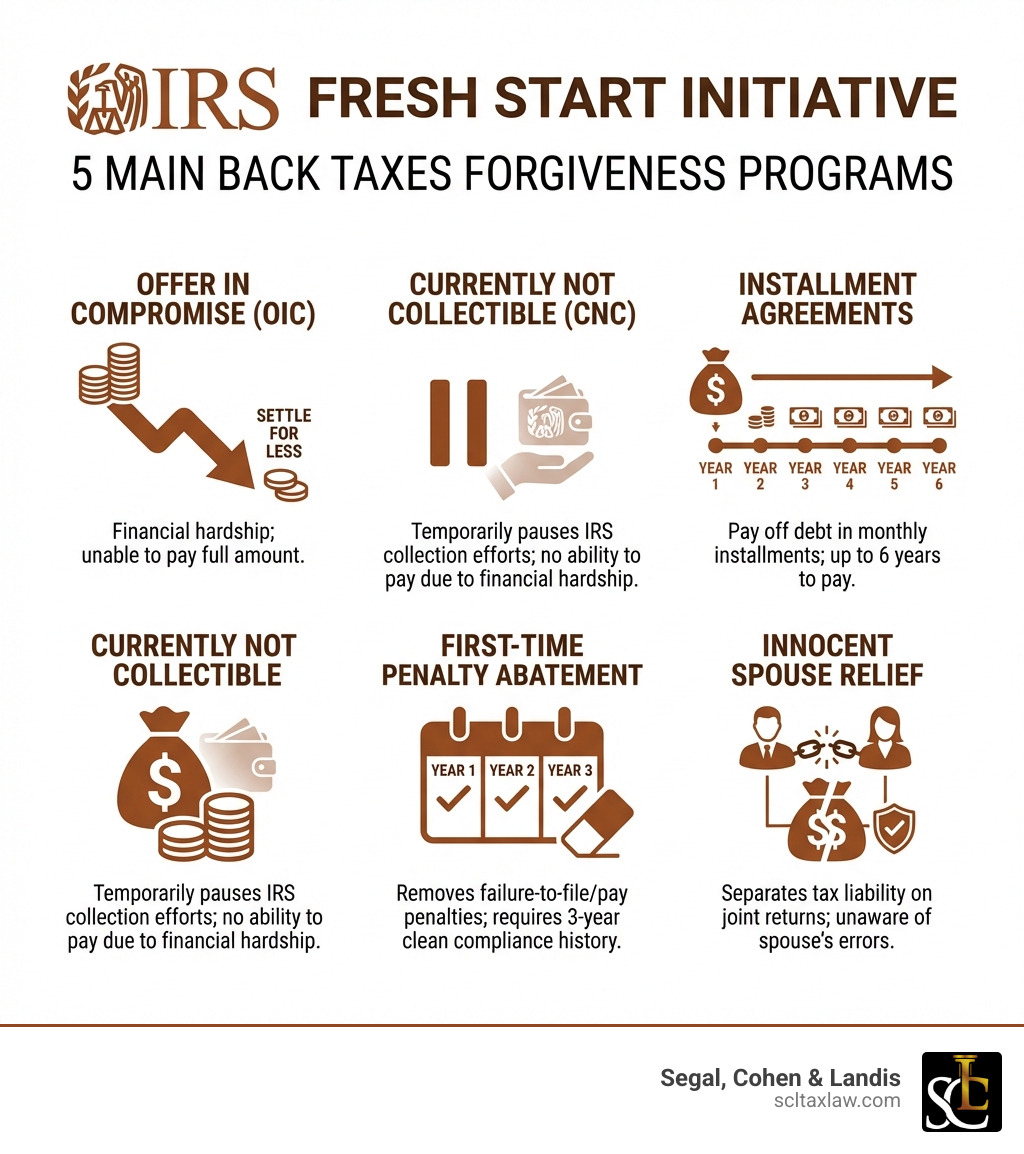
A back taxes forgiveness program is a set of IRS programs that let qualifying taxpayers settle their tax debt for less than the full amount owed, pause collections, or eliminate certain penalties. Here are the main options at a glance:
| Program | What It Does | Best For |
|---|---|---|
| Offer in Compromise (OIC) | Settle debt for less than you owe | Taxpayers who can’t pay in full |
| Currently Not Collectible (CNC) | Temporarily pauses IRS collection | Taxpayers with no ability to pay |
| Installment Agreement | Pay off debt over up to 6 years | Those who need more time to pay |
| First-Time Penalty Abatement | Removes penalties for first-time offenders | Clean compliance history (3 years) |
| Innocent Spouse Relief | Separates liability on joint returns | Spouses unaware of a partner’s tax errors |
None of these programs erase your debt automatically. But for taxpayers facing real financial hardship, they can make a massive difference.
For 2026, the seriously delinquent tax debt threshold is more than $66,000, subject to the statutory collection conditions and exclusions. IRS certification goes to the State Department, which handles passport decisions.
The challenge is knowing which program fits your situation, whether you actually qualify, and how to apply correctly without making costly mistakes. A wrong move — like submitting an Offer in Compromise before filing all your returns — can get your application rejected outright.
back taxes forgiveness programs: Review the relevant notices, filing history, records, and deadlines before choosing a response. Evaluate professional assistance according to the facts, applicable law, and agreed scope of representation.
Understanding the IRS Back Taxes Forgiveness Program
When people talk about a back taxes forgiveness program, they are usually referring to a collection of policies designed to help those in over their heads. At the heart of this is the Fresh Start Program (or Fresh Start Initiative), which the IRS launched in 2011. This wasn’t just a one-time deal; it was a fundamental shift in how the IRS handles taxpayers who owe money but lack the assets to pay it back.
The most famous “forgiveness” tool is the Offer in Compromise (OIC). This is a formal agreement where the IRS allows you to settle your tax debt for less than the full amount. Think of it as a “pennies on the dollar” settlement, though the IRS doesn’t hand these out like candy. You have to prove that paying the full amount would create an “unfair economic hardship.”
If paying federal tax would prevent you from meeting basic, reasonable living expenses, request an IRS review of your financial circumstances. Currently Not Collectible status delays most collection; the debt remains due, interest and applicable penalties continue, refunds may be offset, and the IRS may still file a Notice of Federal Tax Lien. Eligibility and later review depend on the facts.
It is also vital to understand the Collection Statute Expiration Date (CSED). Generally, the IRS only has 10 years to collect a tax debt. Some relief programs, like a Partial Payment Installment Agreement, allow you to pay what you can until that 10-year clock runs out, at which point the remaining balance may effectively vanish. For a deeper dive into these strategies, see our IRS tax debt resolution complete guide.
While it is possible to learn how to settle your debt with the IRS on your own, the paperwork is dense and the stakes are high. One small error in calculating your “equity in assets” can lead to a swift rejection.
How to Qualify for an Offer in Compromise (OIC)

Qualifying for an OIC is a mathematical exercise. The IRS uses a formula called Reasonable Collection Potential (RCP). To find your RCP, the IRS looks at:
- Asset Equity: The value of your home, cars, and bank accounts (minus what you owe on them).
- Future Income: What they expect you can pay over the next several years based on your current earnings.
Under the Fresh Start rules, the IRS has become slightly more lenient. For example, if you can pay off your offer in five months or less, they only look at one year of future income (instead of four). If you take up to 24 months to pay, they look at two years of income.
Before you spend hours on paperwork, you should check your eligibility with the OIC Pre-Qualifier Tool. This tool gives you a “ballpark” idea of whether the IRS will even consider your offer. Additionally, if you meet low-income certification guidelines, the IRS will waive the $205 application fee and the initial down payment, making the program accessible to those who need it most.
Eligibility Requirements for the Back Taxes Forgiveness Program
To even get a foot in the door for a back taxes forgiveness program, you must meet these non-negotiable requirements:
- File All Returns: You must have filed all required federal tax returns. If you have unfiled years, the IRS will return your application immediately.
- Estimated Payments: If you are self-employed, you must be current on your estimated tax payments for the current year.
- No Open Bankruptcy: You cannot apply for an OIC if you are currently in an open bankruptcy proceeding.
- Financial Disclosure: You must provide a complete picture of your finances using Form 433-A (for individuals) or Form 433-B (for businesses), along with Form 656.
For a step-by-step breakdown of the forms and documentation required, refer to our Offer in Compromise complete guide.
Penalty Abatement and Interest Relief Options
Sometimes, the “principal” tax isn’t the problem—it’s the mountain of penalties and interest that has grown on top of it. The IRS has a specific “one-time” relief option called First-Time Penalty Abatement (FTA).
To qualify for FTA, you generally need a clean compliance history for the past three years. This means you haven’t had any significant penalties during that time and are currently caught up on your filings. It’s an administrative waiver that can remove failure-to-file and failure-to-pay penalties with just a phone call or a simple letter.
If you don’t qualify for FTA, you can still request relief based on Reasonable Cause. This requires proving that you had a valid reason for not paying or filing on time, such as:
- Death or serious illness in the immediate family.
- Natural disasters (fire, flood, etc.).
- Inability to obtain records.
- Bad advice from a tax professional (in very specific cases).
While the IRS rarely forgives interest, if a penalty is removed, the interest associated with that penalty is also removed. For more details on navigating these requests, check our IRS penalty abatement details. If you feel the IRS is treating you unfairly, the Taxpayer Advocate Service is an independent organization within the IRS that can help protect your rights.
Reducing Penalties via the Back Taxes Forgiveness Program
The IRS recently provided a massive window of relief for the 2020 and 2021 tax years. Because the pandemic disrupted IRS operations and notice deliveries, the agency issued IRS relief for 2020-2021 tax years. This program automatically waived failure-to-pay penalties for individuals and businesses with assessed income tax under $100,000.
For other years, you’ll need to use Form 843 to request a refund or abatement of penalties. The “Failure to Pay” penalty is 0.5% of the unpaid taxes for each month or part of a month the tax remains unpaid, up to 25%. Over several years, that adds up to a staggering amount of money that a back taxes forgiveness program could potentially wipe out.
Alternatives to Debt Forgiveness: Payment Plans and State Programs
If you don’t qualify for an OIC because you have too much equity in your home or your income is too high, don’t panic. There are other ways to manage the debt through the IRS Fresh Start Program.
| Feature | Installment Agreement | Offer in Compromise (OIC) |
|---|---|---|
| Debt Reduction | Pay 100% of tax + interest | Settle for a fraction of the debt |
| Eligibility | Very easy to qualify | Very difficult to qualify |
| Credit Impact | Potential lien withdrawal | Potential lien withdrawal |
| Timeline | Eligible taxpayers may have up to ten years under current IRS Simple Payment Plans, depending on the remaining collection period and applicable requirements. | 6 to 24 months to pay offer |
| Financial Disclosure | Not required for “Streamlined” | Extensive disclosure required |
Streamlined Installment Agreements are available for those who owe $50,000 or less. These plans allow you to pay off the debt over 72 months without having to provide the IRS with a detailed financial statement.
State-Specific Relief
Don’t forget about your state taxes! Many states have their own versions of a back taxes forgiveness program.
- Review the relevant notices, filing history, records, and deadlines before choosing a response. Evaluate professional assistance according to the facts, applicable law, and agreed scope of representation. Related resources: California state tax resolution services.
- Illinois: The state recently ran a Tax Amnesty Program that allowed taxpayers to pay back taxes with zero penalties and zero interest. While that specific window has passed, the state often offers OIC-style settlements for those in hardship.
To find the contact information for your specific state’s tax authority, visit the NASACT state tax directory.
Frequently Asked Questions about Tax Relief
What happens if my Offer in Compromise is rejected?
The IRS rejects a high percentage of OIC applications, often because they believe the taxpayer can afford to pay more than they offered. If this happens, you have the right to an appeals process. You have 30 days from the date of the rejection letter to file a protest using Form 13711. Your case will then be reviewed by the Independent Office of Appeals, which is separate from the office that rejected your initial offer. For help with this process, see our IRS appeals guide.
How long does the IRS take to process forgiveness requests?
Patience is a requirement here. A typical OIC takes 6 to 12 months to process, though backlogs can push this even further. However, there is a “Two-Year Rule”: If the IRS does not make a determination on your OIC within two years of the date they received it, the offer is automatically accepted.
How can I avoid tax relief scams?
The tax relief industry is unfortunately full of “scammers” who promise to settle your debt for pennies without even looking at your financial records. Red Flags Include:
- Guarantees that they can settle your debt.
- Large upfront fees before they’ve analyzed your case.
- High-pressure sales tactics.
- Companies that don’t have tax attorneys on staff.
Check the Signs of a trustworthy professional provided by the IRS. A legitimate firm like Segal, Cohen & Landis will always give you a realistic assessment based on the law, not a sales pitch.
Conclusion
Navigating a back taxes forgiveness program is one of the most complex financial challenges you can face. Whether you are aiming for an Offer in Compromise, seeking penalty abatement, or trying to secure a payment plan that won’t bankrupt your family, the details matter.
Review the relevant notices, filing history, records, and deadlines before choosing a response. Evaluate professional assistance according to the facts, applicable law, and agreed scope of representation.
Don’t let the IRS dictate your financial future. Contact us for back taxes help today and let us help you find the fresh start you deserve.
Have questions about this topic? Talk to an IRS attorney today.
Segal, Cohen & Landis, P.C. — Beverly Hills. Serving clients nationwide.

Samuel Landis, Esq.
LL.M. (Tax) · Selected to Super Lawyers®
Sam Landis is a Beverly Hills IRS tax attorney specializing in IRS collection defense, audit representation, and international tax compliance for foreign nationals and US expats.