


Facing Tax Debt? Understanding Your IRS Fresh Start Options
Unpaid tax debt is incredibly stressful, with the IRS assessing billions of dollars in penalties annually. Ignoring the problem can lead to mounting interest, penalties, and severe collection actions like a Tax Levy or wage garnishment. Fortunately, there’s a path to relief.
The IRS Fresh Start program is a collection of policies designed to help taxpayers resolve delinquent tax debt. It provides several powerful tools, including:
- Offer in Compromise (OIC): Settle your tax debt for less than the full amount.
- Installment Agreements: Make manageable monthly payments over an extended period.
- NFTL withdrawal has separate criteria and does not cancel the debt. Public liens may affect lending or property rights, although tax liens are no longer included in nationwide consumer credit reports.
- Penalty Abatement: Obtain relief from certain IRS penalties.
IRS Fresh Start program: Review the relevant notices, filing history, records, and deadlines before choosing a response. Evaluate professional assistance according to the facts, applicable law, and agreed scope of representation.
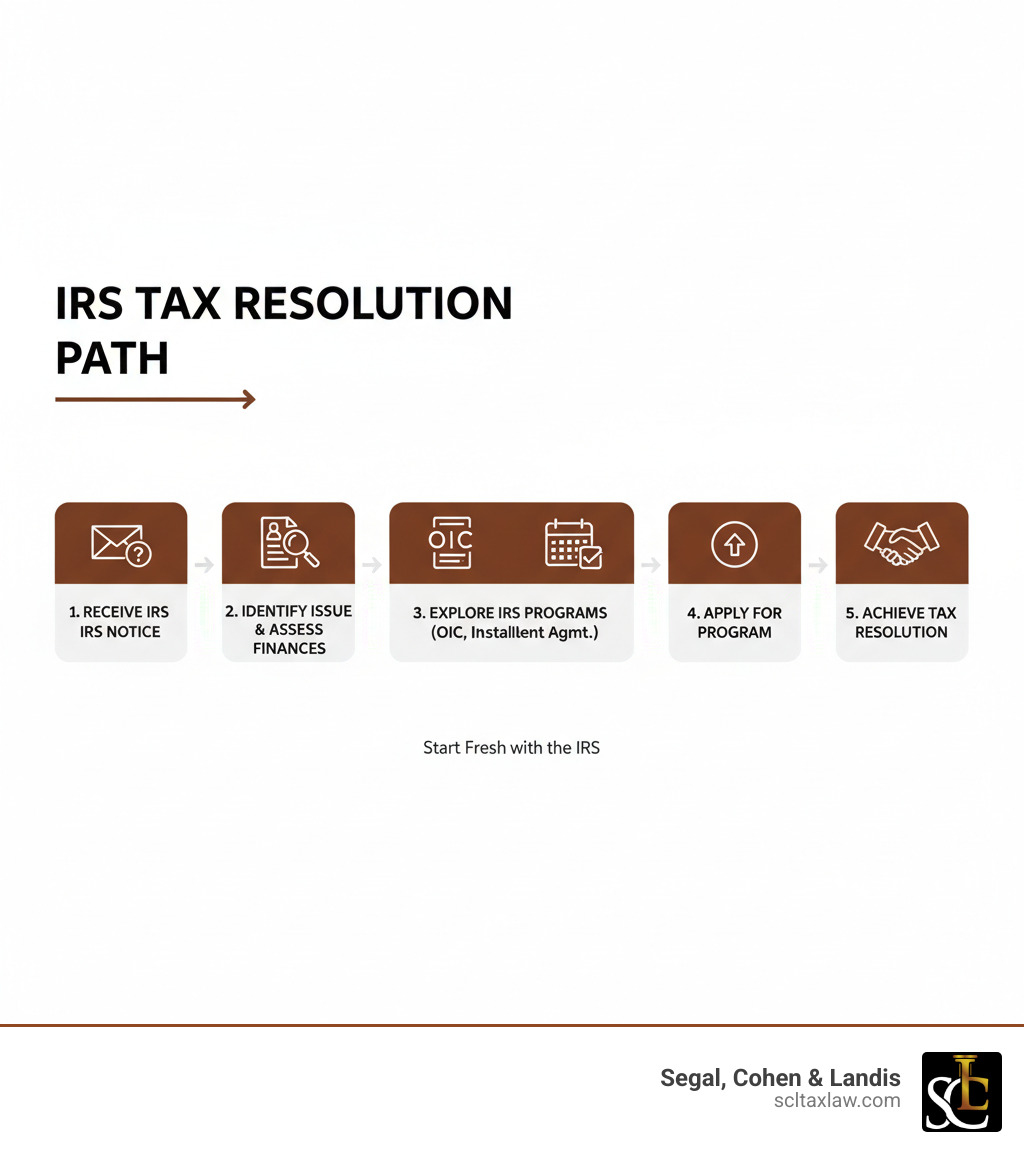
What is the IRS Fresh Start Initiative?
The IRS Fresh Start program isn’t a single application but a comprehensive package of policy changes the IRS introduced in 2011. Launched during a tough economic period, the initiative was designed to make it easier for struggling taxpayers to resolve their debts and avoid harsh collection actions. The core idea is that it’s better for the government to collect something from taxpayers facing genuine hardship than to collect nothing at all.
At Segal, Cohen & Landis, we’ve seen these policies provide life-changing relief for clients dealing with Back Taxes. The IRS even provides its own resources to help you Get help with tax debt, but navigating them can be complex. The initiative’s primary goal is to ease your financial burden with realistic solutions.
Key Benefits of the Program
The Fresh Start provisions offer significant advantages designed to help you regain financial stability.

- Preventing Tax Liens and Levies: This is a major benefit. A federal Tax Lien is a public claim on your assets, while a levy is the actual seizure of those assets. Fresh Start raised the debt threshold for automatically filing a lien from $5,000 to $10,000, offering immediate protection to many taxpayers. It also made lien withdrawal more accessible, especially for those who enter into a Direct Debit Installment Agreement. This protects your credit and prevents the IRS’s most aggressive collection tactics.
- Flexible Payment Terms: Eligible Simple Payment Plans generally allow most taxpayers the remaining collection period, usually up to ten years. These plans have compliance and balance criteria and generally do not require a collection financial statement; other agreements may require additional information.
- Debt Reduction Potential: Through an Offer in Compromise (OIC), you may be able to settle your tax debt for significantly less than you owe if you can demonstrate financial hardship. For those with overwhelming debt, this can be a path to a true fresh start.
- Penalty Relief: The initiative reinforces ways to request penalty abatement for reasons like reasonable cause or first-time compliance. This can reduce your total bill by thousands of dollars.
These benefits lead to improved financial stability. By resolving your tax issues, you can stop worrying about IRS collections, start rebuilding your credit, and plan for the future.
A Deep Dive into the IRS Fresh Start Program Options
The IRS Fresh Start program offers a toolkit of solutions, not a one-size-fits-all fix. The right option for you depends on your specific financial situation—your income, expenses, and assets. The IRS assesses these factors to determine what you can realistically afford. Understanding these paths is key, a process we detail in our guide to Resolving Back Taxes: Understanding Your Options and the Importance of Tax Attorneys.

Let’s break down the main options available.
Offer in Compromise (OIC)
An Offer in Compromise, or OIC, allows you to settle your tax debt for less than the full amount owed. It’s the most sought-after option but also the hardest to get. The IRS accepts an OIC if they believe your offer is the most they can reasonably expect to collect, a figure known as your Reasonable Collection Potential (RCP).
Your RCP is based on your ability to pay (income minus necessary living expenses) and the equity in your assets. The Fresh Start program made OICs more accessible by changing how future income is calculated, reducing the projection from 48-60 months to just 12-24 months. The most common reason for acceptance is Doubt as to Collectibility, where you prove you can’t pay the full amount. Applying requires Form 656 and detailed financial statements (Form 433-A/B). You can get a preliminary idea using the IRS’s Offer in Compromise Pre-Qualifier tool. Successfully navigating the IRS Offer in Compromise process often requires professional expertise.
Installment Agreements (IA)
If you can pay over time, an installment agreement may be appropriate. Eligible individual Simple Payment Plans generally require a balance of $50,000 or less and allow most taxpayers the remaining collection period, usually up to ten years. Business eligibility and balance limits differ according to trust-fund liability and operating status.
A key benefit of streamlined agreements is their simplicity; you often don’t need to submit a detailed financial statement. You can frequently Apply online for a payment plan directly on the IRS website. While interest and penalties continue to accrue, an IA prevents aggressive collection actions. For those with larger debts, a Partial Pay Installment Agreement may be an option, allowing you to pay what you can afford, even if it doesn’t cover the full debt before the collection statute expires. We cover this in our guide to IRS Partial Pay Installment Arrangements.
Currently Not Collectible (CNC) Status
If you’re facing severe financial hardship and can’t afford to pay anything toward your tax debt, you may qualify for Currently Not Collectible (CNC) status. This temporarily pauses collection activities, including levies. To qualify, you must prove to the IRS (using Form 433-F or 433-A) that paying your tax debt would prevent you from affording basic living expenses. It’s important to know that CNC is not forgiveness; your debt remains, and interest and penalties continue to accrue. The IRS will periodically review your financial situation to see if you can resume payments. Learn more about IRS Currently Not Collectible Status.
Penalty Abatement
IRS penalties can significantly inflate your tax debt. While not exclusively part of Fresh Start, the initiative reinforced existing relief options. You can request IRS Penalty Abatement for reasonable cause, meaning you couldn’t comply with tax laws due to circumstances beyond your control (e.g., serious illness, natural disaster). Another valuable option is First-Time Penalty Abatement, which may be available if you have a clean three-year compliance history. Successfully abating penalties can drastically reduce your total liability.
Comparing Offer in Compromise vs. Installment Agreement
OIC and IA are two of the most common Fresh Start options, but they serve different needs. Here’s a quick comparison:
| Criteria | Offer in Compromise (OIC) | Installment Agreement (IA) |
|---|---|---|
| Debt Amount | Can be for any amount of tax debt, often used for significant liabilities. | Individual Simple Plans: generally $50,000 or less. Business limits vary with trust-fund liability and operating status. |
| Payment Structure | Lump sum or short-term periodic payments (typically 5-24 months) for a reduced amount. | Scheduled monthly payments under the approved agreement; eligible Simple Plans generally use the remaining collection period. |
| Impact on Total Debt | Reduces the total amount of tax debt owed. | Does not reduce the total amount owed; interest and penalties continue to accrue. |
| Eligibility | Based on Reasonable Collection Potential (ability to pay, equity in assets, future income potential). Requires demonstration of financial hardship. | Generally available to anyone who can’t pay in full, provided they meet debt limits and compliance requirements. |
| Complexity | Highly complex, requires extensive financial disclosure (Form 433-A/B, Form 656). Often benefits from professional assistance. | Relatively simpler, especially for streamlined agreements (Form 9465 or online application). |
| Application Fee | $205 (can be waived for low-income taxpayers). | Installment-agreement setup fees depend on the method and taxpayer eligibility. Short-term payment plans and specified low-income arrangements have different fee rules. |
| Acceptance Rate | Historically lower acceptance rate (around 38% in recent years), requires strong justification. | High acceptance rate if eligibility criteria are met. |
| Impact on Credit | Can have a negative impact while pending, but resolution is generally positive long-term. | Generally positive as it shows proactive debt resolution, preventing liens and levies. |
| Total Amount Paid | Less than the full amount owed. | The full amount owed, plus interest and penalties. |
The Application Process: Eligibility and What to Expect
Applying for relief under the IRS Fresh Start program requires careful preparation and full disclosure. Success often hinges on getting the details right and avoiding common pitfalls that can derail an application.

General Eligibility for the IRS Fresh Start Program
Before applying for any relief option, you must meet some baseline requirements:
- Be current with tax filings: You must have filed all required tax returns. The IRS will not consider relief if you have Unfiled Tax Returns.
- Be current with payments: You must be up-to-date on current estimated tax payments or have adequate withholdings from your wages.
- Not be in open bankruptcy: Bankruptcy proceedings generally pause IRS collections, and tax debt is handled through the bankruptcy court.
Specific programs have additional criteria, such as the applicable balance and compliance criteria for Simple Payment Plans.
Documentation Needed for Your Application
The IRS requires extensive proof of your financial situation. Be prepared to provide:
- Application Forms: Form 656 and Form 433-A/B for an Offer in Compromise, or Form 9465 for an Installment Agreement.
- Proof of Income: Recent pay stubs or profit and loss statements if self-employed.
- Bank Statements: Typically for the last three to six months.
- Proof of Expenses: Mortgage or rent statements, utility bills, and records of other necessary living expenses.
- Asset Information: Details on real estate, vehicles, retirement accounts, and other significant assets.
- Filed Tax Returns: Copies of returns for the years in question.
Incomplete or inaccurate documentation is a common reason for rejection.
What Happens After You Apply?
After you submit your application, the process unfolds over several weeks or months. An Offer in Compromise review can take six months or longer.
- Case Assignment and Review: Your case is assigned to an IRS representative who will scrutinize your financial information.
- Requests for Information: The IRS may contact you for clarification or additional documents. It is critical to respond promptly and completely.
- Decision: You will receive a written decision. If accepted, the letter will detail the terms of your agreement. If rejected, it will explain why.
- Review the relevant notices, filing history, records, and deadlines before choosing a response. Evaluate professional assistance according to the facts, applicable law, and agreed scope of representation. Related resources: IRS Appeals.
During an OIC review, the IRS generally suspends aggressive collection actions, but interest and penalties continue to accrue.
What If You Don’t Qualify? Exploring Alternatives
If you don’t meet the specific requirements for the IRS Fresh Start program options, don’t despair. The IRS’s primary goal is to collect owed taxes, and they are often flexible. Several other pathways exist to resolve your debt, a topic we cover in our guide on Understanding Tax Debt Relief Options.
- Custom Installment Agreements: Other arrangements may be available above the applicable Simple Payment Plan limit. They may require financial disclosure using the form requested by the IRS; eligibility and terms depend on the case.
- Appealing a Rejection: If your Offer in Compromise was rejected, it’s not necessarily the final word. A tax attorney can review the IRS’s calculations, identify errors, and help you file an appeal or submit a revised offer.
- Innocent Spouse Relief: If your tax debt stems from a joint return and was caused by your spouse or ex-spouse without your knowledge, you may qualify for Innocent Spouse Relief, which could absolve you of the liability.
- Bankruptcy: In some rare cases, older income tax debt can be discharged in bankruptcy. This is a complex process with strict rules and should be explored with both a tax attorney and a bankruptcy attorney.
When to Seek Professional Help
While you can handle simple IRS matters on your own, you should consider hiring a tax attorney in several situations:
- Your tax debt is substantial.
- Your case is complex (e.g., involves business taxes, multiple unfiled years, or international issues).
- You don’t qualify for streamlined options and need to negotiate a custom agreement or OIC.
- You are facing aggressive collection actions like liens, levies, or wage garnishments.
- Your application for relief has been rejected and you need to appeal.
Review the relevant notices, filing history, records, and deadlines before choosing a response. Evaluate professional assistance according to the facts, applicable law, and agreed scope of representation.
Frequently Asked Questions about the IRS Fresh Start Program
Many clients come to us with similar questions and concerns about the IRS Fresh Start program. Here are answers to some of the most common ones.
What are common misconceptions about the IRS Fresh Start Program?
Misinformation about tax relief is rampant. Here are the facts:
- It’s not a single program: Fresh Start is a collection of policies (OIC, Installment Agreements, etc.), each with its own rules and forms.
- Qualification is not automatic: Eligibility depends on your specific financial situation and compliance history. You must prove you qualify.
- Debt is not automatically forgiven: Only a successful Offer in Compromise reduces your total debt. Other options, like installment agreements, require full payment plus interest and penalties.
- The program is not a scam, but scams exist: The IRS Fresh Start initiative is legitimate. However, be wary of companies making unrealistic promises like guaranteed “pennies on the dollar” settlements. The IRS will never initiate contact by phone, text, or email to demand payment. You can Learn how to settle your debt with the IRS on your own through official channels.
How much will the IRS settle for with an Offer in Compromise?
There is no fixed percentage. The settlement amount is based on your Realistic Collection Potential (RCP), which is the most the IRS believes it can collect from you. The RCP formula considers your disposable income (income minus IRS-allowed necessary living expenses), the equity in your assets (like your home, car, and bank accounts), and your future income potential. The Fresh Start changes made this calculation more favorable by reducing the future income projection period to 12 or 24 months. A skilled tax attorney can help present your RCP in the most accurate and favorable light.
Can I apply for the Fresh Start Program on my own?
Yes, you can apply on your own, especially for simpler options like a streamlined installment agreement. The IRS provides forms and online tools, including the Offer in Compromise Pre-Qualifier and the online payment plan application.
However, the Offer in Compromise process is highly complex. It requires detailed financial analysis and extensive documentation (Form 433-A/B). A single error can lead to delays or rejection. A tax professional understands IRS standards, procedures, and negotiation tactics. For complex cases, large debts, or OIC applications, professional guidance significantly increases your chances of a successful outcome. At Segal, Cohen & Landis, we have the expertise to prepare a compelling case that anticipates and addresses potential IRS objections.
Conclusion: Taking the First Step Towards a Fresh Start
The IRS Fresh Start program offers a clear message: tax debt does not have to be a permanent burden. With options like an Offer in Compromise, Installment Agreements, and Penalty Abatement, the IRS provides real paths for taxpayers to resolve their issues and move forward.
The most critical step is to take action. Waiting only allows interest and penalties to grow, increasing the risk of aggressive collection actions like a Tax Levy. By understanding your options and choosing a path forward, you can regain control of your financial future.
Review the relevant notices, filing history, records, and deadlines before choosing a response. Evaluate professional assistance according to the facts, applicable law, and agreed scope of representation. Related resources: Back Taxes; Tax Lien; Unfiled Tax Returns.
Your fresh start is within reach. Don’t let tax debt control your life any longer. Contact us for help with your Tax Lien or any other tax issue today, and let us find your path to financial peace of mind.
Related guidance: IRS Fresh Start Program Help.
Have questions about this topic? Talk to an IRS attorney today.
Segal, Cohen & Landis, P.C. — Beverly Hills. Serving clients nationwide.

Samuel Landis, Esq.
LL.M. (Tax) · Selected to Super Lawyers®
Sam Landis is a Beverly Hills IRS tax attorney specializing in IRS collection defense, audit representation, and international tax compliance for foreign nationals and US expats.