

When IRS Debt Feels Overwhelming, Here’s What You Need to Know
IRS tax relief attorneys are licensed lawyers who negotiate with the IRS on your behalf to resolve back taxes, stop collection actions, and reduce or settle what you owe.
Here’s a quick overview of how they can help:
- Offer in Compromise — Settle your tax debt for less than the full amount owed
- Installment Agreements — Set up a manageable monthly payment plan
- Penalty Abatement — Request removal of penalties added to your balance
- Currently Not Collectible — Temporarily pause IRS collection if you can’t pay
- Audit Representation — Have an attorney defend you during an IRS audit
- Lien and Levy Relief — Stop wage garnishments, bank levies, and tax liens
Review the available options and applicable requirements for the particular matter. Outcomes depend on the facts and law; another taxpayer’s result does not predict yours. Confirm the scope of the proposed engagement.
The IRS has powerful tools to collect what it’s owed. It can garnish your wages, freeze your bank account, and file a lien against your property. And while you wait, interest and penalties keep growing.
The good news? You have options. And the right legal help makes a real difference.
This guide discusses irs tax relief attorneys the definitive guide. Review the applicable rules and facts, and verify the qualifications and scope of any proposed representation.
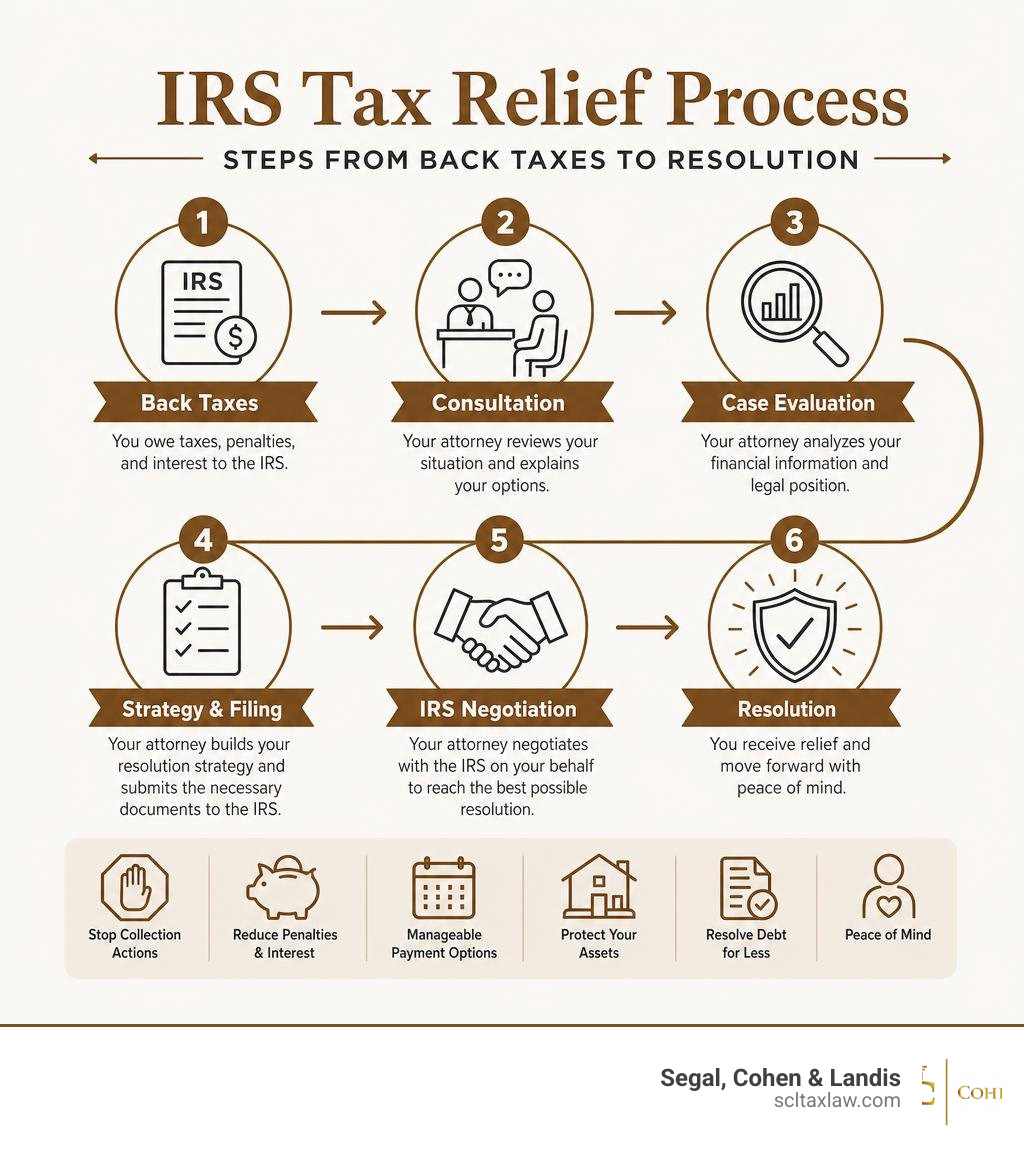
Irs tax relief attorneys vocabulary:
Understanding the IRS Fresh Start Program
If you are currently carrying the weight of tax debt, you have likely heard whispers of the IRS Fresh Start Program. Some advertisements make it sound like a magical, secret government clearinghouse that deletes your debt with the push of a button. While it is not magic, it is a highly effective, 100% legitimate initiative launched by the IRS to help struggling individuals and businesses resolve their back taxes under more flexible, realistic terms.
Before the Fresh Start Initiative was introduced, negotiating with the IRS was a bit like trying to reason with a brick wall. The program updated internal IRS policies, making it much easier for taxpayers to qualify for settlement programs, avoid devastating tax liens, and set up payment plans that do not require sacrificing basic living necessities.
The primary goal of the Fresh Start Program is to bring taxpayers back into compliance while ensuring the IRS collects what is reasonably possible without causing complete financial ruin.
Key Tax Relief Options Under the Fresh Start Initiative
The Fresh Start Initiative is not a single program; rather, it is an umbrella that covers several distinct tax relief pathways. Depending on your income, assets, and total debt, we can guide you toward the option that fits your financial reality:
- Offer in Compromise (OIC): This is the crown jewel of tax resolution. An IRS Offer in Compromise allows qualified taxpayers to settle their federal tax liabilities for significantly less than the full amount owed. The IRS evaluates your income, asset equity, and future earning potential to calculate what they call your “Reasonable Collection Potential” (RCP). If your RCP is lower than your total debt, they may accept a lump-sum or short-term payment settlement.
- Installment Agreements: If you cannot pay your tax bill in full but could chip away at it over time, an IRS Installment Agreement is the way to go. The Fresh Start Program streamlined this process, allowing taxpayers with up to $50,000 in debt to set up monthly payment plans for up to 72 months without having to submit a detailed, invasive financial disclosure statement.
- Currently Not Collectible (CNC) Status: Sometimes, life throws a curveball, and you genuinely cannot afford to pay anything. If making monthly payments would prevent you from covering basic living expenses like rent, food, and medicine, we can petition to have your account placed in IRS Currently Not Collectible status. This temporarily halts all active collection efforts, levies, and garnishments. While interest and penalties still accrue, it gives you the breathing room you need to get back on your feet.
- Penalty Abatement: The IRS has over 100 different penalties they can tack onto your bill, and they accumulate fast. Through IRS Penalty Abatement, we can request the removal of failure-to-file or failure-to-pay penalties if you had “reasonable cause” (such as a serious illness, natural disaster, or reliance on bad advice from a professional) or if you qualify for First-Time Penalty Abatement.
Eligibility Requirements for the Fresh Start Program
While the Fresh Start Program is incredibly beneficial, the IRS does not hand out these relief options like candy at a parade. To qualify, you must meet strict threshold criteria:
- Tax Compliance is Non-Negotiable: You must have filed all required tax returns. If you have unfiled returns from previous years, the IRS will flatly reject your application.
- Current Payments Must Be Up to Date: If you are self-employed or a business owner, you must be current on your estimated tax payments or federal tax deposits for the current year.
- No Open Bankruptcy: You cannot be in an active, open bankruptcy proceeding, as tax liabilities are handled through the bankruptcy court in those cases.
- Demonstrated Financial Need: For hardship-based programs like an OIC or CNC, you must provide a detailed, accurate picture of your financial life.
If you find yourself staring at a massive tax bill and wondering What to Do When You Owe the IRS But Can’t Pay, the absolute first step is getting your unfiled returns prepared and submitted so you can open the door to these Fresh Start programs.
What to Do If Your Fresh Start Application Is Denied
Evaluate the applicable procedure using the taxpayer’s actual facts and supporting records. An agency-wide rate or another taxpayer’s result does not establish individual eligibility, audit selection, or the outcome of a request.
An Offer in Compromise rejection may be appealed within 30 days of the rejection letter using Form 13711. A Collection Due Process hearing requires a separate qualifying collection notice and its own deadline.
An Offer in Compromise rejection may be appealed within 30 days of the rejection letter using Form 13711. A Collection Due Process hearing requires a separate qualifying collection notice and its own deadline. See IRS Tax Debt Resolution Complete Guide.
Why You Need IRS Tax Relief Attorneys
Navigating the IRS on your own is a lot like walking through a legal minefield blindfolded. The tax code is incredibly complex, and IRS revenue officers are highly trained collectors whose primary job is to secure the maximum amount of money for the government.

When you hire experienced irs tax relief attorneys, you are putting a shield between yourself and the federal government. We take over all direct communication with the IRS, meaning you will no longer have to endure stressful phone calls or intimidating letters.
Review the relevant notices, filing history, records, and deadlines before choosing a response. Evaluate professional assistance according to the facts, applicable law, and agreed scope of representation. Related resources: Don’t Face the IRS Alone: Why You Need a Tax Debt Lawyer.
How IRS Tax Relief Attorneys Differ from Tax Relief Companies
You have probably seen late-night television commercials featuring “tax resolution specialists” promising to settle your debt for pennies on the dollar. It is vital to understand the difference between these generic tax relief companies and a dedicated, licensed Tax Debt Lawyer.
Many tax relief companies are essentially sales operations. They employ aggressive telemarketers to sign you up, and then pass your file to administrative staff or low-level preparers.
When you work with a licensed tax law firm, you receive direct representation from an attorney who is bound by strict ethical standards and holds a legal duty to act in your best interest.
| Feature | IRS Tax Relief Attorneys | Tax Relief Companies |
|---|---|---|
| Legal Representation | Yes, can represent you in U.S. Tax Court and federal appeals | No, limited to administrative paperwork |
| Attorney-Client Privilege | Yes, qualifying confidential legal communications may be privileged, subject to applicable limits and exceptions | No, they can be subpoenaed by the IRS |
| Customized Legal Advice | Yes, tailored to your specific financial and legal risks | No, often use generic “one-size-fits-all” templates |
| Handling of Criminal Audits | Yes, fully qualified to defend against tax fraud allegations | No, cannot handle criminal tax matters |
For a comprehensive breakdown of how to evaluate these options, read our guide on Understanding Tax Debt Relief Options: How an IRS Tax Law Firm Can Guide You.
The Risks of Ignoring IRS Debt and How IRS Tax Relief Attorneys Protect You
Ignoring the IRS is one of the most expensive mistakes a taxpayer can make. The federal government does not simply forget about unpaid balances; instead, they deploy aggressive collection tools that can disrupt your entire life:
- Federal Tax Liens: A lien is a legal claim against your current and future assets (like your home or business). It ruins your credit score and makes it nearly impossible to sell or refinance property.
- Bank Levies: The IRS can instruct your bank to freeze the funds in your account and transfer them directly to the government after a 21-day holding period.
- Wage Garnishments: The IRS can legally command your employer to send a massive portion of your weekly paycheck directly to them, leaving you with barely enough to cover basic groceries.
Review the relevant notices, filing history, records, and deadlines before choosing a response. Evaluate professional assistance according to the facts, applicable law, and agreed scope of representation. Related resources: Wage Garnishment; Tax Levy; Tax Lien Resolution.
Common IRS Tax Cases Handled by Tax Lawyers
Tax law covers a massive spectrum of issues. While some situations are straightforward, others require highly specialized legal knowledge and strategic litigation.
IRS Audits and Appeals
An IRS audit can feel like an invasive medical procedure performed by an accountant. Whether you are facing a mail-in correspondence audit or an in-person field audit, the stakes are incredibly high.
During an audit, the burden of proof is entirely on you to substantiate every deduction, write-off, and income source on your return.
Review the relevant notices, filing history, records, and deadlines before choosing a response. Evaluate professional assistance according to the facts, applicable law, and agreed scope of representation. Related resources: IRS Audit Representation; IRS Audit Defense Complete Guide; IRS Tax Problems.
International Tax Compliance and Voluntary Disclosure
The IRS has dramatically ramped up its enforcement of offshore and international tax compliance. Under the Foreign Account Tax Compliance Act (FATCA) and Foreign Bank Account Reporting (FBAR) laws, U.S. citizens and residents are legally required to report foreign bank accounts, offshore assets, and foreign trust distributions.
Failure to file these forms can result in astronomical penalties — often starting at $10,000 per violation or up to 50% of the account balance for willful non-disclosure.
Since 2009, over 56,000 taxpayers have participated in voluntary disclosure programs to resolve their offshore tax issues. If you have undisclosed foreign assets, we can help you navigate the IRS Voluntary Disclosure Program or Streamlined Filing Compliance Procedures to bring you back into full compliance while minimizing your penalty exposure.
Frequently Asked Questions about IRS Tax Relief
Dealing with the IRS naturally brings up a lot of questions. Here are some of the most common inquiries we receive from taxpayers looking for relief.
What are the consequences of not filing required tax returns or failing to pay IRS debt?
Failing to file your tax returns is actually a much bigger problem than failing to pay your taxes.
First, the failure-to-file penalty is incredibly harsh — it accrues at 5% of the unpaid taxes per month, capping out at 25%. In contrast, the failure-to-pay penalty is only 0.5% per month.
Second, if you do not file, the IRS may eventually file a “Substitute for Return” (SFR) on your behalf. When the IRS files an SFR, they do not include any of the deductions, exemptions, or write-offs you are legally entitled to, resulting in a much higher tax bill than you actually owe.
The collection period generally begins when the IRS assesses tax, including an assessment based on a substitute return. An unfiled required return can leave the assessment period open. See Tax Debt Lawyer.
How do you choose the right IRS tax relief attorney for your case?
When choosing a tax relief attorney, you should look for three key attributes:
- Credentials and Focus: Ensure the attorney specializes specifically in tax law and controversy. Look for advanced credentials like a Master of Laws (LL.M.) in Taxation.
- Local and Accessible Service: Avoid national “mills” that won’t let you speak directly with your attorney. You want a firm with a physical presence and an established reputation in your region.
- Honesty and Transparency: A trustworthy attorney will never guarantee a specific settlement amount before thoroughly reviewing your financial files. They will give you a realistic, honest assessment of what can be achieved.
If you are ready to explore your options with a team that has a proven track record, we invite you to Get expert tax help today.
How much does the IRS Fresh Start Program cost to apply?
The IRS itself does not charge a fee to apply for the “Fresh Start Program” as a whole, but individual pathways carry administrative costs. For example, submitting an Offer in Compromise requires a standard application fee of $205, along with an initial payment (usually 20% of the offer amount for lump-sum offers), unless you qualify for the IRS Low-Income Certification waiver.
Installment agreements also carry setup fees that vary depending on whether you apply online and set up automatic direct debits. Professional fees for attorney representation vary based on the complexity and volume of your tax issues, but investing in experienced representation regularly saves taxpayers thousands of dollars in reduced liabilities and waived penalties.
Conclusion
Facing the IRS can feel like a lonely, uphill battle, but you do not have to carry this burden by yourself. The tax laws are incredibly complex, but they also contain powerful relief mechanisms designed to help you get a fresh start.
Contact the firm to confirm meeting arrangements, the jurisdictions and matters it can handle, and the scope of any proposed engagement.
Let us handle the paperwork, the negotiations, and the stress, so you can focus on getting your life back. Get expert tax help today and schedule your consultation with our experienced team.
Have questions about this topic? Talk to an IRS attorney today.
Segal, Cohen & Landis, P.C. — Beverly Hills. Serving clients nationwide.

Samuel Landis, Esq.
LL.M. (Tax) · Selected to Super Lawyers®
Sam Landis is a Beverly Hills IRS tax attorney specializing in IRS collection defense, audit representation, and international tax compliance for foreign nationals and US expats.