

What the IRS CP215 Notice Means — and What to Do About It
A cp215 irs notice is an official IRS letter informing you that a civil penalty has been assessed against your tax account. Here’s what you need to know at a glance:
Quick Summary: IRS Notice CP215
| Key Detail | What It Means |
|---|---|
| What it is | A formal Notice of Penalty Charge from the IRS |
| Who receives it | Businesses and individuals with tax compliance failures |
| Common triggers | Failure to file W-2s, Form 941 errors, ACA violations, underreported income |
| Response deadline | Follow the payment and response dates on the actual CP215 notice. Interest and available dispute procedures depend on the assessed penalty and applicable rules; do not assume a universal ten-day payment or appeal period. |
| Options | Pay the penalty, dispute it, or request penalty abatement |
| Risk of ignoring | Interest charges, tax liens, and potential asset levies |
Opening that envelope and seeing an official IRS penalty notice is stressful — no question about it. The formal language, the government letterhead, and the dollar amount staring back at you can make even the most organized business owner anxious.
Follow the payment and response dates on the actual CP215 notice. Interest and available dispute procedures depend on the assessed penalty and applicable rules; do not assume a universal ten-day payment or appeal period.
The IRS issues CP215 notices to notify taxpayers of a civil penalty charge tied to specific compliance failures. These can range from missing payroll tax filings to reporting errors on health coverage forms. Left unaddressed, even a modest penalty can grow quickly through daily interest and escalating collection actions.
Review the relevant notices, filing history, records, and deadlines before choosing a response. Evaluate professional assistance according to the facts, applicable law, and agreed scope of representation.
What is IRS Notice CP215 and Why Did You Receive It?
When you receive an IRS Notice CP215 – Notice of Penalty Charge, it means the IRS has identified a discrepancy or a failure to comply with specific reporting requirements. Unlike a standard tax bill for income you earned, this is a “civil penalty.” Think of it as a fine for not following the rules of the road regarding tax documentation.
For most business owners, this notice is triggered by a mismatch in employment tax reporting. The IRS frequently sends this notice when they receive your Form 941 (Employer’s Quarterly Federal Tax Return) but have no record of the corresponding Form W-2 copies that should have been filed with the Social Security Administration. Without those W-2s, the IRS cannot verify the wages you reported, leading to a failure-to-file penalty.
CP215 is a notice informing the taxpayer of a civil penalty charge.
Review the relevant notices, filing history, records, and deadlines before choosing a response. Evaluate professional assistance according to the facts, applicable law, and agreed scope of representation. Related resources: payroll tax services.
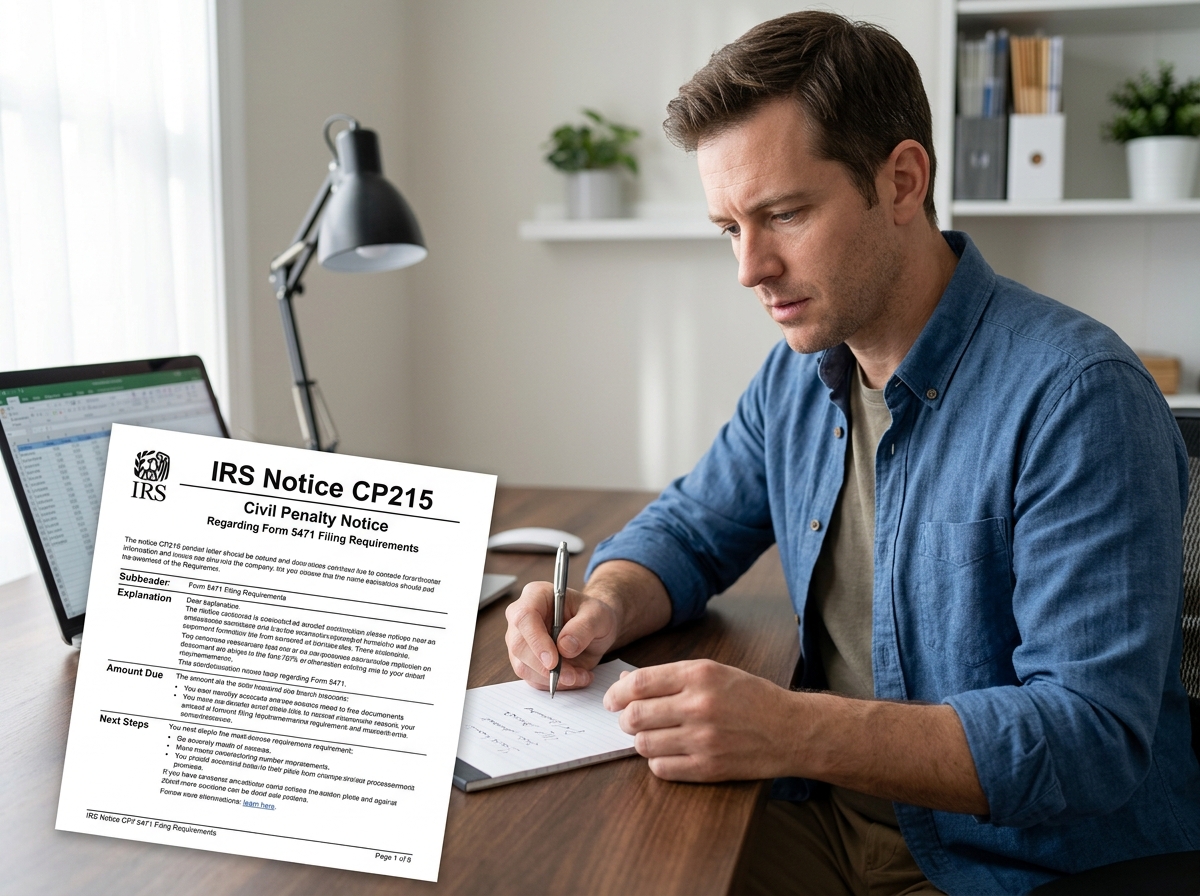
Common Triggers for a CP215 IRS Notice
While missing W-2s are a leading cause, several other compliance “hiccups” can land a cp215 irs notice in your mailbox:
- Failure to File Required Information Returns: This includes not just W-2s, but also various 1099 forms or Affordable Care Act (ACA) compliance forms like the 1095-C.
- Underreporting Income: If third-party data (like bank reporting) shows you received more income than you reported on your returns, the IRS may assess a penalty via this notice.
- ACA Compliance Failures: Large employers who fail to provide adequate health coverage reporting often see CP215 notices as the IRS enforces employer mandate penalties.
- International Reporting Omissions: This is a “heavy hitter” in the penalty world. If you fail to file international forms like Form 3520 (Reporting Foreign Trusts and Receipts of Foreign Gifts), the penalties can be astronomical.
- Incorrect Filing Format: Starting in tax year 2023, the electronic filing threshold was reduced to just 10 returns. If you filed 15 paper returns when you were required to file electronically, you might receive a penalty for using the wrong format.
Understanding the Penalties and Interest Associated with CP215 IRS Notice
The costs associated with a cp215 irs notice are governed primarily by Internal Revenue Code (IRC) sections 6721 and 6722. These penalties are tiered based on how late the correction is made.
For returns required to be filed after 2015, the standard failure-to-file penalties (IRC 6721) generally look like this:
- $60 per return if corrected within 30 days of the due date.
- $120 per return if corrected after 30 days but by August 1st.
- $310 per return if corrected after August 1st or not at all (for 2024 rates).
Small businesses (those with average annual gross receipts of $5 million or less) have lower “maximum” caps on these penalties, but the per-return cost remains a significant burden.
Watch Out for “Intentional Disregard” If the IRS decides you intentionally ignored the filing requirements, the penalty jumps significantly. Under IRC 6721(e), the penalty for 2024 is $630 per return (or 10% of the amount required to be reported, whichever is greater), and there is no maximum limit on the total penalty.
Follow the payment and response dates on the actual CP215 notice. Interest and available dispute procedures depend on the assessed penalty and applicable rules; do not assume a universal ten-day payment or appeal period. Related guidance: IRS penalty abatement complete guide.
Immediate Steps to Take After Receiving Notice CP215
When a cp215 irs notice arrives, the clock is ticking. You should not wait more than 48 hours to begin your internal review. Here is your immediate action plan:
- Read the Notice Carefully: Identify exactly which tax year and which form (e.g., Form 941, Form 3520) the penalty refers to. The IRS includes a “Penalty Reference Number” (PRN) that explains the specific code violation.
- Verify Your Records: Check your filing receipts. Did you actually file the W-2s? Do you have the certified mail receipt or the electronic filing confirmation?
- Check for Calculation Errors: The IRS is not infallible. Sometimes their automated systems “mismatch” data that is actually correct.
- Secure Your Documentation: Gather bank statements, payroll records, and copies of the returns in question. Having organized business tax records is the foundation of a successful dispute.
If you realize you do owe the money but can’t pay it all at once, don’t panic. There are ways to manage resolving back taxes that don’t involve losing your business assets.
How to Respond if You Agree with the Penalty
If your review confirms that a mistake was made—perhaps a clerk forgot to mail the W-2s or an international form was overlooked—the best course of action is to settle the matter quickly to stop the interest from growing.
- Pay in Full: You can pay the balance immediately through IRS Direct Pay or at IRS.gov/payments. This is the fastest way to close the case.
- File Missing Forms: If the penalty is for a missing return, file that return immediately. The IRS will not consider the matter resolved until the underlying compliance issue is fixed.
- Request an Installment Agreement: If the penalty is large, you can apply for a payment plan. This allows you to pay off the debt over several months, though interest will continue to accrue on the remaining balance.
- Use Form 843: In some cases, even if you agree the penalty was technically correct, you can use IRS Form 843 to claim a refund or abatement based on specific administrative errors or “Reasonable Cause.”
How to Dispute the CP215 Notice if You Disagree
If you have proof that you filed correctly and on time, you must fight the notice. You generally have 30 days to file a formal protest if you wish to go to the Appeals Office.
To dispute the notice:
- Write a Formal Dispute Letter: Clearly state that you disagree with the penalty. Include your name, taxpayer ID, the notice number (CP215), and the tax period.
- Attach Proof of Filing: Provide copies of stamped returns, “Accepted” e-file status reports, or certified mail logs.
- Explain the Error: If the IRS says you underreported income, provide the documents that show the IRS data is incorrect.
- Request a De Novo Review: If your initial dispute is rejected, you have the right to an independent review by the IRS Appeals Office. This is a “new and independent” look at your case where a fresh set of eyes evaluates your evidence.
For more detailed strategies, check out our guide on what to do when you disagree with an IRS audit.
Options for Penalty Relief: Abatement and Reasonable Cause
Even if the IRS is technically right that you filed late, you might not have to pay the penalty. The IRS has a heart (occasionally), and they provide two primary paths for relief:
Identify the penalty shown on the notice before choosing a relief procedure. FTA and AEP apply to specified filing, payment and deposit penalties and do not cover every information-return or civil penalty.
2. Reasonable Cause If you don’t qualify for FTA, you must prove “Reasonable Cause.” This means you acted with “ordinary business care and prudence” but were still unable to meet your obligations due to circumstances beyond your control.
Valid Reasonable Cause criteria include:
- Death, Serious Illness, or Unavoidable Absence: Of the taxpayer or an immediate family member.
- Fire, Casualty, or Natural Disaster: If your records were destroyed in a flood or fire.
- Inability to Obtain Records: If you couldn’t get the information needed to file despite your best efforts.
- Erroneous Advice from the IRS: If you called the IRS and they gave you the wrong instructions (you’ll need proof of the call).
- Mail Issues: If you can prove the documents were lost in the mail or delayed by the postal service.
If you have a lower income and need help navigating these requests, you may qualify for assistance from Low Income Taxpayer Clinics (LITC).
Frequently Asked Questions about CP215
What happens if I ignore the CP215 notice?
Ignoring the IRS is like ignoring a small leak in your ceiling—it only gets worse and eventually causes a collapse. If you ignore a cp215 irs notice:
- Follow the payment and response dates on the actual CP215 notice. Interest and available dispute procedures depend on the assessed penalty and applicable rules; do not assume a universal ten-day payment or appeal period.
- Tax Liens: The IRS may file a public Notice of Federal Tax Lien, which alerts creditors that the government has a legal right to your property. This can devastate your credit score.
- Asset Levies: The IRS can eventually seize your bank accounts, garnish your wages, or take your business equipment to satisfy the debt.
If things have already reached this stage, you should immediately look into tax levy resolution to protect your assets.
How long do I have to respond to a CP215?
Follow the payment and response dates on the actual CP215 notice. Interest and available dispute procedures depend on the assessed penalty and applicable rules; do not assume a universal ten-day payment or appeal period. Related guidance: Taxpayer Advocate Service (TAS).
When should I contact a tax professional for CP215?
While a small $50 penalty might be something you can handle with a quick phone call, you should contact a professional if:
- The penalty amount is large (generally over $5,000).
- The notice involves international forms like 3520 or 5471.
- You are facing “Intentional Disregard” charges.
- You have received multiple notices for the same issue.
- You are an employer facing ACA compliance penalties.
Having an IRS Audit Attorney represent you ensures that you don’t accidentally say something to the IRS that compromises your case.
Conclusion
Receiving a cp215 irs notice is a serious matter, but it is entirely manageable with a proactive approach. By verifying your records, responding within the 10-day window, and exploring abatement options like Reasonable Cause, you can often significantly reduce or even eliminate these civil penalties.
Review the relevant notices, filing history, records, and deadlines before choosing a response. Evaluate professional assistance according to the facts, applicable law, and agreed scope of representation.
Don’t let a penalty notice derail your business or your peace of mind. If you need help to reduce IRS tax penalties, contact us today for a consultation. We’ll help you decode the IRS’s formal language and build a strategy to protect your financial future.
Automatic Exemption from Penalty transition: For covered returns with an original due date on or after January 1, 2027, AEP replaces FTA. This is distinct from the summer-2026 rollout for eligible original 2025 annual returns and 2026 quarterly returns. Eligibility depends on covered return and penalty types, prior same-form compliance history, current filing and payment compliance, and applicable exclusions. Consult the current IRS AEP guidance.
Have questions about this topic? Talk to an IRS attorney today.
Segal, Cohen & Landis, P.C. — Beverly Hills. Serving clients nationwide.

Samuel Landis, Esq.
LL.M. (Tax) · Selected to Super Lawyers®
Sam Landis is a Beverly Hills IRS tax attorney specializing in IRS collection defense, audit representation, and international tax compliance for foreign nationals and US expats.